by Dan Thompson » Wed Nov 16, 2011 10:51 am
One of the main purposes of this site is sharing photographs of models so photography is important. I have been very impressed with the quality of the photographs shared by Kostas Katseas. Recently, in another thread, I asked how he took pictures with such great depth of field. I have taken a large number of model photographs over the years and I know that depth of field is the most difficult aspect to accomplish. It is virtually impossible to get a long, narrow model like a ship completely in focus from one end to the other using the equipment normally available to a hobbyist. There are large format cameras and special lenses that produce better results but their cost makes them impractical for most of us. The other traditional technique is to use a very small aperature (high F number) and a very long exposure. Even this will not get a long ship model completely in focus and the long exposure time means the risk of ruining a shot by camera motion is high. However, Kostas' recent pictures did have a startling depth of field and he was kind enough to explain that he accomplished it using a digital processing technique called "focus stacking." This process has two steps. First, a "stack" of photos is taken of the subject in which each photo is shot at a slightly different focal point. This can be done manually but it is much easier to do using a computer to control the camera. The second step is to "stack" the set of photos using a computer program that analyzes the photos, finds the area of highest focus in each, and digitally combine them into a single photo that is in focus completely from front to back. Kostas said he used a software package called Helicon Focus which is a commercial product that is fairly expensive. I wondered if there was free or, at least, less expensive software that would perform focus stacking and it turns out, there is.
Helicon Focus is a very popular application and it does cover both parts of the process by providing remote control of the camera and focus stacking. First, I should make clear that you don't have to remote control the camera, it's just a lot easier and produces far more consistent results. I did try shooting a series of photos, manually adjusting the focus between each shot, and it worked, sort of. But it was very difficult to do and time consuming. However, remote control is limited to cameras that have a function called "Live View." At this time, as far as I can tell, only some models of Nikon and Canon cameras have this function. Fortunately, one of the least expensive digital SLR cameras, the Canon Rebel XS, does have this capability. So that's what I got. I did an extensive search on line and turned up two other programs besides Helicon Focus that provide remote control (also called "tethered" operation) but both were limited to Canon cameras. One is a commercial application and the other is freeware. The commercial app, DSLR Remote Pro, seemed overly complicated and it cost money. I tried the freeware application, DSLR Bracketeer (
http://milosparipovic.com/index.php/dlsr-bracketeer/) and was completely satisfied with its performance. It gave me just the control I needed and was easy to use.
The second step is the processing of the stack of photos taken with the remote control software. There are several free applications for this, too. I tried the most popular, an open source program called CombineZP (
http://hadleyweb.pwp.blueyonder.co.uk/CZP/News.htm). It worked very well and the resulting photos appeared to me to be virtually identical to those produced by Helicon Focus. However, I tried another commercial program called Zerene Stacker and it seemed to do a slightly better job than CombineZP in reducing artifacts. I'm still on the 30 day free trial of Zerene Stacker and haven't decided if the difference in quality is worth the cost.
Focus stacking, even with automated remote control of the camera, does take more time and effort than just shooting a single picture. Is it worth it? I think so. Look at the pictures of the last half dozen or so models that Kostas has in the gallery to see how good it can look. Or, here is a sample comparison (sorry it's not a ship but I haven't shot any ship models yet using this technique).
- Attachments
-
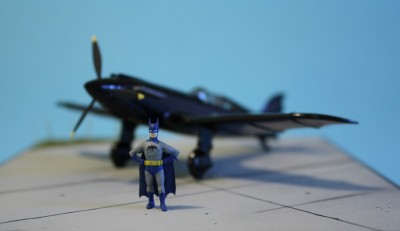
- The first sample picture is a single shot that has limited depth of field.
-
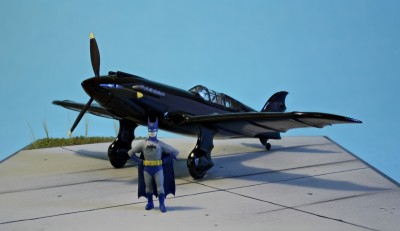
- The second sample is a compilation of that first picture and 28 others, each taken at a slightly different focal length. As you can see, the digital processing produces a picture with depth of field far greater than would be obtainable otherwise, even using a very high F number and long exposure (the traditional way to increase DOF).
One of the main purposes of this site is sharing photographs of models so photography is important. I have been very impressed with the quality of the photographs shared by Kostas Katseas. Recently, in another thread, I asked how he took pictures with such great depth of field. I have taken a large number of model photographs over the years and I know that depth of field is the most difficult aspect to accomplish. It is virtually impossible to get a long, narrow model like a ship completely in focus from one end to the other using the equipment normally available to a hobbyist. There are large format cameras and special lenses that produce better results but their cost makes them impractical for most of us. The other traditional technique is to use a very small aperature (high F number) and a very long exposure. Even this will not get a long ship model completely in focus and the long exposure time means the risk of ruining a shot by camera motion is high. However, Kostas' recent pictures did have a startling depth of field and he was kind enough to explain that he accomplished it using a digital processing technique called "focus stacking." This process has two steps. First, a "stack" of photos is taken of the subject in which each photo is shot at a slightly different focal point. This can be done manually but it is much easier to do using a computer to control the camera. The second step is to "stack" the set of photos using a computer program that analyzes the photos, finds the area of highest focus in each, and digitally combine them into a single photo that is in focus completely from front to back. Kostas said he used a software package called Helicon Focus which is a commercial product that is fairly expensive. I wondered if there was free or, at least, less expensive software that would perform focus stacking and it turns out, there is.
Helicon Focus is a very popular application and it does cover both parts of the process by providing remote control of the camera and focus stacking. First, I should make clear that you don't have to remote control the camera, it's just a lot easier and produces far more consistent results. I did try shooting a series of photos, manually adjusting the focus between each shot, and it worked, sort of. But it was very difficult to do and time consuming. However, remote control is limited to cameras that have a function called "Live View." At this time, as far as I can tell, only some models of Nikon and Canon cameras have this function. Fortunately, one of the least expensive digital SLR cameras, the Canon Rebel XS, does have this capability. So that's what I got. I did an extensive search on line and turned up two other programs besides Helicon Focus that provide remote control (also called "tethered" operation) but both were limited to Canon cameras. One is a commercial application and the other is freeware. The commercial app, DSLR Remote Pro, seemed overly complicated and it cost money. I tried the freeware application, DSLR Bracketeer ([url]http://milosparipovic.com/index.php/dlsr-bracketeer/[/url]) and was completely satisfied with its performance. It gave me just the control I needed and was easy to use.
The second step is the processing of the stack of photos taken with the remote control software. There are several free applications for this, too. I tried the most popular, an open source program called CombineZP ([url]http://hadleyweb.pwp.blueyonder.co.uk/CZP/News.htm[/url]). It worked very well and the resulting photos appeared to me to be virtually identical to those produced by Helicon Focus. However, I tried another commercial program called Zerene Stacker and it seemed to do a slightly better job than CombineZP in reducing artifacts. I'm still on the 30 day free trial of Zerene Stacker and haven't decided if the difference in quality is worth the cost.
Focus stacking, even with automated remote control of the camera, does take more time and effort than just shooting a single picture. Is it worth it? I think so. Look at the pictures of the last half dozen or so models that Kostas has in the gallery to see how good it can look. Or, here is a sample comparison (sorry it's not a ship but I haven't shot any ship models yet using this technique).