Last year, as part of a project to test 3D printing, I made a series of 1/350, 1/700, 1/1000 and 1/2500 scale figures:
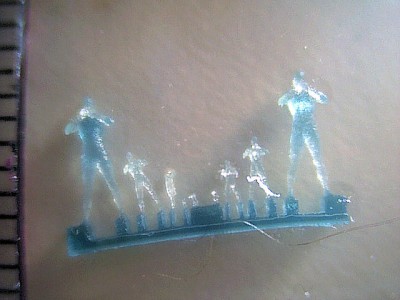
- 1/350, 1/700, 1/1000 and 1/2500 scale 3D printed figures - first try.
I learned a few lessons from that test:
- no need to have a high polygon count on figures below 1/350
- 1/2500 figures was at the limit of the printing technology used by Printapart, but the 1/350 to 1/1000 scale figures came out well
- The material used by Printapart is very, very fragile
- the design I had was next to impossible to mold effectively
I have plenty of 3D 1/350 and 1/400 figures, so I made a set of 1/700 and 1/1000 scale figures, which printed nicely. This time I used much lower polygon count figures, and attached them to the "casting block" by a thin fin on their backs, much like L'Arsenal does with their 1/350 scale figures:
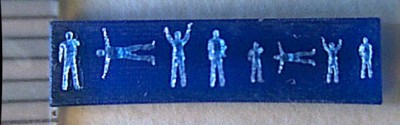
- 1/700 and 1/1000 scale 3D printed figures - 2nd try
I still don't know if they'll cast. I'm thinking of using a two part mold using a really soft mold material, like the excellent Dow silicone rubber that's sold with Alumilite resin kits. The lower half would come up to the waists (except for the sideways figure with the arms extended) and the upper half would be from the waist up.
I used three programs to produce these figures. The first was AC3D, which is far more intuitive and easy to use than Rhino. The edited figures were exported as .obj files and opened in Rhino, where I scaled them and ran mesh checks.
Rhino's .stl (stereolithography) file generation is not very good and will sometimes declare unprintable objects as printable, so I checked the .stl files with miniMagics and used AC3D and Rhino to fix the inevitable problems until I had a file that MiniMagics was happy with. Then I uploaded the file to
Printapart and was rewarded with a quick, error free print. The main project is bigger and smoother, but these small figures were a pretty good way to learn how to make error free, printable files.
Even unpainted, the 1/700 figures look better than 1/700 scale PE figures, which even when bulked up with paint, can look flat and unrealistic.
Frank
Last year, as part of a project to test 3D printing, I made a series of 1/350, 1/700, 1/1000 and 1/2500 scale figures:
[attachment=1]350-2500figures.jpg[/attachment]
I learned a few lessons from that test:
- no need to have a high polygon count on figures below 1/350
- 1/2500 figures was at the limit of the printing technology used by Printapart, but the 1/350 to 1/1000 scale figures came out well
- The material used by Printapart is very, very fragile
- the design I had was next to impossible to mold effectively
I have plenty of 3D 1/350 and 1/400 figures, so I made a set of 1/700 and 1/1000 scale figures, which printed nicely. This time I used much lower polygon count figures, and attached them to the "casting block" by a thin fin on their backs, much like L'Arsenal does with their 1/350 scale figures:
[attachment=0]700-1000figures.jpg[/attachment]
I still don't know if they'll cast. I'm thinking of using a two part mold using a really soft mold material, like the excellent Dow silicone rubber that's sold with Alumilite resin kits. The lower half would come up to the waists (except for the sideways figure with the arms extended) and the upper half would be from the waist up.
I used three programs to produce these figures. The first was AC3D, which is far more intuitive and easy to use than Rhino. The edited figures were exported as .obj files and opened in Rhino, where I scaled them and ran mesh checks.
Rhino's .stl (stereolithography) file generation is not very good and will sometimes declare unprintable objects as printable, so I checked the .stl files with miniMagics and used AC3D and Rhino to fix the inevitable problems until I had a file that MiniMagics was happy with. Then I uploaded the file to [url=http://www.printapart.com/]Printapart[/url] and was rewarded with a quick, error free print. The main project is bigger and smoother, but these small figures were a pretty good way to learn how to make error free, printable files.
Even unpainted, the 1/700 figures look better than 1/700 scale PE figures, which even when bulked up with paint, can look flat and unrealistic.
Frank