Below Deck hangar

Post a reply

Confirmation code
Enter the code exactly as it appears. All letters are case insensitive.

BBCode is OFF
Smilies are OFF

Topic review
   

Expand view Topic review: Below Deck hangar

Re: Below Deck hangar

by navydavesof » Sat Dec 15, 2012 10:09 pm

Very interesting! Thank you very much for all of the input, Rick! :woo_hoo:

Re: Below Deck hangar

by Rick E Davis » Sat Dec 15, 2012 2:15 pm

Too many "What-ifs".

Try reading Friedman for thoughts on what a Guided Missile conversion for KENTUCKY and for that matter HAWAII would look like (there were all kinds of proposals ... most assumed NO 16-in guns). It has been awhile since I read his book, but I think it varied with time and had various options proposed (including POLARIS missiles). As for the ASW mission being assigned to these ships, that was pretty much a standard practice in the USN for most warships. The degree and capabilities of the installed suite varied on the size of the ship and what could be installed. Sonar on a large platform provided relatively long-range detection in heavier seas than a WWII era destroyer, so helped a Task Force. By 1960, ASW had evolved to use of helicopters (manned or DASH drones) for "long-range" weapons delivery against a submarine. ASROC really was more of a "medium-range" delivery system. With nuclear equipped torpedoes ... reasonable "stand-off" ranges were desirable.

It is your "What-if", so unless you try to meet the parameters of one of the various proposals provided in say Friedman, you can establish your own. But, I think providing "some" ASW capability for such a high-value Task Force unit, would be seen as a given. Some of the proposals in Friedman's book are for the existing IOWA class (and SOUTH DAKOTA class as well), and are all over the map.

I have no idea about if or what the USN would think about including a hangar (fantail or otherwise) on KENTUCKY. Part of the problem may be what was located in the fantail area below decks already based on the original battleship design (armor deck?). I frankly could see a pair of superstructure hangars (port and starboard) where the helicopters could be moved past the AA guided-missile launcher (TALOS/TERRIER) on the main deck to the fantail to a helo-pad. A superimposed guided-missile launcher could be added between the hangars on the 01 deck level. The hangars may reduce the total number of 5-in guns ... which could be one of the newer marks as was being installed in the 1960s. If TARTAR was added amidships as was done on the ALBANY's, there would be room/need for say only four-six 5-in guns.

You seem to be speculating on a ship originally converted in the 1960s and then upgraded in the 1980s/90s/2000s. What the heck would still be installed and changed is a question mark to me. Look at weapon's systems available. If the mission shifted to say USMC fire-support ... older systems and stuff could be removed from the AA mission and either a reduced (more self-defense than Task Force defense) added. Heck by 2009, a couple "banks" of vertical launchers (for AA self-defense, ASW, and land-attack) on the 01 deck level aft where the superimposed launcher was would free up the fantail for an EXPANDED helicopter mission ... making the USMC happy. The guidance systems for the missiles is going to be the real driver in the ship's design.

Re: Below Deck hangar

by navydavesof » Sat Dec 15, 2012 7:56 am

So, Rick, I find it interesting that the sole reason why the Albanys retained the stern hangar was for "ASW" helicopters. What kind of ASW mission would those ships possibly do?! They seem like such AAW only ships! I guess they have such a large crew that they could actually perform multiple big missions like that at a time, but really...she was an AAW ship. However, AAW ship or not, I see they had a keel mounted sonar, ASROC, and a hangar for ASW helo/s. So I see that ASW incorporation was a mission priority.

This makes me wonder about another project I have packed in a box. I made a lot of progress on a model of a completed USS Kentucky in 2009 based on the thought that if worked had resumed on the Kentucky hulk in the early '60s, around the same time as the Albany conversions, would she have that same mission set (AAW and ASW or self-defense ASW) as well? )Also, keep in mind that my conversion has her as a battleship forward and a missile shooter aft like the Bostons.)

If that answer is a "yes", they would have resumed work on a ship that was only completed up to the armored second deck. This would have given them the opportunity to begin incorporating below-decks things such as missile magazines, different secondary battery locations, etc. So in the era of the Albany being a full AAW ship and modifying her stern hangar to support ASW helicopters, perhaps could/would Kentucky have been finished with an Albany-style stern hanger?

I think the feeling of the Navy a the time was to try to get all of these "conversion" ships to do as much as possible. What do you think?

So IF the Navy had incorporated a hangar, do you think that it was more likely that she would have been finished with a sliding hatch with the elevated landing pad like we discussed, or do you think she may have been completed with an Albany-style flush deck?

Thanks! :thumbs_up_1:

Re: Below Deck hangar

by navydavesof » Fri Dec 14, 2012 4:57 am

Rick E Davis wrote:I also was thinking that because the TALOS launcher is located further aft than the previous gun armament, that the deck space available for a "landing pad" was smaller than could be accommodated by the original hangar and hatch arrangement.

I really suspect the selection of the elevator/cover method on the CG-10 class was done as a trade-off of all the possibilities and weight.
I was thinking the same about the deck space required to slide the hatch forward. However, if they were so pressed on weight to count a hangar hatch...then they would have been in terrible trouble :big_grin:

...but these conversions also prove what could have been done with these Baltimore and larger hulls. The potential seems pretty darn limitless. :heh:

And just imagine, if Dragon made a 1/350 USS Baltimore, they could use the hull for an Oregeon City and an Albany :big_grin:

Re: Below Deck hangar

by Rick E Davis » Thu Dec 13, 2012 1:56 pm

I should have mentioned in my previous post.

I also was thinking that because the TALOS launcher is located further aft than the previous gun armament, that the deck space available for a "landing pad" was smaller than could be accommodated by the original hangar and hatch arrangement.

I really suspect the selection of the elevator/cover method on the CG-10 class was done as a trade-off of all the possibilities and weight.

Re: Below Deck hangar

by navydavesof » Wed Dec 12, 2012 10:54 am

Rick E Davis wrote:I know that the four earlier BALTIMORES with two cranes (CA 68-71) had the centerline/slide forward hatch. I'm not sure about PITTSBURGH (CA-72) ... I don't have a good overhead view of her to be sure, what I have looks like the earlier units. But, it looks like all of the later units (CA-73 on) had the sideways sliding hatch.

That's very interesting. Since they so easily changed how the hatch moved, it could theoretically be moved back centerline again.

Sorry, I have no idea why the Guided Missile Cruisers moved the hangar elevator location. I suspect that the missile battery took up more space aft and that the hangar was made smaller. HNSA web site has a set of plans for the CG-10 class ... http://www.hnsa.org/doc/plans/cg11.pdf ...
With them, it seems that it was just an effort to provide equal room on both sides of the elevator. The port side is equipment and weapons storage area, and starboard is helo storage providing for only one HSS-1 helo. It does not seem to have anything to do with Talos magazine issue. It seems to turn into a symety issue. In this hangar arrangement, if there was a sliding hatch, another helo could be stored on the elvator, providing the ship with 2 birds.

It's interesting. Thanks again!

Re: Below Deck hangar

by Rick E Davis » Tue Dec 11, 2012 6:36 pm

I know that the four earlier BALTIMORES with two cranes (CA 68-71) had the centerline/slide forward hatch. I'm not sure about PITTSBURGH (CA-72) ... I don't have a good overhead view of her to be sure, what I have looks like the earlier units. But, it looks like all of the later units (CA-73 on) had the sideways sliding hatch.

Sorry, I have no idea why the Guided Missile Cruisers moved the hangar elevator location. I suspect that the missile battery took up more space aft and that the hangar was made smaller. HNSA web site has a set of plans for the CG-10 class ... http://www.hnsa.org/doc/plans/cg11.pdf ...

Re: Below Deck hangar

by navydavesof » Tue Dec 11, 2012 5:00 am

Rick E Davis wrote:Dave, I guess we were going down the same path ... or at least close. An elevated deck should be a solution to the "leaking" hangar issue. Sliding the cover forward would be a solution in most cases I can think of.
:heh: :thumbs_up_1:
I'm not sure that the USN will ever use an "in the hull" hangar again for several reasons. Reality is that an in hull hangar simply can not be used on smaller ships.
I realize that, and I agree. While the Navy needs to build lower cost lower end ships, the USN really needs to get away from making the entire fleet small hull, one-hit ships. Even our most "survivable" modern ships, the DDG-51s, are taken out with only one hit...and that sucks so badly. Even though there was an in-hull hanger design for the DDG-51s, I would only suggest an in hull hanger for a ship like a Worchester-class size/arranged cruiser equipped with Mk71 8" guns, Mk41 VLS arrangements, arranged in a two-island command approach where the forward and aft can operate independently of the other. A combat effective hull like this would require both ends of the ship to be weapons oriented as opposed to sacrificing the entire stern of the ship to a helicopter landing pad and hangar. The convenience of helicopters can be accommodated with an in-hull hangar.
I think that the USN went to the fantail hangar after having used the midships hangars on cruisers for a number of years, solely to make room for more AA guns with better arcs.
That was also one of the concerns I read in Friedman's Cruiser book about the Alaskas. The amidships was taken up by the float planes instead of more 5"/38s, and a stern hangar would have been preferred instead. The heavier Alaska+ design would have had greater armor and blister protection, but it would also have had the stern hangar.
But for a What-If use of an existing or reused classic design that has a hangar or space for it in the fantail area, it should work.
I saw that you included earlier the picture of CA-133 with a side-sliding hangar hatch. Do you by chance know how many of the CAs were modified with a side-sliding hatch? I have a YMW Baltimore I was going to build as a 1980s version with the previously mentioned elevated landing pad with the forward sliding hatch.

Another question: have you come across much information as to why on the Albanys the hangar hatch was moved from its position of offset to port to directly centerline? I find it interesting and wonder if it would be better to do that when attempting to accommodate the storage and maintenance of helicopters of the time (SH-3 and SH-60s). To me, the advantage of having the elevator stored in the down position is that you don't just have a better sealing mechanism but you instead can store another helicopter on the elevator.

Re: Below Deck hangar

by Rick E Davis » Mon Dec 10, 2012 3:03 pm

Dave, I guess we were going down the same path ... or at least close. An elevated deck should be a solution to the "leaking" hangar issue. Sliding the cover forward would be a solution in most cases I can think of.

I'm not sure that the USN will ever use an "in the hull" hangar again for several reasons. First off a hangar inline with the landing pad is simple. Hangars with one or two aircraft can be used and if mission requires, additional birds can be spotted on the pad for short periods. The requirements for below deck space for crew comforts, electronics, repair shops, etc, argues against using that space for choppers. Reality is that an in hull hangar simply can not be used on smaller ships.

I think that the USN went to the fantail hangar after having used the midships hangars on cruisers for a number of years, solely to make room for more AA guns with better arcs. As the need for seaplanes faded away, interest in hangars did as well. That is until greater use of helos was found to be desirable if not needed. The USN pretty early post-WWII thought about use of helos on destroyers as an ASW delivery vehicle ... like those being deployed from CVEs at the time. But, the "agile" and relatively small destroyer platforms proved too be a pain ... until more space was dedicated to a pad and hangar and things like RAST developed.

But then again it doesn't mean that a helicopter "couldn't" land on a destroyer's fantail. :big_grin: :big_grin: :big_grin: :big_grin:

Image


But for a What-If use of an existing or reused classic design that has a hangar or space for it in the fantail area, it should work.

Re: Below Deck hangar

by navydavesof » Mon Dec 10, 2012 2:49 pm

Tracy White wrote:
navydavesof wrote:Indeed, and it certainly seems to be the only way to do it.
Oh heck no, you could KISS and put a hangar in the superstructure with a simple door. :thumbs_up_1:
Keep in mind that I was onlyusing the drawing of the Iowa's stern as an example of what the elevated deck configuration would look like. I am not staying this kind of hangar would be good to retrofit into an existing ship.

So, on a CA, the elevated deck would be configured similarly, with a gap forward giving the hatch somewhere to go while remaining level with the elevated deck.

Re: Below Deck hangar

by Tracy White » Mon Dec 10, 2012 11:21 am

navydavesof wrote:Indeed, and it certainly seems to be the only way to do it.
Oh heck no, you could KISS and put a hangar in the superstructure with a simple door. :thumbs_up_1:

Re: Below Deck hangar

by navydavesof » Mon Dec 10, 2012 7:05 am

Rick E Davis wrote:My point is the USN did away with the sill lip around the hangar hatch opening and using the elevator as the cover over the hangar bay so that the landing pad was flat, the whole deck area around the hatch would be available for helo operation (multiple birds) and no special lifting would be required to get the copter on the elevator up over the sill. The simple solution is to raise the landing pad some (much as was done on the IOWA's in the 1980s) to allow it to be level with the top of the elevator/sill. The USN tried to make the hangar bay access like an Aircraft Carrier. The elevator both lifts aircraft and acts as a cover.
I understand, and I have always seen the hatch cover as a problem. However, the solution I have come up with is similar to what you described. My idea is that the deck is elevated over the main deck like on the Iowas, and the top of the hatch is part of the landing deck. The hatch can be slid forward so the elevator can be brought up to either launch or recover an embarked helicopter. The appearance of the deck would be similar to that of the USS Iowa's helo deck where in appearance the hatch slides over the center line wood area.

For instance, the hatch closed would be just like what you typically see on the back of Iowa or Wisconsin.
IowaHelicopter%20deck%20markings-small%20copy.jpg
The seam and track arrangement would be similar to this:
IowaHelicopter%20deck%20markings-small%20MODIFIED.jpg
Then opened,
IowaHelicopter%20deck%20markings-small%20copyOPEN.jpg
Not only would this enable a sliding hatch but would also create a very enlarged landing pad if the hatch were slid forward and the elevator raised.
IowaHelicopter%20deck%20markings-small%FULLYELEVATED.jpg
The sill would still be involved. Do you see a problem with this mechanism?
Dave pointed out that they tried to use rubber seals on the elevators used on the 1960s Guided Missile Cruisers hangars. Seals wear...
this is one of the reasons why I am very curious how those elevators performed and sealed. I no longer work directly with NAVSEA so it's hard to casually ask questions.
Rick E Davis wrote:You do realize why the USN went to "flush-deck" elevator-hangar hatch don't you. They wanted a flat surface for landing/taking-off helicopters to save deck space.
Indeed, and it certainly seems to be the only way to do it.
Look at how convoluted helo landing "pads" were during the 1950s for the BALTIMORE class cruisers (at least the hangar hatch moved sideways).
The sideways method is really cool unless you want to do what I described above. It seems that the idea of a forward sliding hatch would provide for the sides to remain serviceable instead of causing a gap that has to be filled by the open hatch. I would suggest that a hatch sliding forward provides a far larger work space than a side sliding hatch.
A solution that could have been done on "modern" cruisers, would be to have a slightly elevated landing pad to allow for a sill around the elevator cavity. Making the pad area a grate would have allowed for water drainage away from the hangar opening.
:big_grin: Making the pad area grate...fantastic!!! Thank you very much for that. That would do a lot for AFFF wash down and evacuation. Awesome idea. :thumbs_up_1:

I like your ideas about this. How do mine hold up to your sniff test? :big_grin:

Thanks for your input!

Re: Below Deck hangar

by Rick E Davis » Sun Dec 09, 2012 7:59 pm

Sometime I'll tell you how much effort the USN went through TRYING to waterproof around the slot for the gun barrels on the 5-in/38-cal gun mounts during WWII. Water getting in ruined the electrical wiring and motors. Then I can show you the Departure Reports for destroyers where one of the biggest repair expenses was repairing breaks in welded seams on the hull. Anything that moves and vibrates like a ship will twist, bend, and eventually leak. That is why they put sump pumps in the bilge.

Dave pointed out that they tried to use rubber seals on the elevators used on the 1960s Guided Missile Cruisers hangars. Seals wear ... checkout your refrigerator, dishwasher, or your front storm door after a few years of use. The pre-WWII solution was to have a sill around the weather deck hatches ... whether for crew, ammo, aircraft. But, back then they didn't roll an aircraft on the elevator aboard a cruiser ... they used a crane and moved a cover over the opening. Try rolling a helicopter over this sill to get it onto the elevator. :smallsmile:

Re: Below Deck hangar

by Timmy C » Sun Dec 09, 2012 7:14 pm

It's the 21st century and you're telling me we can't make a ship watertight?! Come on!

Re: Below Deck hangar

by Rick E Davis » Sun Dec 09, 2012 7:08 pm

My point is the USN did away with the sill lip around the hangar hatch opening and using the elevator as the cover over the hangar bay so that the landing pad was flat, the whole deck area around the hatch would be available for helo operation (multiple birds) and no special lifting would be required to get the copter on the elevator up over the sill. The simple solution is to raise the landing pad some (much as was done on the IOWA's in the 1980s) to allow it to be level with the top of the elevator/sill. The USN tried to make the hangar bay access like an Aircraft Carrier. The elevator both lifts aircraft and acts as a cover.

An accordion hatch would still have a sill to deal with. The problem is how to eliminate water intrusion into the below deck hangar.

Re: Below Deck hangar

by Russ2146 » Sun Dec 09, 2012 2:16 pm

Rick,
I see a mixing of apples and oranges in terms of technology.
Gun Mounts are no longer that big.
The stern crane is no longer needed.
Helicopters are now reduceable.
Hatch covers can be made to accordian rather than slide, and perhaps both, and still maintain a watertight lip on the opening.
Ships now have landing signalman/landing signal lights to set the bird on the existing RAST system, so landings and take offs should be less of a stressor.

Re: Below Deck hangar

by Rick E Davis » Sun Dec 09, 2012 11:37 am

You do realize why the USN went to "flush-deck" elevator-hangar hatch don't you. They wanted a flat surface for landing/taking-off helicopters to save deck space. The pre-WWII designed hangars for seaplanes didn't meet the test. Look at how convoluted helo landing "pads" were during the 1950s for the BALTIMORE class cruisers (at least the hangar hatch moved sideways). It was far worse on the sole CLEVELAND class cruiser (hangar hatch moved forward) left active during the 1950s ... USS MANCHESTER.

A solution that could have been done on "modern" cruisers, would be to have a slightly elevated landing pad to allow for a sill around the elevator cavity. Making the pad area a grate would have allowed for water drainage away from the hangar opening.

I'm not sure that the design used with flush elevator-landing pad can be blamed on a "contractor", given that the USN was the one who designed and converted the CG-10 guided-missile cruisers in Navy Yards during about 1959-60. The USN used Gibbs-Cox as their design agent from well before WWII and from best I can tell up to about 1962 (I don't have an exact date on that) ... http://en.wikipedia.org/wiki/Gibbs_%26_Cox ... after some point total design responsibility was given to the prime.

Re: Below Deck hangar

by navydavesof » Sat Dec 08, 2012 10:03 pm

I was able to chase down and ask a number of members of the USS Newport News about how well the float plane hangar's hatch sealed against the elements.

The Virginia-class CGNs had elevators that would elevate all the way up to be flush with the deck, and a gasket-like seal was supposed to seal them off form the elements. That did not work well, and water often intruded into the hangar causing constant problems. Having only been designed for the SH-2 Sea Sprite, the hangar could not accommodate larger helicopters. As Seasick pointed out it is very hard to expand a below deck hangar, because it is surrounded by the hull of the ship. On those ships they wound up welding the hangar closed.

The similarity between the below decks hangars, however has led to speculation by many about the hangars on the light cruisers and heavy cruisers of WWII. Some have said that they all leaked the same, because it was a below decks hangar...and they're all the same-ish. It turns out that is an incorrect assumption.

Just from a mechanical point of view it would make sense that the raised rails that the hatch rolled on would provide a sill to channel the water away from the opening. Crewmen of the USS Newport News have said that even in "the storm of '61" where the ship struck such an intense storm that the ship's super structure and light weapons sustained damage, there was never any appreciable leaking inside the hangar. A NAVSEA representative told me that during shipchecks of the Des Moines while she laid in the mothball fleet there was no evidence of leaing at any other time.

It turns out that the sliding hatch mechanism of the CLs and CAs formed a capable seal that prevented water from entering the ship.

On a strange note, however the conversions of the Albany and Chicago, the hangar was retained and expanded to accommodate the large HSS-1 helicopter. Its mechanism was the same as on the Virginia CGNs. Here it is on the plans:
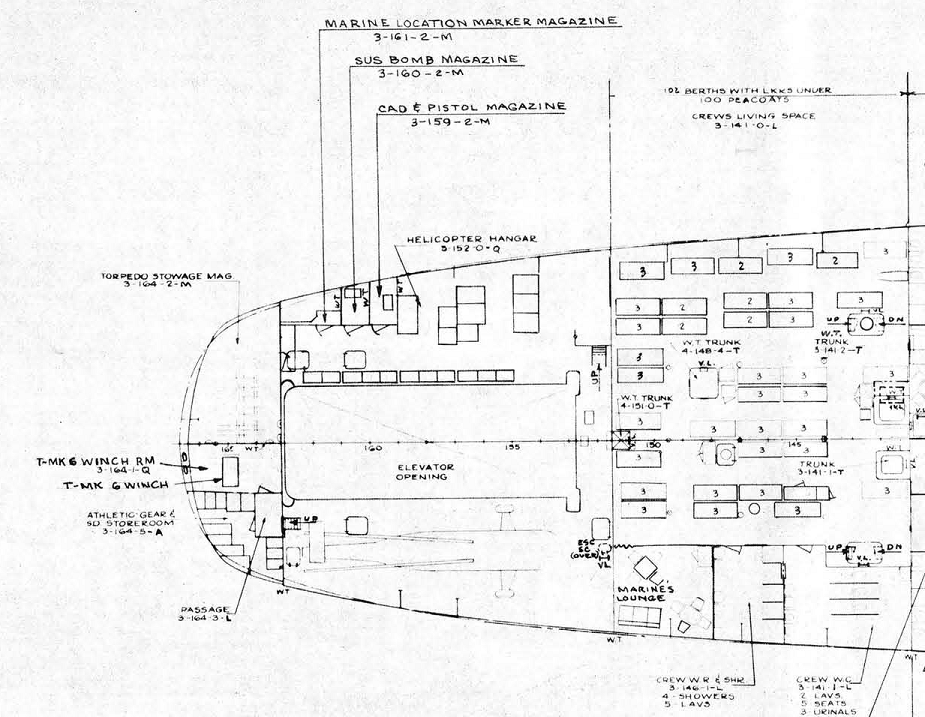
Image

The strange thing is that this hangar arrangement was retained for the ship's entire service life. It can even be seen on the Albany as she lay mothballed at Norfolk Naval Shipyard. The hangar opening was covered over in the mothballing process. This makes me wonder if there was a better sealing method being used for these Talos AAW heavy cruisers. For instance:

Image

It would not surprise me that the better method of sealing off the hangar was lost, because when BuShips was disestablished, and the Navy quit designing its own warships, they began contracting their design out, and a LOT of corporate warship knowledge was lost.

So, on my end of this (WIFing new classes of ships), if we were to design another CL or CA that employed gun and missile batteries on both sides of the ship (combat reliability) and center of gravity consideration, it may be necessary to have a below deck hangar as opposed to an above deck one. The single-ender approach (FFG and DDG where the whole stern of the ship is dedicated to a helicopter landing pad and hangar) is only good for small ships that cannot survive more than one hit. A bigger ship needs to be able to use both ends of the ship for its combat systems (mission) and find somewhere to put its helicopters (convenience). A below deck hangar answers this call very well.

Next for consideration: combat effectivness of a below deck hangar. :heh:

Re: Below Deck hanger

by navydavesof » Thu Apr 05, 2012 3:17 pm

Tracy White wrote:I have some photos of a Brooklyn class hangar and it's surprisingly roomy. The closest I have for a drawing is this damage plate for CL-81 Houston's (Cleveland class) [url=http://www.researcheratlarge.com/Ships/CL81/CL81ForwardRepair.html]
Thanks for the link, Tracy. That's really interesting. I would like to go to the Salem and see how big her hanger is. A friend of mine was on Newport News in the '70s, and he makes it sound like it was only side-to side. I am still very curious about the Baltimores. While there are pictures like I posted last time, there is also this one:
j-huck-ca-janes-1945a750.jpg
Like you said, Tracy, it looks to me like there is a LOT of room in there. I hope there are better pictures of the Baltimores as they were built.

Re: Below Deck hanger

by Tracy White » Thu Apr 05, 2012 9:02 am

I have some photos of a Brooklyn class hangar and it's surprisingly roomy. The closest I have for a drawing is this damage plate for CL-81 Houston's (Cleveland class) damage and repair in forward areas write up. You can see why they would mention there being room for one port site and forward of the elevator...

Top