I have been working for several years to prepare drawings for a 1:96 model of the USS Oklahoma City CLG-5 in the late 1971 configuration. For this I have created a 3D CAD model to verify how all the parts fit together, and then to create 2D drawings to work from while building the actual model. I decided to post a small part of that project to illustrate how CAD modelling can be used to facilitate real modeling.
I know that I am "preaching to the choir" on this thread, but the AN/SPS-10 antenna was ubiquitous on US Navy ships from the 1950s through the 1990s, so this should be of interest to anyone modelling this antenna.
1. The first step was collecting dimensioned drawings to work from. I got the BUSHIPS RE 65 F 2076 D "Outline and Mounting Dimensions" from Tom at The Floating Dry Dock (thanks Tom!). A friend working on restoration of an historic ship sent me a copy of the NAVSHIPS 0967-156-3040 "Technical Manual for Antenna Assemblies AS-936()/SPS-10B." I also visited the Buffalo and Erie Naval Park and photographed the antenna on the
USS Sullivans.
2. From these drawings and photos I was able to construct a very accurate 3D CAD model of the antenna, right down to 3/16" rivets.
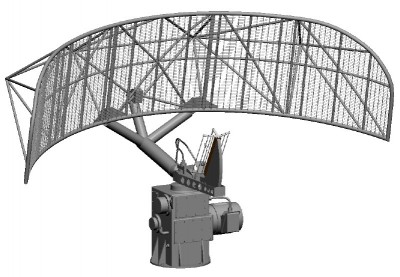
- AN/SPS-10A 3D model
Note: this is the configuration on the
Sullivans. Throughout the fleet there were slight variations in drive motors from different manufacturers, but they were all about the same size.
3. I used the 3D model to produce 2D projections from all sides and the top.

- 2D views of the antenna
4. Using measurements from the 3D model I prepared a "flattened" 2D plan diagram of the antenna frame and support structure.
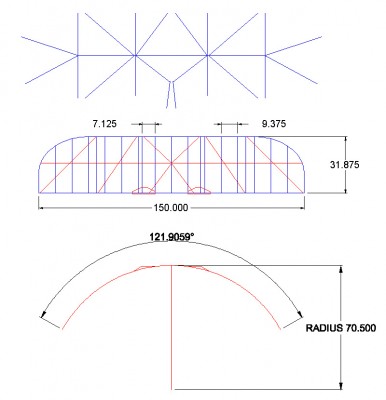
- Plan view of antenna
Note: the dimensions are for the 1:1 antenna, in inches.
Getting these 2D plans right would be very difficult without using Computer Aided Drafting. With CAD it is pretty simple. I will use these patterns to produce a photoetch parts set for the antenna.
5. Then I created 2D and perspective images of the antenna support "spider" and the radiator horn.
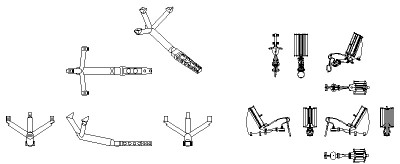
- Spider and horn.
Because I am working in a CAD program I can print these drawings at any scale (in my case at 1:96) for use in creating the model. But if I wanted to make a 1:50 scale drawing it would be a matter of just resetting the drawing scale and printing.
I have been working for several years to prepare drawings for a 1:96 model of the USS Oklahoma City CLG-5 in the late 1971 configuration. For this I have created a 3D CAD model to verify how all the parts fit together, and then to create 2D drawings to work from while building the actual model. I decided to post a small part of that project to illustrate how CAD modelling can be used to facilitate real modeling.
I know that I am "preaching to the choir" on this thread, but the AN/SPS-10 antenna was ubiquitous on US Navy ships from the 1950s through the 1990s, so this should be of interest to anyone modelling this antenna.
1. The first step was collecting dimensioned drawings to work from. I got the BUSHIPS RE 65 F 2076 D "Outline and Mounting Dimensions" from Tom at The Floating Dry Dock (thanks Tom!). A friend working on restoration of an historic ship sent me a copy of the NAVSHIPS 0967-156-3040 "Technical Manual for Antenna Assemblies AS-936()/SPS-10B." I also visited the Buffalo and Erie Naval Park and photographed the antenna on the [i]USS Sullivans[/i].
2. From these drawings and photos I was able to construct a very accurate 3D CAD model of the antenna, right down to 3/16" rivets.
[attachment=3]SPS-10 3D.jpg[/attachment]
Note: this is the configuration on the [i]Sullivans[/i]. Throughout the fleet there were slight variations in drive motors from different manufacturers, but they were all about the same size.
3. I used the 3D model to produce 2D projections from all sides and the top.
[attachment=2]antenna 2D views.jpg[/attachment]
4. Using measurements from the 3D model I prepared a "flattened" 2D plan diagram of the antenna frame and support structure.
[attachment=1]antenna plan.jpg[/attachment]
Note: the dimensions are for the 1:1 antenna, in inches.
Getting these 2D plans right would be very difficult without using Computer Aided Drafting. With CAD it is pretty simple. I will use these patterns to produce a photoetch parts set for the antenna.
5. Then I created 2D and perspective images of the antenna support "spider" and the radiator horn.
[attachment=0]spider and horn.jpg[/attachment]
Because I am working in a CAD program I can print these drawings at any scale (in my case at 1:96) for use in creating the model. But if I wanted to make a 1:50 scale drawing it would be a matter of just resetting the drawing scale and printing.