by Rob Wood » Mon Nov 26, 2012 2:13 am
I work only in 1:144 scale, and do most of my work in a 4 meter x 4 meter spare bedroom, but only half of it is for my hobby. (The room is also used by my wife for some computer-related work, which means dust is to be avoided.) Luckily, we have a decent sized balcony/deck that I use for work that produces lots of dust and debris, such as building the hulls and cutting materials for the larger structures; but the prohibition against producing dust inside the room has led to quite a bit of experimentation with materials and techniques that don't produce dust (wet sanding, for example, and shaping epoxy fillers with wet fingers, instead of sanding, etc.) or fumes (using water-based finishes, including spar varnish for natural wood decks).
I know from experience that the ideal workbench is a heavy table in the center of the room. That way, you don't have to rotate the model to work on it - you simply walk around it. Of course, you have to have control of the entire floorspace of the room. In the image below, you see what I consider to be the ideal ideal situation: central island workbench, and cutting/fabricating stations against the surrounding walls. Even if your space is much smaller, the table could be made narrower, but the idea - walking around the work, instead of rotating the work - increases efficiency, and you're able to not only build more quickly, it's much more enjoyable.

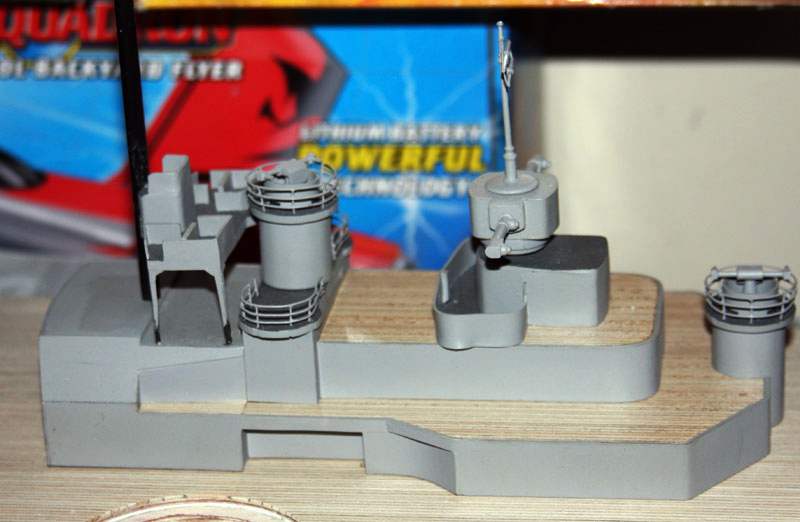
Currently, my heavy bench is against one wall, because, as I mentioned, the room is also used by my wife for some computer-related work, but my goal is to take over the entire room for my hobby. The largest ship in my shipyard is a 1:144 Bismarck (approximately 2 meters long). I don't believe I could handle anything larger in the space. As I mentioned, I brush acrylics, due to a lack of a spray booth and fumes. I have found, over years of brushing acrylics, that by using the right materials and techniques, I can produce a satisfactory finish - well, satisfactory for my purposes, which are for RC warship combat in 1:144 scale. The gray in the unfinished Bismarck main hangar sub-assembly below was hand-painted acrylic, and the wooden deck is protected with water-based urethane spar varnish:
Rob
I work only in 1:144 scale, and do most of my work in a 4 meter x 4 meter spare bedroom, but only half of it is for my hobby. (The room is also used by my wife for some computer-related work, which means dust is to be avoided.) Luckily, we have a decent sized balcony/deck that I use for work that produces lots of dust and debris, such as building the hulls and cutting materials for the larger structures; but the prohibition against producing dust inside the room has led to quite a bit of experimentation with materials and techniques that don't produce dust (wet sanding, for example, and shaping epoxy fillers with wet fingers, instead of sanding, etc.) or fumes (using water-based finishes, including spar varnish for natural wood decks).
I know from experience that the ideal workbench is a heavy table in the center of the room. That way, you don't have to rotate the model to work on it - you simply walk around it. Of course, you have to have control of the entire floorspace of the room. In the image below, you see what I consider to be the ideal ideal situation: central island workbench, and cutting/fabricating stations against the surrounding walls. Even if your space is much smaller, the table could be made narrower, but the idea - walking around the work, instead of rotating the work - increases efficiency, and you're able to not only build more quickly, it's much more enjoyable.
[img]http://lumberjocks.com/assets/pictures/projects/77351-438x.jpg[/img]
Currently, my heavy bench is against one wall, because, as I mentioned, the room is also used by my wife for some computer-related work, but my goal is to take over the entire room for my hobby. The largest ship in my shipyard is a 1:144 Bismarck (approximately 2 meters long). I don't believe I could handle anything larger in the space. As I mentioned, I brush acrylics, due to a lack of a spray booth and fumes. I have found, over years of brushing acrylics, that by using the right materials and techniques, I can produce a satisfactory finish - well, satisfactory for my purposes, which are for RC warship combat in 1:144 scale. The gray in the unfinished Bismarck main hangar sub-assembly below was hand-painted acrylic, and the wooden deck is protected with water-based urethane spar varnish:
[img]http://www.robwood.net/Warships/battleships/bismarck/images/main-hangar_web_IMG_0654.jpg[/img]
Rob