I was able to chase down and ask a number of members of the USS
Newport News about how well the float plane hangar's hatch sealed against the elements.
The Virginia-class CGNs had elevators that would elevate all the way up to be flush with the deck, and a gasket-like seal was supposed to seal them off form the elements. That did not work well, and water often intruded into the hangar causing constant problems. Having only been designed for the SH-2 Sea Sprite, the hangar could not accommodate larger helicopters. As Seasick pointed out it is very hard to expand a below deck hangar, because it is surrounded by the hull of the ship. On those ships they wound up welding the hangar closed.
The similarity between the below decks hangars, however has led to speculation by many about the hangars on the light cruisers and heavy cruisers of WWII. Some have said that they all leaked the same, because it was a below decks hangar...and they're all the same-ish. It turns out that is an incorrect assumption.
Just from a mechanical point of view it would make sense that the raised rails that the hatch rolled on would provide a sill to channel the water away from the opening. Crewmen of the USS
Newport News have said that even in "the storm of '61" where the ship struck such an intense storm that the ship's super structure and light weapons sustained damage, there was never any appreciable leaking inside the hangar. A NAVSEA representative told me that during shipchecks of the Des Moines while she laid in the mothball fleet there was no evidence of leaing at any other time.
It turns out that the sliding hatch mechanism of the CLs and CAs formed a capable seal that prevented water from entering the ship.
On a strange note, however the conversions of the
Albany and
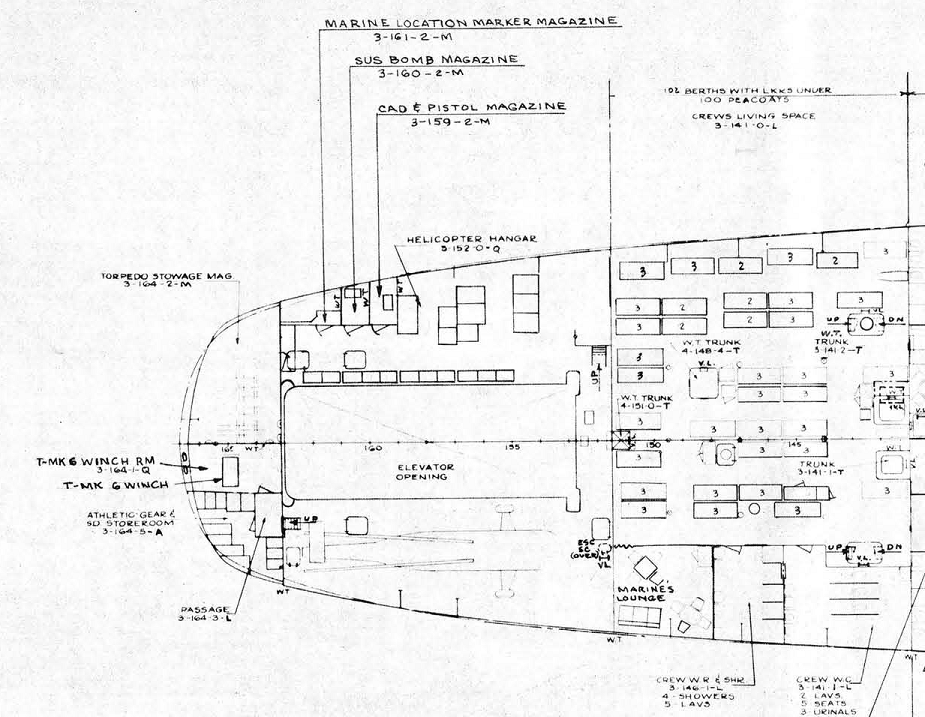
Chicago, the hangar was retained and expanded to accommodate the large HSS-1 helicopter. Its mechanism was the same as on the
Virginia CGNs. Here it is on the plans:
The strange thing is that this hangar arrangement was retained for the ship's entire service life. It can even be seen on the
Albany as she lay mothballed at Norfolk Naval Shipyard. The hangar opening was covered over in the mothballing process. This makes me wonder if there was a better sealing method being used for these Talos AAW heavy cruisers. For instance:

It would not surprise me that the better method of sealing off the hangar was lost, because when BuShips was disestablished, and the Navy quit designing its own warships, they began contracting their design out, and a LOT of corporate warship knowledge was lost.
So, on my end of this (WIFing new classes of ships), if we were to design another CL or CA that employed gun and missile batteries on both sides of the ship (combat reliability) and center of gravity consideration, it may be necessary to have a below deck hangar as opposed to an above deck one. The single-ender approach (FFG and DDG where the whole stern of the ship is dedicated to a helicopter landing pad and hangar) is only good for small ships that cannot survive more than one hit. A bigger ship needs to be able to use both ends of the ship for its combat systems (mission) and find somewhere to put its helicopters (convenience). A below deck hangar answers this call very well.
Next for consideration: combat effectivness of a below deck hangar.

I was able to chase down and ask a number of members of the USS [i]Newport News [/i]about how well the float plane hangar's hatch sealed against the elements.
The Virginia-class CGNs had elevators that would elevate all the way up to be flush with the deck, and a gasket-like seal was supposed to seal them off form the elements. That did not work well, and water often intruded into the hangar causing constant problems. Having only been designed for the SH-2 Sea Sprite, the hangar could not accommodate larger helicopters. As Seasick pointed out it is very hard to expand a below deck hangar, because it is surrounded by the hull of the ship. On those ships they wound up welding the hangar closed.
The similarity between the below decks hangars, however has led to speculation by many about the hangars on the light cruisers and heavy cruisers of WWII. Some have said that they all leaked the same, because it was a below decks hangar...and they're all the same-ish. It turns out that is an incorrect assumption.
Just from a mechanical point of view it would make sense that the raised rails that the hatch rolled on would provide a sill to channel the water away from the opening. Crewmen of the USS [i]Newport News [/i]have said that even in "the storm of '61" where the ship struck such an intense storm that the ship's super structure and light weapons sustained damage, there was never any appreciable leaking inside the hangar. A NAVSEA representative told me that during shipchecks of the Des Moines while she laid in the mothball fleet there was no evidence of leaing at any other time.
It turns out that the sliding hatch mechanism of the CLs and CAs formed a capable seal that prevented water from entering the ship.
On a strange note, however the conversions of the [i]Albany [/i]and [i]Chicago[/i], the hangar was retained and expanded to accommodate the large HSS-1 helicopter. Its mechanism was the same as on the [i]Virginia[/i] CGNs. Here it is on the plans:
[img]http://i1179.photobucket.com/albums/x390/navydavesof/small1CG-11hangar.png[/img]
The strange thing is that this hangar arrangement was retained for the ship's entire service life. It can even be seen on the [i]Albany [/i]as she lay mothballed at Norfolk Naval Shipyard. The hangar opening was covered over in the mothballing process. This makes me wonder if there was a better sealing method being used for these Talos AAW heavy cruisers. For instance:
[img]http://upload.wikimedia.org/wikipedia/commons/thumb/5/5e/USS_Albany_%28CG-10%29_mothballed.jpg/800px-USS_Albany_%28CG-10%29_mothballed.jpg[/img]
It would not surprise me that the better method of sealing off the hangar was lost, because when BuShips was disestablished, and the Navy quit designing its own warships, they began contracting their design out, and a LOT of corporate warship knowledge was lost.
So, on my end of this (WIFing new classes of ships), if we were to design another CL or CA that employed gun and missile batteries on both sides of the ship (combat reliability) and center of gravity consideration, it may be necessary to have a below deck hangar as opposed to an above deck one. The single-ender approach (FFG and DDG where the whole stern of the ship is dedicated to a helicopter landing pad and hangar) is only good for small ships that cannot survive more than one hit. A bigger ship needs to be able to use both ends of the ship for its combat systems (mission) and find somewhere to put its helicopters (convenience). A below deck hangar answers this call very well.
Next for consideration: combat effectivness of a below deck hangar. :heh: