by PATMAT » Thu Jun 20, 2013 5:51 pm
OK, I took EJFoeth's advice and used Hauler in CZ (
http://www.etchworks.eu/).
So with about 1 month elapsed (not so bad really), I have my custom PE fret in hand. Only real issue- I had the privilege of paying for a bad fret as well as the good revised design... well, that's just to be expected in "product development", it was my design after all!
The issue was that the design is defined by an outline, and on whatever print device is used, the line has thickness. On small parts with holes close to edges, with the extra etching that occurs with thick stock (1/2 mm), and with the slight registration errors that will always happen between front and rear transparencies, you can expect some trouble! Many of the stanchions just broke in half at the holes. The fixed design widened the stanchions a wee bit, and shrunk the holes a tad. Looks like I may have to open up some holes now, but that's OK.
Now the fun starts- despruing, cleaning, and then soldering the rails. The top rail actually sits on top of the stanchion, that should be interesting.
BTW, this is for my 1:72 3D Printed CCG MSRV:
viewtopic.php?f=13&t=151938
- Attachments
-
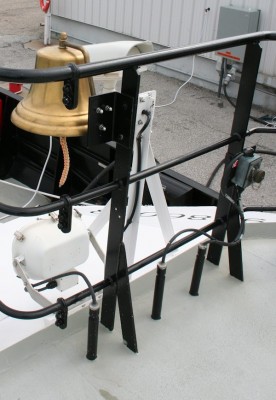
- 1:1 stanchions
-
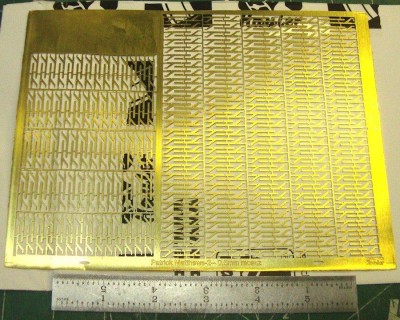
- The final fret... Hauler (Jan) was nice enough to fill up the sheet with extra copies of my stanchions.
-
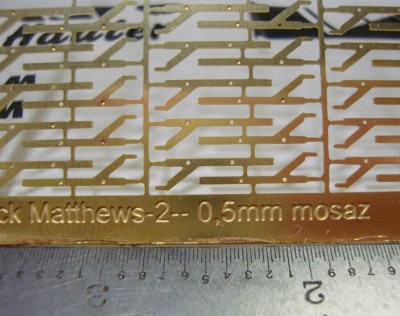
- Detail
OK, I took EJFoeth's advice and used Hauler in CZ (http://www.etchworks.eu/).
So with about 1 month elapsed (not so bad really), I have my custom PE fret in hand. Only real issue- I had the privilege of paying for a bad fret as well as the good revised design... well, that's just to be expected in "product development", it was my design after all!
The issue was that the design is defined by an outline, and on whatever print device is used, the line has thickness. On small parts with holes close to edges, with the extra etching that occurs with thick stock (1/2 mm), and with the slight registration errors that will always happen between front and rear transparencies, you can expect some trouble! Many of the stanchions just broke in half at the holes. The fixed design widened the stanchions a wee bit, and shrunk the holes a tad. Looks like I may have to open up some holes now, but that's OK.
Now the fun starts- despruing, cleaning, and then soldering the rails. The top rail actually sits on top of the stanchion, that should be interesting.
BTW, this is for my 1:72 3D Printed CCG MSRV: http://www.shipmodels.info/mws_forum/viewtopic.php?f=13&t=151938