Acrylic over Enamel?

Post a reply

Confirmation code
Enter the code exactly as it appears. All letters are case insensitive.

BBCode is ON
[img] is ON
[url] is ON
Smilies are OFF

Topic review
   

Expand view Topic review: Acrylic over Enamel?

Re: Acrylic over Enamel?

by gott_cha » Sun Feb 07, 2016 11:35 am

Wefalck you mentioned possible problems if the coatings were to be applied with a Hairy-Stick.. in that the solvents when brushed on would be too concentrated, or too "hot" and would/may cause problems.
Using a test mule,..I found that to be true. It tended to dissolve and bubble up the paint.

But I also have found it can be used to an advantage in simulating "weathered chipping"....much like the effect achieved using the Hair Spray technique. Very cool lesson learned. :smallsmile:

Re: Acrylic over Enamel?

by wefalck » Sat Feb 06, 2016 5:41 am

Polymethacrylic acid (PMMA) is resistant against petrol and oils, but against alcohols, acetone and benzene. So, the problem can be, when you paint in oil too 'lean', i.e. with too much solvent (turpentine, white spirit), that the solvent attacks the PMMA. The speed with which this happens also depend on the ageing of the acrylic paint film. I would let it cure a few days before touching it with a (bristle) brush. Spray painting typically is less problematic, as the solvent evaporates very quickly.

Re: Acrylic over Enamel?

by gott_cha » Fri Feb 05, 2016 8:56 am

Matthew I think the work around on the solvent issue is to spray very light mist coats to build up the color..allowing each coat to cure of course. In my test of these,..it seems my hesitation to rush the results proved very helpful .
Also, interesting information from the Both of you on paint compositions.

Re: Acrylic over Enamel?

by MatthewB » Thu Feb 04, 2016 8:35 pm

wefalck wrote:I think they gave you the wrong message in your art school. Traditionally, painters would paint in oil over an underpainting in tempera, which in turn would be put on a chalk plus glue base. Now tempera is an emulsion on the basis of the egg yolks in it (think of real! mayonnaise), which provides the physical-chemistry for the oil paint to stick. Actually, it partly the physical-chemistry of the materials and partly the surface roughness that allows the oil to stick.

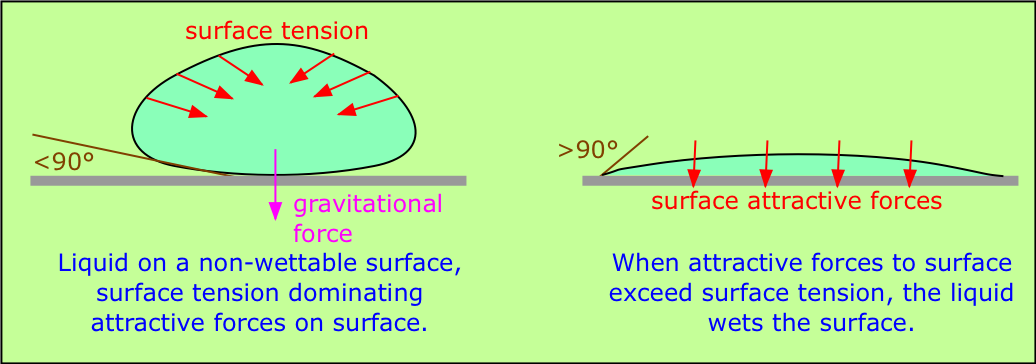
Apart from so-called van-der-Waal's attractive forces and other types of chemical interaction, it is the 'wetting' angle that in the first place determine, whether a liquid will spread out on a surface or form droplets:
Image
https://www.chem1.com/acad/sci/wat-images/wetting.png

The wetting angle is determined by the solvent in which the paint particles are immersed. Water has a high surface tension and a wetting angle of less than 90� with respect to oils/enamels. This is why it will form droplets. By adding alcohol, one can reduce the surface tension so that the wetting angle become larger than 90�. It may then form a uniform layer on the surface. Adding a detergent (washing-up liquid) will have a similar effect (which is why washing-up liquid gets the grease of your pan).

Another way to overcome the problem, is to have a rough surface with wetting angles point into many different directions at a microscopic scale. The average wetting angle may then be larger than 90�. That is why oils/enamels will stick to flat acrylics, or even acrylics may stick to flat enamels. The flatting agent itself may also increase the wetting angle.

Surface tension is only part of the story. Having the right wetting properties will help you getting the paint onto the surface, but will not necessarily make it stick. Ideally, there should be physico-chemical interaction between the paint and the surface. However, it may be sufficient, if the paint is able to 'key' into the surface. Which is why it sticks better to flat surfaces and why we lightly sand surfaces to be (re)painted.

The 'drying' of oils/enamels and acrylics are rather different processes. In oil paints the oil actually oxidises due to short-wave radiation (UV) energy input. In most cases the volume change is quite small. What happens with enamels depends on their formulation. There may be polymerisation and/or simply evaporation of the solvent. Acrylics physically dry on one hand, but also form cross-links between the molecules. The high water content in them can mean a significant change of volume, i.e. shrinking.

The problem of volume change can be overcome by applying thin layers, preferably with an airbrush or spray can. When the shrinking forces are smaller than the tension strength of the paint, the keying-in will keep it on the surface. This condition arises when applying only very thin layers at any one time. In this way one may be able to built up a layer of paint on even unfavourable surfaces, but it may not stick very strongly.
Tempera paint isn't an acrylic. It is just a "Water-based Paint."

Acrylics have plastics in them, which can be affected by a solvent.

The Tempera paint only has albumen proteins in it, which only face the danger of denaturation. That happens anyway in the process of the paint drying on a canvas (I am familiar with glazing over Tempera paints).

The problem is not that oils will not stick to acrylics. It is that acrylics tend to react to the solvents in the oils/enamels.

MB

Re: Acrylic over Enamel?

by gott_cha » Sun Jan 31, 2016 10:36 am

Ok now I have done the same over the flight deck and it does appear that allowing longer "cure" and "gass-off" times makes a big difference in bonding. no problems so far.

Re: Acrylic over Enamel?

by wefalck » Sun Jan 31, 2016 6:06 am

I think they gave you the wrong message in your art school. Traditionally, painters would paint in oil over an underpainting in tempera, which in turn would be put on a chalk plus glue base. Now tempera is an emulsion on the basis of the egg yolks in it (think of real! mayonnaise), which provides the physical-chemistry for the oil paint to stick. Actually, it partly the physical-chemistry of the materials and partly the surface roughness that allows the oil to stick.

Apart from so-called van-der-Waal's attractive forces and other types of chemical interaction, it is the 'wetting' angle that in the first place determine, whether a liquid will spread out on a surface or form droplets:

Image
https://www.chem1.com/acad/sci/wat-images/wetting.png

The wetting angle is determined by the solvent in which the paint particles are immersed. Water has a high surface tension and a wetting angle of less than 90� with respect to oils/enamels. This is why it will form droplets. By adding alcohol, one can reduce the surface tension so that the wetting angle become larger than 90�. It may then form a uniform layer on the surface. Adding a detergent (washing-up liquid) will have a similar effect (which is why washing-up liquid gets the grease of your pan).

Another way to overcome the problem, is to have a rough surface with wetting angles point into many different directions at a microscopic scale. The average wetting angle may then be larger than 90�. That is why oils/enamels will stick to flat acrylics, or even acrylics may stick to flat enamels. The flatting agent itself may also increase the wetting angle.

Surface tension is only part of the story. Having the right wetting properties will help you getting the paint onto the surface, but will not necessarily make it stick. Ideally, there should be physico-chemical interaction between the paint and the surface. However, it may be sufficient, if the paint is able to 'key' into the surface. Which is why it sticks better to flat surfaces and why we lightly sand surfaces to be (re)painted.

The 'drying' of oils/enamels and acrylics are rather different processes. In oil paints the oil actually oxidises due to short-wave radiation (UV) energy input. In most cases the volume change is quite small. What happens with enamels depends on their formulation. There may be polymerisation and/or simply evaporation of the solvent. Acrylics physically dry on one hand, but also form cross-links between the molecules. The high water content in them can mean a significant change of volume, i.e. shrinking.

The problem of volume change can be overcome by applying thin layers, preferably with an airbrush or spray can. When the shrinking forces are smaller than the tension strength of the paint, the keying-in will keep it on the surface. This condition arises when applying only very thin layers at any one time. In this way one may be able to built up a layer of paint on even unfavourable surfaces, but it may not stick very strongly.

Re: Acrylic over Enamel?

by MatthewB » Sat Jan 30, 2016 10:54 pm

In art school, we were taught:

Water over oil: OK.

Oil over Water: Problem.

Most Acrylic paints shrink rather a lot when they dry/cure.

Many Oil/enamel (petroleum based carriers) paints tend to out gas when they cure/dry (there is a distinction between "drying' and "curing." Most Acrylics "dry," whereas most enamels/oils "cure" - but you do have varieties of both that do both, or the other).

The shrinking of acrylics means that putting enamels over them can cause the enamels to wrinkle or peel off.

The out-gassing of oil/enamels, though, tends to be less of a problem, as most acrylics are porous enough to allow the gasses to pass through.

There are also problems of enamel/oil's solvents that can soften an acrylic (which is basically a plastic) if applied over an acrylic.

Think of it this way:

When you prime a model, most primers are petroleum-based (enamels).

Yet you can easily paint an acrylic over a spray-can, enamel primer. In fact, almost ALL miniatures painters do this (use acrylics over an enamel primer). Only a very few use an acrylic primer and an acrylic paint.

All that said....

IFF (spelled correctly) you allow an Acrylic to dry/cure long enough, then most of the enamels on the market today will work over them, as long as it isn't gigantic areas.

MB

Re: Acrylic over Enamel?

by gott_cha » Wed Jan 20, 2016 7:02 pm

Ahh..Okay.
Thanx for the tip Channell :thumbs_up_1:

Re: Acrylic over Enamel?

by Channell » Wed Jan 20, 2016 10:51 am

My favorite mix is to use Tamiya surface primer (enamel) rattle cans with airbrushed acrylic top coat (model master and Tamiya) and I get great results with no peeling/lifting of the paint. I'll airbrush acrylic primer on smaller pieces/areas I don't want to loose detail clarity but it seems the acrylic primed pieces scratch/flake/lift much easier. I'll usually hit the surface of the plastic with 600 or 1000 grit sandpaper before painting too, especially if I'm doing a larger area... just doing that gives you much better paint adhesion with either acrylic or enamel primer over painting the slick plastic surfaces right out of the box.

As for the "don't put acrylic on enamel rule" I think that applies more to painting walls, and the acrylic in that case is latex paint... very different stuff than the artist's acrylic formulas we are putting on our models.

Re: Acrylic over Enamel?

by gott_cha » Tue Jan 19, 2016 9:43 am

Have you noticed the TAMIYA effect with any other brand of acrylic?

As far as being the easiest to work with, Thin, Spray,Coverage and cleanup, which manufacturer can you recommend as a basic staple ? I have only hand brushed acrylics so far...nothing out of my AirBrush yet

Again thank you for your replies and assistance.

Re: Acrylic over Enamel?

by Jon » Mon Jan 18, 2016 10:24 am

Each acrylic and enamel can be very different, but what people have said above is for the mostly true. I know I recently painted a subject that I was willing to try painting acrylic over enamel without testing first. Before the acrylic could 100% cure, I sealed it with Future floor wax. No problem. I think if the acrylic had fully cured it would have been okay. Paint was Humbrol enamel flat/dull base and Tamiya acrylic. I think the Tamiya acrylic is a stronger acrylic paint so held better and the flat/dull paint gave enough teeth.

Re: Acrylic over Enamel?

by gott_cha » Mon Jan 18, 2016 8:00 am

wefalck wrote:White spirit is a petroleum-derived solvent, so it is not surprising that is dissolves enamels - that is what it is for, after all.

Yes that I understand, My concern was that it ate thru the Lacquer top coat.

The old painter's rule is 'fat over lean', meaning that you can paint with oil-based paints (enamels, artists' oils) e.g. over acrylics, but not normally the other way around. This has something to do with surface physico-chemistry and the so-called polarity of the surfaces. Oils and enamels have 'unpolar' (oily) surfaces on which acrylics in their polar solvents (usually water and/or alcohol) just form drops. Sometimes one can tweak this a bit by adding a detergent to the acrylics, which has the effect of making the enamel surface less polar. When spraying acrylics on oils, they may form a continuous film, but they don't really attach to the surface properly. Oils stick to the acrylics because of the surface roughness of the latter, which allows them to key in.
I knew there were problems with acrylic over enamels just not why,..so it seems that you are saying maybe it's due to "surface tension" = "less polar"?
I have noticed in the past that attempts to touch in small details with acrylic over an enamel paint base that the acrylic just didn't perform as needed ,..now I know why. Okay then I must "assume" that the craft bond acrylic spray that I applied must be a modified formula or type of acrylic due to it actually bonding and curing.


Thanx for the chemistry lesson Wefalck

Re: Acrylic over Enamel?

by wefalck » Sun Jan 17, 2016 4:42 pm

White spirit is a petroleum-derived solvent, so it is not surprising that is dissolves enamels - that is what it is for, after all.

Polymerised acrylics a pretty insoluble in most organic solvents a modeller comes across (at least on the short term), so again it is not surprising that white spirit didn't do any harm.

The old painter's rule is 'fat over lean', meaning that you can paint with oil-based paints (enamels, artists' oils) e.g. over acrylics, but not normally the other way around. This has something to do with surface physico-chemistry and the so-called polarity of the surfaces. Oils and enamels have 'unpolar' (oily) surfaces on which acrylics in their polar solvents (usually water and/or alcohol) just form drops. Sometimes one can tweak this a bit by adding a detergent to the acrylics, which has the effect of making the enamel surface less polar. When spraying acrylics on oils, they may form a continuous film, but they don't really attach to the surface properly. Oils stick to the acrylics because of the surface roughness of the latter, which allows them to key in.

Re: Acrylic over Enamel?

by gott_cha » Sun Jan 17, 2016 7:26 am

Jon, here is what I have found out.

(1) On a piece of sheet stock I shot a coat of Model Masters Lt. Ghost gray enamel and when dried I over-coated that with Testors Gloss Coat Lacquer.
After it dried over nite I applied AK's "salt streak" and "hull grime" enamels and then worked them down with the white spirits for the streaking effect.
NOT GOOD. It may be fine if you just apply it randomly as a pin wash or a dry brush effect, but for "streaking" where you need to work it a time or two with the Spirits, it tends to cut down thru the lacquer ( I didn't expect that).., and into the enamel creating more of a stained area that looks like crap and difficult to repair. :scratch:

(2) On another piece of stock I shot the same paint but over coated it with a "Craft Type" acrylic sealer..(Rattle can craft section at wally world)...applied 3 lite mist coats allowing 10 minutes cure between each coat...
Again I let that dry over nite. I applied the Ak streaks and let it set for a couple moments then worked it with the white spirits. Much much better. I was able to work it down to the effects I was looking for and even able to remove it with a dampened cotton bud without "breaking" thru the sealer.

This may be old hat to some but for me it was a new experience due to my lack of working with acrylics and enamels together.
I do believe it's time for me to come on over to the 21'st century :cool_2:

Re: Acrylic over Enamel?

by Jon » Fri Jan 15, 2016 8:34 am

Simply find some plastic spare parts you aren't going to use and test it. That's all I can recommend as each enamel and acrylic can be very different. I've sprayed Future over both without any problem.

Acrylic over Enamel?

by gott_cha » Fri Jan 15, 2016 8:17 am

I use Model Master enamel FS colors in most of my builds,..Humbrol colors on occasions.
and for weathered effects I normally use artist chalks, powdered pigments thinned with water to make washes and stains.
But I like what I have seen of the AK-International "weathering products". They are oil based so they use white spirits to thin.
I would like to start using these but they need to be applied over acrylic paints from what I understand.

Can acrylic clear coat be sprayed over enamel and it bond and cure enough to do what I want?
Would Lacquer clear coats work as well or would the white spirits break it down?
I have no experience with acrylic paints so I don't know what can be top-coated over what.


What are your thoughts or opinions on this....

Top