Inspired by an excellent example in another forum (
https://modelshipworld.com/index.php?/t ... ent-452268 and newer version further down in the thread as well as a review of it:
https://modelshipworld.com/index.php?/t ... ent-473797), I decided to put into action something that I had planned to do for a long time. From my late father�s estate I inherited a cast-iron foot that presumably belonged to a some sort of chemical laboratory equipment. Not being impressed with the commercial �third-hand� I kept this piece of cast-iron with the view of converting it into a tool with less and better controllable degrees of freedom. Also just having a pair of cheaply made alligator clamps didn�t add to the useability of that tool that, in consequence, spent most of its life on the shelf. I also inhereted a good quantity of pre-war quality alligator clamps.
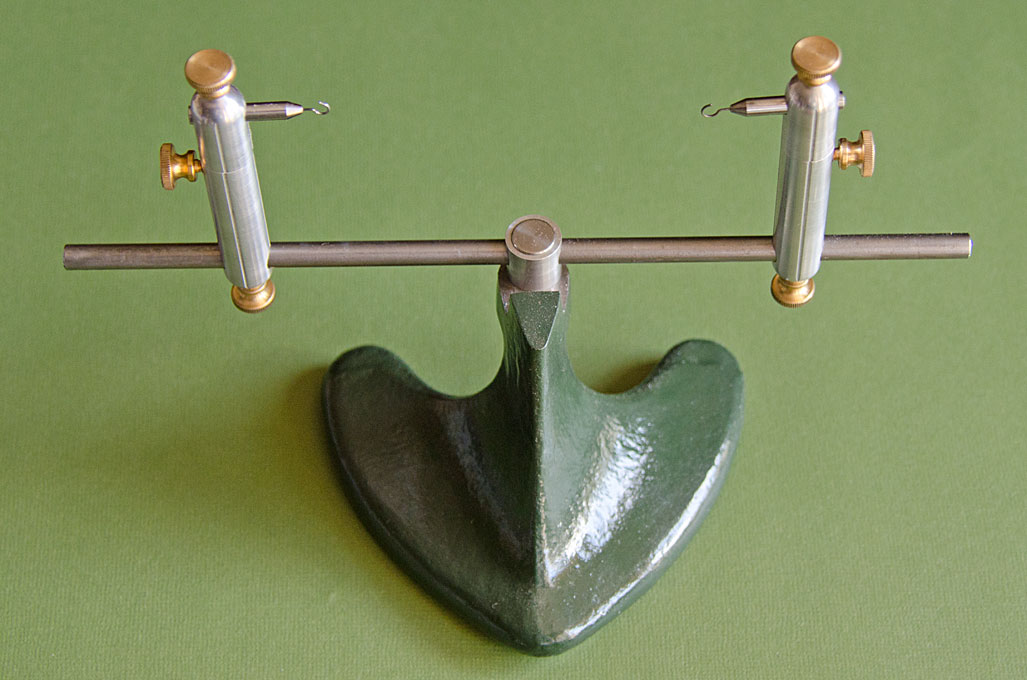 Third hand with small hooks for rigging work
The cast-iron foot was de-rusted and a proper seat for the bar-clamp had to be filed � I could not find a way to clamp the piece to the table of my milling machine. The foot then was primed and painted in my favourite �bottle green� (RAL 6007).
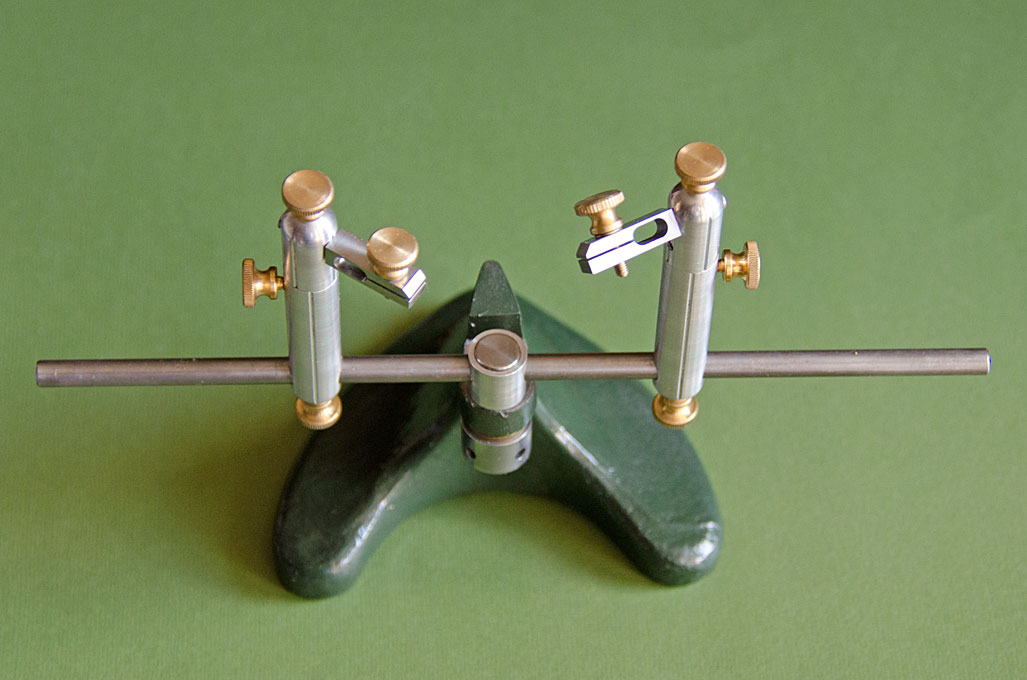 Third hand with small clamps in steel
Working predominantly in small scales with tiny parts, I sized the tool appropriately. The main bar is 6 mm steel and the two pillars are 10 mm aluminium. I actually prefer steel, but in this case working with aluminium was faster on my small machines. The arbors for all the clamps are 4 mm steel rod. The diameter of 4 mm was chosen, as the alligator-clamps have sleeves that are meant to be pushed over 4 mm-banana-plugs.
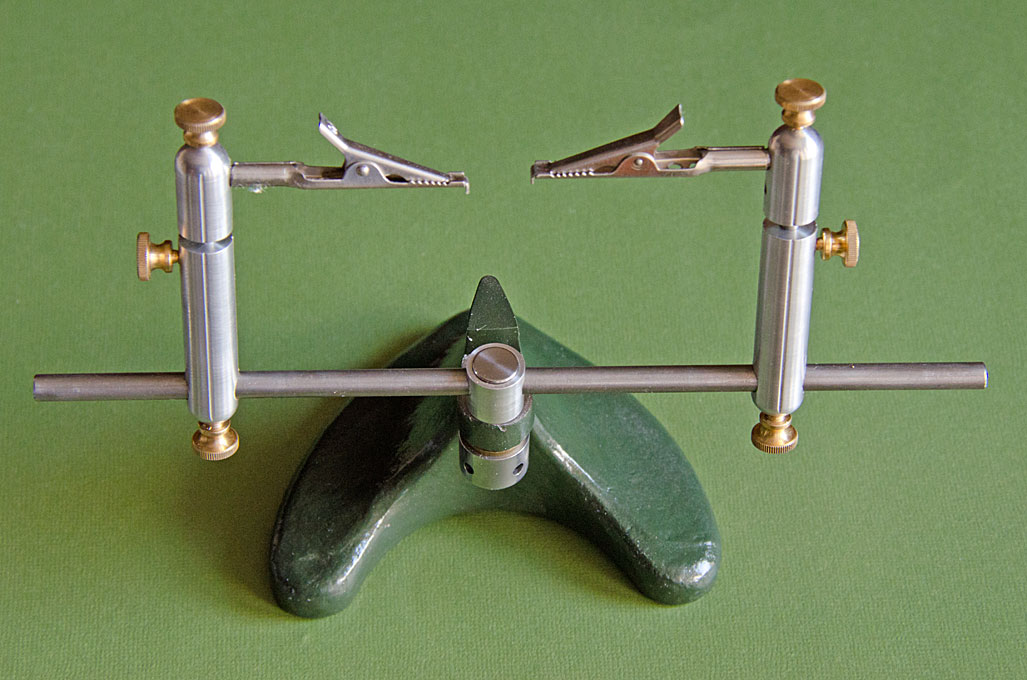 Third hand with alligator clamps
Thinking about the likely kind of applications, I made a pair of small sprung clamps from steel, a pair of larger toolmaker-style clamps (excellent idea by Michael, btw) in aluminium to be used for soldering, a pair of small hooks in 0.5 mm piano-wire for rigging tasks, and a pair of collect-chucks.
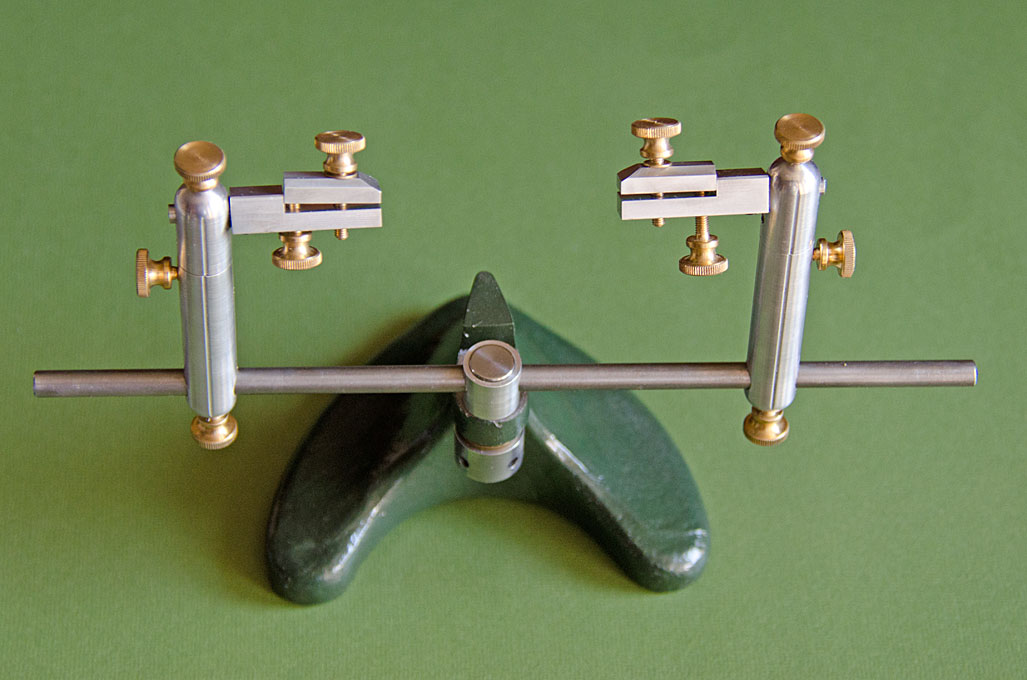 Third hand with toolmakers-style clamps in aluminium
The collet-chucks are a commercial products from China with ten collets that clamp from 0 to 3.2 mm. I thought this might be a good idea for clamping wires and perhaps ropes safely without distortion or marring. They were so cheap at 1.50� for a chuck with ten collets that there was no point in makimng them myself.
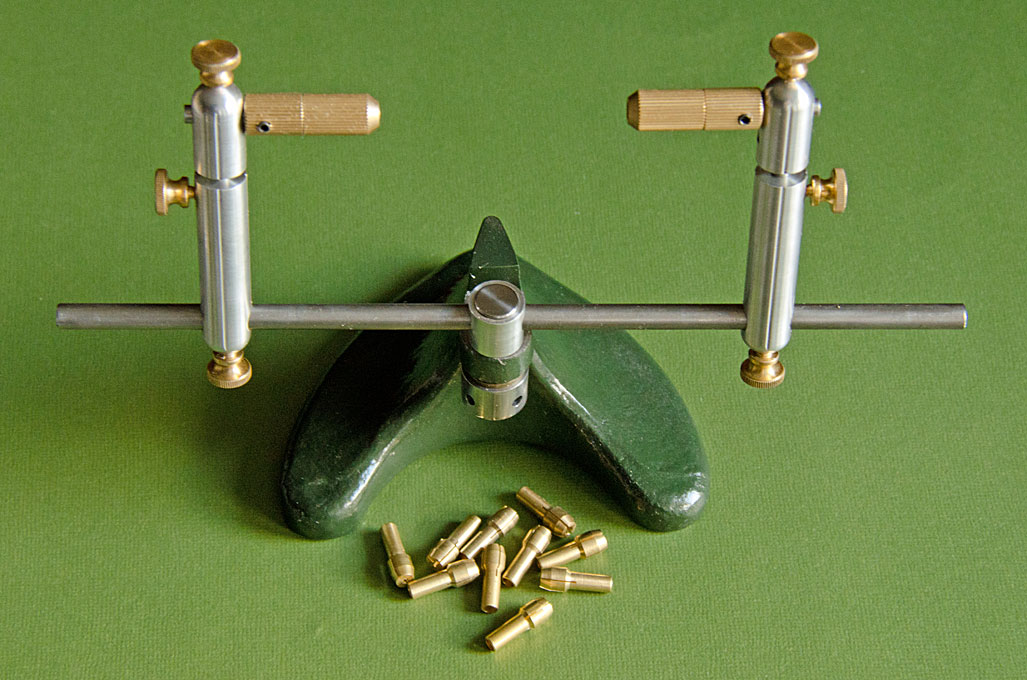 Third hand with collet chucks to hold wires etc.
I also plan to make set of clamps from bakelite for soldering, but have not received the material yet.
The thumb-screws are also bought-in, as I have local source here in Paris that sells them for one Euro a piece, which is not exactly cheap, but good value considering how much time I would have spent making them myself.
Inspired by an excellent example in another forum (https://modelshipworld.com/index.php?/topic/14463-restoration-of-bassett-lowke-albertic-by-michael-mott-scale-1100/&page=5&tab=comments#comment-452268 and newer version further down in the thread as well as a review of it: https://modelshipworld.com/index.php?/topic/15249-michael-mott-designed-third-hand/&tab=comments#comment-473797), I decided to put into action something that I had planned to do for a long time. From my late father�s estate I inherited a cast-iron foot that presumably belonged to a some sort of chemical laboratory equipment. Not being impressed with the commercial �third-hand� I kept this piece of cast-iron with the view of converting it into a tool with less and better controllable degrees of freedom. Also just having a pair of cheaply made alligator clamps didn�t add to the useability of that tool that, in consequence, spent most of its life on the shelf. I also inhereted a good quantity of pre-war quality alligator clamps.
[img]http://www.maritima-et-mechanika.org/tools/thirdhand/ThirdHand-Hooks.jpg[/img]
[b][i]Third hand with small hooks for rigging work[/i][/b]
The cast-iron foot was de-rusted and a proper seat for the bar-clamp had to be filed � I could not find a way to clamp the piece to the table of my milling machine. The foot then was primed and painted in my favourite �bottle green� (RAL 6007).
[img]http://www.maritima-et-mechanika.org/tools/thirdhand/ThirdHand-SmallJaws2.jpg[/img]
[b][i]Third hand with small clamps in steel[/i][/b]
Working predominantly in small scales with tiny parts, I sized the tool appropriately. The main bar is 6 mm steel and the two pillars are 10 mm aluminium. I actually prefer steel, but in this case working with aluminium was faster on my small machines. The arbors for all the clamps are 4 mm steel rod. The diameter of 4 mm was chosen, as the alligator-clamps have sleeves that are meant to be pushed over 4 mm-banana-plugs.
[img]http://www.maritima-et-mechanika.org/tools/thirdhand/ThirdHand-AlligatorClamps.jpg[/img]
[b][i]Third hand with alligator clamps[/i][/b]
Thinking about the likely kind of applications, I made a pair of small sprung clamps from steel, a pair of larger toolmaker-style clamps (excellent idea by Michael, btw) in aluminium to be used for soldering, a pair of small hooks in 0.5 mm piano-wire for rigging tasks, and a pair of collect-chucks.
[img]http://www.maritima-et-mechanika.org/tools/thirdhand/ThirdHand-BigJaws.jpg[/img]
[b][i]Third hand with toolmakers-style clamps in aluminium[/i][/b]
The collet-chucks are a commercial products from China with ten collets that clamp from 0 to 3.2 mm. I thought this might be a good idea for clamping wires and perhaps ropes safely without distortion or marring. They were so cheap at 1.50� for a chuck with ten collets that there was no point in makimng them myself.
[img]http://www.maritima-et-mechanika.org/tools/thirdhand/ThirdHand-Collets.jpg[/img]
[b][i]Third hand with collet chucks to hold wires etc.[/i][/b]
I also plan to make set of clamps from bakelite for soldering, but have not received the material yet.
The thumb-screws are also bought-in, as I have local source here in Paris that sells them for one Euro a piece, which is not exactly cheap, but good value considering how much time I would have spent making them myself.