by afrodri » Sun Apr 18, 2010 11:52 pm
DrPR wrote:robsam,
How smooth is the surface on the prototypes you are getting?
I've been using Shapeways. With their default White, Strong, and Flexible material the surface is a bit rough. With the 'White Detail' Material, it is smooth, but you still will see some 'jaggies' - they are less than 200 microns in size, but still visible. A bit of paint often smooths over some of the roughness.
Here are some 1:2000 ships I've done recently. You can see some of the roughness in the photos below and the enlargement.
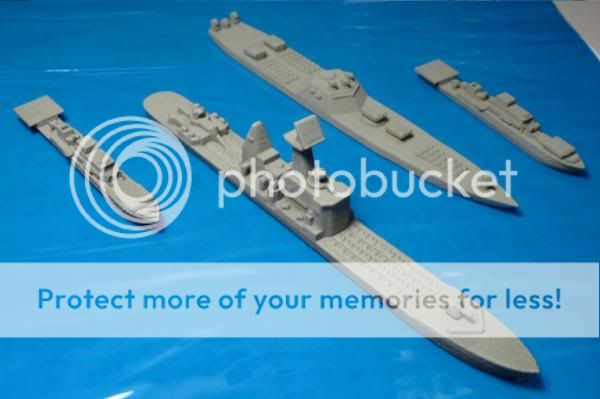

enlarged:
http://i871.photobucket.com/albums/ab27 ... 000403.jpg
I've just posted a set of fourteen new models, including oil rigs, sea forts, destroyers, landing craft, frigates, submarines, and a prototype "arsenal ship", all in 1:2000 scale. The ships are based on a variety of modern craft, such as the German Elbe Class, Chinese Type 52 Destroyer, Soviet Tarantul class, and US Wasp-class. It also includes notional designs which never made it past the drawing board, such as the Soviet Project 1165.
http://www.shapeways.com/shops/objects? ... %5D=thumbs
Some more photos at:
http://s871.photobucket.com/albums/ab27 ... l%20Ships/[quote="DrPR"]robsam,
How smooth is the surface on the prototypes you are getting?
[/quote]
I've been using Shapeways. With their default White, Strong, and Flexible material the surface is a bit rough. With the 'White Detail' Material, it is smooth, but you still will see some 'jaggies' - they are less than 200 microns in size, but still visible. A bit of paint often smooths over some of the roughness.
Here are some 1:2000 ships I've done recently. You can see some of the roughness in the photos below and the enlargement.
[img]http://i871.photobucket.com/albums/ab273/afrodri/Naval%20Ships/xxP1000404.jpg[/img]
[img]http://i871.photobucket.com/albums/ab273/afrodri/Naval%20Ships/xxP1000405.jpg[/img]
enlarged: [url]http://i871.photobucket.com/albums/ab273/afrodri/Naval%20Ships/P1000403.jpg[/url]
I've just posted a set of fourteen new models, including oil rigs, sea forts, destroyers, landing craft, frigates, submarines, and a prototype "arsenal ship", all in 1:2000 scale. The ships are based on a variety of modern craft, such as the German Elbe Class, Chinese Type 52 Destroyer, Soviet Tarantul class, and US Wasp-class. It also includes notional designs which never made it past the drawing board, such as the Soviet Project 1165. [url]http://www.shapeways.com/shops/objects?sg24221%5BviewMode%5D=thumbs[/url]
Some more photos at:
[url]http://s871.photobucket.com/albums/ab273/afrodri/Naval%20Ships/[/url]