by sandy » Wed Jan 04, 2012 3:49 pm
The photo is on the web, and it is also in the Friedman book on an excellent two page spread. It is amazing how much better the quality of the photo is and shows up quite a fair bit of detail.
The downside is that there are so few photos of the Curacoa, as with all the converted 'C' class ships. The photo I mentoned above was taken after its last refit and, in comaprison with the one taken in 1940/41 shows qite a few differences. In fact, there seem to be quite a lot of differences (apart from the trawler bow) with her half sister HMS Carlisle. The bridge is totally different having a peaked front, the splinter shields around 'A' and 'Y' guns are different, the blast shield protecting 'A' gun from the overhead firing quadruple pom-pom is different, as is the corresponding one aft which was removed to allow depression for the two single pom=poms, and yet a huge vertical blast shield was erected between 'X' gun and the single pom-poms to protect their crews, meaning 'X' gun could not fire at low angle across a proportion of the stern.
I have spent quite a long time comparing photos and Curacoa does seem unique.
In the book, co-written by one of the two surviving officers it categorically states that when she arrived to escort the Queen Mary Curacoa was painted Mountbatten Pink. One account by a US serviceman onboard QM also states that the cruiser was brightly camouflaged or coloured or words to that effect. Close scrutiny of the photo shows the quite distinctive lighter coloured sweep under the flare of the bow, but also that, while there is a similar coloured (shaded in black and white) horizontal swathe along the fore part of the deck housing abaft 'A' gun, the angled part of the blast shield is much lighter, maybe white. Also, the swathe along the after deckhouse under 'Q' mount is also white and there appears to be medium shaded horizontal shades along the upper bridge and upper part of the aft deckhouse. All in all quite an unusual scheme.
It will be quite interesing making a 1/72 scale model of a ship that many folk have 'heard' of from one photograph. Fingers crossed.
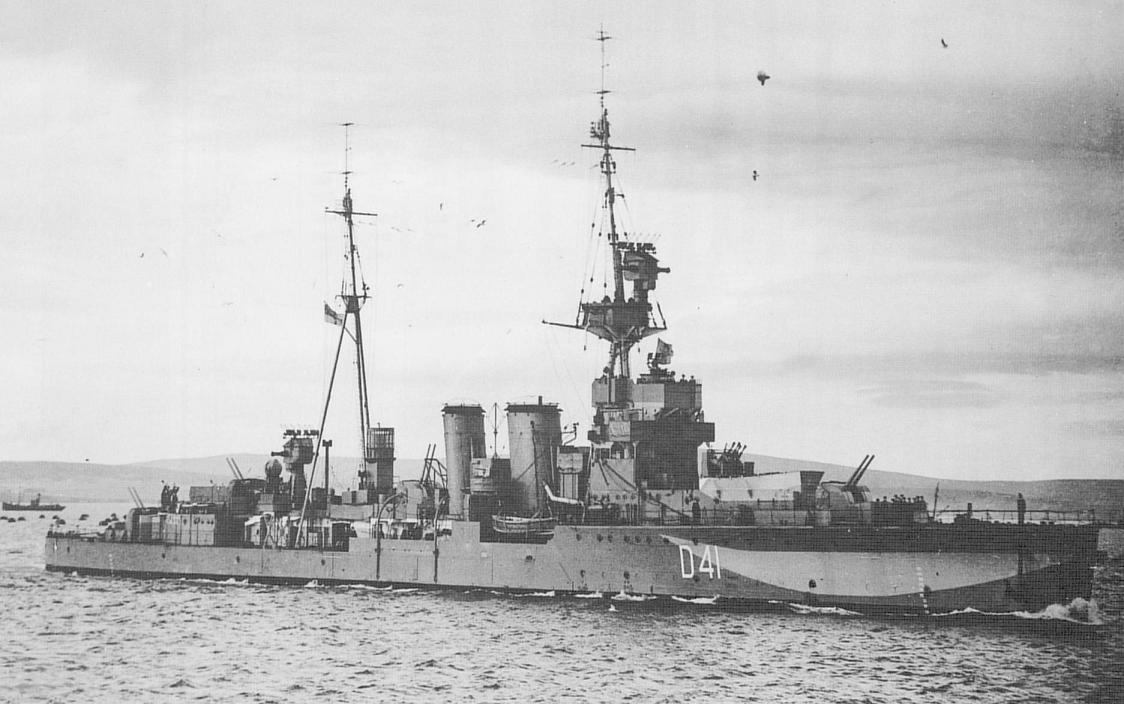
The other unique feature to Curacoa is the very tall tripod main mast with no cross braces. None of her sisters had anything quite so tall, or unbraced.
If the book is correct, and there is no reason to hugely doubt it, some of the 'stories' of eyewitnesses on the web are wildly inaccurate. One claims that the cruiser was zig-zagging wildly when in actual fact the Curacoa, once she fell in with the Queen Mary, steamed a dead constant course while it was the Queen Mary that was zig-zagging. The simple reason was that the Queen Mary was faster than the Curacoa and the only way the cruiser could keep station with the liner long enough to provide protection was for her to go just about flat out (25 or so knots) while the liner overhauled her. The captain of the cruiser had ordered the escorting destryoers to turn off and head back towards Ireland before meeting the liner so that as the liner passed out of the protection of the cruiser she would enter the AA protection of the Hunt class destroyers ahead. The collision seems to have resulted from the two captains interpreting the rules of the sea differently. The cruiser captain, the only other officer to survive, was relying on the rule that overtaking vessel at sea should always keep clear of the vessel being overtaken. the captain of the liner was working to the de facto convoy rule (and in this case despite being a single ship the Queen Mary was regarded as a convoy) that the convoy always took precedence and the escort should keep out of the way. The snag to this argument was that while it was common for escorts be able to outmanouvre ships in convoy, in this case the convoy was actually far faster than the escort travelling as she was a 28 knots as opposed to Curacoa's 25.
It is also worth pointing out, if you are interested, that almost everything on the internet regarding the collision refers to the cruiser as the Curacao, whereas, in actual fact, she was called the Curacoa.
Apologies for the waffle.
The photo is on the web, and it is also in the Friedman book on an excellent two page spread. It is amazing how much better the quality of the photo is and shows up quite a fair bit of detail.
The downside is that there are so few photos of the Curacoa, as with all the converted 'C' class ships. The photo I mentoned above was taken after its last refit and, in comaprison with the one taken in 1940/41 shows qite a few differences. In fact, there seem to be quite a lot of differences (apart from the trawler bow) with her half sister HMS Carlisle. The bridge is totally different having a peaked front, the splinter shields around 'A' and 'Y' guns are different, the blast shield protecting 'A' gun from the overhead firing quadruple pom-pom is different, as is the corresponding one aft which was removed to allow depression for the two single pom=poms, and yet a huge vertical blast shield was erected between 'X' gun and the single pom-poms to protect their crews, meaning 'X' gun could not fire at low angle across a proportion of the stern.
I have spent quite a long time comparing photos and Curacoa does seem unique.
In the book, co-written by one of the two surviving officers it categorically states that when she arrived to escort the Queen Mary Curacoa was painted Mountbatten Pink. One account by a US serviceman onboard QM also states that the cruiser was brightly camouflaged or coloured or words to that effect. Close scrutiny of the photo shows the quite distinctive lighter coloured sweep under the flare of the bow, but also that, while there is a similar coloured (shaded in black and white) horizontal swathe along the fore part of the deck housing abaft 'A' gun, the angled part of the blast shield is much lighter, maybe white. Also, the swathe along the after deckhouse under 'Q' mount is also white and there appears to be medium shaded horizontal shades along the upper bridge and upper part of the aft deckhouse. All in all quite an unusual scheme.
It will be quite interesing making a 1/72 scale model of a ship that many folk have 'heard' of from one photograph. Fingers crossed.
[img]http://www.naval-history.net/Photo06clCuracoaSP.JPG[/img]
The other unique feature to Curacoa is the very tall tripod main mast with no cross braces. None of her sisters had anything quite so tall, or unbraced.
If the book is correct, and there is no reason to hugely doubt it, some of the 'stories' of eyewitnesses on the web are wildly inaccurate. One claims that the cruiser was zig-zagging wildly when in actual fact the Curacoa, once she fell in with the Queen Mary, steamed a dead constant course while it was the Queen Mary that was zig-zagging. The simple reason was that the Queen Mary was faster than the Curacoa and the only way the cruiser could keep station with the liner long enough to provide protection was for her to go just about flat out (25 or so knots) while the liner overhauled her. The captain of the cruiser had ordered the escorting destryoers to turn off and head back towards Ireland before meeting the liner so that as the liner passed out of the protection of the cruiser she would enter the AA protection of the Hunt class destroyers ahead. The collision seems to have resulted from the two captains interpreting the rules of the sea differently. The cruiser captain, the only other officer to survive, was relying on the rule that overtaking vessel at sea should always keep clear of the vessel being overtaken. the captain of the liner was working to the de facto convoy rule (and in this case despite being a single ship the Queen Mary was regarded as a convoy) that the convoy always took precedence and the escort should keep out of the way. The snag to this argument was that while it was common for escorts be able to outmanouvre ships in convoy, in this case the convoy was actually far faster than the escort travelling as she was a 28 knots as opposed to Curacoa's 25.
It is also worth pointing out, if you are interested, that almost everything on the internet regarding the collision refers to the cruiser as the Curacao, whereas, in actual fact, she was called the Curacoa.
Apologies for the waffle.