same basic principles still apply
.........................................
Hello Gentlemen!
PART TWO--- ( the painting of the Sea )
can be found here at this direct link
viewtopic.php?f=4&t=37406
I get numerous e-mails each week inquiring how I make water using the water-colour paper method.
As a result I thought it worthwhile to photo-document the procedure on my current build of HMS Scylla.
That way I can then also simply send a link to this thread!

But first a bit of theory--very important!
https://web.archive.org/web/20200105102 ... tterns.htm
HMS Scylla is being built in 1/700 scale using the WSW kit as a starting point.
For most 1/700 models I use textured watercolour paper- Bockingford Rough 140 lbs
in a block measuring 14" x 22"- available
https://www.artsupplies.co.uk/p/bocking ... aper/BR140
for modelling water in 1/700 scale for sheltered coastal areas-- Solent, harbours etc ,
I use the less textured variety
Bockingford® Watercolour Paper - CP(NOT)
https://www.artsupplies.co.uk/c/cold-pr ... lour-paper
Any textured watercolour paper from any reputable manufacturer will work.
It is especially effective at depicting a calm sea with only a gentle ripple caused by a light winds, an example of which can be seen in the overhead views of my 1/700 Kolchida
But first a bit of preparation....
To prevent warpage in the resin hull years down the line, I mount all my models on a stainless steel plate, in which are are
drilled an array of countersunk holes for later screwing down.
At the beginning of the build I drill a selection of holes drilled (3mm drill bit) into the underside of the hull that correspond with the pe-drilled holes in the mounting plate.
These then have a thread cut using a No 6 pozi drive countersunk selftapping screw.
I placed the hull of the model on a well oversize piece of watercolour paper -prior to commencing construction-and drew a pencil line around at waterline
The paper was thereafter pushed down so as to make contact with the double-sided tape.
======================================================================================================
........and altreantive to the double sided tape is to gradually glue the paper with runny cyaoncrylie glue.==> Pink Paces ZaP
Spraying it with accelerator to persuade a quick set--wear a mask as cumulative CA glue fumes are not ideal!
=======================================================================================================
and the paper pushed down in between the cocktail sticks to form the desired swell
Because the ship is at speed the displacement waveform created would reveal parts of her red 'underbelly'..!
To achieve this I placed some styrene strips in position to raise the hull slightly within the paper cutout, these also formed the lower hull where it would be revealed-hence their positions midships had to be accurate.
Had the decision to show the vessel in a swell been taken at the commencement of the build, I would have simply added a hull footprint sized waterline shim underneath!!!!
A testfit of the model showed all to well with levels and size.
The entire water-seascape was the soaked in Cyanocrylite glue( superglue) to make it strong, structurally stable and totally impervious to moisture.
==============================================================================================================================
This sets firm within about 5 minutes so that the coarse trimming of any surplus can take place with ease-again using the stainless mounting plate as the knife guide.
Within 10 minutes the reaction is complete and final trimming and a light sand can take place.
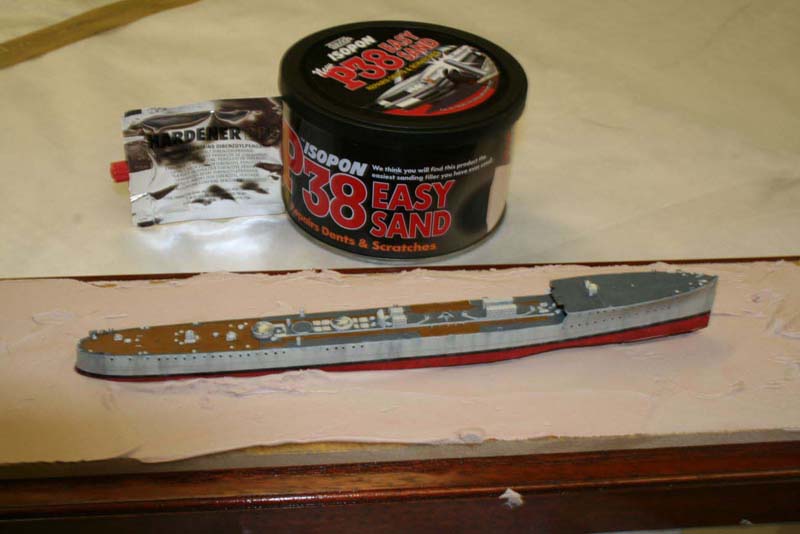
there are a number of Body-filler makes available, in the UK I use Isopon P 38 or Plastic Padding. In the USA understand a popular make to be 'Bondo'
The technique that seems works best is to make a number of small' bridges' with a small dollop of white glue; once these are partially set, infill the spaces between using thinned white glue allowing the 'glue bridges' to make the frame required for the surface tension to span any gaps.
The bow wave and wake patterns are then added using Acrylic texture paste, I prefer the Daler-Rowney variant-it is easy to use, fast-drying and dries matt, so unlike glossy variants of acrylic gels it can maintain very fine curls and undercut bow-waves, as well as having a 'sharper' appearance when used for the crests of breaking water on the wake.
The water is now essentially complete. I shall now finish the model to the flat-coated-but-not-rigged stage
Colouring the water and finishing the wakes will be the subject of PART TWO
right here: viewtopic.php?f=4&t=37406
Jim Baumann