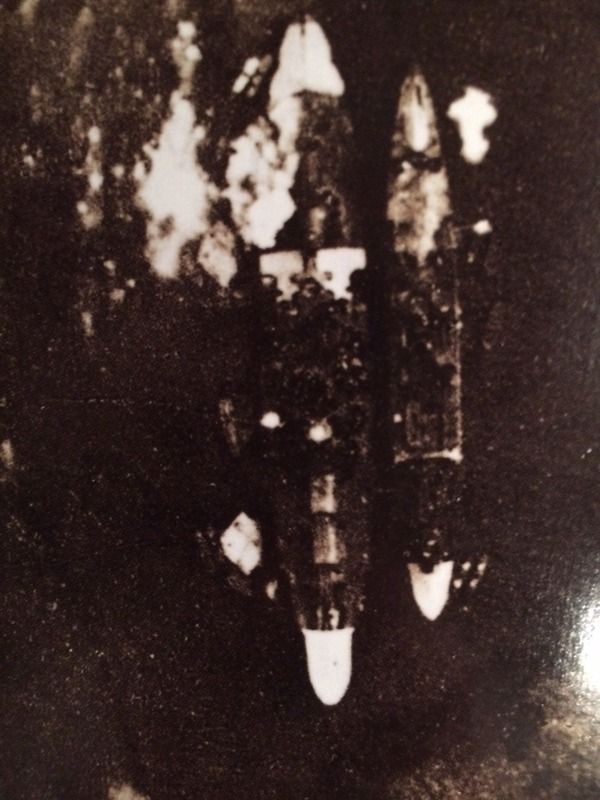
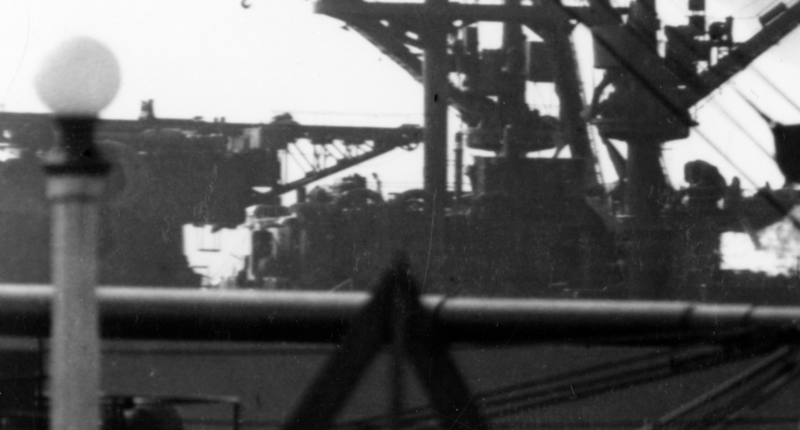
Cropped view of 80-G-411193 dated 13 October 1941. This was one of series of photos showing various ships in anchorage around Ford Island and the Navy yard complex.

Moderators: BB62vet, MartinJQuinn, Timmy C, Gernot, Olaf Held, Dan K, HMAS, ModelMonkey

This difference is also why many of the photographs we see of ships in Ms. 11/21, or Ms. 12/22 look so "Light" compared to the likely actual Shade for the Hue of Blue in question.Rick E Davis wrote:Jeff,
There were two types of B&W film in use during WWII. Their spectral response to light are different.
Orthochromatic; Orthochromatic photography refers to a photographic emulsion that is sensitive to only blue and green light, and thus can be processed with a red safelight. The increased blue sensitivity causes blue objects to appear lighter, and red ones darker. Orthochromatic film proved troublesome for motion pictures, rendering pink skies as perpetually overcast, blond hair as washed-out, blue eyes nearly white, and red lips nearly black.
Panchromatic; Panchromatic photography has a photographic emulsion that is sensitive to a broader spectral response range (of colors) and is generally "truer" to what the human eye sees.
Panchromatic film was quite a bit more expensive and harder to process, enhance Orthochromatic film continued in use for a long time.
So it is likely that the overhead film was Panchromatic and the onboard image you posted used Orthochromatic film. The RED on Turret Two looks closer to the GREY on Turret One in the onboard view and as completely different colors in the overhead view.
This is one of the reasons I really don't try to determine "colors" from grayscale images without knowing what kind of film was used.
This shot of 'Zona prior to the explosion would suggest that both forward tops were painted the same but I would love to see a hi-rez copy of this photo to get a better look.Rick E Davis wrote:Thanks, I didn't even think about USS PENNSYLVANIA. I scanned another photo at Pearl Harbor dated 13 October 1941 and it was clear that USS ARIZONA and USS NEVADA were tied up in the same locations that they were on 7 December 1941. Since the USN was cycling different BatDiv in and out of Pearl for training, etc., in thinking about it there likely wasn't a permanent assignment of mooring locations.
Cropped view of 80-G-411193 dated 13 October 1941. This was one of series of photos showing various ships in anchorage around Ford Island and the Navy yard complex.
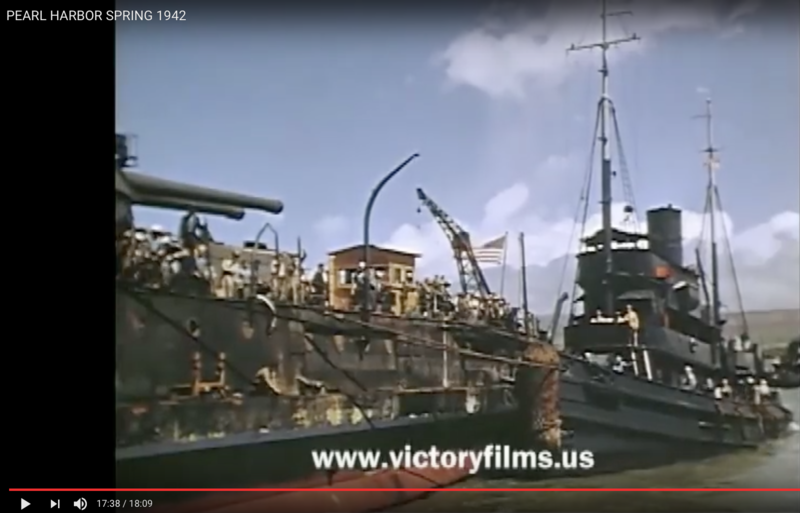
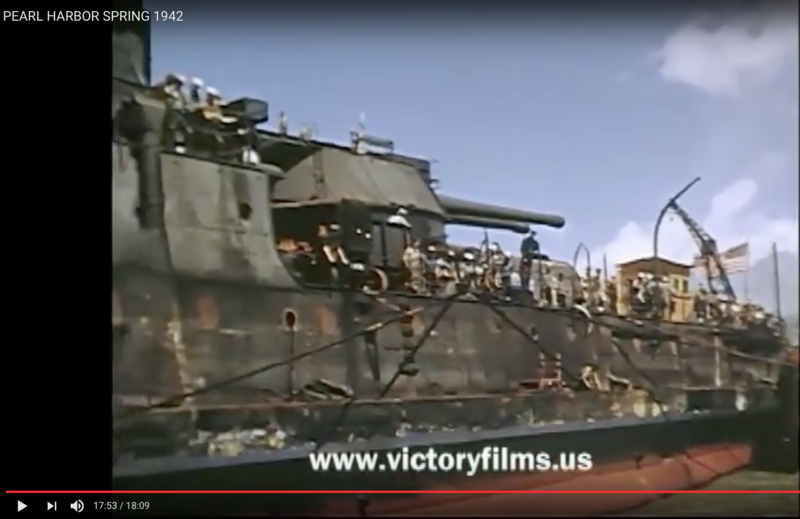
Sean,SeanF wrote:So, do we suppose the (likely blown clear) rafts had been painted red, or 5-D so as not to stand out when the ship was seen in profile? (And if 5-D, and if only the #2 turret top were painted, they'd be obscuring over a third of the color meant for aerial recognition. Seeing how Maryland appears to have had both aft turrets blue at one point, and seeing the variations in where the 5-D/5-L boundaries are on the various ships, I suspect the individual captains exercised some influence over their ships' schemes. Drastic variations in placement of those rafts as well. I wonder... I've seen some models of Nevada carrying rafts on the #4 turret... perhaps her captain personally opposed to the whole color coding thing, especially as it conflicted in principle with the navy's decision to paint his ship's deck?)
- Sean F.
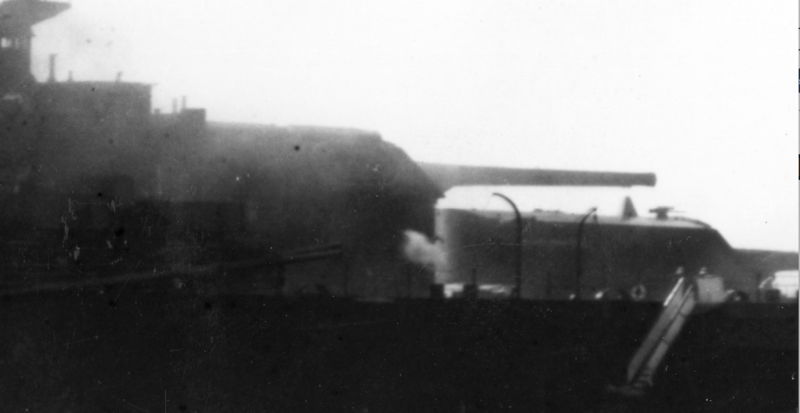



Yes, 1 & 4 are larger.SigfanUSAF wrote:Quick question-
Are the barbetts of turrets 1 & 4 larger diameter or did they use the same basic barbett for turrets 2 & 3?
I need to know for my 1945 Oklahoma (bombarding Okinawa). I�m wondering if it would have been feasible to put Arizona�s #3 & 4 in place.....
Hobby Boss 1/350. I�m actually doing the OK and the NV in �45.DavidP wrote:SigfanUSAF, barbetts 2 & 3 are 30' 2" OD compared to barbetts 1 & 4 that are 32' 2" OD. turrets 2 & 3 are narrower & shorter in length compared to turrets 1 & 4. what scale is your Oklahoma as I'm kitbashing Revell's 1/429 scale Arizona into the 1941 version Oklahoma & 1945 Nevada?