I believe many have anchored a cast resin hull to avoid the possibility of a "memory" return to the original warped shape. I have corrected a wl hull using a very hot water soaking method and will share the technique I used but am reluctant to begin kit construction until I am sure of the apparent success of my method.
So here are my questions:
1, Who has experienced a return to the original warped shape once the hull has cooled (assuming heat was used)? What method was used to attempt to initially correct the warping and was another method used to finally correct the warping?
2. Who has had a success in correcting the problem using any technique and not experienced a memory return to the original warped condition over time and further has not anchored the hull to hold the corrected hull flat?
3. Who has not been able to correct the problem at all using any technique and what was the technique used and the probable reason it did not work?
I am sure there are answers out there but if you are reluctant to share yours on an open post please send me a PM and I will keep your response confidential.
Thanks
Steve
Resin "Memory" of a Warped Hull (Correcting warped hulls)
Moderator: JIM BAUMANN
-
Steve

- Posts: 782
- Joined: Wed Jun 27, 2007 11:59 am
Resin "Memory" of a Warped Hull (Correcting warped hulls)
Last edited by Timmy C on Sat Jul 27, 2019 2:53 pm, edited 1 time in total.
Reason: Thread moved to FAQ
Reason: Thread moved to FAQ
-
drasticplastic
- Posts: 1439
- Joined: Sun Aug 20, 2017 9:46 am
- Location: Montreal, Canada
Re: Resin "Memory" of a Warped Hull
The few time I've had to correct resin parts worked out well for me. Dip the part into boiling water for about 10 sec (not with your fingers, though!), or until you can straighten the part. Thinly cast parts will require less time than large solid pieces. When straightened, plunge or soak immediately into cold water and leave there for a few minutes until the resin has completely cooled and set. Resin doesn't have the memory that styrene has and so will keep it's new shape. I haven't had to straighten ships' hulls, but I think you would have to fasten it to a piece of flat metal to ensure a flat straight shape.

-
maxim
- Posts: 4006
- Joined: Tue Jun 14, 2005 6:23 am
- Location: Bonn
Re: Resin "Memory" of a Warped Hull
I had experienced that recently several times with resin hulls.
As far as I understand it, resin cannot be reshaped by heat (because of the crosslinking of the polymers), i.e. it is a thermoset polymer.
If a hull is warped, there are two options:
it was warped during removal of the hull from the mould, i.e. the resin was completely cured only after leaving the mould. In this case it should be impossible to correct the hull and the producer should offer a replacement hull. The wrong form is "memorised".
it was warped e.g. by severe temperature stress during transport. In this case it is possible to cure it by heat. The correct form is "memorised".
As far as I understand it, resin cannot be reshaped by heat (because of the crosslinking of the polymers), i.e. it is a thermoset polymer.
If a hull is warped, there are two options:
it was warped during removal of the hull from the mould, i.e. the resin was completely cured only after leaving the mould. In this case it should be impossible to correct the hull and the producer should offer a replacement hull. The wrong form is "memorised".
it was warped e.g. by severe temperature stress during transport. In this case it is possible to cure it by heat. The correct form is "memorised".

-
Steve
- Posts: 782
- Joined: Wed Jun 27, 2007 11:59 am
Re: Resin "Memory" of a Warped Hull
Maximmaxim wrote:I had experienced that recently several times with resin hulls.
As far as I understand it, resin cannot be reshaped by heat (because of the crosslinking of the polymers), i.e. it is a thermoset polymer.
If a hull is warped, there are two options:
it was warped during removal of the hull from the mould, i.e. the resin was completely cured only after leaving the mould. In this case it should be impossible to correct the hull and the producer should offer a replacement hull. The wrong form is "memorised".
it was warped e.g. by severe temperature stress during transport. In this case it is possible to cure it by heat. The correct form is "memorised".
Were you able to correct the hulls using heat and if so what technique did you use?
Steve
-
maxim
- Posts: 4006
- Joined: Tue Jun 14, 2005 6:23 am
- Location: Bonn
Re: Resin "Memory" of a Warped Hull
I was able to correct some hulls using heat, but not others - see the for me most likely explanation why above.
I put them into boiling water, then fix them to a flat surface and let them cool down slowly.
Fast cooling in a freezer appears to be dangerous, because it causes massive stress to the material.
I put them into boiling water, then fix them to a flat surface and let them cool down slowly.
Fast cooling in a freezer appears to be dangerous, because it causes massive stress to the material.
-
Maarten Sch�nfeld

- Posts: 1843
- Joined: Fri Dec 12, 2008 12:44 pm
- Location: Herk-de-Stad, Belgium
Re: Resin "Memory" of a Warped Hull
I'm afraid it is not that simple: "resin" may refer to rather various plastics, for instance polyurethane (PUR). The buff colored resin in many kits seems to be PUR in most cases. As this PUR is thermoplastic and not thermosetting, it may be formed vary well with heat. While others like grey resin may not.As far as I understand it, resin cannot be reshaped by heat (because of the crosslinking of the polymers), i.e. it is a thermoset polymer.
So there is no final answer that works for all resin kits, depending on the material in case.
"I've heard there's a wicked war a-blazing, and the taste of war I know so very well
Even now I see the foreign flag a-raising, their guns on fire as we sail into hell"
Roger Whittaker +9/13/2023
Even now I see the foreign flag a-raising, their guns on fire as we sail into hell"
Roger Whittaker +9/13/2023
-
maxim
- Posts: 4006
- Joined: Tue Jun 14, 2005 6:23 am
- Location: Bonn
Re: Resin "Memory" of a Warped Hull
Polyurethane is used for similar casting methods, true, they are often called resin kits.
My comment refers to kits, which I think are made from thermosetting resins.
I cannot remember to have had a warped polyurethane hull.
My comment refers to kits, which I think are made from thermosetting resins.
I cannot remember to have had a warped polyurethane hull.
-
maxim
- Posts: 4006
- Joined: Tue Jun 14, 2005 6:23 am
- Location: Bonn
Re: Resin "Memory" of a Warped Hull
My last attempts to correct some hulls:
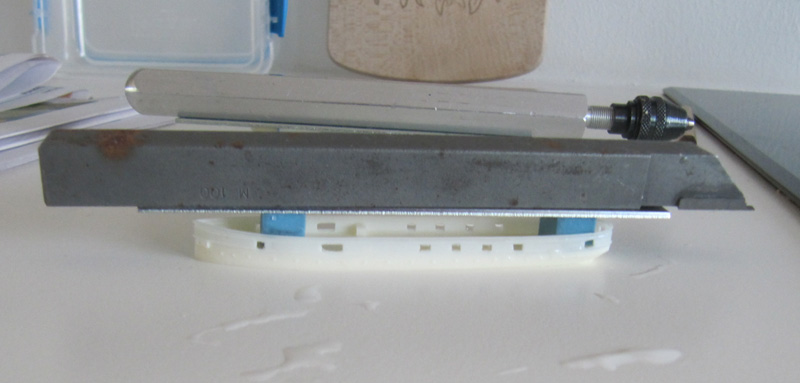
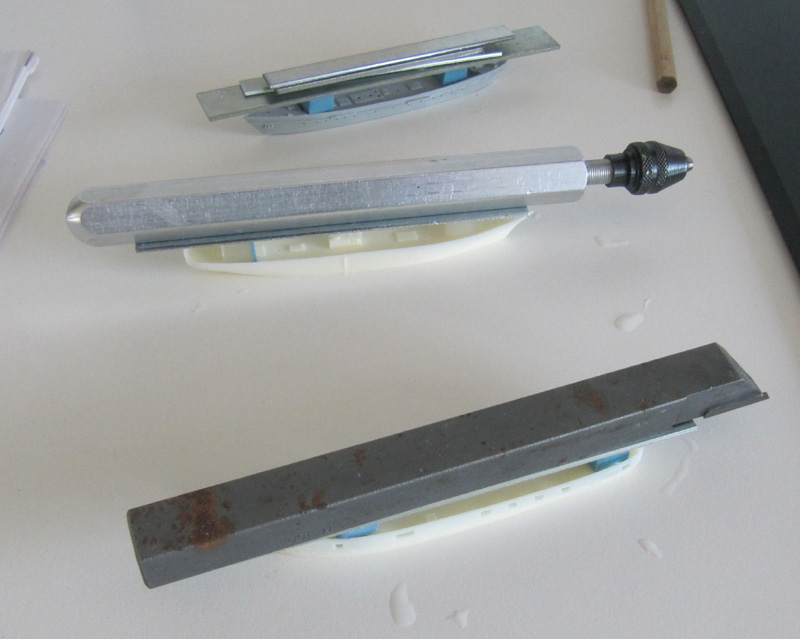
Yangwu, Fupo,and Volta, the first two Oceanmoon kits, the last one Doggy Industries. All from the 1884 Sino-French War.
Yangwu, Fupo,and Volta, the first two Oceanmoon kits, the last one Doggy Industries. All from the 1884 Sino-French War.
-
Admhawk

- Posts: 959
- Joined: Sat Feb 03, 2007 1:00 pm
- Location: Bowmanville, ON, Canada
Re: Resin "Memory" of a Warped Hull
In regards to most resins used by cottage industry manufacturers,
First, cured resin doesn't melt, it will get soft, but it will catch on fire before it melts at approx 220f
Second, resin warps due to uneven cooling. This can be caused by a number of factors like being pulled from a mold too soon or a breeze from a fan.
Third, you don't need water to transfer heat. It doesn't hurt, but it doesn't help much either.
Fourth, putting a large thick warm piece in a freezer is risking uneven cooling. It's not necessary.
Fifth, resin does not retain a 'memory'.
Sixth, different colours are simply dyes added to the resin. Color doesn't change how the resin reacts.
So, keep it simple.
Secure your piece to a flat wood board. Use screws in the bottom, or clamps on flat areas. Or weights. Avoid details and edges. Use only enough pressure to flatten the item. If you feel it takes too much pressure, do it in stages. Flatten a little, then do it again flattening a little more.
Do not flatten your piece after its heated. Clamps and weights will be cold and could cause uneven cooling.
Place in cold oven.
Place on rack or sheet, it doesn't matter.
Turn oven on to 130-160f it doesn't matter if it's gas or electric. The temp matters.
Leave in for 30-40min after it is at temperature.
Remove and place somewhere it won't be touched or be in a breeze. I usually just leave on the stove.
Walk away.
Next morning, remove from board.
If happy with results, resume building.
If not, do it again.
It will not warp again unless exposed to high temps and uneven cooling.
If you have super glued any parts, the glue will most likely be crumbly and have to be scraped off. SG.doesnt like heat. The part will most likely come of with a little pressure. I work a knife blade into the joint and give a little twist.
That's it.
Good luck!
First, cured resin doesn't melt, it will get soft, but it will catch on fire before it melts at approx 220f
Second, resin warps due to uneven cooling. This can be caused by a number of factors like being pulled from a mold too soon or a breeze from a fan.
Third, you don't need water to transfer heat. It doesn't hurt, but it doesn't help much either.
Fourth, putting a large thick warm piece in a freezer is risking uneven cooling. It's not necessary.
Fifth, resin does not retain a 'memory'.
Sixth, different colours are simply dyes added to the resin. Color doesn't change how the resin reacts.
So, keep it simple.
Secure your piece to a flat wood board. Use screws in the bottom, or clamps on flat areas. Or weights. Avoid details and edges. Use only enough pressure to flatten the item. If you feel it takes too much pressure, do it in stages. Flatten a little, then do it again flattening a little more.
Do not flatten your piece after its heated. Clamps and weights will be cold and could cause uneven cooling.
Place in cold oven.
Place on rack or sheet, it doesn't matter.
Turn oven on to 130-160f it doesn't matter if it's gas or electric. The temp matters.
Leave in for 30-40min after it is at temperature.
Remove and place somewhere it won't be touched or be in a breeze. I usually just leave on the stove.
Walk away.
Next morning, remove from board.
If happy with results, resume building.
If not, do it again.
It will not warp again unless exposed to high temps and uneven cooling.
If you have super glued any parts, the glue will most likely be crumbly and have to be scraped off. SG.doesnt like heat. The part will most likely come of with a little pressure. I work a knife blade into the joint and give a little twist.
That's it.
Good luck!
Last edited by Admhawk on Mon Jul 29, 2019 7:35 pm, edited 1 time in total.
Darren (Admiral Hawk)
In the not so tropical climate of the Great White North.
In the not so tropical climate of the Great White North.
-
Tim Jacobs

- Posts: 413
- Joined: Mon Jan 10, 2005 11:40 pm
- Location: Peyton, Colorado
Re: Resin "Memory" of a Warped Hull
Admhawk's answer should be saved in the Tips section
On the workbench:
I Love Kit 1/72 OSA-I
Recently completed:
Das Werk 1/16 Panzer III Ausf. J (early)
Trumpeter 1/35 SA-8 Gecko
Trumpeter 1/350 Moskva (Slava-class)
I Love Kit 1/72 OSA-I
Recently completed:
Das Werk 1/16 Panzer III Ausf. J (early)
Trumpeter 1/35 SA-8 Gecko
Trumpeter 1/350 Moskva (Slava-class)
-
maxim
- Posts: 4006
- Joined: Tue Jun 14, 2005 6:23 am
- Location: Bonn
Re: Resin "Memory" of a Warped Hull (Correcting warped hulls
@ Admhawk: thank you very much for your detailed explanation!
I would have two questions:
a) how do you clean the oven afterwards? Resin and food are not really compatible and some resins smell quite strongly even after a long time.
b) You wrote that resin has no "memory". A thermoplastic as polystyrene has clearly no "memory", it can be reformed by heat to any form, because there is no cross-linking between the polymers.
In contrast, in resins the individual polymers are cross-linked. They cannot be reformed into any form. I experienced very often that bended small parts (e.g. missiles, cranes, parts of masts) themselves went back into the correct form after a short time in hot water. I think that is referred to as the "memory" of the correct form.
I would have two questions:
a) how do you clean the oven afterwards? Resin and food are not really compatible and some resins smell quite strongly even after a long time.
b) You wrote that resin has no "memory". A thermoplastic as polystyrene has clearly no "memory", it can be reformed by heat to any form, because there is no cross-linking between the polymers.
In contrast, in resins the individual polymers are cross-linked. They cannot be reformed into any form. I experienced very often that bended small parts (e.g. missiles, cranes, parts of masts) themselves went back into the correct form after a short time in hot water. I think that is referred to as the "memory" of the correct form.
-
Admhawk
- Posts: 959
- Joined: Sat Feb 03, 2007 1:00 pm
- Location: Bowmanville, ON, Canada
Re: Resin "Memory" of a Warped Hull (Correcting warped hulls
Hi Maxim, Sorry for the delay in answering, my computer decided it didn't want to listen to me anymore. I finally convinced it otherwise.
To answer your first question, I have run across some foul smelling resins. Fortunately, none required oven treatment. Anything I've put in the oven hasn't caused much odor. If it did, I'd probably run a clean cycle to burn it out. Any oven cleaner I've smelled is much worse than most resins.
As far as memory goes, I'm not a chemist, but this is what I've learned. (Full Disclosure, Some of the fancier words/sentences have been plagiarized)
There may be many resins that exhibit Memory traits. However, I don�t believe many in our hobby do.
Crosslink density varies depending on the monomer or prepolymer mix, and the mechanism of crosslinking. The higher the crosslink density and aromatic (organic compound) content of a thermoset polymer, the higher the resistance to heat degradation and chemical attack. Mechanical strength and hardness also improve with crosslink density, although at the expense of brittleness. They normally decompose before melting.
The degree of crosslinking and resulting physical type (elastomer or plastic) is adjusted from the molecular weight and functionality of isocyanate resins, prepolymers, and the exact combinations of diols, triols and polyols selected, with the rate of reaction being strongly influenced by catalysts and inhibitors.
Thermosetting polymer mixtures based on thermosetting resin monomers and pre-polymers can be formulated and applied and processed in a variety of ways to create distinctive cured properties.
Conventional thermoset plastics or elastomers cannot be melted and re-shaped after they are cured. However, Some thermoset polyurethanes have transient properties, which allow moderate reforming. Some hard, plastic thermosets may undergo permanent or plastic deformation under load. Most Formulas used in our hobby undergo permanent deformation when heated and under load.
One thing to keep in mind, there are so many formulas out there that someone might use a different kind of resin than we are used to. One that may not deform under heat or might retain a strong memory.
So to sum it up, The better resins used are formulated in such a way to allow a bit of reforming. Heating and cooling need to be done slowly for best results. And finally, there are many variables that can interfere and cause issues, but some people are just luckier than others.
To answer your first question, I have run across some foul smelling resins. Fortunately, none required oven treatment. Anything I've put in the oven hasn't caused much odor. If it did, I'd probably run a clean cycle to burn it out. Any oven cleaner I've smelled is much worse than most resins.
As far as memory goes, I'm not a chemist, but this is what I've learned. (Full Disclosure, Some of the fancier words/sentences have been plagiarized)
There may be many resins that exhibit Memory traits. However, I don�t believe many in our hobby do.
Crosslink density varies depending on the monomer or prepolymer mix, and the mechanism of crosslinking. The higher the crosslink density and aromatic (organic compound) content of a thermoset polymer, the higher the resistance to heat degradation and chemical attack. Mechanical strength and hardness also improve with crosslink density, although at the expense of brittleness. They normally decompose before melting.
The degree of crosslinking and resulting physical type (elastomer or plastic) is adjusted from the molecular weight and functionality of isocyanate resins, prepolymers, and the exact combinations of diols, triols and polyols selected, with the rate of reaction being strongly influenced by catalysts and inhibitors.
Thermosetting polymer mixtures based on thermosetting resin monomers and pre-polymers can be formulated and applied and processed in a variety of ways to create distinctive cured properties.
Conventional thermoset plastics or elastomers cannot be melted and re-shaped after they are cured. However, Some thermoset polyurethanes have transient properties, which allow moderate reforming. Some hard, plastic thermosets may undergo permanent or plastic deformation under load. Most Formulas used in our hobby undergo permanent deformation when heated and under load.
One thing to keep in mind, there are so many formulas out there that someone might use a different kind of resin than we are used to. One that may not deform under heat or might retain a strong memory.
So to sum it up, The better resins used are formulated in such a way to allow a bit of reforming. Heating and cooling need to be done slowly for best results. And finally, there are many variables that can interfere and cause issues, but some people are just luckier than others.
Darren (Admiral Hawk)
In the not so tropical climate of the Great White North.
In the not so tropical climate of the Great White North.
-
rfwood1
- Posts: 19
- Joined: Thu Mar 29, 2012 9:19 am
Re: Resin "Memory" of a Warped Hull (Correcting warped hulls
The posts on this topic have all been helpful, because they have explained why resin hulls might warp, while recapping what to do in order to restore them to their proper shape. I have had 2 instances where warship hulls have warped and now I have a third case. In the past I'd tried the hot water method and both kits "bent back" to their original shape. One remained OK after heating/cooling; the other did not.
Sadly, this issue didn't occur until long after I had built the kits. I'm unsure what caused it, but my best guess is temperature fluctuations. The kit that couldn't be restored bent slowly (over many weeks) back to a point where the bow and stern were ~1/2" above a flat surface. I tried this same process multiple times, but the kit always worked itself back to this same point, so I had to strip it of parts and dump it.
Now I have a third kit to work on. (FYI, a 1/700 White Ensign HMS Sheffield.) If there are any new thoughts on this matter, I'd appreciate all input. Thanks in advance for your ideas.
Sadly, this issue didn't occur until long after I had built the kits. I'm unsure what caused it, but my best guess is temperature fluctuations. The kit that couldn't be restored bent slowly (over many weeks) back to a point where the bow and stern were ~1/2" above a flat surface. I tried this same process multiple times, but the kit always worked itself back to this same point, so I had to strip it of parts and dump it.
Now I have a third kit to work on. (FYI, a 1/700 White Ensign HMS Sheffield.) If there are any new thoughts on this matter, I'd appreciate all input. Thanks in advance for your ideas.
-
Timmy C
- Posts: 12468
- Joined: Mon Jan 10, 2005 6:00 pm
- Location: Ottawa, Canada
Re: Resin "Memory" of a Warped Hull (Correcting warped hulls
I have no thoughts on your issue, rfwood, but here's something I just did this past weekend: flattening the ISW 1/350 Halifax class frigate waterline hull. I followed Darren's instructions (though my oven's lowest temperature is 170F, so I had to use that), and put it in for two rounds for 30-35 minutes each. The first round was nearly sufficient, but there was still a bit of springing up when I loosened one clamp to check the following day, so I went for a second round. When using clamps, make sure to use ones with a foot that's flat rather than concave with a rim, as that will cause an indentation on the surface (see pics below)
Some photos:
Some photos:
- Attachments
-
- The now-flattened hull - excuse the jaggedy waterline resulting from my manual sawing of excess resin
-
- In the oven, clamped down to a piece of ceramic tile.
-
- Avoid clamps with the foot type of the one in red, as that'll apply much more pressure resulting in the circular imprint in the next photo despite using some aluminium foil padding
-
De quoi s'agit-il?
-
rfwood1
- Posts: 19
- Joined: Thu Mar 29, 2012 9:19 am
Re: Resin "Memory" of a Warped Hull (Correcting warped hulls
I have no thoughts on your issue, rfwood, but here's something I just did this past weekend: flattening the ISW 1/350 Halifax class frigate waterline hull. I followed Darren's instructions (though my oven's lowest temperature is 170F, so I had to use that), and put it in for two rounds for 30-35 minutes each. The first round was nearly sufficient, but there was still a bit of springing up when I loosened one clamp to check the following day, so I went for a second round. When using clamps, make sure to use ones with a foot that's flat rather than concave with a rim, as that will cause an indentation on the surface (see pics below)
Thanks for all the advice. I will need it, since my kit "rebounded" to the point where the bow and stern are both almost 1/4" above a level surface. My next try will involve the use of clamps after I follow the steps provided here.
-
rfwood1
- Posts: 19
- Joined: Thu Mar 29, 2012 9:19 am
Re: Resin "Memory" of a Warped Hull (Correcting warped hulls
To update all of you who have had issues with resin hull warping, I followed the advice of Admiral Hawk, clamping and keeping my ship in the oven for ~30 minutes at 170 degrees Fahrenheit and allowing it to cool down while clamped to the flat surface. After 24 hours I released the kit from the clamps and it immediately rebounded to where the bow and stern are both ~1/4" off level. I tried the same process again, but for 40 minutes at 170 degrees and got the same result. I'm to the point where I don't see this kit as being salvageable, but I thank you for your suggestions.
-
Admhawk
- Posts: 959
- Joined: Sat Feb 03, 2007 1:00 pm
- Location: Bowmanville, ON, Canada
Re: Resin "Memory" of a Warped Hull (Correcting warped hulls
It sounds like the resin used may have been the wrong type, defective or possibly old. The only other possible solution is to secure the hull to the base. Screws preferably, but crazy glue might work. Otherwise, I'm afraid you're out of luck. Thanks for publishing your results.
Darren (Admiral Hawk)
In the not so tropical climate of the Great White North.
In the not so tropical climate of the Great White North.
-
TheDuneSea
- Posts: 9
- Joined: Mon Mar 22, 2021 3:45 am
Re: Resin "Memory" of a Warped Hull (Correcting warped hulls
Thanks for posting your methods for curing resin!
However the thing that really freaks me out, is resin ships that all of a sudden bend after years.
Here are my two examples after which I am almost afraid to start any new projects:
1) WEMs Type 23 frigate in 1/700: When I received it, the hull was perfectly shaped. I built that particular ship about 15 years ago, detailed it with PE and lots of scratch parts, painted it and placed it in the showcase. Then I moved out of my parents house to go to university and left my models there. About seven or eight years later on a visit I had the feeling that bow and aft were slightly pointing downwards. Didn't think much about it, as I knew next to nothing about resin. At my next visit the ship had visibly deformed to a banana shape and not only were the rails ruined, but also the typical shape of the T23 gone.
I still don't know why. No direct sunlight, no sudden changes in temperature.
2) L'Arsenals La Fayette also in 1/700: The ship is still unbuilt (thank god) but again, the hull was correctly shaped when I received it in 2007 or 2008, now as I just restarted building ships, I checked my stash and suddenly the La Fayette looks like a stealth-banana.
Again I don't know what happened in the last 10-15 years that lead to a warped hull.
The resin carriers on the other side (OH-Ocean, OH-Juan Carlos, HP-Charles de Gaulle) seem to be okay.
Now I fear that all the ships I recently purchased (Dodo, BigBlueBoy, EV-Model, Ostrich Hobby etc.) might be ruined in a few years if I decide to build them now. Or shall I wait ten years, reshape the hull and only then start building?
However the thing that really freaks me out, is resin ships that all of a sudden bend after years.
Here are my two examples after which I am almost afraid to start any new projects:
1) WEMs Type 23 frigate in 1/700: When I received it, the hull was perfectly shaped. I built that particular ship about 15 years ago, detailed it with PE and lots of scratch parts, painted it and placed it in the showcase. Then I moved out of my parents house to go to university and left my models there. About seven or eight years later on a visit I had the feeling that bow and aft were slightly pointing downwards. Didn't think much about it, as I knew next to nothing about resin. At my next visit the ship had visibly deformed to a banana shape and not only were the rails ruined, but also the typical shape of the T23 gone.
I still don't know why. No direct sunlight, no sudden changes in temperature.
2) L'Arsenals La Fayette also in 1/700: The ship is still unbuilt (thank god) but again, the hull was correctly shaped when I received it in 2007 or 2008, now as I just restarted building ships, I checked my stash and suddenly the La Fayette looks like a stealth-banana.
Again I don't know what happened in the last 10-15 years that lead to a warped hull.
The resin carriers on the other side (OH-Ocean, OH-Juan Carlos, HP-Charles de Gaulle) seem to be okay.
Now I fear that all the ships I recently purchased (Dodo, BigBlueBoy, EV-Model, Ostrich Hobby etc.) might be ruined in a few years if I decide to build them now. Or shall I wait ten years, reshape the hull and only then start building?
-
maxim
- Posts: 4006
- Joined: Tue Jun 14, 2005 6:23 am
- Location: Bonn
Re: Resin "Memory" of a Warped Hull (Correcting warped hulls
It is not a problem, which affects all resin hulls. I have many, more than 100 built models, and only very few are affected.
In all these cases, the hull was already deformed before I started to built them - I tried to correct it, but in the longterm, I was not successful in all cases.
In all these cases, the hull was already deformed before I started to built them - I tried to correct it, but in the longterm, I was not successful in all cases.
-
rfwood1
- Posts: 19
- Joined: Thu Mar 29, 2012 9:19 am
Re: Resin "Memory" of a Warped Hull (Correcting warped hulls
I am concerned about the very same thing. My WEM 1/700 Sheffield type cruiser only began to warp after many years on my model shelf. My 1/700 Classic Warships HMS Lion did the same thing after even more years on display. Both were exposed to the exact same conditions as my other 56 warship kits, but these two warped out of shape and could not be restored. I don't know what to expect down the road, but I am concerned....
However the thing that really freaks me out, is resin ships that all of a sudden bend after years.
Here are my two examples after which I am almost afraid to start any new projects:
1) WEMs Type 23 frigate in 1/700: When I received it, the hull was perfectly shaped. I built that particular ship about 15 years ago, detailed it with PE and lots of scratch parts, painted it and placed it in the showcase. Then I moved out of my parents house to go to university and left my models there. About seven or eight years later on a visit I had the feeling that bow and aft were slightly pointing downwards. Didn't think much about it, as I knew next to nothing about resin. At my next visit the ship had visibly deformed to a banana shape and not only were the rails ruined, but also the typical shape of the T23 gone.
I still don't know why. No direct sunlight, no sudden changes in temperature.
2) L'Arsenals La Fayette also in 1/700: The ship is still unbuilt (thank god) but again, the hull was correctly shaped when I received it in 2007 or 2008, now as I just restarted building ships, I checked my stash and suddenly the La Fayette looks like a stealth-banana.
Again I don't know what happened in the last 10-15 years that lead to a warped hull.
The resin carriers on the other side (OH-Ocean, OH-Juan Carlos, HP-Charles de Gaulle) seem to be okay.
Now I fear that all the ships I recently purchased (Dodo, BigBlueBoy, EV-Model, Ostrich Hobby etc.) might be ruined in a few years if I decide to build them now. Or shall I wait ten years, reshape the hull and only then start building?
Last edited by Timmy C on Fri Apr 09, 2021 2:53 pm, edited 1 time in total.
Reason: fixed quote
Reason: fixed quote