Oh Mike. You're thinking grand thoughts aren't you. Remember the advantage and curse of the larger scale is the opportunity for greater detail.
Looking back on my journey I'd have to say that I wasted a huge amount of time and resources trying to save time and resources. I kept thinking that I could get by shaping the hull by eye, for example, or by bending the plastic hull - with various methods - into submission. After I got pretty deep into the reshaping of the resin hull, I kept thinking how much time I'd lose if I started over with another material. Truth is, I estimate I removed about 35% of the resin by weight in the process of getting down to size. There is NO short, easy, or clean way to do this. I tried every way I could think of. If you haven't joined the bottom of the hull (that below the waterline) you can bandsaw a lot of the resin off instead of grinding. The hard part is removing the undercut areas from the bow almost all the way back to midships. You can try burrs, Surform tools, rattail files, and so forth. I tried taping coarse sandpaper to a large PVC coupling (I think it was about 4" diameter) and that worked OK. Problem is, there is no radius that will fit all or even most of the undercut areas. I can still smell the resin if I think hard enough about it. Not fun. This is why I say I'd use the basswood 'lift' method.
When I finally gave in and realized that I just had to build a hull jig, then things started to move much more quickly in relative terms. If I were to do it again, and I may do so with ENTERPRISE at Midway, I would build the hull jig first. Here's a quick picture of the jig - I posted this picture before back about page 12 or so.
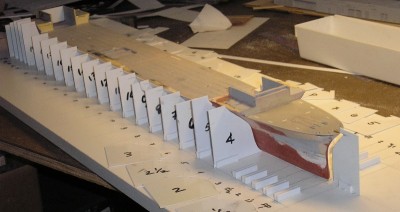
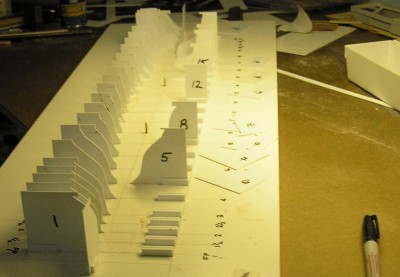
I would use layers of basswood in layer cake fashion. I would carve the hull using the same jig I built, then use other kit parts and plastic scrachbuilding to get the rest of the ship built. The jig ensures the hull is shaped true and fair. One the hull is 'fair and square', the rest of the ship will go along pretty well. I would also take the time and effort to reduce (or blow up) a set of plans to the scale you in which you are building. It is a real pain, even with proportional dividers, to keep going back and forth between the scales. You can lay your parts right down on the plans as you build them. I did this in shrinking the Webb plans to 1/350 and it really helped out a lot and saved time - I'm certain of that.
While you would obviously need to scratchbuild the hull in 1/144 unless there is a hull in fiberglas from the R/C folks, you could still use a variation of the method I describe. At the end of the day, I have come to terms with doing the unthinkable - scratchbuilding - to get what I want. After all, the shipbuilders mostly used large flat steel plates. Evergreen sheet styrene isn't much different . . . .
Hope that answers your question, Mike. Seems like you answer lots of other questions, let me know if I can answer any more.
Some people make you happy, then they leave.
Others make you happy when they leave. (apologies to Oscar Wilde if he ever said anything similar, of which there is some doubt . . .)




 . Space is the main issue.