I am trying to understand the concept of deck camber for my current project and others to come. Specifically, I'm interested in the rise of deck surfaces for passenger vessels in the steam era to today.
Some ships like the Titanic had little deck camber. Others were very pronounced, such as the Lusitania which had 18" of camber. A model of the Titanic in smaller scales may not have have any camber for ease of construction and the minimal visual impact it would have, on other vessels the builder may want to include some camber, even if it less than scale, to communicate the pronounced slope such ships had, particularly in the upper deck structures.
My question is did the same camber extend all the way from the bow to the stern, or was it mostly amidships? With a pronounced camber the overhanging stern would have to slope markedly across the beam or the rails/bulkheads would not be parallel to the deck. Since the fore and aft decks usually curved upwards, wouldn't the water flow toward the center, were it could drain off from there?
So, if the center section always had camber, would the forecastle and poop also be as curved, or flatter?
Thanks in advance.
Understanding deck camber re: scratchbuilding
Moderators: MartinJQuinn, JIM BAUMANN, HMAS, Tiny69, Dave Wooley
-
Harper57
- Posts: 41
- Joined: Sun Feb 12, 2012 11:10 pm
-
Harper57
- Posts: 41
- Joined: Sun Feb 12, 2012 11:10 pm
Re: Understanding deck camber re: scratchbuilding
Here is a pic of the ship I'm working on. Notice that the stern does not seem particularly sloped, though with the curve in the plan view it's difficult to determine for sure.
- Attachments
-
-
rtwpsom2

- Posts: 1438
- Joined: Tue Aug 19, 2008 10:15 pm
- Location: State of Denial
Re: Understanding deck camber re: scratchbuilding
In short, yes it extended from foc'sle to stern and in most cases the camber remained constant. But I don't mean that a ship with 18 inches of camber at the waist had 18 inches at the bow. What I mean is that the radius was constant. But you will never get the radius from any drawing, even in builders drawings. You will have to figure it out yourself. The easiest way is if you know the main deck's width at the waist. I usually use CAD to plot the points and use an arc to determine the radius across several stations near the waist. Then I average the number I get because they are never the same. The average will be pretty close to an even number of feet or meters (depending on the standard of the country that built it). Once you have that number you can then plot out the deck of the ship you are building, either through CAD or hand drafting.
-
Harper57
- Posts: 41
- Joined: Sun Feb 12, 2012 11:10 pm
Re: Understanding deck camber re: scratchbuilding
I do have a midship section. it is posted here. Reading your reply I realized that the drop in inches would be less for a narrower section. I guess I'll have to figure out some sections using the center radius, and go from there.
- Attachments
-
-
rtwpsom2
- Posts: 1438
- Joined: Tue Aug 19, 2008 10:15 pm
- Location: State of Denial
Re: Understanding deck camber re: scratchbuilding
Yep. Also, the camber radius tends to be the same for all decks, but it rarely applies to catwalks, they tend to be flat with grates or sloped outboard, but not really in accordance with the camber.
-
Laurent

- Posts: 481
- Joined: Wed Nov 08, 2006 9:13 am
- Location: Li�ge , Belgium
Re: Understanding deck camber re: scratchbuilding
Hi Harper,
I see you're building a Manchuria model. She is also on my wish list. May I ask you where you got the plans to build her?
as for deck camber, the curve, as rtwpsom2 told you, remains constant for the deck's whole length. The dimensions of this curve (height to beam ratio) depended on the classification society, depending also frome the ship's overall dimensions. There was a minimum height imposed to be sure that green water would wash away rapidly yet assuring some comfort to the people walking on the decks
Having a main frame cutaway, as you do, is the better option to determine the curve of your decks, here the picture of the main frame of a little cargo ship I built some years ago:

when you don't have any information about the deck camber, take your information from other sources.
Drawing the curve is done the following way:
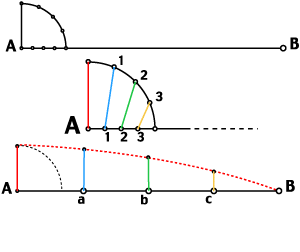
- draw a horizontal line from A to B, from the centreline of the ship to the hull's side, at the main frame
- draw a vertical line at the centerline, from numbers you already know from the original ship or other similar ships, or even from pictures of the superstructures of the ship you model
- draw a quart of a circle as on the picture above
- divide the quarter circle and the horizontal line within by four
- draw the intermediate lines as shown here above (red, blue, green, yellow)
- put those segments on your first horizontal line, line once again being divided by four
And there you are, the dotted red line shows you the perfect deck camber you then put on your framing plan
I see you're building a Manchuria model. She is also on my wish list. May I ask you where you got the plans to build her?
as for deck camber, the curve, as rtwpsom2 told you, remains constant for the deck's whole length. The dimensions of this curve (height to beam ratio) depended on the classification society, depending also frome the ship's overall dimensions. There was a minimum height imposed to be sure that green water would wash away rapidly yet assuring some comfort to the people walking on the decks
Having a main frame cutaway, as you do, is the better option to determine the curve of your decks, here the picture of the main frame of a little cargo ship I built some years ago:
when you don't have any information about the deck camber, take your information from other sources.
Drawing the curve is done the following way:
- draw a horizontal line from A to B, from the centreline of the ship to the hull's side, at the main frame
- draw a vertical line at the centerline, from numbers you already know from the original ship or other similar ships, or even from pictures of the superstructures of the ship you model
- draw a quart of a circle as on the picture above
- divide the quarter circle and the horizontal line within by four
- draw the intermediate lines as shown here above (red, blue, green, yellow)
- put those segments on your first horizontal line, line once again being divided by four
And there you are, the dotted red line shows you the perfect deck camber you then put on your framing plan
Scared of Nothing , Always Thirsty
Just call me the "Cereals Box Killer" , I guess
Just call me the "Cereals Box Killer" , I guess
-
Neptune

- Posts: 2466
- Joined: Sun Mar 13, 2005 11:51 am
- Location: Belgium
Re: Understanding deck camber re: scratchbuilding
This is not always the case though. Certainly on more recent ships, but perhaps also on older ones, the camber reduces and may even completely disappear towards the forward and aft.
So in short, towards the stern on the ship you're showing, it may be completely absent. The question is, where does it disappear? On the tanker I'm building it disappears just in front of accomodation, where a certain length of deck covers the changes the camber to completely flat. Same applies to some ships forward.
Since it's an old subject I'd go with Laurent and the others though. Even if there was no more camber, and considering the narrowness of the hull forward, you'll hardly notice it on the model. If someone says there is no camber, you can always say you had difficulty getting the deck straight
So in short, towards the stern on the ship you're showing, it may be completely absent. The question is, where does it disappear? On the tanker I'm building it disappears just in front of accomodation, where a certain length of deck covers the changes the camber to completely flat. Same applies to some ships forward.
Since it's an old subject I'd go with Laurent and the others though. Even if there was no more camber, and considering the narrowness of the hull forward, you'll hardly notice it on the model. If someone says there is no camber, you can always say you had difficulty getting the deck straight
The merchant shipyard