Going to get Konig off the ground tonight I think. I'm just going to experiment with a portion of the deck and see how things go before I commit to spending a week masking the whole thing in 1/32" bits of graphic tape to get the ultimate deck. (Do believe I'm going to skip the torpedo nets even though I have a Jutland metal mast coming from WEM. I've never done anything this complex and have no idea how one would fit a blizzard of microscopic shelf davits to the hull. Haven't a clue how I'd build a net either and rigging the net apparatus looks like IPMS contest stuff. That ain't me.)
Would like some advice for anyone that has built one of the ICM Konig class ships. Can the masts provided with the ship support the rigging? Jim Baumann advises replacing all plastic masts with metal as I recall, and I'm glad I did when I built the Airfix Iron Duke a few months back. But I've never done a 350 scale ship and am not sure whether that would be necessary or even a good idea here. Advice appreciated.
Eric
Calling all SMS König class fans
Moderators: BB62vet, MartinJQuinn, Timmy C, Gernot, Olaf Held, Dan K, HMAS, ModelMonkey
-
Eric Bergerud
- Posts: 359
- Joined: Thu Apr 01, 2010 10:24 pm
Re: Calling all SMS K�nig class fans
A model boat is much cheaper than a real one and will not sink with you in it.
-
Maarten Sch�nfeld

- Posts: 1845
- Joined: Fri Dec 12, 2008 12:44 pm
- Location: Herk-de-Stad, Belgium
Re: Calling all SMS K�nig class fans
Hi Eric and all,
While working on and off on the ICM K�nig, I recently discovered a little annoying error which rather spoils the looks of the model. However it appeared not very difficult to correct.
I found that the forward funnel is too broad in fore-and-aft direction, making it too 'heavy' in side view. Height and width however are OK, and so is the rear funnel. It had dawned onto me that the German designers had a tendency to apply round figure dimensions where they could, and ICM have found that too. Only, they made the forward funnel 7 metres in length fore-and-aft instead of six.
The result of this error is also that the middle turret (Cesar) has very little spare room, and the antenna lead-in trunk (K48) is litterally squeezed between the turret and the funnel.
Correction of the error consisted of simply cutting through the funnel (J23 and J 24) vertically with the razor saw, removing 3 mm of material, and also through the deck halfway up (J1 or J41). Also the superstructure beneath (parts K11 and K12) should be shortened correspondingly, this can be done best just forward of the air intake louvres. This has the good effect that these louvres stand less proud of the superstructure, which is also more correct.
The deck below the funnel (J12 or J21) should then be slightly shortened at its rear and, this will destroy the bulwark moulded on. However, most of us would take this off anyway and replace it with PE railing and maybe paper dodgers.
I'm sure you will find that the side profile of the ship is now much more in line with all the photographs.
And before I forget to mention: deck J31 is incorrectly engraved with planking, this deck is covered with linoleum in reality as all the other superstructure decks, and is best simply replaced with plastic card of 1 mm.
While working on and off on the ICM K�nig, I recently discovered a little annoying error which rather spoils the looks of the model. However it appeared not very difficult to correct.
I found that the forward funnel is too broad in fore-and-aft direction, making it too 'heavy' in side view. Height and width however are OK, and so is the rear funnel. It had dawned onto me that the German designers had a tendency to apply round figure dimensions where they could, and ICM have found that too. Only, they made the forward funnel 7 metres in length fore-and-aft instead of six.
The result of this error is also that the middle turret (Cesar) has very little spare room, and the antenna lead-in trunk (K48) is litterally squeezed between the turret and the funnel.
Correction of the error consisted of simply cutting through the funnel (J23 and J 24) vertically with the razor saw, removing 3 mm of material, and also through the deck halfway up (J1 or J41). Also the superstructure beneath (parts K11 and K12) should be shortened correspondingly, this can be done best just forward of the air intake louvres. This has the good effect that these louvres stand less proud of the superstructure, which is also more correct.
The deck below the funnel (J12 or J21) should then be slightly shortened at its rear and, this will destroy the bulwark moulded on. However, most of us would take this off anyway and replace it with PE railing and maybe paper dodgers.
I'm sure you will find that the side profile of the ship is now much more in line with all the photographs.
And before I forget to mention: deck J31 is incorrectly engraved with planking, this deck is covered with linoleum in reality as all the other superstructure decks, and is best simply replaced with plastic card of 1 mm.
"I've heard there's a wicked war a-blazing, and the taste of war I know so very well
Even now I see the foreign flag a-raising, their guns on fire as we sail into hell"
Roger Whittaker +9/13/2023
Even now I see the foreign flag a-raising, their guns on fire as we sail into hell"
Roger Whittaker +9/13/2023
-
StevenS

- Posts: 14
- Joined: Thu May 19, 2011 5:18 am
- Location: United Kingdom
Re: Calling all SMS K�nig class fans
Thanks for the information. Was fiddling around with my model (actually the model packaged as the Grosser Kurfurst) last night and I noticed how tight the fit between the middle turret and the superstructure was. All a bit of a pain! After I saw your post I checked that the fore-aft dimension of the front funnel compared with the rear funnel is indeed relatively wider compared with drawings on the net. Not that I doubted you 
btw, at the rear of the hull where the rearmost anchor is attached, should the top of the hull have a "notch" in it ? I've seen some paintings and a drawing which suggest it should.
btw, at the rear of the hull where the rearmost anchor is attached, should the top of the hull have a "notch" in it ? I've seen some paintings and a drawing which suggest it should.
All the best
-
Yevgeniy
- Posts: 596
- Joined: Thu May 10, 2007 9:46 am
- Location: Kyiv, Ukraine
Re: Calling all SMS K�nig class fans
Yes, it should. I cut it myself. Below are the pics (all pics are clickable)StevenS wrote:btw, at the rear of the hull where the rearmost anchor is attached, should the top of the hull have a "notch" in it ? I've seen some paintings and a drawing which suggest it should.

This fragment of drawing supports this opinion:

i have a documentary photo showing rear anchor placement (I am not sure if it is Koenig but just for understanding of principle)

You can look at this wonderful model in 1:100 for reference also http://www.igkm.de/igkm-d/Modelle/Seite ... af.html#20 While it contains some arguable points (according to some experts) it is still accurate more then enough as a reference for 1:350 model due to scale simplification in case of ICM kit.
Cheers,
Yevgeniy
-
StevenS
- Posts: 14
- Joined: Thu May 19, 2011 5:18 am
- Location: United Kingdom
Re: Calling all SMS K�nig class fans
Thanks for the interesting links. I hadn't seen that particular model of the Markgraf before in my web searching.
All the best
-
Eric Bergerud
- Posts: 359
- Joined: Thu Apr 01, 2010 10:24 pm
Re: Calling all SMS K�nig class fans
Yevgeniy
Thankee much for the post. A 100 scale Iron Duke was of huge help when I tried humble skills with Iron Duke: this one is even better. I've also taken much inspiration from your Konig on the Gallery: really helps handling detail to have so many pictures of such a fine build.
It does look like I didn't get the paint scheme right, although it could be changed now. (Probably didn't get RAL 7000 and 7001 quite right, but we will live with what we have. I have not yet begun to weather.) At the bottom of the page is a quote from the latest version of Tom Tanner's article on colors from, I think, 2007. (http://www.sms-navy.com/paint/sms_paint-overview.htm.) Anyway, I took last sentence "If the superstructure was recessed from the edge, then it was painted Silver Grey (Lfd. Nr. 4 or RAL 7001) like the rest of the superstructure." to mean on Konig that the vertical surface that runs from the break on the bow line and covers the secondary armament directly under the battery deck but over the weather deck was painted 7001. (Thought that was the point in bringing up von der Tann). Many modelers, (unless the computer monitor lies) either paint everything the same grey or start 7001 at the battery deck so the metal covering the secondary guns is RAL 7000. An example of what I thought was the case is the first pic: the alternate reading is displayed on the second. (Apologies if my eyes misread the evidence: do wish we could see these in person.) I'd like to know if I've bungled another one because it would be pretty simple to repaint at this stage.
Eric


(From Tanner)
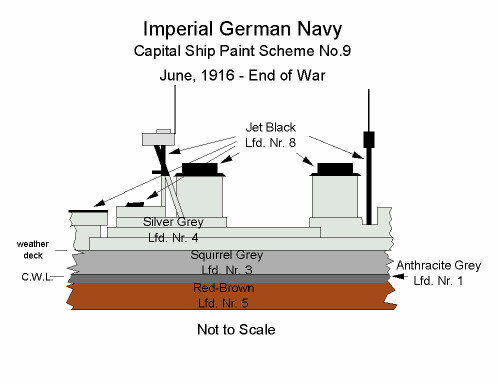
"The vertical hull area was painted Squirrel Grey (Lfd. Nr. 3 or RAL 7000), from the waterline up to the level of the main deck or main deck bulwark or forecastle outer edge, and the extension of this line in way of the enclosed main deck. For example, SMS Von der Tann, with it's raised forecastle, would have the superstructure aft of the break in the hull below the bridge painted this same grey if it stretched to the outer edge of the hull, up to the height of the forecastle. If the superstructure was recessed from the edge, then it was painted Silver Grey (Lfd. Nr. 4 or RAL 7001) like the rest of the superstructure.
Silver Grey was used on the vertical surfaces of the superstructure and funnels from the weather deck up into the mast-tops. It was also used at the horizontal edge of the main decks where the wooden decks ended and in the scuppers, and inside/outside of all masts, casings, ventilators, turrets and guns."
Thankee much for the post. A 100 scale Iron Duke was of huge help when I tried humble skills with Iron Duke: this one is even better. I've also taken much inspiration from your Konig on the Gallery: really helps handling detail to have so many pictures of such a fine build.
It does look like I didn't get the paint scheme right, although it could be changed now. (Probably didn't get RAL 7000 and 7001 quite right, but we will live with what we have. I have not yet begun to weather.) At the bottom of the page is a quote from the latest version of Tom Tanner's article on colors from, I think, 2007. (http://www.sms-navy.com/paint/sms_paint-overview.htm.) Anyway, I took last sentence "If the superstructure was recessed from the edge, then it was painted Silver Grey (Lfd. Nr. 4 or RAL 7001) like the rest of the superstructure." to mean on Konig that the vertical surface that runs from the break on the bow line and covers the secondary armament directly under the battery deck but over the weather deck was painted 7001. (Thought that was the point in bringing up von der Tann). Many modelers, (unless the computer monitor lies) either paint everything the same grey or start 7001 at the battery deck so the metal covering the secondary guns is RAL 7000. An example of what I thought was the case is the first pic: the alternate reading is displayed on the second. (Apologies if my eyes misread the evidence: do wish we could see these in person.) I'd like to know if I've bungled another one because it would be pretty simple to repaint at this stage.
Eric
(From Tanner)
"The vertical hull area was painted Squirrel Grey (Lfd. Nr. 3 or RAL 7000), from the waterline up to the level of the main deck or main deck bulwark or forecastle outer edge, and the extension of this line in way of the enclosed main deck. For example, SMS Von der Tann, with it's raised forecastle, would have the superstructure aft of the break in the hull below the bridge painted this same grey if it stretched to the outer edge of the hull, up to the height of the forecastle. If the superstructure was recessed from the edge, then it was painted Silver Grey (Lfd. Nr. 4 or RAL 7001) like the rest of the superstructure.
Silver Grey was used on the vertical surfaces of the superstructure and funnels from the weather deck up into the mast-tops. It was also used at the horizontal edge of the main decks where the wooden decks ended and in the scuppers, and inside/outside of all masts, casings, ventilators, turrets and guns."
A model boat is much cheaper than a real one and will not sink with you in it.
-
Maarten Sch�nfeld
- Posts: 1845
- Joined: Fri Dec 12, 2008 12:44 pm
- Location: Herk-de-Stad, Belgium
Re: Calling all SMS K�nig class fans
Hi all,
regarding the stern anchor:
I don't have the right documenting photo available, but I'm convinced that the K�nigs (just like the Kaisers and the Bayerns) had a hawsepipe for the stern anchor that was open to the rear. So you might call it a 'notch' indeed, however it should end a little lower than in the model shown I believe, I'd estimate some 5 mm below the deck level.
Just my humble opinion.
Maarten
regarding the stern anchor:
I don't have the right documenting photo available, but I'm convinced that the K�nigs (just like the Kaisers and the Bayerns) had a hawsepipe for the stern anchor that was open to the rear. So you might call it a 'notch' indeed, however it should end a little lower than in the model shown I believe, I'd estimate some 5 mm below the deck level.
Just my humble opinion.
Maarten
"I've heard there's a wicked war a-blazing, and the taste of war I know so very well
Even now I see the foreign flag a-raising, their guns on fire as we sail into hell"
Roger Whittaker +9/13/2023
Even now I see the foreign flag a-raising, their guns on fire as we sail into hell"
Roger Whittaker +9/13/2023
-
Yevgeniy
- Posts: 596
- Joined: Thu May 10, 2007 9:46 am
- Location: Kyiv, Ukraine
Re: Calling all SMS K�nig class fans
Eric, hi,

You may be also interested to read page 3 of this thead viewtopic.php?f=47&t=28612&start=100 esp this ). Actually I stick to the choise like on the second photo you show in your post (although dark grey looks too blueish as to my choise - look at color photo of Tirpitz - the photo is not digitally colorized but original and as far as I know it was same greys for WWI and WWII paint scheme).

May be other modelers will chime in on this issue - whether secondary guns 'wall' shell be painted dark or light grey - but from what I saw the majority does the same as on your second photo. But it can be a mistake also.
Cheers,
Yevgeniy
Thank you for undeserved praise but it was probably not mine as mine is still unfinished after 5 years standing in Work in Process section viewtopic.php?f=59&t=40962&start=20 as I now work on other models. But I will finish it one day I am sure. If you go to my thread you will see I missed the color completely (the paint work was done before I knew anything on various greys for warshipsEric Bergerud wrote: I've also taken much inspiration from your Konig on the Gallery
I gathered so much information about this ship over 2-3 years that sometimes I think of starting a new model of it correcting mistakes of my first build...As to paint scheme I stick to this one http://german-navy.tripod.com/SMS_No9_1916-1942-s.jpg from this article http://german-navy.tripod.com/SMS_No9_1916-1942-s.jpgEric Bergerud wrote: It does look like I didn't get the paint scheme right, although it could be changed now.
You may be also interested to read page 3 of this thead viewtopic.php?f=47&t=28612&start=100 esp this
As to the line where one grey stopped and other began it is actually a good point - thank you - I never thought about it (probably because I messed with the colorsSo my conclusion is, that one is not totally wrong if white and black paint is mixed - 9:1 for the hull and 10:1 for the superstructure. Just an idea (which works, btw.)
). Actually I stick to the choise like on the second photo you show in your post (although dark grey looks too blueish as to my choise - look at color photo of Tirpitz - the photo is not digitally colorized but original and as far as I know it was same greys for WWI and WWII paint scheme).
May be other modelers will chime in on this issue - whether secondary guns 'wall' shell be painted dark or light grey - but from what I saw the majority does the same as on your second photo. But it can be a mistake also.
Cheers,
Yevgeniy
Last edited by Yevgeniy on Fri Aug 19, 2011 5:31 am, edited 4 times in total.
-
Yevgeniy
- Posts: 596
- Joined: Thu May 10, 2007 9:46 am
- Location: Kyiv, Ukraine
Re: Calling all SMS K�nig class fans
Maarten, hi,Maarten Sch�nfeld wrote: So you might call it a 'notch' indeed, however it should end a little lower than in the model shown I believe, I'd estimate some 5 mm below the deck level.
I agree with you opinion - I realized that the 'notch' should be a little 'deeper' into the hull after I made it and decided to leave it to later stage - as you say it shoud be some 4-5 mm below the deck - for the anchor to 'hang' down and not to 'protrude' from the ship - the anchor stem is some 4-5 mm.
So I will make the notch longer at the point of attaching the anchor - it will be the final point of the build sometime

Cheers,
Yevgeniy
-
Eric Bergerud
- Posts: 359
- Joined: Thu Apr 01, 2010 10:24 pm
Re: Calling all SMS K�nig class fans
I'm beginning to wonder if I didn't read the article correctly (and thus the first picture is correctly done). Below is a pic of Von Der Tann from Dreadnought Project. It illustrates what I think Tanner was talking about. Note that the secondary armament is painted RAL 7000 but it does not go above the weather deck. Of course I do specialize in doing things wrong. (Sorry about the mistake in the names: the gent in question is named Yuri Logaziak.
Eric

Eric
A model boat is much cheaper than a real one and will not sink with you in it.
-
Yevgeniy
- Posts: 596
- Joined: Thu May 10, 2007 9:46 am
- Location: Kyiv, Ukraine
Re: Calling all SMS K�nig class fans
You are right but Koenig has 2 decks (excluding those of superstructure) whereas Von der Tann - 3 decks with secondary armament on 1st 'battery deck' (I understand you call it 'weather deck'?). If we take away 3-d deck of Von Der Tann (forecastle), making 'Anton' turret on the same level as side main turrets, we will receive same paint scheme as Koenig painted as on picture No. 2 in your post, right?
I can be wrong too, as I said I did not investigate where the division between dark/light grey shall be during my build as I grossly neglected this point
Cheers,
Yevgeniy
P.S The model in 1:100 on igkm.de website http://www.igkm.de/igkm-d/Modelle/Seite ... raf.html#3 is also painted as on your photo No.2
I can be wrong too, as I said I did not investigate where the division between dark/light grey shall be during my build as I grossly neglected this point
Cheers,
Yevgeniy
P.S The model in 1:100 on igkm.de website http://www.igkm.de/igkm-d/Modelle/Seite ... raf.html#3 is also painted as on your photo No.2
-
Eric Bergerud
- Posts: 359
- Joined: Thu Apr 01, 2010 10:24 pm
Right Paint Scheme for Konig Turrets?
Still laboring on Konig. I was trying to figure out the best way to paint the white circles on two of the turrets. (Not sure if decals would work on the irregular surface.) Then I was checking the article by Mr. Tanner on German Navy Tripod about color schemes. I had missed the last paragraph in previous readings in my eagerness to find the world's best RAL 7001. Here's what Tanner says about the turrets:
"To allow German ships to be identified from the air, the tops of the main turrets and armoured conning tower were painted Jet Black. After identification problems were encountered during the occupation of the islands of Oesel and Dag� in October, 1917, distinctive White circles were painted on the uppermost turrets forward and aft on capital ships ... while smaller warships and merchant ships carried them on the forecastle and quarterdeck."
If Tanner is right two conclusions appear obvious:
1. The turret tops should be painted black. I've looked at a lot of lovely Konigs in our gallery and elsewhere and a dark gray appears to be the most common color. This could be the monitor playing tricks but some models are clearly grey. I was thinking of payne's grey or panzer grey: now it looks like black. (That would mean breaking out Polly Scale "Engine Black" which leaves a hue darker than Stalin's soul. That's a sweet paint. Actually I wish some brave soul would go through the Polly Scale railroad colors and give approximate military colors. They're hard things to buy online with only monitor samples to go on. Bet a lot of them are a lot of excellent military colors: but what railroad painted their caboose a perfect olive drab? They're wonderful paints to work with. Easily my favorite US paint.)
2. And the circles. With one exception every Konig class ship has had ID circles. Yet if Tanner is right, they would have been on there only in the last year of the war. I'm very keen on artistic license, but this project has eaten time like a hungry hyena and I'd feel like a dope if I spent a few hours to make the ship less accurate. Ironically, I was thinking of modeling Konig as it would have appeared during the Baltic operations referred to by Mr. Tanner. (When I thought through what would be required to do torpedo nets properly, I junked a Jutland rig as fast as Scheer could yell "turn around.") And the Balkan festivities were at least a major operation. Anyway, am I misreading something? Wouldn't it legit to simply leave them off?
Eric
"To allow German ships to be identified from the air, the tops of the main turrets and armoured conning tower were painted Jet Black. After identification problems were encountered during the occupation of the islands of Oesel and Dag� in October, 1917, distinctive White circles were painted on the uppermost turrets forward and aft on capital ships ... while smaller warships and merchant ships carried them on the forecastle and quarterdeck."
If Tanner is right two conclusions appear obvious:
1. The turret tops should be painted black. I've looked at a lot of lovely Konigs in our gallery and elsewhere and a dark gray appears to be the most common color. This could be the monitor playing tricks but some models are clearly grey. I was thinking of payne's grey or panzer grey: now it looks like black. (That would mean breaking out Polly Scale "Engine Black" which leaves a hue darker than Stalin's soul. That's a sweet paint. Actually I wish some brave soul would go through the Polly Scale railroad colors and give approximate military colors. They're hard things to buy online with only monitor samples to go on. Bet a lot of them are a lot of excellent military colors: but what railroad painted their caboose a perfect olive drab? They're wonderful paints to work with. Easily my favorite US paint.)
2. And the circles. With one exception every Konig class ship has had ID circles. Yet if Tanner is right, they would have been on there only in the last year of the war. I'm very keen on artistic license, but this project has eaten time like a hungry hyena and I'd feel like a dope if I spent a few hours to make the ship less accurate. Ironically, I was thinking of modeling Konig as it would have appeared during the Baltic operations referred to by Mr. Tanner. (When I thought through what would be required to do torpedo nets properly, I junked a Jutland rig as fast as Scheer could yell "turn around.") And the Balkan festivities were at least a major operation. Anyway, am I misreading something? Wouldn't it legit to simply leave them off?
Eric
A model boat is much cheaper than a real one and will not sink with you in it.
-
Maarten Sch�nfeld
- Posts: 1845
- Joined: Fri Dec 12, 2008 12:44 pm
- Location: Herk-de-Stad, Belgium
Re: Right Paint Scheme for Konig Turrets?
Hi Eric,
I cannot give you any more confirmation about either question, the 'jet black' appears to be subdued anyway in most pictures: as the turret tops are horizontal surfaces, they catch much light and will most likely appear to be lighter, i.e. some hue of grey.
As for the turret rings, I spent some time on measuring them up on photographs and relating them to the turret dimensions. This because on my SMS Baden model the turret top shape appeared to be quite unforgiving when this would be done wrong.
I'm pretty convinced now the outside dimension of these white rings for all battleships should be 6, and the inside 4 metres, so that the ring width is one metre. This falls nicely in line with the German liking for round figure dimensions (which I noticed in several instances before) , although I haven't been able to locate any 'official' document that confirmed my measurements.
Since the turret rings were intended to be an ident from the air, they only made sense in an environment where German aircraft or airships operated, and both friendly and enemy battleships could appear. I think this was hardly the case in the Baltic. So if your assumptions are correct you wouldn't need the turret rings anyhow...
I cannot give you any more confirmation about either question, the 'jet black' appears to be subdued anyway in most pictures: as the turret tops are horizontal surfaces, they catch much light and will most likely appear to be lighter, i.e. some hue of grey.
As for the turret rings, I spent some time on measuring them up on photographs and relating them to the turret dimensions. This because on my SMS Baden model the turret top shape appeared to be quite unforgiving when this would be done wrong.
I'm pretty convinced now the outside dimension of these white rings for all battleships should be 6, and the inside 4 metres, so that the ring width is one metre. This falls nicely in line with the German liking for round figure dimensions (which I noticed in several instances before) , although I haven't been able to locate any 'official' document that confirmed my measurements.
Since the turret rings were intended to be an ident from the air, they only made sense in an environment where German aircraft or airships operated, and both friendly and enemy battleships could appear. I think this was hardly the case in the Baltic. So if your assumptions are correct you wouldn't need the turret rings anyhow...
"I've heard there's a wicked war a-blazing, and the taste of war I know so very well
Even now I see the foreign flag a-raising, their guns on fire as we sail into hell"
Roger Whittaker +9/13/2023
Even now I see the foreign flag a-raising, their guns on fire as we sail into hell"
Roger Whittaker +9/13/2023
-
Eric Bergerud
- Posts: 359
- Joined: Thu Apr 01, 2010 10:24 pm
Re: Calling all SMS K�nig class fans
I'm going to ignore the circles: one of our wizards who is doing a full build on the ship suggests painting the top of the turret white and then masking that with circles: no simple task for yours truly. And if Tanner is right no German battleship carried circles before October 1917 when they were put on because of aerial identification problems during the Baltic operations which finished that month.
Things are never simple in model land of course. I found the lost Gary Staff book (hiding in my class files - exactly where you want a model reference work) on German BBs. Staff shows circles in all of his color plates. (I'd guess the turret color in the plates to be payne's gray. BTW: the kit calls for dark gray turret tops but I'm not sure how far I'd trust ICM after getting up close and personal with one of their products.) There are, however, several aerial view photos in the Staff book - most show no circles. Three of the five that do show circles specifically note that it was 1918 - when Tanner said should have been on. There's also one from 1918 that has no circles. Earlier in the article Tanner stated that ID marks were temporary - put on only when the ships had left harbor. Things like colors painted on ID funnels were changed randomly to confuse potential spies. (Not impossible when you think of the role played by the naval mutiny in bringing the war to a crashing conclusion.) So maybe that photo was either mislabeled or maybe circles were on or off depending upon operational circumstance.
Anyway, enough evidence to forget circles and paint the turrets black.
Thankee for your thoughts.
Eric
Things are never simple in model land of course. I found the lost Gary Staff book (hiding in my class files - exactly where you want a model reference work) on German BBs. Staff shows circles in all of his color plates. (I'd guess the turret color in the plates to be payne's gray. BTW: the kit calls for dark gray turret tops but I'm not sure how far I'd trust ICM after getting up close and personal with one of their products.) There are, however, several aerial view photos in the Staff book - most show no circles. Three of the five that do show circles specifically note that it was 1918 - when Tanner said should have been on. There's also one from 1918 that has no circles. Earlier in the article Tanner stated that ID marks were temporary - put on only when the ships had left harbor. Things like colors painted on ID funnels were changed randomly to confuse potential spies. (Not impossible when you think of the role played by the naval mutiny in bringing the war to a crashing conclusion.) So maybe that photo was either mislabeled or maybe circles were on or off depending upon operational circumstance.
Anyway, enough evidence to forget circles and paint the turrets black.
Thankee for your thoughts.
Eric
A model boat is much cheaper than a real one and will not sink with you in it.
-
Eric Bergerud
- Posts: 359
- Joined: Thu Apr 01, 2010 10:24 pm
Konig boat on davits or deck?
The ICM Konig I'm building calls for a boat of some kind to be attached to davits on both sides of the ship on the lower deck a little rear of midship. The boat is swung out, so it would be over the railing. The several models of this ship in our gallery have the boat deployed in this manner, although one has the davits reversed and the boat hanging over the upper deck as opposed to over the railing. I do have WEM davits (the ICM equivalents are made of soap are are worthless) and I could get it up, although as configured it's going to make attaching the rail a little harder.
However, I have Gary Staff's book on the late German BBs and his plates, and to the extent that I can tell from the photos, show no davits deployed on Konig, and the boat in question lashed to the upper deck. I would like to think of my model as Konig returning from fun and games in the Baltic during October 1917, not resting in harbor. Is this a judgement call or would a ship underway normally have this boat either lashed to the deck on attached to davits? This has been a tough build and I really would like to do it right.
Eric
However, I have Gary Staff's book on the late German BBs and his plates, and to the extent that I can tell from the photos, show no davits deployed on Konig, and the boat in question lashed to the upper deck. I would like to think of my model as Konig returning from fun and games in the Baltic during October 1917, not resting in harbor. Is this a judgement call or would a ship underway normally have this boat either lashed to the deck on attached to davits? This has been a tough build and I really would like to do it right.
Eric
A model boat is much cheaper than a real one and will not sink with you in it.
-
Yevgeniy
- Posts: 596
- Joined: Thu May 10, 2007 9:46 am
- Location: Kyiv, Ukraine
Re: Konig boat on davits or deck?
Hi,
I take the following as a rule of thumb - if you have a photo it is a best evidence whatever somebody say
I read somewhere that it was normal practice in German navy to take all boats from decks shortly before and after battle. Reasons were obvious - during the battle those boats will be the source of fire, frag, etc. and most likely will be destroyed. I am not 100% sure on this question but saw SMS battleships photos on high speed without any boat at all - photos signed "prepared for battle".
Here is a couple of such photos (1st photo - Konig at the bottom,


Last photo - Konig (or Grosser Kurfust as name of the photo says) on the way to surrender - also no hanging over boat

My reasoning would be if one wants to make a battleship shortly before or after the battle there should be definitely no hanging over boats or admiral ladders etc and most probably no boats at the deck. Other thing is that I like those motor-boats same as the ship itself (also the look of a boat hanging overboard) so hiding them leaves the ship without part of its beauty... But it depends on the scene you want to depict.
Cheers,
Yevgeniy
I take the following as a rule of thumb - if you have a photo it is a best evidence whatever somebody say
I read somewhere that it was normal practice in German navy to take all boats from decks shortly before and after battle. Reasons were obvious - during the battle those boats will be the source of fire, frag, etc. and most likely will be destroyed. I am not 100% sure on this question but saw SMS battleships photos on high speed without any boat at all - photos signed "prepared for battle".
Here is a couple of such photos (1st photo - Konig at the bottom,


Last photo - Konig (or Grosser Kurfust as name of the photo says) on the way to surrender - also no hanging over boat

My reasoning would be if one wants to make a battleship shortly before or after the battle there should be definitely no hanging over boats or admiral ladders
etc and most probably no boats at the deck. Other thing is that I like those motor-boats same as the ship itself (also the look of a boat hanging overboard) so hiding them leaves the ship without part of its beauty... But it depends on the scene you want to depict.Cheers,
Yevgeniy
-
Maarten Sch�nfeld
- Posts: 1845
- Joined: Fri Dec 12, 2008 12:44 pm
- Location: Herk-de-Stad, Belgium
Re: Konig boat on davits or deck?
Hi Eric,
The only note I can add here is that the general plan drawings we inherited from German Imperial Navy ships almost invariably show these with their full complement of allocated boats, and some of these are hanging from their davits. I think ICM used these drawings too for designing their kit, maybe in the form of a copy worked over by Lothar Wischmayer.
In practice however these boats would only be swung out in preparation for their use, otherwise they would be too vulnerable to waves. In all other cases they would be swung inboard over the deck. Compare this with boats on liners: these are hardly ever swung outboard, only when they are needed (tenders f.i.)
The other point is that German (and other) navy ships got rid of flammable material in the face of a battle, so if boats could be missed they would be jettisoned or otherwise. In particular after the square Marx floats were introduced (in 1917) the use of boats during or after a battle would be very limited, so many of these were probably landed shortly before the ship left harbour on operations, or jettisoned when caught by surprise.
However for normal routine cruising the boat complement would be on board. A nice thing that sets the K�nigs apart from the rest are the boat cradles on tracks, so that they could be moved to provide a field of fire for the middle gun turret. I would conclude that apparently at least part of the boats would remain on board during battle.
So I would start out with the full boat complement on board, and than judiciously consider which boats might be left off, regarding the situation to be displayed.
The only note I can add here is that the general plan drawings we inherited from German Imperial Navy ships almost invariably show these with their full complement of allocated boats, and some of these are hanging from their davits. I think ICM used these drawings too for designing their kit, maybe in the form of a copy worked over by Lothar Wischmayer.
In practice however these boats would only be swung out in preparation for their use, otherwise they would be too vulnerable to waves. In all other cases they would be swung inboard over the deck. Compare this with boats on liners: these are hardly ever swung outboard, only when they are needed (tenders f.i.)
The other point is that German (and other) navy ships got rid of flammable material in the face of a battle, so if boats could be missed they would be jettisoned or otherwise. In particular after the square Marx floats were introduced (in 1917) the use of boats during or after a battle would be very limited, so many of these were probably landed shortly before the ship left harbour on operations, or jettisoned when caught by surprise.
However for normal routine cruising the boat complement would be on board. A nice thing that sets the K�nigs apart from the rest are the boat cradles on tracks, so that they could be moved to provide a field of fire for the middle gun turret. I would conclude that apparently at least part of the boats would remain on board during battle.
So I would start out with the full boat complement on board, and than judiciously consider which boats might be left off, regarding the situation to be displayed.
"I've heard there's a wicked war a-blazing, and the taste of war I know so very well
Even now I see the foreign flag a-raising, their guns on fire as we sail into hell"
Roger Whittaker +9/13/2023
Even now I see the foreign flag a-raising, their guns on fire as we sail into hell"
Roger Whittaker +9/13/2023
-
Eric Bergerud
- Posts: 359
- Joined: Thu Apr 01, 2010 10:24 pm
Re: Konig boat on davits or deck?
Do appreciate the feedback. Just another example of knowing something about the subject helping out the modeling and there's a lot I don't know about the nuts and bolts of operations aboard a big ship. (Never been on one minus the Channel ferry.)
I was rather wondering myself whether ICM's instructions were calling for a configuration that was not typical of high seas operations: wouldn't think a boat slung out over the railing would be well placed in heavy weather North Seas style. I very carefully counted all of the beans on Gary Staff's plate of Konig and the boat in question is very clearly on the upper deck just a little in front of the launches and that looks like a real good place for mine. Wouldn't leave the things off altogether - I've already built and painted them, although I wouldn't doubt by late 1917 embellishments were getting pretty rare. (The first ship I ever built was Tamiya's Rodney. After painting the deck teak, I found a source that suggested it had been painted grey before the fight with Bismarck. I did not repaint.) A good friend of mine models ships. His wife calls them "the grey things." She does have a point. My next floating object will carry USN Measure 21: hard to think of anything more boring. War may be the enemy of art. (I draw the line at the chain. Staff wants the chain grey. I bought little chains and they're sweet - but they're black. Black they will stay.)
Eric
I was rather wondering myself whether ICM's instructions were calling for a configuration that was not typical of high seas operations: wouldn't think a boat slung out over the railing would be well placed in heavy weather North Seas style. I very carefully counted all of the beans on Gary Staff's plate of Konig and the boat in question is very clearly on the upper deck just a little in front of the launches and that looks like a real good place for mine. Wouldn't leave the things off altogether - I've already built and painted them, although I wouldn't doubt by late 1917 embellishments were getting pretty rare. (The first ship I ever built was Tamiya's Rodney. After painting the deck teak, I found a source that suggested it had been painted grey before the fight with Bismarck. I did not repaint.) A good friend of mine models ships. His wife calls them "the grey things." She does have a point. My next floating object will carry USN Measure 21: hard to think of anything more boring. War may be the enemy of art. (I draw the line at the chain. Staff wants the chain grey. I bought little chains and they're sweet - but they're black. Black they will stay.)
Eric
A model boat is much cheaper than a real one and will not sink with you in it.
-
Barry.6728
SMS Konig
I'm new to the forum so if this is old stuff please forgive me. I just got the ICM Konig and have a few questions: What were the decks made of, teak or oak? And I've seen some pics of the model and some of the upper decks seem to be a reddish color? I am going to use the White Ensign paints that are designed for WW1 German ships, has anyone out there have any experience with them? Thanks so much, more questions will probably come as I get into it more. Thanks.
-
Maarten Sch�nfeld
- Posts: 1845
- Joined: Fri Dec 12, 2008 12:44 pm
- Location: Herk-de-Stad, Belgium
Re: Calling all SMS K�nig class fans
Hi Barry,
No problem at all.
The German battleship decks were certainly not made of oak, teak is possible, but there are many more options like mohagony or pine. It's impossible to judge from b&w pictures, and one should have firm documentation or at least colour pictures - which we have not to my knowledge. I would advise for making the wooden deck very light, teak is a good option therefore.
All decks above (including the first deck of the forward supperstructure which has planks in error) were covered with Linoleum, which had a dark red colour (unlike British Corticene which was much more brown). There are several WW1 paintings that confirm this (Claus Bergen a.o.). The linoleum was laid in strips and edged with brass (like we know from Japanese warships).
As for the paintwork, the German ships were painted in two shades of very light grey, hardly distinguishable from another, the somewhate darker shade on the hull. The grey was definitely lighter than the hues used in WW2 (RAL 7001 and 7000). I use Humbrol 147 and 196 for these, I haven't tried WEM in this case.
Please note the only distracting error I found in the ICM kit, the forward funnel being too lumpy and should be reduced in size. Read the thread above.
Maarten
No problem at all.
The German battleship decks were certainly not made of oak, teak is possible, but there are many more options like mohagony or pine. It's impossible to judge from b&w pictures, and one should have firm documentation or at least colour pictures - which we have not to my knowledge. I would advise for making the wooden deck very light, teak is a good option therefore.
All decks above (including the first deck of the forward supperstructure which has planks in error) were covered with Linoleum, which had a dark red colour (unlike British Corticene which was much more brown). There are several WW1 paintings that confirm this (Claus Bergen a.o.). The linoleum was laid in strips and edged with brass (like we know from Japanese warships).
As for the paintwork, the German ships were painted in two shades of very light grey, hardly distinguishable from another, the somewhate darker shade on the hull. The grey was definitely lighter than the hues used in WW2 (RAL 7001 and 7000). I use Humbrol 147 and 196 for these, I haven't tried WEM in this case.
Please note the only distracting error I found in the ICM kit, the forward funnel being too lumpy and should be reduced in size. Read the thread above.
Maarten
"I've heard there's a wicked war a-blazing, and the taste of war I know so very well
Even now I see the foreign flag a-raising, their guns on fire as we sail into hell"
Roger Whittaker +9/13/2023
Even now I see the foreign flag a-raising, their guns on fire as we sail into hell"
Roger Whittaker +9/13/2023