Page 9 of 26
Re: 1/144 Jorge Juan (ex USS McGowan)
Posted: Mon Jul 06, 2020 6:23 am
by Willie
Hi all again,
After the last on-line exams of this nightmarish Covid school year I have again some spare time to devote to more serious matters 
As I have not clear the issue of the aft stack wiring yet, I have thought of doing some more minor (but very necessary) work, the fixing of elements on deck, starting with the hedgehogs and ready ammo boxes ahead of the bridge. These elements are to be fixed after the structure and the bridge are themselves fixed, and therefore you will be handling the whole ship rather than smaller sections as I have been doing as far as now.
As all the elements will, of course, have to be painted before hand, and the points to be glued would be very small and very visible at the same time, I found out after some trying that it would be wiser to revert to the old pre-fixing method. I made then two plans in paper for the fixing areas of the elements, some rod shanks with 0.64 mm. Evergreen rod that I attached to the undersides, and a plan directly on deck to make the drills. Easiest thing ever.

All the elements can now be handled way easier, and as the shanks will be painted with the same deck dark grey, they will be virtually invisible in plain sight, and even more when the stanchions and handrails are also set in place.
The forward structure is then like this at the moment:
I hope you like it, and very best regards from this side,
Willie.[/size]
Re: 1/144 Jorge Juan (ex USS McGowan)
Posted: Mon Jul 06, 2020 7:20 am
by EJFoeth
Looking very good

Re: 1/144 Jorge Juan (ex USS McGowan)
Posted: Mon Jul 06, 2020 8:07 am
by BB62vet
Willie,
You've really done the 01 Level Fwd really nice - Looks exact! Very impressive indeed!
Hank
Re: 1/144 Jorge Juan (ex USS McGowan)
Posted: Tue Jul 07, 2020 7:13 am
by Willie
Hi there all friend modelers,
And thanks EJFoeth and Hank for your always kind remarks.
I have realized (and my IQ has to be at an amoeba�s level to not have realized before) that even after the shanks I have been placing the elements following the pattern I had previously drawn on deck, but all these lines will disappear when the deck is finally painted. It is so easy to ruin excellent pieces and a nice paintwork job with stains of glue that I don�t want to run any risks, and there fore I have set the definitive positions using pieces of thin stretched sprue.
This way there will be no allowance for any mistakes at all when gluing things in the last steps of the construction. Of course these lines do not exist on board the real ship, but after being painted in dark gray again, they will virtually disappear too. In any case, the
for�s are more than the
against�s.
I hope you like it.
I am still bogged down with the oil canning. This oil canning:
Drawing the lines will be no problem at all, but the carving is a different chapter. Has anybody tried to do this, or has any idea of how to do it ?
TIA for any suggestion, and very best regards from (at last sunny) Spain,
Willie.[/size]
Re: 1/144 Jorge Juan (ex USS McGowan)
Posted: Tue Jul 07, 2020 8:08 am
by BB62vet
Willie,
Oil Canning - if memory serves me correctly, there was a post about this not too long ago (maybe 6 months?) on another sub-forum on SMF. I can't recall where, but they were asking about an oil canning template that was offered by one of the model companies. Perhaps if you have time to go through the forums (possibly tips & tricks?) and look for it, this might be beneficial.
Basically, the guy put a PE scaled template over the hull, sprayed a slightly different shade of paint and then removed the template. It left a "shadowed" effect which gave the illusion of oil canning. That's about the closest I can describe it. Perhaps another member will see your post and offer further info, etc.
Hope this helps,
Hank
Re: 1/144 Jorge Juan (ex USS McGowan)
Posted: Wed Jul 08, 2020 6:24 am
by marijn van gils
Great work as always Willie!
Simulating oil canning by painting can look great in 1/350 and smaller, but for 1/144 scale (and the level of detail you work in) I feel it would be worthwhile to actually carve it.
For this, you can do what aircraft modellers have been doing for a long time to create similar distressed surfaces: scrape the surface down with a curved scalpel.
First, you draw the pattern in pencil, which will result in a grid pattern. Follow your references of course! That will look much better than just guessing the pattern. Next, you scrape the inside of each 'box' in that 'grid' down a little with a curved scalpel blade. This would be my weapon of choice (Swan & Morton n� 15):
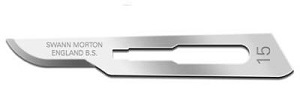
Be carefull not to overdo the effect.
Afterwards, sand the entire surface carefully to make sure all transitions are smooth.
This will take a lot of time, but the result should be spectacular!
This is an article describing the process for aircraft models:
http://www.clubhyper.com/reference/stre ... ctkh_1.htm
You can also do the carving with a motortool:
https://www.youtube.com/watch?v=TJ8oLa4VOEU
But that is not necessarily faster or more comfortable...
Re: 1/144 Jorge Juan (ex USS McGowan)
Posted: Wed Jul 08, 2020 8:47 am
by Willie
Hi there Hank, Marijn and all,
Thanks a lot for the inputs. Sorry I could not answer, but 1/1 scale life has again interfered with 1/144.
marijn van gils wrote:
Simulating oil canning by painting can look great in 1/350 and smaller, but for 1/144 scale (and the level of detail you work in) I feel it would be worthwhile to actually carve it.
For this, you can do what aircraft modellers have been doing for a long time to create similar distressed surfaces: scrape the surface down with a curved scalpel.
I absolutely agree. This relatively big hull demands attention, and the oil canning cannot be simulated in a proper way by template/paint.
Your links to the scalpels open a new gate for me. My wife is a nurse, and she provides me with scalpels from time to time, but the blades are always the same ones, way too big for this subtle canning, roughly the same as the old X-acto half round blades. I have already tried these ones, but the effect is no good, as the carving is too wide. Your nr.15C ( https://es.swann-morton.com/product/28.php ) and even the tip of nr. 10R ( https://es.swann-morton.com/product/159.php ) seem much more promising, and they are nor even expensive. I will have a try at them.
Thanks again Hank and Marijn, and very best regards from this side,
Willie.
Re: 1/144 Jorge Juan (ex USS McGowan)
Posted: Wed Jul 08, 2020 8:54 pm
by oneslim
Hi Willie,
No oil canning amidships. The hull was covered with 1/2" armor plating as protection from strafing. This included the forward boiler room and engine room, the aft boiler room and engine room.
Hope this helps
Bob W
Re: 1/144 Jorge Juan (ex USS McGowan)
Posted: Fri Jul 10, 2020 9:31 am
by Willie
Hi there again.
After Marijn�s advice (thanks again for it), I went to a pharmacy and voil�, #15 scalpels are the easiest thing to have, they apparently have the correct blade curve, and they come at a surprising low price as well, 70/80 cents each. I will have to make some testing before addressing my hull, but I think I have got it.
Once the how was solved, the what comes. The previous picture depicting D24 Alcal� Galiano in dry dock lacks the correct perspective, as it was taken at --I would say-- 135�, so the measures are to be only partially trusted.
I was lucky to find this other picture of USS Hunt, DD674 which is almost a broadside, and hence much more useful because the shadows allow to see numbers and shapes very clearly as well.
The upper section is easy to follow, and I have been able to count 38 frames in the indicated section.
Just to make sure that I was doing the right thing, I compared the previous pic with this other one of
USS Kidd, with quite clear shades, and found apparently 36 frames in the same area, but probably I am mistaken, again because of the perspective.
After some calculations I found out that at my scale the frames should be 3.8 mm. away from each other, and I simplified them to 4.0 to make things a bit easier. 4.0 mm. gaps seem to be easier to draw and to carve as well.
I have then made this initial pattern:
Only after this, as usual, I came across this other thread...
viewtopic.php?f=59&t=40032&hilit=oil+canning
...and realized that Rotorhead has done the same thing, in the very same area, with 39 frames, so I can more assume that my calculations are more or less correct, and I can proceed with confidence.
At the same time, as i will not overdo anything (I hope !!!), and after the thing is done, and the whole lot painted, I suppose it will not be that easy to distinguish between 37 and 39 frames, with my 38 in the middle.
Also thanks to Oneslim for this info:[/size]
oneslim wrote:
No oil canning amidships. The hull was covered with 1/2" armor plating as protection from strafing. This included the forward boiler room and engine room, the aft boiler room and engine room.
Hope this helps.
It does, and lots. I had not realized what the riveted plates are. I have also made a search in my files, and I have found a couple of pics like this one of USS Cassin Young DD-793:
The problem with it is that I see very straight lines below the waterline, and therefore, unless it is covered by rust and mussels, no possible oil canning. On the other hand, I can see that Rotorhead has made a very deep oil canning in the area around the sonar, well ahead of the bilge keels, where I see nothing at all.
And then my question: Does somebody have any references of these areas, or can give me an idea of where and (specially) where
not do the oil canning effect under the waterline ?
TIA, and very best regards from this side,
Willie.[/size]
Re: 1/144 Jorge Juan (ex USS McGowan)
Posted: Fri Jul 10, 2020 1:02 pm
by Rick E Davis
I don't know that specifically that "armor" (more likely just thicker steel) thick steel was added amidships for protection, but was there structurally because of the power-plant area created large voids, that needed more strength of the hull in that area. Also, the oil canning in photos of individual ships will vary. Destroyers saw most stress and wear in the bow (pounding of the seas while underway) and stern areas (prop vibration and depth charge use) while in operationally use. Thus depending on how much wear and any cracks, etc showing up, destroyers would routinely get "re-skinned" in those areas. A freshly overhauled destroyer may well not show any oil canning.
The distance between frames on the FLETCHER-SUMNER-GEARING classes was 21-in., except at the forward and aft areas where things get compressed. But, in reality, no one is going to count or tell the difference in the spacing for oil canning purposes. They will only be amazed by your modeling skill overall.


The image below is a favorite of mine in showing the variation in oil canning on destroyers. Taken in July 1956, it shows USS PRESTON (DD-795) after a "close encounter" with an Aircraft Carrier, moored next to USS PICKING (DD-685). Notice that very little oil canning is present on PRESTON, but very visible on PICKING. According to BuShips Records, Preston had completed her latest overhaul in March 1956,

Re: 1/144 Jorge Juan (ex USS McGowan)
Posted: Fri Jul 10, 2020 1:33 pm
by Rick E Davis
As a follow-on comment about oil canning below the waterline. From the images I have (which are fewer) of FLETCHER class destroyers in drydock, the evidence of oil canning if seen at all, is more subdued. Here are two images of USS OWEN (DD-536) taken in 1956 as she was being returned to mothballs. She still has an earlier post-WWII era sonar. Korean War recommissioned units that remained in service had a slightly larger sonar/dome installed on the centerline (late WWII a retractable dome type sonar was installed, post-WWII a fixed dome type sonar was installed in its place) and the looks of the hull was quite similar. I don't have good images of FLETCHER's in drydock "after at sea operation" showing the larger sonar domes installed in late 1950s into 1960s. Those larger domes may have caused more stress issues and more oil canning.
Also, note where roughly the oil canning on OWEN stops.


One additional image I forgot to load with the others, this is another view of USS ROSS (DD-563) during 1955 in drydock. This view looking towards the bow, with the sonar dome in view, providing another perspective view of the bow area and showing oil canning fading out as you go aft with little to no oil canning below the waterline.

Re: 1/144 Jorge Juan (ex USS McGowan)
Posted: Sat Jul 11, 2020 9:33 pm
by oneslim
Willie,
Norman Friedman's book US DESTROYERS, Chapter 6, page 114, starts a discussion about Protection against .50 caliber machine-gun fire, i.e., 20lbs. (half-inch) special treatment steel (STS) over engine and fire rooms.
BobW
Re: 1/144 Jorge Juan (ex USS McGowan)
Posted: Sat Jul 11, 2020 11:54 pm
by Rick E Davis
Go on reading to page 117 ... "These proposals (for increased AA armament) were taken up by the General Board in April (1942) ... Weight compensation would include reductions in the height of the after deckhouse, generally by one deck (this was the beginning of the "Square-Bridge" version). ... the General Board chose the elimination of protection over the ship and fire controls, while retaining the full 5-inch battery and torpedo tubes."
It appears that the original Round-Bridge units likely had the 30-lb STS (0.75-in) steel on the hull sides amidships, but maybe not all units. Depends on when they started construction. BIW Engineering Drawings show that the hull sides amidships (dwg 401172T Outside Plating for frame 72 to 148) were 30-lb STS (0.75-in) initially. The bow, stern, and bottom areas were plated with lighter weight HTS steel that varied in thickness. The drawing says the hull plating plan was to be used for subsequent (Square-Bridge) units, but the changes on the drawing end in mid-1942. I can't find a replacement for this drawing or a revision note that the 30-lb STS was to be replaced with HTS(?), the drawings ending with "T" generally only applied to the original "Round-Bridge" units.
Based on the General Board direction, none of the Square-Bridge units likely would have used 30-lb STS (0.75-in). 20-lb HTS would likely be used. The FLETCHER's went through a lot of changes before the first units were even commissioned. Saving weight became an issue pretty quickly as the demand for more AA armament grew louder. They even refitted the gun houses and bulwarks around AA guns from STS to 10-lb HTS to save weight.
In either case, the use of thicker steel in the midships section of the ship would explain why those areas weren't re-plated as often and had little to no oil-canning.
Re: 1/144 Jorge Juan (ex USS McGowan)
Posted: Sun Jul 12, 2020 11:40 am
by BB62vet
Willie,
In regards to the oil-canning - DAMN!!! you guy keep upping the ante on these models!!!!

OK, so here is a photo I took of STODDARD in drydock in Sasebo, JN in 1968 - you can see the full effect of "oil-canning" on the stern in this shot. We were there for battle damage repairs to the hull.
Should help you figure out your grid pattern for the stern area, etc.
Hank
Re: 1/144 Jorge Juan (ex USS McGowan)
Posted: Mon Jul 13, 2020 4:29 pm
by Willie
Hi there, Mr. Davis, Oneslim and Hank,
Thanks very much for your remarks and, as always, valuable information. I really apreciate it.
As I had advanced, the next step was oil canning. I made some tests before attacking the hull, but the thing is very easy to do using the scalpel #15 that Marijn suggested.
I have tried to make it as realistic as possible, within the limitations that my poor tools have, and therefore I have tried to stress the canning around the waterline, and to make it a bit shallower upwards, where the stress of the head wave is less intense, and take the whole lot to the keel level.
Well into it, but before it was too late, I realized that Jorge Juan had at some stage a reinforcement plate just under the hawsehole, that had to be hurriedly done with a piece of thing yogurt container.
After this I have more or less completed the first part of the job, to achieve this:
This work took me a full day, but thank God, it is
much less than I had anticipated. I didn�t worry about making the cells as identical to each other as possible, as this is not desirable at all. I have tried not to overdo the thing, but the memories that I have of these ships, confirmed by the previous pic of
Jorge Juan, are of severely beaten hulls, and the bleak jokes that we used to make about it.
With a counter light against the window the thing is like this:
After deleting the markings, things improved substantially, although some mistakes came also to light, and the smaller grids and some other points will need some further attention:
One of the most serious mistakes is that I did not realized at first that the grid "
doubles" at a certain point, but this is a very easy to solve thing, as removing plastic is easier than adding it

. This is what I mean :
On the other hand, I have planned to extend the grid --combining
singles and
doubles to the section between the two bilge keels, more or less, reducing progressively the depth of each section.
Does it sound reasonable to you guys, or should I do otherwise --and then how ?
Again TIA to all of you, and very best regards from this side,
Willie.[/size]
Re: 1/144 Jorge Juan (ex USS McGowan)
Posted: Mon Jul 13, 2020 6:58 pm
by Fliger747
Friedman discusses the midships plating somewhere in his US Destroyer book. I could find what was discussed for the Fletchers as proposed but not actually what was installed. From his cover photo showing DD 445 you can see this: It begins abaft the bridge structure and is in two rows above the boot top and joined at the ends of the plates by vertical butt straps very similar to the method of joining the heavier shell plating via way of the citadel on the Iowa's, joints staggered. I don't have a length on each plate, but perhaps 40'? I believe that the side plating may have been 30 lb amidships and 20 # deck. The pilot house was originally 30# plate for splinter protection. Apparently ships varied as the earliest ships had aluminum deckhouses.
Though not suitable except in a scratch built hull, I oil canned the transom stern on my Alaska by building a grid to represent the framing on a solid background, glued a very thin styrene over it the softened with a heat gun.
Very interesting project! Cheers: Tom
Re: 1/144 Jorge Juan (ex USS McGowan)
Posted: Tue Jul 14, 2020 2:56 am
by USSCYCLOPS
Willie, your detail on this destroyer is unimaginably exquisite
Re: 1/144 Jorge Juan (ex USS McGowan)
Posted: Tue Jul 14, 2020 6:04 am
by marijn van gils
The oil canning looks abdsolutely great Willie!
As far as the 'amount' of effect goes, I'm guessing that now you are at the limit of what still looks realistic. More than this might be too much. So, great for a beat-up hull!
It would be good to add in the doubles too. Purposeful variation in the pattern will look even more realistic!
Just make sure not to make them double as deep, but instead keep the same depth as the singles.
Re: 1/144 Jorge Juan (ex USS McGowan)
Posted: Sun Jul 19, 2020 8:14 am
by Willie
Hi all folks,
Thanks a lot once more for your comments and advice.
marijn van gils wrote:As far as the 'amount' of effect goes, I'm guessing that now you are at the limit of what still looks realistic. More than this might be too much.
Marijn, I agree again: more than this would not be realistic. Anyhow, I am actually surprised how beaten this hull of Jorge Juan was, both in my memories and in the pictorial evidence that I have gathered, but considering that this ship was already in the action at the Surigao Straits in 1944, then (with a short decomm. between 1946-1951) full active in the Korean War, and later in the Suez crisis and the landings at Lebanon, and then in the Spanish Navy for 28 years more, this ship was in virtually continuous action for 45 years !!! No wonder the hull was so beaten.
The stbd. side is already done too, with the grid still in place...
...And without it:
I went to the keel level, and stressed it slightly more than the rest, considering (maybe my guess is wrong) that this part of the hull supported much more pressure than the parts that suffered only the bow wave.
I would like to listen to your expert opinions to know wether you find this reasonable or not. I think it would be relatively easy to soften these frames a bit, if you considered this necessary.
As for the keel from this point on, I will soften the canning effect much more while progressing to the midship section, that will be done only "
underwater", before stressing it progressively again for reaching the stern.
TIA, and very best regards from this side of the world,
Willie.
[/size]
Re: 1/144 Jorge Juan (ex USS McGowan)
Posted: Sun Jul 19, 2020 12:09 pm
by Pere
Que alegria ver que sigues en forma , mejor que nunca
un saludo desde PMI
siroc ( u-modelismo )