Calling all Essex-class (WWII configuration) fans
Moderators: BB62vet, MartinJQuinn, Timmy C, Gernot, Olaf Held, Dan K, HMAS, ModelMonkey
-
Timmy C

- Posts: 12470
- Joined: Mon Jan 10, 2005 6:00 pm
- Location: Ottawa, Canada
Re: Calling all WWII Essex Class Carrier Fans!
The SK-2 outboard-of-funnel position can be seen in this photo of Franklin: http://www.history.navy.mil/pics2/frank ... r56-14.jpg

De quoi s'agit-il?
-
Rdutnell

- Posts: 822
- Joined: Mon Dec 19, 2011 9:11 pm
- Location: Norman, Oklahoma
Re: Calling all WWII Essex Class Carrier Fans!
IKES!Timmy C wrote:The SK-2 outboard-of-funnel position can be seen in this photo of Franklin: http://www.history.navy.mil/pics2/frank ... r56-14.jpg
The pic is added to my library because you are right it does show the SK-2 position well, but man that's not all it shows. No doubt there is a romantacism associated with ships, especially as ship modelers. This picture reminds you how terrifying the reality of it really was.
THANKS!
Completed:
1/350 USS Missouri (BB-63) * 1/350 USS England (DE-635) * "Underway Personnel Transfer" Diorama
In Progress:
1/350 USS Bennington (CV-20)
1/144 USS Greenling (SSN-614) - ACAD/3D Printing
1/144 USS Batfish (SS-310) - ACAD/3D Printing
1/350 USS Missouri (BB-63) * 1/350 USS England (DE-635) * "Underway Personnel Transfer" Diorama
In Progress:
1/350 USS Bennington (CV-20)
1/144 USS Greenling (SSN-614) - ACAD/3D Printing
1/144 USS Batfish (SS-310) - ACAD/3D Printing
-
grayson72
- Posts: 78
- Joined: Thu Apr 05, 2012 1:57 pm
Re: Calling all WWII Essex Class Carrier Fans!
Hi guys, some of you may have seen my build log of LPH-5 USS Princeton. I need to update the superstructure with covered bridge sections that contain many windows.
Does anyone have some tips for scratching these windows (actually the frames)?
I've purchased some N Scale Plastruct ladders but even they look a little large for my purposes.
Thanks in advance.
Does anyone have some tips for scratching these windows (actually the frames)?
I've purchased some N Scale Plastruct ladders but even they look a little large for my purposes.
Thanks in advance.
-
Rdutnell
- Posts: 822
- Joined: Mon Dec 19, 2011 9:11 pm
- Location: Norman, Oklahoma
Re: Calling all WWII Essex Class Carrier Fans!
I think I recall reading somewhere that someone used 1/700 scale ladders for 1/350 window frames, but I wouldn't swear they were 1/700.grayson72 wrote:Hi guys, some of you may have seen my build log of LPH-5 USS Princeton. I need to update the superstructure with covered bridge sections that contain many windows.
Does anyone have some tips for scratching these windows (actually the frames)?
I've purchased some N Scale Plastruct ladders but even they look a little large for my purposes.
Thanks in advance.
Completed:
1/350 USS Missouri (BB-63) * 1/350 USS England (DE-635) * "Underway Personnel Transfer" Diorama
In Progress:
1/350 USS Bennington (CV-20)
1/144 USS Greenling (SSN-614) - ACAD/3D Printing
1/144 USS Batfish (SS-310) - ACAD/3D Printing
1/350 USS Missouri (BB-63) * 1/350 USS England (DE-635) * "Underway Personnel Transfer" Diorama
In Progress:
1/350 USS Bennington (CV-20)
1/144 USS Greenling (SSN-614) - ACAD/3D Printing
1/144 USS Batfish (SS-310) - ACAD/3D Printing
-
grayson72
- Posts: 78
- Joined: Thu Apr 05, 2012 1:57 pm
Re: Calling all WWII Essex Class Carrier Fans!
Well I know people use 1/350 PE ladders for 1/700 windows. So it seems like those would be too small.Rdutnell wrote:I think I recall reading somewhere that someone used 1/700 scale ladders for 1/350 window frames, but I wouldn't swear they were 1/700.grayson72 wrote:Hi guys, some of you may have seen my build log of LPH-5 USS Princeton. I need to update the superstructure with covered bridge sections that contain many windows.
Does anyone have some tips for scratching these windows (actually the frames)?
I've purchased some N Scale Plastruct ladders but even they look a little large for my purposes.
Thanks in advance.
The width of the ladders that I have are a little too wide (thereby making the windows too tall). I was thinking I could cut one side of them off along with some of the width on the rails and then glue a new strip of styrene back on.
-
Rdutnell
- Posts: 822
- Joined: Mon Dec 19, 2011 9:11 pm
- Location: Norman, Oklahoma
Re: Calling all WWII Essex Class Carrier Fans!
I told you I wouldn't swear to it. I guess I had it bassackwards.grayson72 wrote: Well I know people use 1/350 PE ladders for 1/700 windows. So it seems like those would be too small.
The width of the ladders that I have are a little too wide (thereby making the windows too tall). I was thinking I could cut one side of them off along with some of the width on the rails and then glue a new strip of styrene back on.
Completed:
1/350 USS Missouri (BB-63) * 1/350 USS England (DE-635) * "Underway Personnel Transfer" Diorama
In Progress:
1/350 USS Bennington (CV-20)
1/144 USS Greenling (SSN-614) - ACAD/3D Printing
1/144 USS Batfish (SS-310) - ACAD/3D Printing
1/350 USS Missouri (BB-63) * 1/350 USS England (DE-635) * "Underway Personnel Transfer" Diorama
In Progress:
1/350 USS Bennington (CV-20)
1/144 USS Greenling (SSN-614) - ACAD/3D Printing
1/144 USS Batfish (SS-310) - ACAD/3D Printing
-
Tracy White
- Posts: 10628
- Joined: Mon Jan 10, 2005 11:02 am
- Location: EG48
- Contact:
Re: Calling all WWII Essex Class Carrier Fans!
If that interests you, you should read the damage reports I've posted online:Rdutnell wrote:No doubt there is a romantacism associated with ships, especially as ship modelers. This picture reminds you how terrifying the reality of it really was.
CV-13 Franklin October 1944 Damage Reports - (Ship & Shipyard reports)
CV-13 Franklin October '44 & March '45 Report (Bureau of Ships)
Also:
CV-11 Intrepid handling after Torpedo damage
CV-12 Hornet Forward Flight Deck Collapse in Typhoon
CV-14 Ticonderoga January 1945 Kamikaze damage
Tracy White -Researcher@Large
"Let the evidence guide the research. Do not have a preconceived agenda which will only distort the result."
-Barbara Tuchman
"Let the evidence guide the research. Do not have a preconceived agenda which will only distort the result."
-Barbara Tuchman
-
Rdutnell
- Posts: 822
- Joined: Mon Dec 19, 2011 9:11 pm
- Location: Norman, Oklahoma
Re: Calling all WWII Essex Class Carrier Fans!
In the first link it reads...Tracy White wrote:If that interests you, you should read the damage reports I've posted online:
CV-13 Franklin October 1944 Damage Reports - (Ship & Shipyard reports)
CV-13 Franklin October '44 & March '45 Report (Bureau of Ships)
Also:
CV-11 Intrepid handling after Torpedo damage
CV-12 Hornet Forward Flight Deck Collapse in Typhoon
CV-14 Ticonderoga January 1945 Kamikaze damage
"With a loud roar and blast of flame the bomb exploded, wrenching upwards the edges of a hole 30 by 35 feet in diameter. Shrapnel tore through the galley and hangar deck spaces..."
This must be the more generic form of shrapnel and not true shrapnel.
Great stuff! Thanks for the links!
Completed:
1/350 USS Missouri (BB-63) * 1/350 USS England (DE-635) * "Underway Personnel Transfer" Diorama
In Progress:
1/350 USS Bennington (CV-20)
1/144 USS Greenling (SSN-614) - ACAD/3D Printing
1/144 USS Batfish (SS-310) - ACAD/3D Printing
1/350 USS Missouri (BB-63) * 1/350 USS England (DE-635) * "Underway Personnel Transfer" Diorama
In Progress:
1/350 USS Bennington (CV-20)
1/144 USS Greenling (SSN-614) - ACAD/3D Printing
1/144 USS Batfish (SS-310) - ACAD/3D Printing
-
Tracy White
- Posts: 10628
- Joined: Mon Jan 10, 2005 11:02 am
- Location: EG48
- Contact:
Re: Calling all WWII Essex Class Carrier Fans!
Heh... that was actually the first thing I did on my site... about seven years ago. Didn't know as much as I know now, and I haven't gone back to update text. Seems better to work on adding new stuff....Rdutnell wrote:Shrapnel tore through the galley and hangar deck spaces..."
But I'll fix that one

Tracy White -Researcher@Large
"Let the evidence guide the research. Do not have a preconceived agenda which will only distort the result."
-Barbara Tuchman
"Let the evidence guide the research. Do not have a preconceived agenda which will only distort the result."
-Barbara Tuchman
-
Russ2146
- Posts: 2126
- Joined: Tue Nov 03, 2009 9:28 pm
- Location: Egg Harbor Twp, NJ
Re: Calling all WWII Essex Class Carrier Fans!
Shrapnel's shells, filled with musket balls, released them above the target, allowing them to carry on with the "remaining velocity" of the shell. If the point on the trajectory at which the shells burst was well-chosen the balls would reach the target with lethal velocity. They were simply hollow cast-iron spheres filled with a mixture of balls and powder, with a crude time fuze, but they increased the effective range of case from 300 to about 1100 meters.
During World War I, shrapnel was widely used by all sides to cut the barbed wire entanglements in no man's land as a precursor to an attack. Shrapnel's effectiveness for wire cutting was enhanced by the widespread introduction of the French percussion fuse (known to the British as the No. 106 fuse) which ensured the shell detonated immediately on contact with the ground, rather than after it had buried itself.
As explosives improved it was found that a properly designed shell casing fragmented so effectively that additional shot was not required, and during World War II shrapnel, in the strict sense of the word, fell out of use.
Thus, currently, Fragments from an exploded artillery shell, mine, or bomb, and I would suggest metal fragments arising from a metalic target object in or against which the above named devices explode.
During World War I, shrapnel was widely used by all sides to cut the barbed wire entanglements in no man's land as a precursor to an attack. Shrapnel's effectiveness for wire cutting was enhanced by the widespread introduction of the French percussion fuse (known to the British as the No. 106 fuse) which ensured the shell detonated immediately on contact with the ground, rather than after it had buried itself.
As explosives improved it was found that a properly designed shell casing fragmented so effectively that additional shot was not required, and during World War II shrapnel, in the strict sense of the word, fell out of use.
Thus, currently, Fragments from an exploded artillery shell, mine, or bomb, and I would suggest metal fragments arising from a metalic target object in or against which the above named devices explode.
-
Rdutnell
- Posts: 822
- Joined: Mon Dec 19, 2011 9:11 pm
- Location: Norman, Oklahoma
Re: Calling all WWII Essex Class Carrier Fans!
Does any one know where parts B23 and B27 in Trumpeter's 1/350 Essex go? I can't find them in the plans anywhere. Surely, they didn't make parts that aren't needed.
Completed:
1/350 USS Missouri (BB-63) * 1/350 USS England (DE-635) * "Underway Personnel Transfer" Diorama
In Progress:
1/350 USS Bennington (CV-20)
1/144 USS Greenling (SSN-614) - ACAD/3D Printing
1/144 USS Batfish (SS-310) - ACAD/3D Printing
1/350 USS Missouri (BB-63) * 1/350 USS England (DE-635) * "Underway Personnel Transfer" Diorama
In Progress:
1/350 USS Bennington (CV-20)
1/144 USS Greenling (SSN-614) - ACAD/3D Printing
1/144 USS Batfish (SS-310) - ACAD/3D Printing
-
Timmy C
- Posts: 12470
- Joined: Mon Jan 10, 2005 6:00 pm
- Location: Ottawa, Canada
Re: Calling all WWII Essex Class Carrier Fans!
Is the B Sprue in the CV 14 kit the same as in the Essex kit? If so, they look to me like they're a pair of rectangular deck-edge tubs for two 20mm guns.
Model companies often include parts that are not meant to be used in a by-the-instructions build - it's cheaper to include some extra plastic than to change the molds to exclude unnecessary parts.
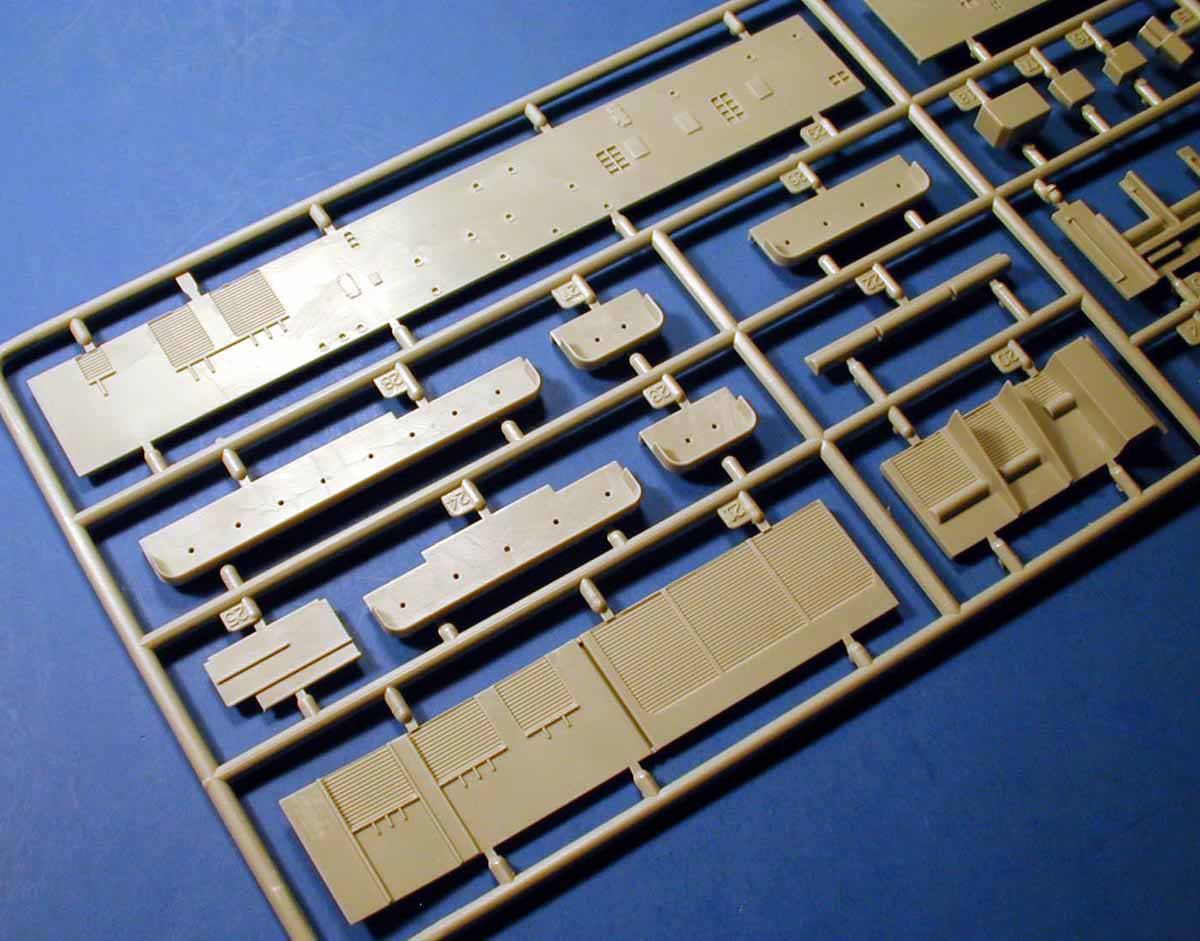
Model companies often include parts that are not meant to be used in a by-the-instructions build - it's cheaper to include some extra plastic than to change the molds to exclude unnecessary parts.
De quoi s'agit-il?
-
Rdutnell
- Posts: 822
- Joined: Mon Dec 19, 2011 9:11 pm
- Location: Norman, Oklahoma
Re: Calling all WWII Essex Class Carrier Fans!
Yep, those are the parts, and I thought they were deck edge tubs, but they don't show up on plans or any of the pix I've been looking at.Timmy C wrote:Is the B Sprue in the CV 14 kit the same as in the Essex kit? If so, they look to me like they're a pair of rectangular deck-edge tubs for two 20mm guns.
Model companies often include parts that are not meant to be used in a by-the-instructions build - it's cheaper to include some extra plastic than to change the molds to exclude unnecessary parts.
I've seen extra parts in kits before, but usually on duplicate sprews.
Thanks for the response! I got my answer, I'm not insane after all. I must have looked at the plans 10 times thinking I must just be missing it. Then I looked at a bunch of pictures and still couldn't figure out where they could possibly go.
Do the parts in question have a spot on the Franklin? If so, the sprew may be used in both models, so they get to cut their costs, like you say.
Completed:
1/350 USS Missouri (BB-63) * 1/350 USS England (DE-635) * "Underway Personnel Transfer" Diorama
In Progress:
1/350 USS Bennington (CV-20)
1/144 USS Greenling (SSN-614) - ACAD/3D Printing
1/144 USS Batfish (SS-310) - ACAD/3D Printing
1/350 USS Missouri (BB-63) * 1/350 USS England (DE-635) * "Underway Personnel Transfer" Diorama
In Progress:
1/350 USS Bennington (CV-20)
1/144 USS Greenling (SSN-614) - ACAD/3D Printing
1/144 USS Batfish (SS-310) - ACAD/3D Printing
-
Timmy C
- Posts: 12470
- Joined: Mon Jan 10, 2005 6:00 pm
- Location: Ottawa, Canada
Re: Calling all WWII Essex Class Carrier Fans!
Yep, they're called out in the Franklin kit - at least, the parts for them are no longer on the sprue in the box of my built-up Franklin, haha.
De quoi s'agit-il?
-
Rdutnell
- Posts: 822
- Joined: Mon Dec 19, 2011 9:11 pm
- Location: Norman, Oklahoma
Re: Calling all WWII Essex Class Carrier Fans!
Definitely a good sign!!!

Completed:
1/350 USS Missouri (BB-63) * 1/350 USS England (DE-635) * "Underway Personnel Transfer" Diorama
In Progress:
1/350 USS Bennington (CV-20)
1/144 USS Greenling (SSN-614) - ACAD/3D Printing
1/144 USS Batfish (SS-310) - ACAD/3D Printing
1/350 USS Missouri (BB-63) * 1/350 USS England (DE-635) * "Underway Personnel Transfer" Diorama
In Progress:
1/350 USS Bennington (CV-20)
1/144 USS Greenling (SSN-614) - ACAD/3D Printing
1/144 USS Batfish (SS-310) - ACAD/3D Printing
-
Rdutnell
- Posts: 822
- Joined: Mon Dec 19, 2011 9:11 pm
- Location: Norman, Oklahoma
Re: Calling all WWII Essex Class Carrier Fans!
WOW!
I just learned two things that I didn't know from one picture on Ray Bean's Essex 2 DVD, which I have reduced and copied before (I hope this is OK). First, I didn't know they actually operated the elevators at the same time as aircraft were landing and second, I didn't know they raised or lowere planes with their engines running and props turning. Hmmmmm!
I just learned two things that I didn't know from one picture on Ray Bean's Essex 2 DVD, which I have reduced and copied before (I hope this is OK). First, I didn't know they actually operated the elevators at the same time as aircraft were landing and second, I didn't know they raised or lowere planes with their engines running and props turning. Hmmmmm!
Completed:
1/350 USS Missouri (BB-63) * 1/350 USS England (DE-635) * "Underway Personnel Transfer" Diorama
In Progress:
1/350 USS Bennington (CV-20)
1/144 USS Greenling (SSN-614) - ACAD/3D Printing
1/144 USS Batfish (SS-310) - ACAD/3D Printing
1/350 USS Missouri (BB-63) * 1/350 USS England (DE-635) * "Underway Personnel Transfer" Diorama
In Progress:
1/350 USS Bennington (CV-20)
1/144 USS Greenling (SSN-614) - ACAD/3D Printing
1/144 USS Batfish (SS-310) - ACAD/3D Printing
-
pbudzik

- Posts: 577
- Joined: Sat Sep 15, 2007 11:40 pm
- Location: California
- Contact:
Re: Calling all WWII Essex Class Carrier Fans!
Judging from the amount of prop blur compared to the other two aircraft in the photo, the prop isn't turning very fast.
Paul
Paul
-
Hippy Ed

- Posts: 2013
- Joined: Wed Nov 29, 2006 12:22 pm
- Location: Calif
- Contact:
Re: Calling all WWII Essex Class Carrier Fans!
Roger that. Looks like they are putting it down below as they come in in order to clear the deck before the rest of the air wing come in...pbudzik wrote:Judging from the amount of prop blur compared to the other two aircraft in the photo, the prop isn't turning very fast.
Paul
If ya lose yer sense of humor...
You've lost everything...
On the Bench:
1/720 Italeri CVN-68 ca 1976/77
1/800 ARii 1/800 CV-59 backdating to 1961 (CVA-59)
1/700Trumpy USS Hornet CV-8 "Doolittle Raiders"
You've lost everything...
On the Bench:
1/720 Italeri CVN-68 ca 1976/77
1/800 ARii 1/800 CV-59 backdating to 1961 (CVA-59)
1/700Trumpy USS Hornet CV-8 "Doolittle Raiders"
-
Tracy White
- Posts: 10628
- Joined: Mon Jan 10, 2005 11:02 am
- Location: EG48
- Contact:
Re: Calling all WWII Essex Class Carrier Fans!
Yes, they obviously wouldn't run the engines at take off power while on the elevator 
One of the advantages of the roller-door design of the post-Lexington class US carriers was that they could ventilate enough to run the engines inside. This was mainly done during warm ups, but in this case, they could also keep them running if it was convenient while putting them below.
It's all about op tempo (operational speed); the faster you can recover and re-spot the deck the quicker you can react. We had refueling stations on the bow and stern, for example, so that as the aircraft landed up front they could be refueled as others were landing behind them. This would continue until everything was down, at which point they would start pushing everything back to re-spot for the next strike. The last aircraft down would be refueled at the stern, that way they didn't have to wait until all of them were refueled to run them back, or start refueling the entire air group only after they were all re-spotted astern. Along with this, aircraft who needed to be pulled for maintenance or repair could be sent below as they were being recovered, so that they weren't in the way when they were trying to re-spot the others for the next strike.
Deck design was more important then most think, and it's one reason that we emerged as such a power house after the war; no one has the experience with large-deck air groups operating with the same cycle speed that we did.
One of the advantages of the roller-door design of the post-Lexington class US carriers was that they could ventilate enough to run the engines inside. This was mainly done during warm ups, but in this case, they could also keep them running if it was convenient while putting them below.
It's all about op tempo (operational speed); the faster you can recover and re-spot the deck the quicker you can react. We had refueling stations on the bow and stern, for example, so that as the aircraft landed up front they could be refueled as others were landing behind them. This would continue until everything was down, at which point they would start pushing everything back to re-spot for the next strike. The last aircraft down would be refueled at the stern, that way they didn't have to wait until all of them were refueled to run them back, or start refueling the entire air group only after they were all re-spotted astern. Along with this, aircraft who needed to be pulled for maintenance or repair could be sent below as they were being recovered, so that they weren't in the way when they were trying to re-spot the others for the next strike.
Deck design was more important then most think, and it's one reason that we emerged as such a power house after the war; no one has the experience with large-deck air groups operating with the same cycle speed that we did.
Tracy White -Researcher@Large
"Let the evidence guide the research. Do not have a preconceived agenda which will only distort the result."
-Barbara Tuchman
"Let the evidence guide the research. Do not have a preconceived agenda which will only distort the result."
-Barbara Tuchman
-
Rdutnell
- Posts: 822
- Joined: Mon Dec 19, 2011 9:11 pm
- Location: Norman, Oklahoma
Re: Calling all WWII Essex Class Carrier Fans!
I have a couple of questions that hopefully someone here will be able to answer.
First, on the Bennington and other Essex class carriers, the front quad 40mm was removed to allow for modifications to the island. I notice that the tower that contained the radar for the quad seems to have remained. What was it used for? Was there anything in the tub, since obviously the radar wasn't necessary?
Second, the Trumpeter 1/350 Essex kit has a platform for the utility boat (Part A15), but from photos I have seen (which aren't very good) it looks like the boat is suspended by cable or rope. How were they really suspended?
First, on the Bennington and other Essex class carriers, the front quad 40mm was removed to allow for modifications to the island. I notice that the tower that contained the radar for the quad seems to have remained. What was it used for? Was there anything in the tub, since obviously the radar wasn't necessary?
Second, the Trumpeter 1/350 Essex kit has a platform for the utility boat (Part A15), but from photos I have seen (which aren't very good) it looks like the boat is suspended by cable or rope. How were they really suspended?
Completed:
1/350 USS Missouri (BB-63) * 1/350 USS England (DE-635) * "Underway Personnel Transfer" Diorama
In Progress:
1/350 USS Bennington (CV-20)
1/144 USS Greenling (SSN-614) - ACAD/3D Printing
1/144 USS Batfish (SS-310) - ACAD/3D Printing
1/350 USS Missouri (BB-63) * 1/350 USS England (DE-635) * "Underway Personnel Transfer" Diorama
In Progress:
1/350 USS Bennington (CV-20)
1/144 USS Greenling (SSN-614) - ACAD/3D Printing
1/144 USS Batfish (SS-310) - ACAD/3D Printing