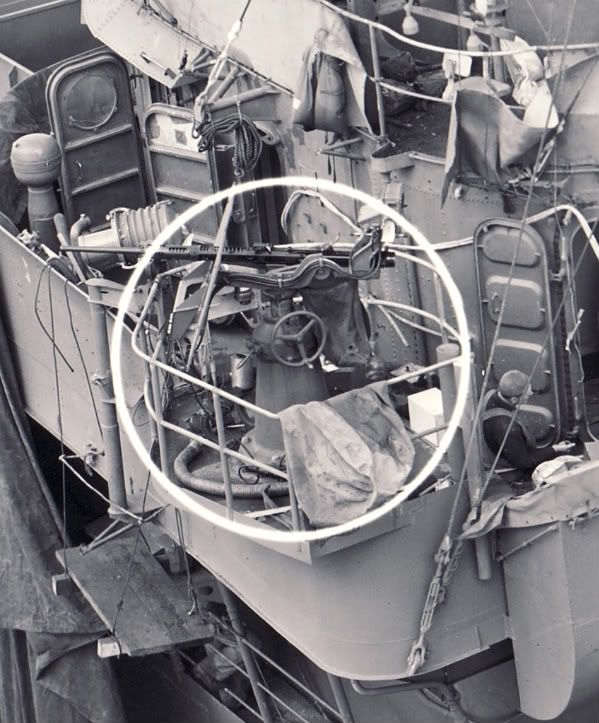
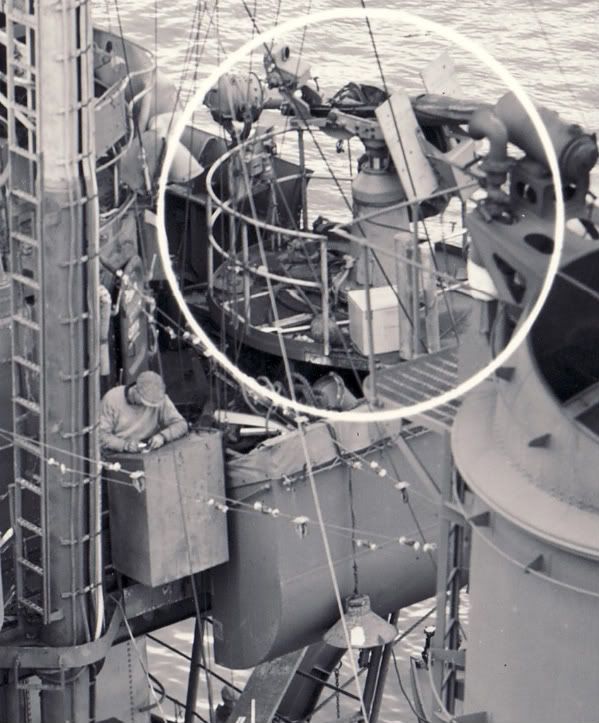
Both images are close-ups of McCalla's bridge on 5 January 1944. The 1st image is the portside bridge wing 20-mm and the other image shows the starboard side 20-mm, cropped from the same photo. This "style" of bridge wing 20-mm installation was the "early" Mare Island Navy Yard type. By the time Buchanan was modified at Mare Island, they changed to the style you see on the Buchanan 1945 kit. Pearl Harbor Navy Yard installed a similar shape mounting platform.
Anyway, I think these will answer your questions. Elevated yes. Shape? Not sure how to define it.
Thanks, Rick. These photos are exactly what I was needing. You are certainly doing "yeoman's service" with all these detail questions. Please know we appreciate your time, knowledge, and efforts.
A bonus on one of these shots is also the detail of the ships horn on the funnel mount! Perfect!
Thanks again,
Rick T.
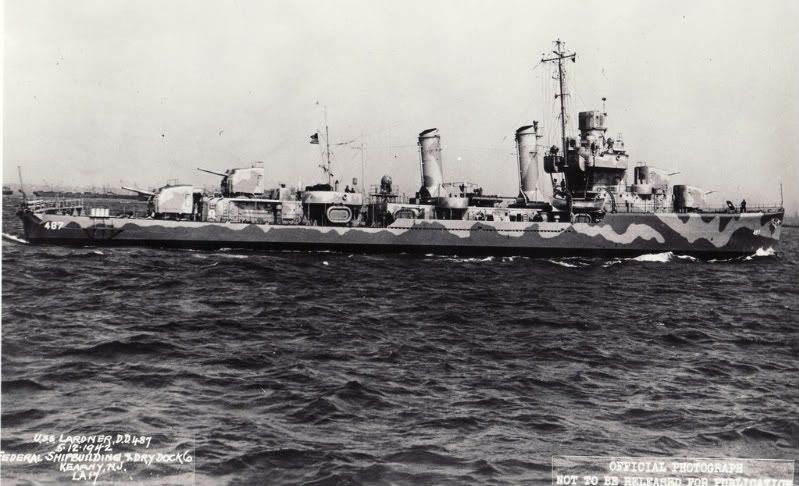
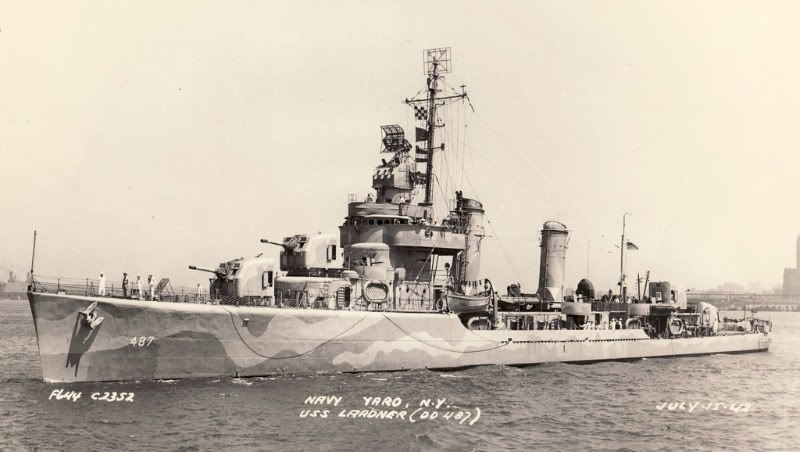
Mirror imaging of Ms 12 Camo is not the desired way. It just is that many times photos of a given ship is NOT available for both sides. It is a close approximation to mirror image for some ships. Here are two images of Lardner (DD-487) one of the Federal built Gleaves units that went to the Pacific. The two images were taken two months apart ... at delivery (Federal seemed to take delivery photos of their ships from the starboard side only ... why I don't know?) and after the New York Navy Yard completed her. They show the port and starboard sides, although not exact, both sides followed a "general" pattern. If you look at the photos of other Federal built Gleaves units built in this "block" ... DD-483 to DD-490 ... Federal did not apply the same style of Ms 12 patterns on all ships. One ship maybe similar to another, but they are not exact. The tricky part is figuring out paterns around the stacks and superstructure.
I'm not a Camo expert. But I don't think anyone will ding you for not having the "RIGHT" pattern on the missing side. These two images show that not being exact may be the most correct. Also, notice how the sun effects the contrast of this camo scheme.
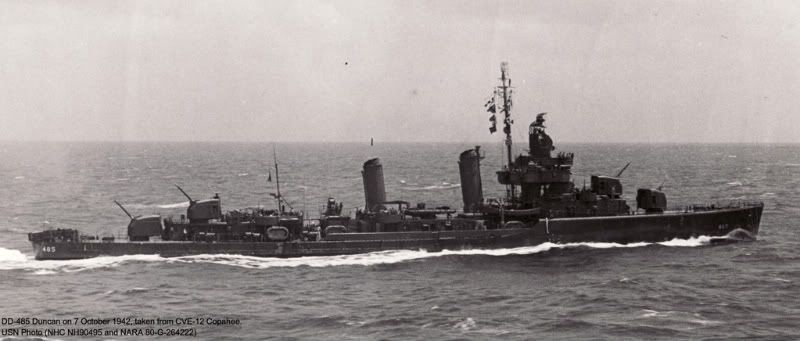
Something else I wanted to illustrate. The third image is of Duncan (DD-485) that I scanned at NHHC dated 7 October 1942. This is why I doubt many ships were still painted in Ms 12 at the time of the November 1942 battles.
Thanks! It looks like the "pattern" on the superstructure funnels etc is a lighter shade than the hull sides? Sorry for the rookie questions, I am much better at late war German armor cammo! I am not looking to be exact, but want to have it look close. And I agree from what little I know, that the ships all seem to have been painted by the time the Fall came.
Rob
If I remember right, the hull was painted with Navy Blue (5-N) and Ocean Grey (5-O), and the superstructure was painted Ocean Grey (5-O) and Haze Grey (5-H). Ms 12 was technically a graded scheme going from darker to lighter as you went up the ship from the waterline.
Thanks, makes sense given how ships look at sea, One final question (well for now) after reading through the posts for the casual observer/builder are the differences in DDs 483-490 as they came from the builders small enough that I could get away with building the Buchanan kit for one of them. This build is planned as a "fun" break from some of my more AMS armor and aircraft builds, but I plan on trying to make minor changes once I settle on a ship at least as much as I can ID them from online pics.
Thanks, Rob
Well the DD-483 through 490 were all built by Federal SB&DD and more or less followed the same configuration. But, there were refinements as the production "line" progressed. In total, Federal built the following 12 "repeat" Gleaves class units with the original round-faced bridge ... DD453-456, and 483-490. DD454-456 were modified by the New York Navy Yard with the squared off 02 deck bridge (below the navigation bridge level ... the Laffey kit has this bridge option) that was made the standard on all repeat Benson-Gleaves units except for Federal-built Gleaves units for some reason. Bristol (DD-453) was completed with 12 50-cal MGs much like the original 24 Benson-Gleaves units were modified to in mid-1941. DD454-456 and 483-488 were completed with a quad 1.1-in mount like the Buchanan kit as a temporary "medium" AA gun until the twin 40-mm mounts were available. DD489-490 were completed with two twin 40-mm mounts as was planned. So, in short DD483-488 can readily be built from the basic Buchanan kit, with minor changes that are not too extreme. DD489-490 can be built if you get a pair of twin 40-mm mounts and make some other modifications that came about with this upgrade and DEPENDING on time period for the model. I would suggest looking through the listed ships at some place like Navsource.org and check out their history at DANFS (linked at the bottom of each ship's page at Navsource) and see which ship is of interest and note any differences.
The list below gives the names to the hull numbers of the Federal-built units and the commissioned date.
I have a question in regard to the Dragon Buchanan model...
Parts A21 and A36, which goes where?
I removed both from the sprue without paying proper attention to which was which. Dose the rolled top edge that shows only on one side face out or in?
Thanks for all the help!
Timm Smith Learn something new about the ship or your job every day. Ignorance is not bliss aboard a warship in wartime. Ignorance could cost the life of yourself, a shipmate, or the loss of the ship.
- Personal Information Booklet CV- 38
So given that there are pictures showing MS 21(?) labeled as being in October on these ships, yet some at least some if not all seem to have sailed in MS 12. When the heck did they paint them? Now admitedly my Navy experience has been on CVs and CVN for the past 22 years and under far different circumstances, and I have seen some big sections painted in port, but that is a big changeover from MS12 to MS21, in a war zone. Late September early October having some more secure anchorages? Or did some of the ones that did not arrive in theater until September arrive in MS21? Or as I have discovered doing armor research (a more difficult subject to research at times it seems) are the dates mis-labeled?
Rob
Timm Smith Learn something new about the ship or your job every day. Ignorance is not bliss aboard a warship in wartime. Ignorance could cost the life of yourself, a shipmate, or the loss of the ship.
- Personal Information Booklet CV- 38
All good questions. I'm not a Camo expert and I only really got interested in the camo used on destroyers more as an aid in ROUGHLY dating images. Ms 12 SEEMS to have had different styles in use that varied with time. I have been curious to see if there was a way of dating the changes. No real luck at that so far. If I remember right, the decision was made in September 1942 by the Pacific Fleet Destroyers CO that all destroyers SHOULD be painted in Ms 21. Meanwhile, at the same time the Atlantic Fleet decided on Ms 22 as a standard. (Tracy White has a copy of the document on his website.) But, these were not the only authorized Camo Schemes in use. Ms 18 is one that makes an appearance on a few Fletchers and on the Leaders in the Atlantic ... why is not clear to me. Destroyers were repainted by the crew in more or less sheltered ports. In the Pacific "Forward areas" it appears that Santos was the most likely location. I don't know when any particular ship was repainted.
As an example: there has been a debate about when the early Fletchers repainted from whatever they were in when they departed the East Coast to Ms 21. Photos are readily available in January 1943 and some post the November battles showing Ms 21. Nicholas for sure and quit likely O'Bannon left the East Coast in Ms 18 and crew reports are that they repainted in the first week of November 1942. Ms 18 would be relatively easy repaint to Ms 21. Ms 18 had the hull in 5-N up to he deck edge and the superstructure painted in Haze (5-H), so all that was needed was to paint the superstructure in 5-N. The other Fletcher class destroyer to arrive at the same time as these two, Fletcher herself, is a mystery of what she was painted in when she left the East Coast. By January 1943 she was in Ms 21. It appears that the Fletchers that arrived after these three were ALL painted in either Ms 21 or Ms 22, which were then repainted in Ms 21. that is except for a couple painted in Ms 18 and they KEPT that scheme well into late 1943. I have found images of Radford departing the East Coast in Ms 22 and arrived in the Pacific still in Ms 22. I looked in her War Diary for other reasons, but did look to see if any mention was made as to when she repainted to Ms 21. From her arrival at Santos in mid-January until mid-February, Radford was quite active and there just doesn't appear to have been any time for a repaint until a downtime period mid-February at Santos.
These are Fletchers and the famous Benson-Gleaves units that fought in the Solomon Islands battles arrived earlier and were in Ms 12. More units of this dual-class arrived with the first Fletchers. I don't really know when they were repainted without a lot of research and that isn't my main focus when I do get a chance to get to NARA. But the photos seem to suggest that at least some repainted in about October 1942 to Ms 21. But, I have not found many photos for that time period, but I have not gotten through all these ships in the card catalog for the 80-G series either. The date on the image of Duncan is likely pretty accurate (exact day?, month likely) because it was identified as being taken by a specific ship that can be traced via War Diaries to when they were together. The authorized Camo Schemes were changed in I think mid-summer 1942 to the Ms 18/21/22 series, but it was awhile before they repainted ships. There are many photos of destroyers in Ms 12 in September 1942. By what date ALL of the destroyers painted out of Ms 12 to Ms 21 ... I don't really know.
Wow great work. For a non Cammo expert you sure seem to have a grip on the subject and are able to distil it well. I agree that Navy pictures seem to be more accurate as far as dates go, than Army (of any nation) or other branches, perhaps it is our love of logging every bloody thing we do from cleaning heads to bombing things that makes it easier!
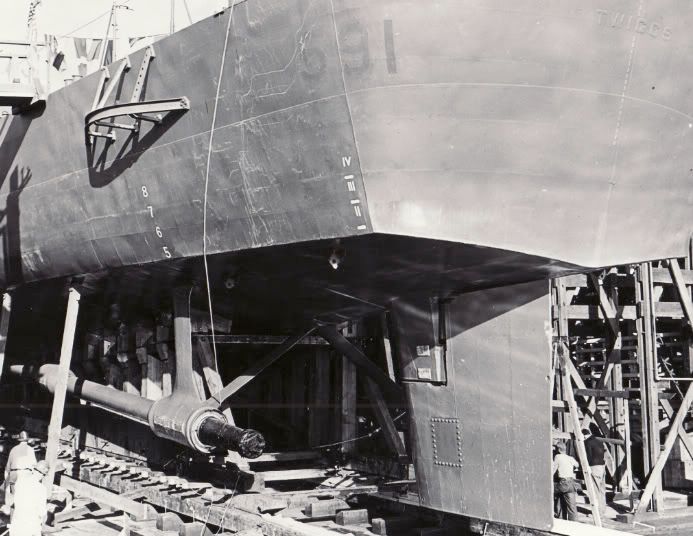
Were the propeller shaft struts tapered on the leading edge (and the trailing edge too) on the Buchanan and less specifically all Gleaves class DD? Just looking at those parts C7 and C8 and seeing the squared off thick strut arm makes me think that in true 1:1 scale that would cause a lot of drag and turbulence. Anyone looked at pictures of DDs in drydock in that area?
Just made me wonder.
Timm Smith Learn something new about the ship or your job every day. Ignorance is not bliss aboard a warship in wartime. Ignorance could cost the life of yourself, a shipmate, or the loss of the ship.
- Personal Information Booklet CV- 38
Yes they were. The ones in the kit are better than most. A few minutes with a sanding stick and you should be good to go. Here is a link to photo of Kidd's (DD-661) struts - no real difference. http://farm3.static.flickr.com/2345/186 ... bb.jpg?v=0
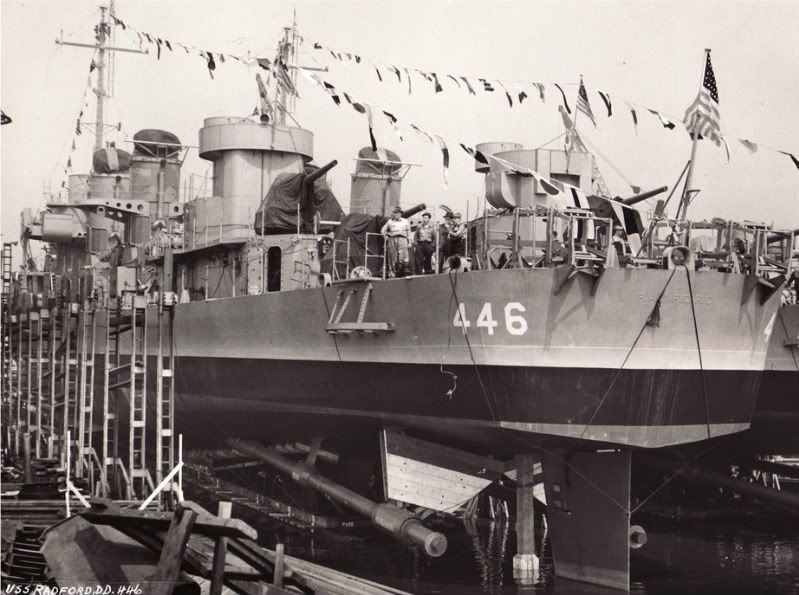
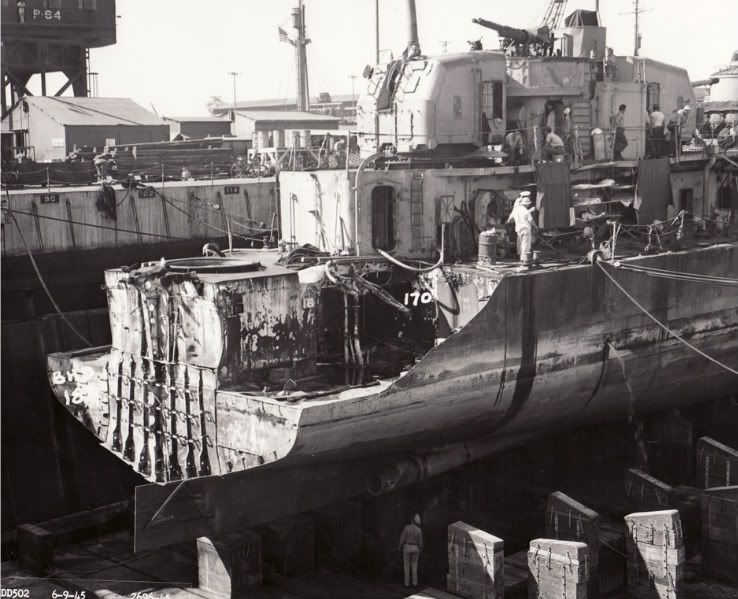
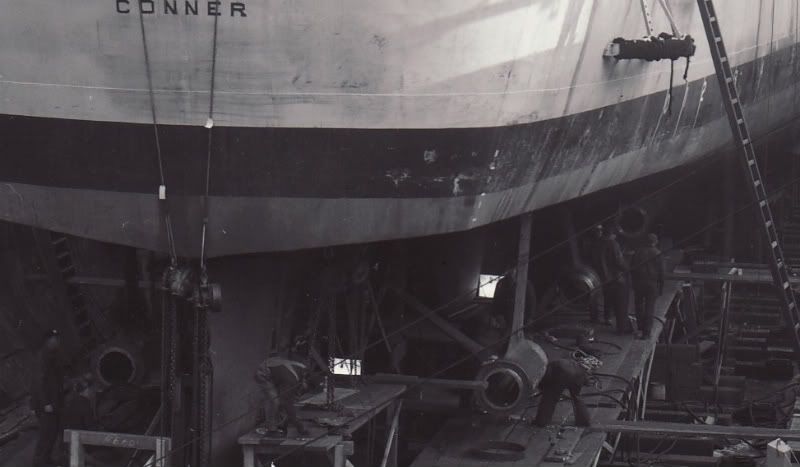
I thought I had scans of Benson-Gleaves out of the water showing the props, struts, rudder area ... but I could not find any. But, I have scanned a few Fletchers and I suspect the construction techniques were similar ...
In the following order: Radford (DD-446) as building, Sigsbee (DD-502) at Pearl Harbor without the struts in place (but you can see how the shaft entered the hull) being repaired from Kamikaze damage in 1945, Conner (DD-582) building, and Twiggs (DD-591) building. Hope these help.
It looks very similar to the profile of the Essex class carrier I just built.
New question...
How wide is the boot topping on these Gleaves class DDs?
Thanks again
Timm Smith Learn something new about the ship or your job every day. Ignorance is not bliss aboard a warship in wartime. Ignorance could cost the life of yourself, a shipmate, or the loss of the ship.
- Personal Information Booklet CV- 38
For what it's worth, the struts were designed from the start to be wing shaped. However they were overly simplified for the molding process. As I look at the way the parts came out I am a little disappointed as I spent a lot of time on that feature.