Thanks for the kind words, gentlemen.
My orginal idea was to turn down some Plexiglas rod to fit into the brass tube, but then I thought that the liquid Plexiglas method would be faster. I will try to heat-shrink the brass tube over the Plexiglas rod, which does away with any glue and thus keeps the brass clean on the outside for smooth insertion into the drill-holes.
I am still far away from completion and, I am afraid, the gun will go in last due to its very fragile nature. I still have to make the boats and then comes the most dreaded part of all: rigging the two-chain-rail around the deck-house and the forecastle. That gives plenty of opportunity to screw things up.
1:160 S.M.S. WESPE Armoured Gunboat (1876)
Moderators: MartinJQuinn, JIM BAUMANN, HMAS, Tiny69, Dave Wooley
-
wefalck

- Posts: 2109
- Joined: Wed Sep 28, 2011 12:04 pm
- Location: Paris
- Contact:
Re: 1:160 S.M.S. WESPE Armoured Gunboat (1876)
Eberhard
Former chairman Arbeitskreis historischer Schiffbau e.V. (German Association for Shipbuilding History)
--------------------------------------------------------------------------------------------------------------------------------------------------------------------------------------------




Former chairman Arbeitskreis historischer Schiffbau e.V. (German Association for Shipbuilding History)
--------------------------------------------------------------------------------------------------------------------------------------------------------------------------------------------
-
Fliger747
- Posts: 5068
- Joined: Wed Jan 02, 2013 1:15 am
Re: 1:160 S.M.S. WESPE Armoured Gunboat (1876)
It will be interesting to see how the skylights come out. The plexiglass method does allow a nice flat realistic surface.
Just curious about the main battery. The installation is interesting, very much like the shore based batteries that retract into a revetment. This was a time of great change in naval armament and armor, leading from the "noughts" to the dreadnoughts in the span of a career. The age of fighting sail and cannonballs would still be in the living memories of old sailors.
Cheers: Tom
Just curious about the main battery. The installation is interesting, very much like the shore based batteries that retract into a revetment. This was a time of great change in naval armament and armor, leading from the "noughts" to the dreadnoughts in the span of a career. The age of fighting sail and cannonballs would still be in the living memories of old sailors.
Cheers: Tom
-
wefalck
- Posts: 2109
- Joined: Wed Sep 28, 2011 12:04 pm
- Location: Paris
- Contact:
Re: 1:160 S.M.S. WESPE Armoured Gunboat (1876)
At that time the designers had to meet several design criteria that are mutually exclusive and also had to battle with a number of technical constraints.
On my Web-page (https://www.maritima-et-mechanika.org/m ... class.html) on S.M.S. WESPE I have pictures of (builders') models of various other designs from different navies of the same type of gun-boat with a very large gun. Originally, the design was meant to be just a platform to test the big Armstrong guns, but then it offered a possibility to 'field' (or rather to 'sea') a large gun at comparatively little cost. The idea was that the large gun could engage an enemy at long distance - before the enemy could bring to bear its own (smaller) guns to bear. Hence no armour was foreseen.
The gun on most types of these boats could not be trained, because the idea was that the gun-boat would approach to the enemy in a shallow curve and the gun would be fired, as soon as the enemy would pass through the line-of-sight - hence the whole gun would be trained. For the same reason the boats often had two screws improve maneuvrability.
One of the tactical ideas behind the German design was that they could fall dry in the shallow Wadden Sea off the German North Sea coast, serving as a kind of detached mobile fort. The shallow tidal flats would prevent the enemy from approaching too close, while the 30,5 cm-gun could engage them. Hence, the gun was put onto a pivoted gun carriage that could be trained over a considerable arc.
We all know that armour became all the rage after it showed its usefulness during the Crimean War. However, the technology of armoured turrets was quite new at the time (about 10 years old) and resulted in a lot of additional weight. The main problem, however, was the poor ventilation of these turrets at the time, when the guns fired black powder charges. It would take a long time to clear out the gun smoke, reducing the effective rate of fire as usually the gun-sights were fixed to the gun itself at that time. A barbette offered less protection, but the gun smoke would clear away more rapidly. It was, for the same reason, also the standard in land fortifications - guns were firing 'over the bank'.
Of course, the barbette arrangement leaves the crews and the gun-barrel completely unprotected. It was probably assumed that these gun-boats would never engage in close combat. However, only a few years later small, fast torpedo-boats appeared and kind of made these gun-boats if not obsolete, so at least vulnerable to attack by such craft. To protect the WESPE-class boats to some degree against the fire from light QF guns or early forms of machine guns (e.g. Hotchkiss), later in their life movable armour shields were installed on top of the barbette and they were given an armoured conning tower that also contained the now powered steering apparatus,
On my Web-page (https://www.maritima-et-mechanika.org/m ... class.html) on S.M.S. WESPE I have pictures of (builders') models of various other designs from different navies of the same type of gun-boat with a very large gun. Originally, the design was meant to be just a platform to test the big Armstrong guns, but then it offered a possibility to 'field' (or rather to 'sea') a large gun at comparatively little cost. The idea was that the large gun could engage an enemy at long distance - before the enemy could bring to bear its own (smaller) guns to bear. Hence no armour was foreseen.
The gun on most types of these boats could not be trained, because the idea was that the gun-boat would approach to the enemy in a shallow curve and the gun would be fired, as soon as the enemy would pass through the line-of-sight - hence the whole gun would be trained. For the same reason the boats often had two screws improve maneuvrability.
One of the tactical ideas behind the German design was that they could fall dry in the shallow Wadden Sea off the German North Sea coast, serving as a kind of detached mobile fort. The shallow tidal flats would prevent the enemy from approaching too close, while the 30,5 cm-gun could engage them. Hence, the gun was put onto a pivoted gun carriage that could be trained over a considerable arc.
We all know that armour became all the rage after it showed its usefulness during the Crimean War. However, the technology of armoured turrets was quite new at the time (about 10 years old) and resulted in a lot of additional weight. The main problem, however, was the poor ventilation of these turrets at the time, when the guns fired black powder charges. It would take a long time to clear out the gun smoke, reducing the effective rate of fire as usually the gun-sights were fixed to the gun itself at that time. A barbette offered less protection, but the gun smoke would clear away more rapidly. It was, for the same reason, also the standard in land fortifications - guns were firing 'over the bank'.
Of course, the barbette arrangement leaves the crews and the gun-barrel completely unprotected. It was probably assumed that these gun-boats would never engage in close combat. However, only a few years later small, fast torpedo-boats appeared and kind of made these gun-boats if not obsolete, so at least vulnerable to attack by such craft. To protect the WESPE-class boats to some degree against the fire from light QF guns or early forms of machine guns (e.g. Hotchkiss), later in their life movable armour shields were installed on top of the barbette and they were given an armoured conning tower that also contained the now powered steering apparatus,
Eberhard
Former chairman Arbeitskreis historischer Schiffbau e.V. (German Association for Shipbuilding History)
--------------------------------------------------------------------------------------------------------------------------------------------------------------------------------------------
Former chairman Arbeitskreis historischer Schiffbau e.V. (German Association for Shipbuilding History)
--------------------------------------------------------------------------------------------------------------------------------------------------------------------------------------------
-
wefalck
- Posts: 2109
- Joined: Wed Sep 28, 2011 12:04 pm
- Location: Paris
- Contact:
Re: 1:160 S.M.S. WESPE Armoured Gunboat (1876)
Assembly of the steering-stands
Progress has been slowed down somewhat due to travels and bread-winning work �
Much time has been spent painting various details, often beginning with a basic layer applied by airbrush and then detailing with a hairbrush. In many cases several coats of paints and washes are needed. In particular parts that are meant to resemble varnished or oiled wood will need a base-coat followed by washes of darker paint and again followed by several coats of varnish to increase the �depth� of the colour. �Oiled� wood is finished off with Vallejo satin varnish, while �varnished� wood is finished off with a 1:1 mixture of Vallejo gloss and satin varnish. The satin varnish is not glossy enough to simulate varnished wood.
Below are a couple of shots of the assembly of the two steering stands from the laser-cut parts produced earlier. The steering wheels and the brackets are painted in Prince August (Vallejo) transparent �mahogany�, while the gratings were given a base-coat of Prince August (Vallejo) �wood�, followed by washes of Schmincke �ochre� to simulate teak.
I have to take some better close-up shots, but the steering-rope leads into flared down-pipes fashion from 0.6 mm OD/0.4 mm ID brass tubes by widening one end.
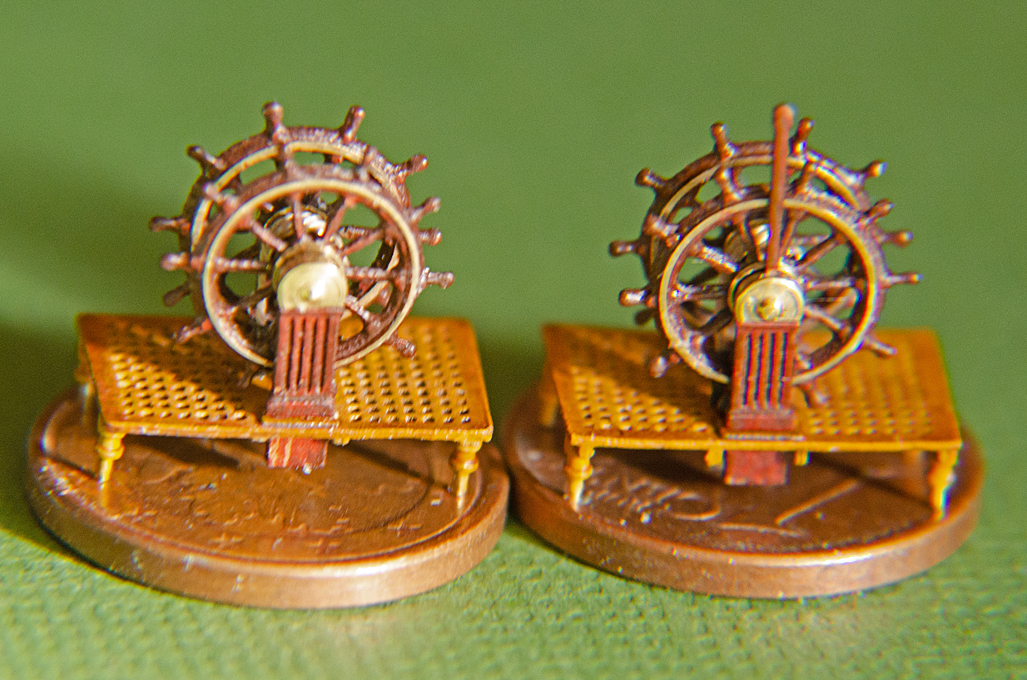
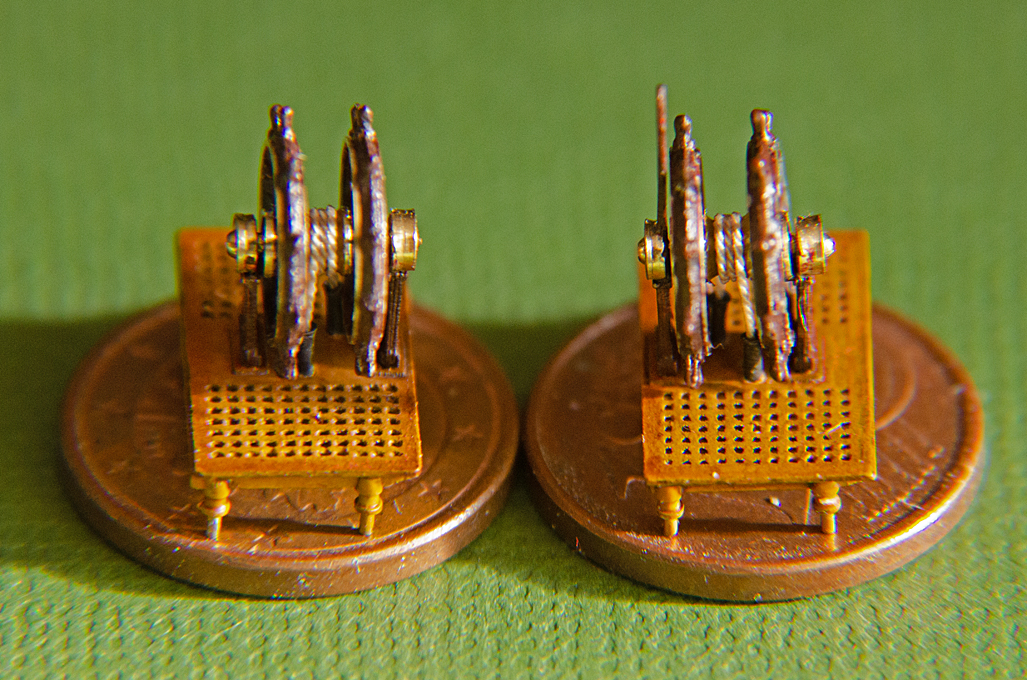
BTW, the steering rope looks a bit like an anachronism in 1876, when steering chains and even steam-steering was available. However, it seems that warships have retained this simple mechanisms for a while, presumably because it was easier to repair battle damage off-shore.
To be continued ....
Progress has been slowed down somewhat due to travels and bread-winning work �
Much time has been spent painting various details, often beginning with a basic layer applied by airbrush and then detailing with a hairbrush. In many cases several coats of paints and washes are needed. In particular parts that are meant to resemble varnished or oiled wood will need a base-coat followed by washes of darker paint and again followed by several coats of varnish to increase the �depth� of the colour. �Oiled� wood is finished off with Vallejo satin varnish, while �varnished� wood is finished off with a 1:1 mixture of Vallejo gloss and satin varnish. The satin varnish is not glossy enough to simulate varnished wood.
Below are a couple of shots of the assembly of the two steering stands from the laser-cut parts produced earlier. The steering wheels and the brackets are painted in Prince August (Vallejo) transparent �mahogany�, while the gratings were given a base-coat of Prince August (Vallejo) �wood�, followed by washes of Schmincke �ochre� to simulate teak.
I have to take some better close-up shots, but the steering-rope leads into flared down-pipes fashion from 0.6 mm OD/0.4 mm ID brass tubes by widening one end.
BTW, the steering rope looks a bit like an anachronism in 1876, when steering chains and even steam-steering was available. However, it seems that warships have retained this simple mechanisms for a while, presumably because it was easier to repair battle damage off-shore.
To be continued ....
Eberhard
Former chairman Arbeitskreis historischer Schiffbau e.V. (German Association for Shipbuilding History)
--------------------------------------------------------------------------------------------------------------------------------------------------------------------------------------------
Former chairman Arbeitskreis historischer Schiffbau e.V. (German Association for Shipbuilding History)
--------------------------------------------------------------------------------------------------------------------------------------------------------------------------------------------
-
Maarten Sch�nfeld

- Posts: 1842
- Joined: Fri Dec 12, 2008 12:44 pm
- Location: Herk-de-Stad, Belgium
Re: 1:160 S.M.S. WESPE Armoured Gunboat (1876)
Hi Wefalck,
Glad you photographed the steering wheels on top of a Eurocent coin, showing how tiny it is! It looks lovely and beautiful, very realistic the painting indeed. Thanks for the details you wrote about the painting.
Reading back your earlier posts on the gun itself I had to do the math how large it really is: only 4cm long! The amount of detail suggests it being four or five times larger... 1:160 is probably a familiar scale only to some train modelers, for ships it's quite uncommon of course.
Glad you photographed the steering wheels on top of a Eurocent coin, showing how tiny it is! It looks lovely and beautiful, very realistic the painting indeed. Thanks for the details you wrote about the painting.
Reading back your earlier posts on the gun itself I had to do the math how large it really is: only 4cm long! The amount of detail suggests it being four or five times larger... 1:160 is probably a familiar scale only to some train modelers, for ships it's quite uncommon of course.
"I've heard there's a wicked war a-blazing, and the taste of war I know so very well
Even now I see the foreign flag a-raising, their guns on fire as we sail into hell"
Roger Whittaker +9/13/2023
Even now I see the foreign flag a-raising, their guns on fire as we sail into hell"
Roger Whittaker +9/13/2023
-
wefalck
- Posts: 2109
- Joined: Wed Sep 28, 2011 12:04 pm
- Location: Paris
- Contact:
Re: 1:160 S.M.S. WESPE Armoured Gunboat (1876)
I choose the 1:160 scale because of the availability of N-scale model railway figures for manning the ship ... 1:100 (or rather 1:90 for the sake of HO-scale figures) would have made a too big model for my limited display space and 1:200 (or rather 1:220 for the sake of Z-scale figures) would have been to small for reasonable detail ...
Eberhard
Former chairman Arbeitskreis historischer Schiffbau e.V. (German Association for Shipbuilding History)
--------------------------------------------------------------------------------------------------------------------------------------------------------------------------------------------
Former chairman Arbeitskreis historischer Schiffbau e.V. (German Association for Shipbuilding History)
--------------------------------------------------------------------------------------------------------------------------------------------------------------------------------------------
-
marijn van gils
- Posts: 2691
- Joined: Tue Feb 06, 2007 10:24 am
- Location: Belgium
Re: 1:160 S.M.S. WESPE Armoured Gunboat (1876)
Beautiful work! 
I find I'm missing threads on the scratchbuilding subforum all too often.
Sometimes I wish it would be merged with the 'works in proegress' section...
I find I'm missing threads on the scratchbuilding subforum all too often.
Sometimes I wish it would be merged with the 'works in proegress' section...
-
Iceman 29

- Posts: 1945
- Joined: Tue Sep 29, 2020 4:35 pm
- Location: Bretagne, France
Re: 1:160 S.M.S. WESPE Armoured Gunboat (1876)
However, if you look closely, I am on the forum every day, it is one of the most active, if not the most.
But it's true that we are at the bottom of the main page and that the members don't think to go and have a look at it
I would say that the "work in progress" forum should be linked to the "scratchbuilding" forum.
Nice job with micro tiny steering wheel! I would say that the 1 cent euro coin is a fake.
But it's true that we are at the bottom of the main page and that the members don't think to go and have a look at it
I would say that the "work in progress" forum should be linked to the "scratchbuilding" forum.
@Welfackmarijn van gils wrote:Beautiful work!
I find I'm missing threads on the scratchbuilding subforum all too often.
Sometimes I wish it would be merged with the 'works in proegress' section...
Nice job with micro tiny steering wheel!
I would say that the 1 cent euro coin is a fake.Pascal
�Battleship Bretagne 3D: https://vu.fr/FvCY
�SS Delphine 3D: https://vu.fr/NeuO
�SS Nomadic 3D: https://vu.fr/tAyL
�USS Nokomis 3D: https://vu.fr/kntC
�USS Pamanset 3D: https://vu.fr/jXGQ
�Battleship Bretagne 3D: https://vu.fr/FvCY
�SS Delphine 3D: https://vu.fr/NeuO
�SS Nomadic 3D: https://vu.fr/tAyL
�USS Nokomis 3D: https://vu.fr/kntC
�USS Pamanset 3D: https://vu.fr/jXGQ
-
wefalck
- Posts: 2109
- Joined: Wed Sep 28, 2011 12:04 pm
- Location: Paris
- Contact:
Re: 1:160 S.M.S. WESPE Armoured Gunboat (1876)
I am clicking every morning on 'view new posts', so I should see all posts, irrespective of where they are located in the forum ... beware that the 'new' counter is reset every time you go back to the forum. So it is really the first thing I do, before going to posts for which I have received a notification.
Eberhard
Former chairman Arbeitskreis historischer Schiffbau e.V. (German Association for Shipbuilding History)
--------------------------------------------------------------------------------------------------------------------------------------------------------------------------------------------
Former chairman Arbeitskreis historischer Schiffbau e.V. (German Association for Shipbuilding History)
--------------------------------------------------------------------------------------------------------------------------------------------------------------------------------------------
-
wefalck
- Posts: 2109
- Joined: Wed Sep 28, 2011 12:04 pm
- Location: Paris
- Contact:
Re: 1:160 S.M.S. WESPE Armoured Gunboat (1876)
Porthole Glazing
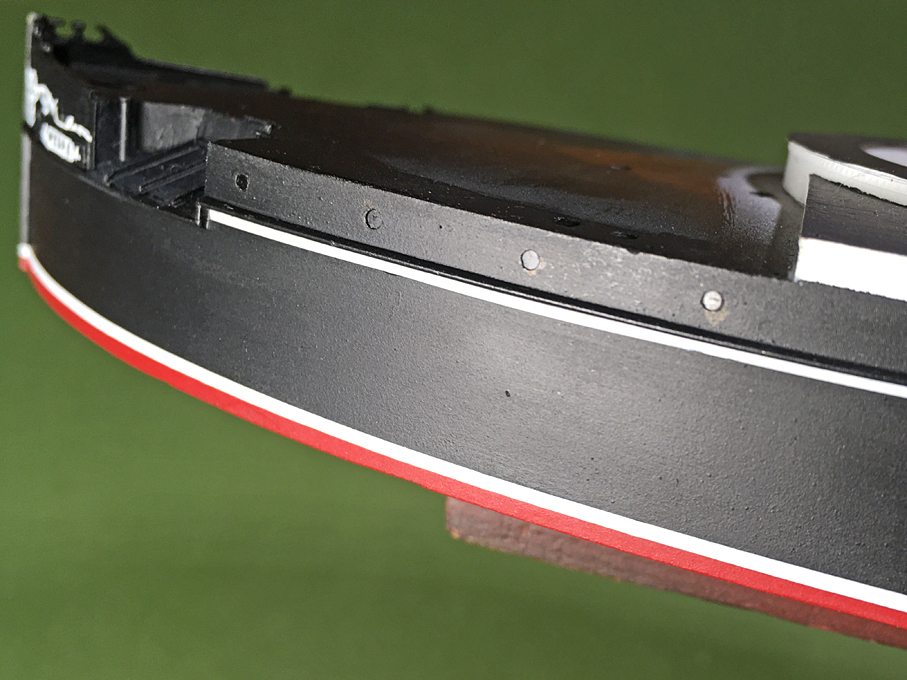
Following the discussion on ways to make the porthole glazing further up, I looked over all available photographs and came to the conclusion that one does not actually seem to see the bronze frame from the outside. On the other hand, most photographs or their scans do not have sufficient resolution to really see such detail.
In order to make my life simpler, I decided to go for solid Plexiglas plugs. I did have 1 mm Plexiglas rod in stock and short sections were cut from this to make 2 mm long plugs. The plugs have to be a bit longer than their diameter, so that they can be inserted straight. The front face was turned flat on the lathe and the back-end was given a bit of a chamfer for easy entry into the pre-drilled holes after which it was painted black using a black permanent marker pen. The pieces were then transferred to the micro-mill for polishing the front face with a silicon rubber polishing bit.
In order ensure that the porthole plugs are set at equal depth, a little �tool� was made, a punch with a recess of 0.3 mm depth around the rim.
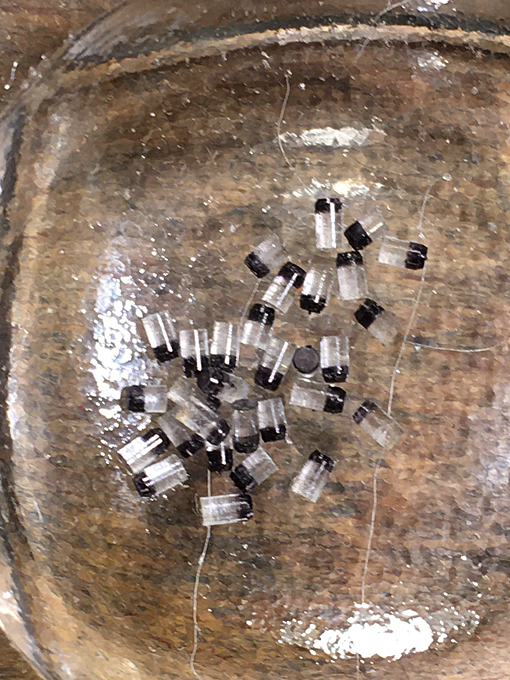
Collection of Plexiglas plugs ready for insertion
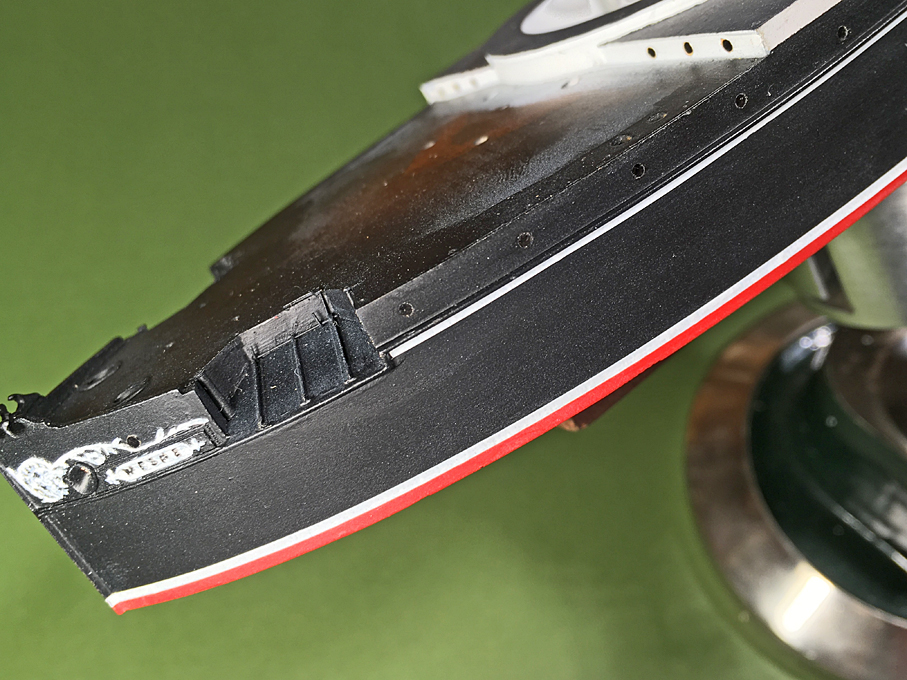
Glazed portholes
Glazed portholes
To be continued ....
Following the discussion on ways to make the porthole glazing further up, I looked over all available photographs and came to the conclusion that one does not actually seem to see the bronze frame from the outside. On the other hand, most photographs or their scans do not have sufficient resolution to really see such detail.
In order to make my life simpler, I decided to go for solid Plexiglas plugs. I did have 1 mm Plexiglas rod in stock and short sections were cut from this to make 2 mm long plugs. The plugs have to be a bit longer than their diameter, so that they can be inserted straight. The front face was turned flat on the lathe and the back-end was given a bit of a chamfer for easy entry into the pre-drilled holes after which it was painted black using a black permanent marker pen. The pieces were then transferred to the micro-mill for polishing the front face with a silicon rubber polishing bit.
In order ensure that the porthole plugs are set at equal depth, a little �tool� was made, a punch with a recess of 0.3 mm depth around the rim.
Collection of Plexiglas plugs ready for insertion
Glazed portholes
Glazed portholes
To be continued ....
Eberhard
Former chairman Arbeitskreis historischer Schiffbau e.V. (German Association for Shipbuilding History)
--------------------------------------------------------------------------------------------------------------------------------------------------------------------------------------------
Former chairman Arbeitskreis historischer Schiffbau e.V. (German Association for Shipbuilding History)
--------------------------------------------------------------------------------------------------------------------------------------------------------------------------------------------
-
Maarten Sch�nfeld
- Posts: 1842
- Joined: Fri Dec 12, 2008 12:44 pm
- Location: Herk-de-Stad, Belgium
Re: 1:160 S.M.S. WESPE Armoured Gunboat (1876)
O, wouldn't that be lovely... lovely!
Maarten
Maarten
"I've heard there's a wicked war a-blazing, and the taste of war I know so very well
Even now I see the foreign flag a-raising, their guns on fire as we sail into hell"
Roger Whittaker +9/13/2023
Even now I see the foreign flag a-raising, their guns on fire as we sail into hell"
Roger Whittaker +9/13/2023
-
wefalck
- Posts: 2109
- Joined: Wed Sep 28, 2011 12:04 pm
- Location: Paris
- Contact:
Re: 1:160 S.M.S. WESPE Armoured Gunboat (1876)
I think the crew in the forecastle would have liked to have a blazing fire and lots of chocolate to eat !
I have the feeling that life on these boats was not too cosy - they must have been hot in summer, cold in winter - not much of insulation from the iron plating ...
I have the feeling that life on these boats was not too cosy - they must have been hot in summer, cold in winter - not much of insulation from the iron plating ...
Eberhard
Former chairman Arbeitskreis historischer Schiffbau e.V. (German Association for Shipbuilding History)
--------------------------------------------------------------------------------------------------------------------------------------------------------------------------------------------
Former chairman Arbeitskreis historischer Schiffbau e.V. (German Association for Shipbuilding History)
--------------------------------------------------------------------------------------------------------------------------------------------------------------------------------------------
-
Maarten Sch�nfeld
- Posts: 1842
- Joined: Fri Dec 12, 2008 12:44 pm
- Location: Herk-de-Stad, Belgium
Re: 1:160 S.M.S. WESPE Armoured Gunboat (1876)
Yes, you got my idea! The portholes will at least keep the wind and water out...
Lots of chocolate for me to eat
Lots of coal makin' lots of heat
Warm face, warm hands, warm feet
Oh, wouldn't it be loverly?
Lots of chocolate for me to eat
Lots of coal makin' lots of heat
Warm face, warm hands, warm feet
Oh, wouldn't it be loverly?
"I've heard there's a wicked war a-blazing, and the taste of war I know so very well
Even now I see the foreign flag a-raising, their guns on fire as we sail into hell"
Roger Whittaker +9/13/2023
Even now I see the foreign flag a-raising, their guns on fire as we sail into hell"
Roger Whittaker +9/13/2023
-
marijn van gils
- Posts: 2691
- Joined: Tue Feb 06, 2007 10:24 am
- Location: Belgium
Re: 1:160 S.M.S. WESPE Armoured Gunboat (1876)
Beautiful work on those portholes!
The quick and easy solution for this 'problem' would be Kristal Klear. But I doubt the surface would look so nicely flat as you have achieved here...
The quick and easy solution for this 'problem' would be Kristal Klear. But I doubt the surface would look so nicely flat as you have achieved here...
-
Fliger747
- Posts: 5068
- Joined: Wed Jan 02, 2013 1:15 am
Re: 1:160 S.M.S. WESPE Armoured Gunboat (1876)
Yes the effect of an optically flat porthole glass is much superior to other methods. For execution a clean, straight and accurate hole must be drilled which can have it's challenges. Nice work and innovative!
Tom
Tom
-
wefalck
- Posts: 2109
- Joined: Wed Sep 28, 2011 12:04 pm
- Location: Paris
- Contact:
Re: 1:160 S.M.S. WESPE Armoured Gunboat (1876)
If you fill a drilled hole with a viscous fluide (e.g. an acrylic gel such as Kristal Klear), it will develop a meniscus - not something one really wants. In order to use that method, one would need to use a a thin tube, fill it (partically) with the material and afterwards grind it flat. I used this method for the skylights in the rear deck, above the officer's quarter, but I used liquid Plexiglas (which is normally used as cement to join together Plexiglas parts and has nearly the same properties as factory-cured Plexiglas).
Eberhard
Former chairman Arbeitskreis historischer Schiffbau e.V. (German Association for Shipbuilding History)
--------------------------------------------------------------------------------------------------------------------------------------------------------------------------------------------
Former chairman Arbeitskreis historischer Schiffbau e.V. (German Association for Shipbuilding History)
--------------------------------------------------------------------------------------------------------------------------------------------------------------------------------------------
-
Fliger747
- Posts: 5068
- Joined: Wed Jan 02, 2013 1:15 am
Re: 1:160 S.M.S. WESPE Armoured Gunboat (1876)
Interesting as used to have a tube of this very thick plexiglass cement. I used it to assemble the main superstructure pieces and stack of my 1:192 Alaska but never considered it for such other uses. With plexiglass bulkheads a decent glass effect can be achieved by masking. I have also made curved boat windshields by shaping, polishing and masking for closed in canopies.
Thank you for sharing your innovative methods! Tom
Thank you for sharing your innovative methods! Tom
-
wefalck
- Posts: 2109
- Joined: Wed Sep 28, 2011 12:04 pm
- Location: Paris
- Contact:
Re: 1:160 S.M.S. WESPE Armoured Gunboat (1876)
Thanks, Tom! One problem with using such very viscous liquids to simulate window glazing is that you can easily get air-bubbles in them. Professionals would put the pieces into a vacuum chamber to remove that, but very few of us would have one ...
I also used the method of 'masking off' areas on sheets of Plexiglas. In fact, when the bullseye frame are attached to the outside, I cemented them onto the Plexiglas sheet and then painted around them. I could have made the deckhouse from Plexiglas and used this technique.
********************
An enigmatic feature in the barbette
On the plan view of the original drawings from the mid-1880s two enigmatic features appear, but they are not represented in the cross-sections, which could have provided further insight. These featured have puzzled me for a while until I realised that the oval shaped items look like the cross-section of a rifle-butt � we are looking down onto two rifle-racks. This interpretation was confirmed, when I came across a later drawing that showed the same feature, but with an annotation.
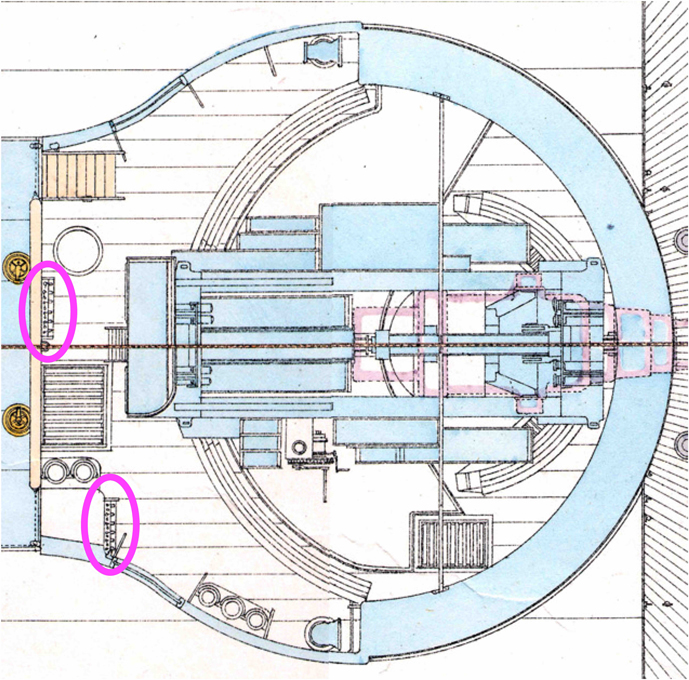
Enigmatic feature in the barbette
Warships at all times were provided with some small arms to fend off boarding-parties, or to form boarding- or landing-parties themselves. According to RECKENDORF (1983) ships of the Imperial German Navy at that time in question were provided with the J�gerb�chse 71 and the appropriate side arm. The J�gerb�chse 71 is a refined version of the Gewehr 71 that was introduced after the Franco-German War 1870/71 to replace the famous �Z�ndnadelgewehr�. J�ger stands for hunter and B�chse for rifle. Compared to the standard infantry weapon Gewehr 71, the J�gerb�chse was more precisely manufactured/inspected and had a finer trigger, as the J�ger-batallions received better gun training and a good proportion recruited from the hunting and forestry professions. Both weapons were still single-loaders, chambered for metal cartridges.
In the cited book and on the Internet I found good photographs of the rifle. At 1:160 scale it is only 7.8 mm long, so requires considerable simplification. I drew the stock to be cut from two layers of 0.2 mm thick Canson-paper using the laser-cutter. At the same time, I drew my interpretation of what the rifle-rack might have looked like, as I only had the plan-view.
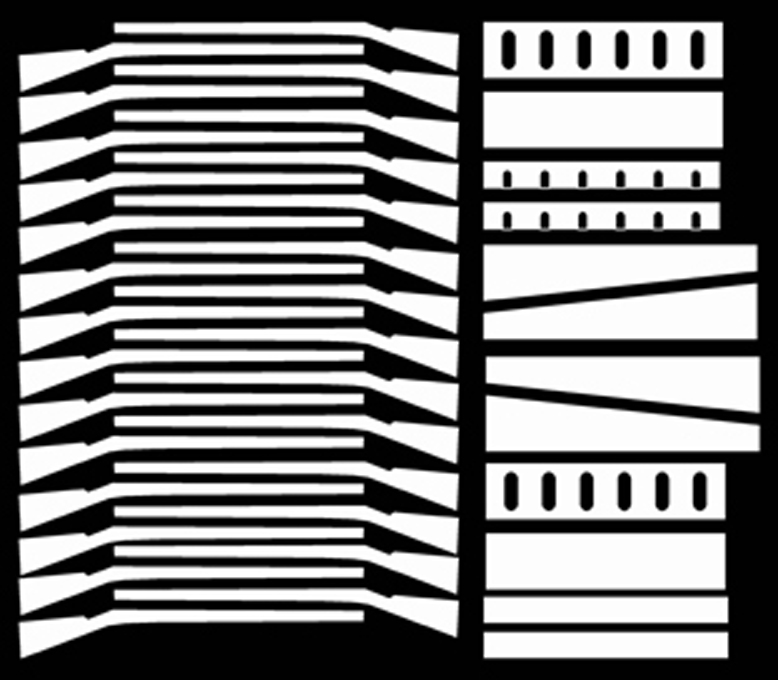
Template for laser-cutting the rifles and the rack
The individual parts were laminated/glued together Zapon-varnish and painted using Vallejo acrylics.
The rifles were fitted out with barrels from appropriate lengths of 0.2 mm tinned copper-wire. The rings that fix the barrel to the stock are flattened 0.1 mm tinned copper wire. As I still did not get around to build the miniature rolling mill for which I had drawn plans years ago, I flattened the wire by rolling a piece of round steel on a thick glass-plate.
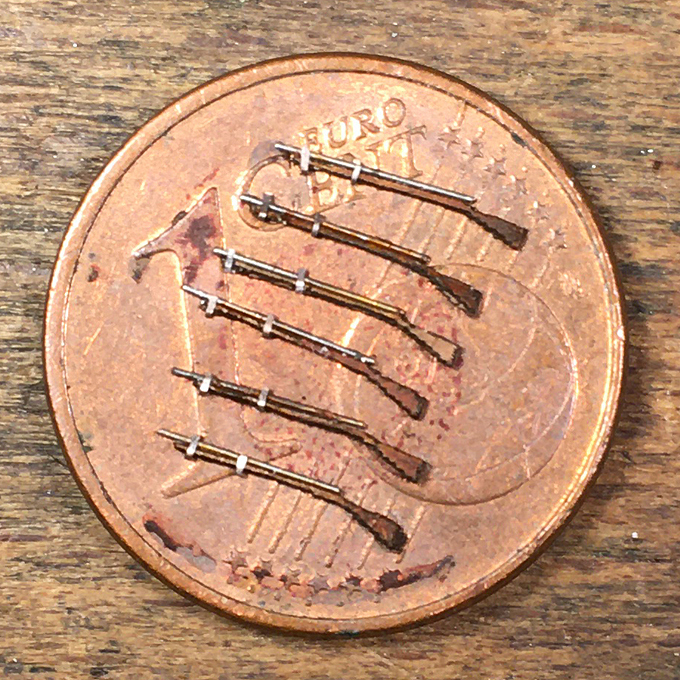
J�gerb�chse M71 in 1:160 scale
As the tiny rifles are difficult to handle, they were glued into the already assembled rack at this stage using some satin acrylic varnish. Originally, I intended to complete them with trigger-guards made from 0.05 mm wire, but I did not manage to glue down the tiny 0.4 mm diameter rings, so I only added shoulder straps from rolled 0.1 mm wire that was painted in brown leather colour. These were also attached using satin acrylic varnish.
Given the amount of work that went into constructing these tiny rifles, I decided to only equip the most visible rack with them.
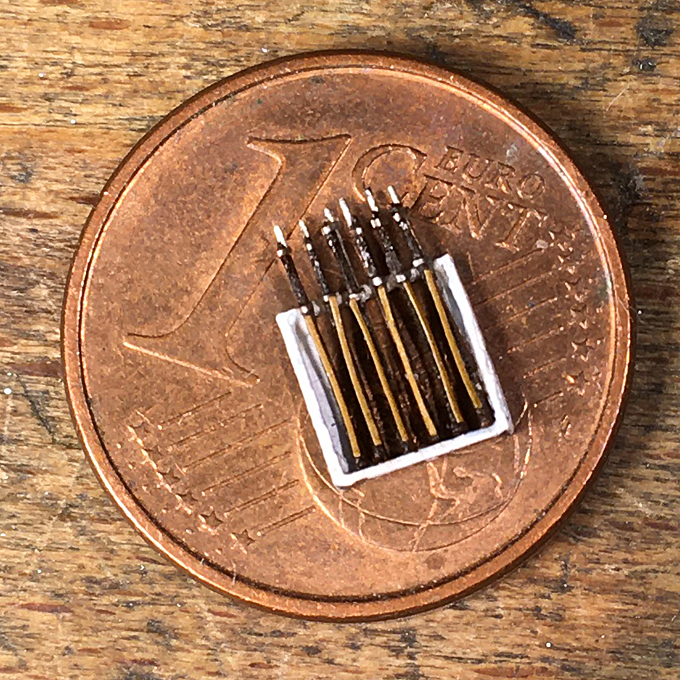
The completed rifle-rack
To be continued ...
___________________________
RECKENDORF, H. (1983): Die Handwaffen der k�niglich preu�ischen und kaiserlichen Marine.- 172 p., plates, Dortmund (Eigenverlag).
I also used the method of 'masking off' areas on sheets of Plexiglas. In fact, when the bullseye frame are attached to the outside, I cemented them onto the Plexiglas sheet and then painted around them. I could have made the deckhouse from Plexiglas and used this technique.
********************
An enigmatic feature in the barbette
On the plan view of the original drawings from the mid-1880s two enigmatic features appear, but they are not represented in the cross-sections, which could have provided further insight. These featured have puzzled me for a while until I realised that the oval shaped items look like the cross-section of a rifle-butt � we are looking down onto two rifle-racks. This interpretation was confirmed, when I came across a later drawing that showed the same feature, but with an annotation.
Enigmatic feature in the barbette
Warships at all times were provided with some small arms to fend off boarding-parties, or to form boarding- or landing-parties themselves. According to RECKENDORF (1983) ships of the Imperial German Navy at that time in question were provided with the J�gerb�chse 71 and the appropriate side arm. The J�gerb�chse 71 is a refined version of the Gewehr 71 that was introduced after the Franco-German War 1870/71 to replace the famous �Z�ndnadelgewehr�. J�ger stands for hunter and B�chse for rifle. Compared to the standard infantry weapon Gewehr 71, the J�gerb�chse was more precisely manufactured/inspected and had a finer trigger, as the J�ger-batallions received better gun training and a good proportion recruited from the hunting and forestry professions. Both weapons were still single-loaders, chambered for metal cartridges.
In the cited book and on the Internet I found good photographs of the rifle. At 1:160 scale it is only 7.8 mm long, so requires considerable simplification. I drew the stock to be cut from two layers of 0.2 mm thick Canson-paper using the laser-cutter. At the same time, I drew my interpretation of what the rifle-rack might have looked like, as I only had the plan-view.
Template for laser-cutting the rifles and the rack
The individual parts were laminated/glued together Zapon-varnish and painted using Vallejo acrylics.
The rifles were fitted out with barrels from appropriate lengths of 0.2 mm tinned copper-wire. The rings that fix the barrel to the stock are flattened 0.1 mm tinned copper wire. As I still did not get around to build the miniature rolling mill for which I had drawn plans years ago, I flattened the wire by rolling a piece of round steel on a thick glass-plate.
J�gerb�chse M71 in 1:160 scale
As the tiny rifles are difficult to handle, they were glued into the already assembled rack at this stage using some satin acrylic varnish. Originally, I intended to complete them with trigger-guards made from 0.05 mm wire, but I did not manage to glue down the tiny 0.4 mm diameter rings, so I only added shoulder straps from rolled 0.1 mm wire that was painted in brown leather colour. These were also attached using satin acrylic varnish.
Given the amount of work that went into constructing these tiny rifles, I decided to only equip the most visible rack with them.
The completed rifle-rack
To be continued ...
___________________________
RECKENDORF, H. (1983): Die Handwaffen der k�niglich preu�ischen und kaiserlichen Marine.- 172 p., plates, Dortmund (Eigenverlag).
Eberhard
Former chairman Arbeitskreis historischer Schiffbau e.V. (German Association for Shipbuilding History)
--------------------------------------------------------------------------------------------------------------------------------------------------------------------------------------------
Former chairman Arbeitskreis historischer Schiffbau e.V. (German Association for Shipbuilding History)
--------------------------------------------------------------------------------------------------------------------------------------------------------------------------------------------
-
marijn van gils
- Posts: 2691
- Joined: Tue Feb 06, 2007 10:24 am
- Location: Belgium
Re: 1:160 S.M.S. WESPE Armoured Gunboat (1876)
Wonderfully tiny details!
Would the rack have something to keep the rifles securely in place (a bar, or strap or chain for each rifle)?
Would the rack have something to keep the rifles securely in place (a bar, or strap or chain for each rifle)?
-
Fliger747
- Posts: 5068
- Joined: Wed Jan 02, 2013 1:15 am
Re: 1:160 S.M.S. WESPE Armoured Gunboat (1876)
Always enjoyable to see derivation of techniques for construction of what is possible in a given scale. Sometimes small side projects like this can take considerable thought and cleverness, which in model building is often the point.
Cheers: Tom
Cheers: Tom