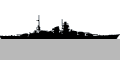
Rockin' posts! The exchange of ideas you guys are having is very informative. So, let me ask you, I saw you said the displacement of existing DD-963 hulls could only support 9,200 to 9,300 tones but could not support 10,000 tones. With that in mind, could a DD-963 in your opinion support the addition of another 64 cell VLS pad back aft in the place of the Sea Sparrow launcher?
Thanks, and I hope I say that for other correspondents here, to whose thoughts and initiative in writing (which is time consuming, gentlemen!) I responded. I appreciate the comments from all.
For time reasons, I shall reply to the post quoted above. About the potential 2nd VLS: from my understanding, no, the DD 963s could not support a second 61-cell VLS or a 64-cell Mk 41 VLS. However, the original intent of the VLS project might have allowed for a VLS of an earlier configuration to support the DDG upgrade option.
In the original contract DD 963 design, which you see in USS
Spruance and her earliest sisters as built (before USS
Moosbrugger), the potential future update for air defense provided for the launcher configuration that existed on the DDG 993 and CGN 38 classes: 24-round Mk 26 Mod 0 forward, 44-round Mk 26 Mod 1 aft. The undersea warfare modernization option provided for a Mk 26 Mod 0 launcher forward.
Mk 26 launchers supported what I shall call,
for the purposes of this post, "short" missiles: Standard SM-1(MR), ASRoc (the box launcher version, not vertical-launch ASRoc), and Harpoon. The original DD 963's had the capacity for 24 ASRocs: 8 in the launcher and 16 in the magazine. For handling reasons, nuclear ASRoc rounds in the magazine displaced more than their number of torpedo ASRoc rounds. Some publications hint that on Mk 26 ships, the forward Mk 26 launcher was similarly intended for 24 ASRocs (some nuclear) and the aft Mk 26 launcher was for 44 SM-1(MR)'s (none nuclear). However, all the Mk 26 launcher arms had the extensions for ASRoc. Since the DDG 993's were begun for Iran, their nuclear option was deleted, and it was not restored when the Carter Administration obtained these ships for the USN. AFAIK both Standards and ASRocs could go in either Mk 26 magazine.
The original concept for VLS was to provide a plug-in successor to the Mk 26 launchers and magazines for "short" missiles only, within the same volume and utilities. The limitation for the DD 963 class would be that the total mass of the loaded VLS could not exceed the allowable mass of the Mk 26 launcher and its loaded magazine, since the Tartar-D system would put the modernized ship at its weight limits.
If you have the weights of these various launchers and "short" missiles, which may exist in the early editions of Norman Friedman's
World Naval Weapons Systems, you might be able to compute the potential number of loaded VLS "short" cells. Notice that the answer could vary depending on the mix among the different missiles. Suppose Missile X weighed 80% of Missile Y; then you could load qty 5 Missile X's in place of qty 4 Missile Y's. Since the short VLS would look the same from above as the actual Mk 41, for a model of a hypothetical DD 963 modernized for air defense you could on this basis legitimately show an aft VLS installation of the number of cells you estimate. Remember that a reload crane occupied the space of another three VLS cells per VLS, in this design.
Reagan's SecNav John Lehman put a high priority on Tomahawk, which had a nuclear version for launch in torpedo tube mode or box launcher mode. Tomahawk was a longer missile and required a deeper VLS than the VLS design for the "short" missiles. Lehman killed the VL-Harpoon to force the uniformed USN to accept his priority for the deep VLS, in order to support Tomahawk anti-ship missiles, and thus to support the naval Tomahawk program, about whose life prospects the uniformed USN was evidently dubious in the early 1980s. Three items here: 1, whether Lehman was really competing against the USSR or against the USAF, some other historian may evaluate. 2, IIRC neither a vertical-launch Tomahawk anti-ship missile nor a vertical-launch nuclear Tomahawk land-attack missile was ever developed, on Lehman's watch or ever since. 3, USN skeptics about Tomahawk could note that the USN nuclear Tomahawks were moved to storage ashore in 1989, the US Army nuclear Tomahawks or GLCMs were scrapped altogether, and the anti-ship Tomahawks were converted to conventional land attack.
The deep VLS became the Mk 41 VLS that went into USN service. Lehman did not think to tell the designers of the CG 52 series about how many Tomahawks to plan for when computing weights. The CG 52 ship designers, not operational planners, proposed 16 Tomahawks and 45 SM-2(MR)'s, which OpNav then authorized as the basis for naval architectural calculations.
The weapons community came up with an abortive antisubmarine weapon called Sea Lance, with VL-ASRoc, and with longer Standard missiles. All of these required the deeper VLS cells and increased the weight of the loaded VLS. The heavier missiles made the VLS reload crane so slow as to be useless for UnReps, since it was sized for the "short" missiles. The Standards required missile guidance systems aboard the launching ship (or aboard a ship data-linked to the launching ship, which USS
Kidd and
Scott actually tested in 1989, but was not implemented), which were never provided for the DD 963 class.
I believe that much of the ballasting of the DD 963s was to counterbalance the mass forward of the VLS if filled with Tomhawk land-attack missiles. It is for that reason that I doubt that mounting a deep Mk 41 VLS aft was a possibility for the DD 963 class; and only the deep VLS entered USN service.
If humanity wishes to preserve a planet similar to that on which civilization developed and to which life on Earth is adapted, [atmospheric] CO2 will need to be reduced from its current 385 ppm to at most 350 ppm.
Dr James Hansen, NASA, 2008.