Tom Lindsay!
Good to finally get ahold of you here! There was/is a build of a ship called the HMS
Rose on the forum here.(I have forgotten who was building it) That was the build that got me thinking about scratching age of sail ships, but I want you to know it was
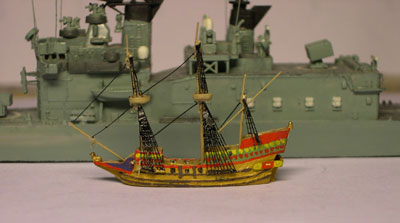
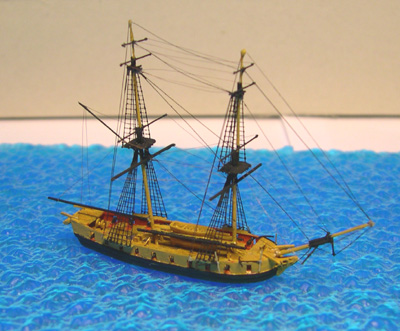
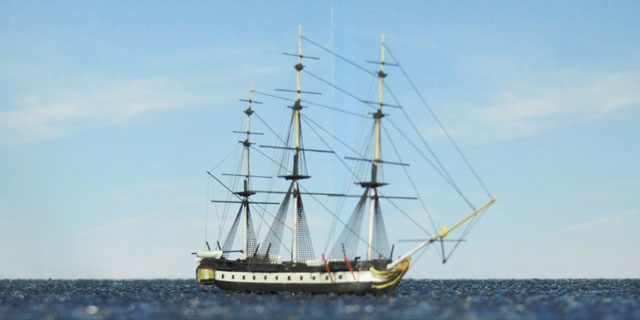
your build that pushed me over the edge and finally got me started. The thing I liked about it was that it (appeared to me) to be all styrene. I haven't had really good luck with putty, and I'm always unsure how to glue other components to it, etc. I feel like if I can create the whole structure out of one medium and one type of adhesive I'm better off for it, and styrene seems like the perfect choice for that. That's not typical of most model builders, but that's how I've had success so far, so I'm 'stickin' with it', as the saying goes, at least for the time being.
I do very much hope you don't abandon the Venetian Carrack. Or, if you have firmly decided to abandon it, I hope that you start another one. You know sheer is a very subjective thing, not to mention that there's no telling what kind of heterogenous or contrasting ship design philosophies existed back then. Heck, it might have been down to the whim of the guy ordering the ship... 'I know you built a curved deck for Lord Guido, but I want mine flat... and I want it done by June...' etc.
I have this long term goal of trying to grow the hobby out of its 20th Century focus to embrace the whole of Naval History, the way that the HO scale hobby has come to encompass the whole of Railroad History. Of course our task is a much bigger task� there's a lot more history to deal with, and there's a lack of documentation that can make any effort prior to the 18th Century or so something of a head-scratcher. But I want to encourage the idea that this very lack of sources gives scope for creativity and personal expression. So us carrack builders have to stick together! There needs to be more carracks in this hobby!

That's one of the reasons I'm making my ships modular like I am, so that when it comes time to cast the various parts, I'll have choices, etc.
Building these ships has led me to a number of 'notions' about the way they were constructed that I'd like to discuss with whoever is interested. Frankly I'd like to know if these ideas even hold water or not. Feel free to shoot them down if you happen to know that they're wrong, but if you do, please let me know your source. This is all a learning game for me. Ok, here goes:
1. Carracks.
Carracks were developed in the Pre-Gunpower era of Ship Design, and were maximized hand-to-hand/boarding style fighting vessels. Essentially they were the naval equivalent of a siege tower, except it was a case of towers attacking other towers. A carrack could be made from a basic ship hull (should we call it a 'round ship' as some do?) that was maximized for cargo and/or transport. Depending on the size of the ship or the insistence of whoever was paying for it, an ordinary ship could be made into a carrack by adding one, two, or three deck (or more?) superstructures to the hull. You might have a situation of a one deck carrack having another added later as a means to increase its offensive capacity (number of soldiers, as well as their height above the water.) You might also have a case of a 'high' or 'heavy' carrack that is unsatisfactory being razed and cut down a deck or two. But you might also have the case of a 'ship in ordinary' being rebuilt into a carrack, and a carrack being returned to the form of an ordinary ship. From a modeling perspective this means that a superstructure without a hull is a perfectly acceptable option for configuring the model, as is a platform or superstructure only forward, or only aft, etc. In other words, I have the notion right now that the
real carracks were modular just like these little models I'm building are. This may be a case of wishful thinking or confusing hobby and History, and of course I realize that there were specially constructed 'purpose built' carracks, but it seems to make sense to me, never the less. I think also there was a good deal of improvisation and adaptation going on as well. If anyone has definite knowledge that this was or was not the case, I'd be very interested in hearing about it, as it obviously bears on my efforts here.

2. Carrack/Nao/Galleon Superstructures.
These ships in general were not built for long voyages, despite the fact that beginning in the 15th Century they were used for precisely that. The attitude designers had towards superstructures was much the same as our attitude toward the construction of things like campers and RVs. They are smaller than an actual house for the purposes of weight savings, economy and scale, and are not intended as fully habitable long term structures the way that modern ships are. So that means you might have deck heights as low as five feet or less, even, since the crucial deck would have been the highest (open) deck anyway. For instance it might have been determined that the maximum height possible for a forecastle on a given ship undergoing conversion into a fighting carrack was, say 16 feet. If their accustomed deck height was, say, seven feet, that might mean they were limited to two decks and a height of 14 feet. But if the captain (or lord) in charge of the construction wanted the maximum height permissible for combat purposes he might have ordered a three deck forecastle with a deck height (subtracting deck planks and supporting beams) of less than five feet. He might even have specified two six foot decks and a 'between deck' that was, say three and a half feet or so. He might even have made gun ports in the between deck and instructed the gunners to crouch, etc.
Does that sound plausible? Or not? I would welcome anyone with insight into these questions. I figure if there's any place on the web to ask these questions, it's here.

Ok, that's all for now. All replies welcome!

 ... and sequels !

 to MW.com