dhenning wrote:Welcome to the forum!
You will probably have better luck with your inquiry on the colors for the camo scheme for the Bligh by posting your question in the Camouflage & Coatings area of the forum. There are a lot of Royal Navy experts on the forum that probably don't look at the Calling All Destroyers section too often.
Hi, I think I know what these are - carriers for the depth charges as used on the USN "K-gun". Are they appropriate for the Captain Class (one of which I am building) that might have replaced them with the later built-in-carrier MkIV thrower?
Cheers, GrahamB
Yes Graham, they're the plates that the charges would be strapped onto before loading into the K-guns and fired off together. It seems RN ships had them as well, though depends on exact vessel and time period. Here's Hotham in 1944: https://en.wikipedia.org/wiki/List_of_C ... _25645.jpg
The Captains retained the USN K guns to the end of their RN careers, they were not replaced by the Thornycroft MK IVs, at least I have never seen a photo of one with other than the USN equipment in any published references or available photos. Depth Charge arbor stowage can appear to vary ship to ship depending on how many had been expended, leaving empty stowing points on the superstructure sides. They may also have been moved depending on the position of other additional RN equipment, such as the extra Carley Float stowage. You wouldn�t expect a ship at the end of a cruise to necessarily have all the stowage positions filled, and they were also stowed under the depth charge roller racks. Which Captain are you building?
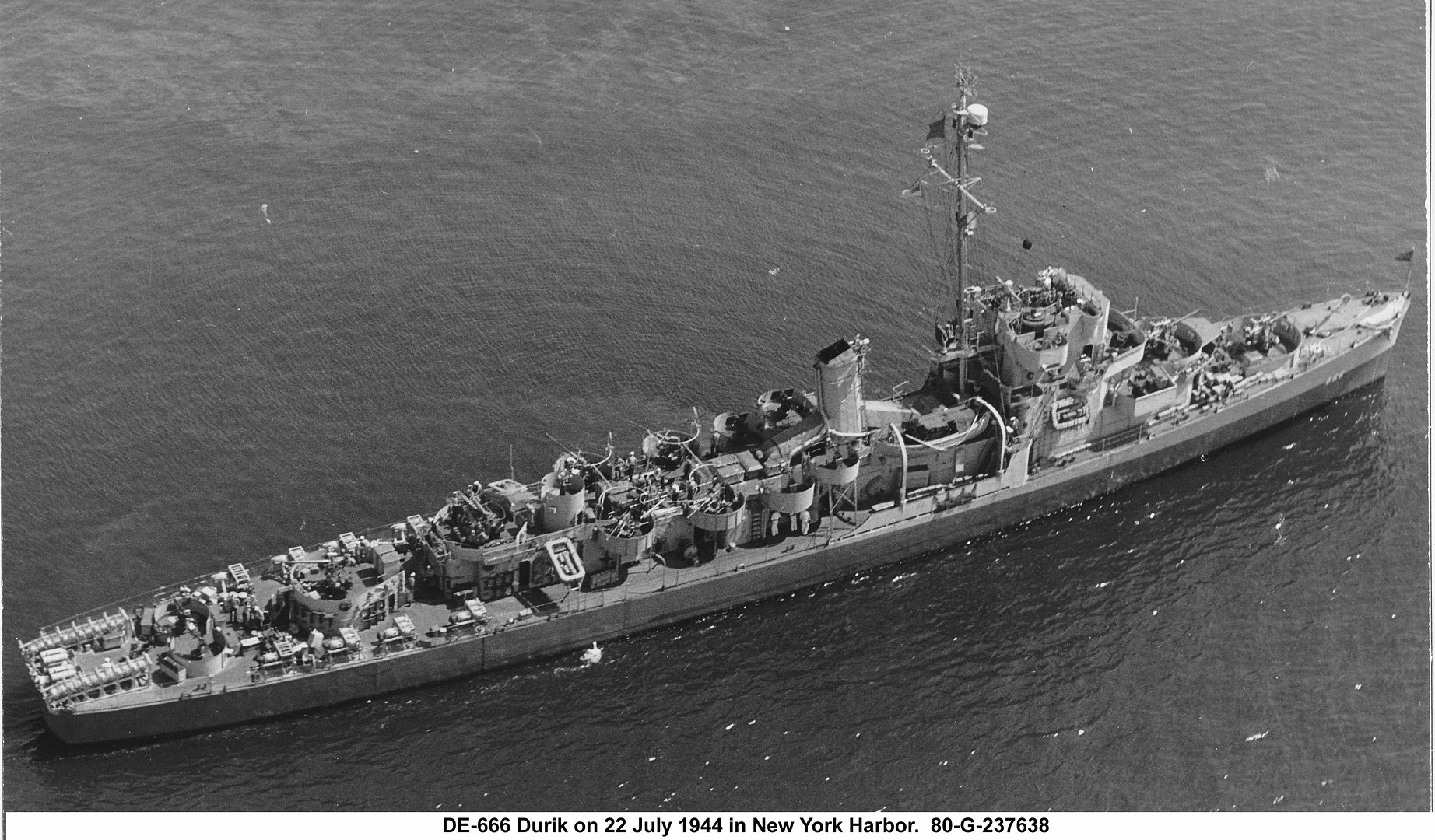
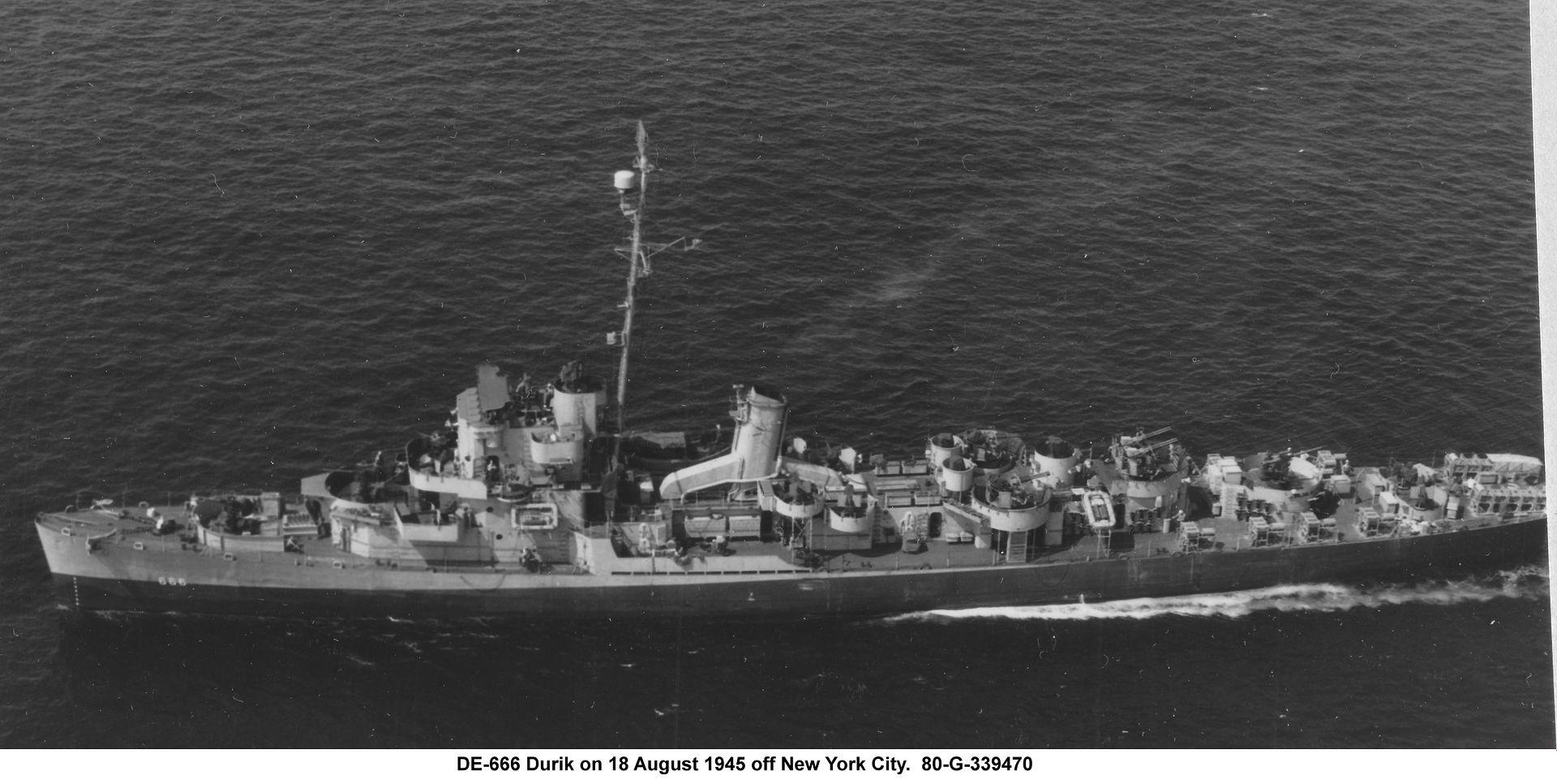
I have come here in hopes of getting a bit of information on a certain Buckley-class DE, the USS Durik DE-666. More exactly, the state of thie ship's AA armament as of 1945. What kinds of guns in which numbers were installed there? I am especially interested in what is going on the forward rear Bofors mount. There seem to be 2 Oerlikon positions around it. Am I right about this or not?
USS DURIK (DE-666) had two armament configurations in 1945. The one she had from mid-1944 as an "interim Anti-Aircraft (AA) upgrade" until the Summer of 1945 (after the war in Europe ended) when she had the final AA upgrade.
The images below of USS DURIK (DE-666) show these two configuration.
The Interim configuration basically saw the removal of the triple Torpedo Tubes and addition of four single 40-mm mounts, while retaining her quad 1.1-in mount and ten 20-mm guns (on Mk 4 mounts).
The Final configuration saw a quad 40-mm mount replace the aft quad 1.1-in mount, two twin 40-mm mounts replacing the four single 40-mm mounts, and adding a Mk 52 GFCS atop the bridge, while retaining the ten 20-mm guns (on Mk 10 tripod mounts).
The term "Reproducer" and "H. P. Reproducer" baffled me for awhile. At first from the shape and multiple "apertures", I thought maybe it was a Nancy (IR) signaling device. But, that was easy to dismiss. As I dug I found out it was an upgrade "voice sound amplifier", aka higher powered speaker. These were installed on many ships for multiple purposes and sometimes were placed higher up (on the foremast) than earlier speakers. This higher-powered voice communications was used to communicate with small craft during amphibious operations, during replenishment operations, any ship to ship transfers, etc, that the older "conventional" single speaker previously seen on the bridge front, etc when radio communication would be too slow or the other vessel lacked a receiver.
There normally were two "boxes" associated with this system, an amplified "black box" and then the "broadcast" speaker box with several speakers. The broadcast box appears in most cases to be trainable to either side of the ship. The H. P. Reproducer started to appear in about late 1944 (could be earlier on some ships) during overhauls. It wasn't fitted to all destroyers during WWII.
I have noted at least two types of Reproducer's, the first one posted below seems to be the most common type installed on the foremast, then the second below I have seen a few times, mounted atop the pilothouse. The third image shows the first type of Reproducer mounted on the front of the pilothouse. The "real-estate" on the foremast got crowded with more comm and RCM antennas, so I think that is why the reproducer was located there.
Perfect. As always. Thanks Rick.
Looking at the photos at first I thought it might be some sort of a speaker but the name reproducer got me confused and my searches brought nothin...��
Hi, Rick. Is Fogg DE57 the only 5-inch gunned Buckley to return to sea before war's end? The 12MAY1945 NavSource photo shows her at Boston Navy Yard - how is she armed forward of the bridge? With the exception of the additional 20mm outboard of the Mk 51 tower aft, is her overall armament location in that MAY photo similar to what we see in the NOV1945 NavSource photos of DEs 217, 218, 219, and 678 at Mare Island Navy Yard? Thank you.
Without some digging, I don't have a firm answer. USS FOGG (DE-57) was converted while being repaired for battle damage at BosNY, which was completed in early June 1945. However, she actually was slated for conversion to a DER, which was done at PhilNY between 1 July and 2 October 1945. Between those two yard periods in June 1945, she did return to sea serving as a "multi-function" training, plane guard duty, etc. There were seven BUCKLEY Class DER conversions with 5-in guns; DE-51, 57, 153, 213, 223, 577, and 578.
So FOGG's upgrade at BosNY shouldn't be confused with the dedicated 5-in conversions done to eleven BUCKLEY's; DE-217, 218, 219, 678, 679, 680, 696, 697, 698, 700, and 701.
From the images I have of USS FOGG at BosNY as she was nearly completion, there are a lot of similarities in armament between the two groups. Two single 40-mm gun mounts were installed forward of the bridge, two twin 40-mm mounts amidships, and a quad 40-mm mount aft. I'm unsure about if all the 20-mm guns seen on the DE-217, 218, 219, and 678 photos, were installed on FOGG. The "full" 1945 DER conversions had a twin 40-mm mount forward in place of the hedgehog and two 20-mm mounts in place of the single 40-mm mounts forward.
Without digging through DANFS, which I don't have time now to do, I can't say which other units out of these two groups went to sea before the war was over. It appears likely few if any did and that none saw combat.
I am building the USS Whitehurst via scratch methods. Currently this is expressed as a 1:514 scale trial model to work out various details of the configuration. It appears that more information comes to light after one commits to some tangible construction. I highly recommend this approach to scratch building as a tremendous amount of additional information has come to light. The odd scale? The longest hull I could print in one piece. Eventually the idea is to build in 1:120 or 1:144.
Whitehurst was damaged by a Kamikaze strike off Okinawa and repaired at Pearl Harbor when she was fitted with large electrical cable spools. My intention is to model her after the post Kamikaze refit but really detailed info on the electrical supply equipment is lacking. NARA has a BOGP dated 1947 which should show this configuration but they are apparently not able to provide any service with regard to this request currently.
My current progress is reflected over in the scratch building forum. Most recently It appears that most of the DD's unshipped the port MWB and a large strong back featured in drawings to stabilize the boat, is not in evidence.
The boats are coming back off and I will probably replace the MK 51 director with a MK 52.
Minor progress today, while managing to break off the torpedo crane and secondary steering station. Added main deck life lines, which the forum troll would correctly criticize as being two wire instead of three wire. Best I could get away with at 1:514 A real modeler would have both the three wires plus the netting. How to pull off the O1 level pipe rail, TBD... Then there is the mast. I can print a satisfactory vertical ladder n this scale, but it's not at all rigid length wise, a issue to be dealt with. Some scars remain on the hull, from the collision with the surfacing USS Bugara in Hawaiian waters. Interesting as I had been at sea on both of these ships. As Bugara survived she didn't get credit for a second sub sunk. She did sink the U boat in Enemy Below via ramming! I am strongly leaning toward a brass wire assembled mast as a printed one would be far too rubbery at this scale. Adding the printed ladder may be real fun! I may be able to pull off a rudimentary version of the Radar. The Hot Shots can rig a ship at this scale, I'll do what I can. The DE markings can be replicated but beyond my ability to do draft marks this small, let alone see them. I'll do some more hull work before adding the props and shafting, and looking crosseyed at bilge keels.
If humanity wishes to preserve a planet similar to that on which civilization developed and to which life on Earth is adapted, [atmospheric] CO2 will need to be reduced from its current 385 ppm to at most 350 ppm.
Dr James Hansen, NASA, 2008.
Note that there photos previously in this section of kits and works in progress. The 86 people who viewed the image weren't forced to and perhaps some information will emerge vis a vis the Electrical power spools that several of these ships were equipped with after Kamikaze repairs. I was actually steered this direction by a moderator on another forum section as it might be a good place to find out some of this mystery..
It's fine (and encouraged) to post one's builds in CASF as part of asking a question related to the real-life configuration/identity of equipment/shapes, etc., but posting build progress in and of itself without clearly relating it to an existing or new question is discouraged. We recognize that no one wants to be "called out" for not sticking to the rules and creates bad blood, so tend to enforce it actively only when it's in a busy(er) thread or is repeatedly happening.