kurt wrote:Does anyone have a copy of the Charles Landrum�s USS Arizona articles that used to be on the Roll Models site? I tried to contact Mr Landrum directly through this site ( he seems to be active not too long ago), but have had no response so far.
Thank you,
Kurt
Hi Kurt, Before Roll Models went dark, I did a web capture of Landrum's pages, everything, text, pics, formatting, everything...
CalV wrote: In addition Raymer book states that his original exploration of the workshop on deck 3 was intended to locate and remove the unexploded bomb believed located there.
In this case, I believe that Mr. Raymer was mis-remembering. If it is the statement I think it is, he goes through the path he was taking to get there and that 'path' is not possible in ARIZONA. The ups and downs and lefts and rights do not match the interior of ARIZONA, even given the damage and possible 'work-arounds'.
Observations - While perusing this thread I came upon these posts and thought to clarify some things.
66misos post of Mar 02 2021 1:05pm
Picture of bulkhead section with label � PH wreckage with the picture described: �A piece of the USS Arizona with scorch marks caused by burning oil.�
The viewable surface of that piece is indeed an interior surface, painted white. What is described as �scorch marks� is nothing more than collected oil residue.
Egilman post of Mar 03 2021 1:53pm
Tracy White quotes:
�First point - it's also possible that this chunk was interior structure in way of the crews galley, casemate guns, and various shops underneath the boat deck.�
Yes, as long as they existed aft of frame 78
Second Point - �National Parks Service Ranger Danny Martinez was one of the main drivers of the Blue paint theory and had at least some access to the wreckage before it was all moved.�
Before it was moved where? Those ARIZONA materials were put there (at Waipio) in the late 50�s, long before Danny Martinez ever saw them.
Jeff Sharp post of Mar 03 2021 2:53pm
�No superstructure bulkhead had both paints.�
Not True. all of the external surfaces remaining between frame 78 and the vegetable locker would have had the 5D or 5S or whatever, and their interior surface would have been painted white.
Second Point - �National Parks Service Ranger Danny Martinez was one of the main drivers of the Blue paint theory and had at least some access to the wreckage before it was all moved.�
Before it was moved where? Those ARIZONA materials were put there (at Waipio) in the late 50�s, long before Danny Martinez ever saw them.
My understanding is that the Waipio wreckage was all moved from the peninsula for preservation and "dissemination." I was unhappy enough about the later part that I haven't bothered to keep track, but there are pieces of ARIZONA that have been showing up in potentially surprising areas.
I have no problem with them wanting to honor the Michigan USS Arizona fallen crewmembers... (but you would think they would at least get someone who remembers what actually happened to write the story)
Well, then you're gonna love this; I'm in the process of trying to get a piece for our VFW, but right now they are not sending any because the Seabee's who were doing the cutting have been retasked with other stuff. So, no relic artifacts are being issued.
Now, with that, I don't think they moved all the material as of yet, although I'd heard that that was a possibility.
While unceremoniously dumping wreckage cut free on land few can visit and letting it rust out of sight doesn't seem like the pinnacle of respect to me, cutting it up into small anonymous chunks and scattering it to the wind also doesn't seem like it's that reverent either. I'm not faulting you - I know you would ensure a good home at your VFW, it just feels like the Navy using her remains as political bargaining chips.
I'd have preferred they try and re-use it similar to how LPD-21 New York was built with some of the salvaged steel from the twin towers or as part of a permanent structure on the grounds of the Arizona Memorial.
So, from my discussions with the PAO at Pearl, every ship in the fleet got a small piece of the relic materials, and rather than let the remainder just rust away, they restarted the relics program, distributing pieces to 'worthy organizations' etc. But as I said, a little while back they lost support from the Seabees so I'm not sure what's going on now other than nothing. Without the 'hired help', I don't thing the materials are being moved to a better storage location.
And to clarify another thing that keeps popping up occasionally, the materials that were 'deposited' at the Waipio site, are only that part of ARIZONA that was cut away for the construction of the memorial. All of the earlier wreckage materials were utilized in the wartime metal recycling, save things like the anchors, a piece of the mast, and what still remains 'on site'. Yes, there is still lots of pieces/parts on, or rather 'in' the mud around the hull. I know, I've seen it.
Thanks DavidP. I also have the BOGPs but I am unable to get a good profile with a height of the structure. Can't make out too much in what pictures are available.
Okay, I asked this question a few years back and just can't recall the answers that I received. Did the Arizona carry two or three anchors at the time of her loss. If it was only two, what happened to the third? Another question, what the metal work on the ships boats a polished brass or a chrome finish? Thanks for any answers.
Hi Jon,
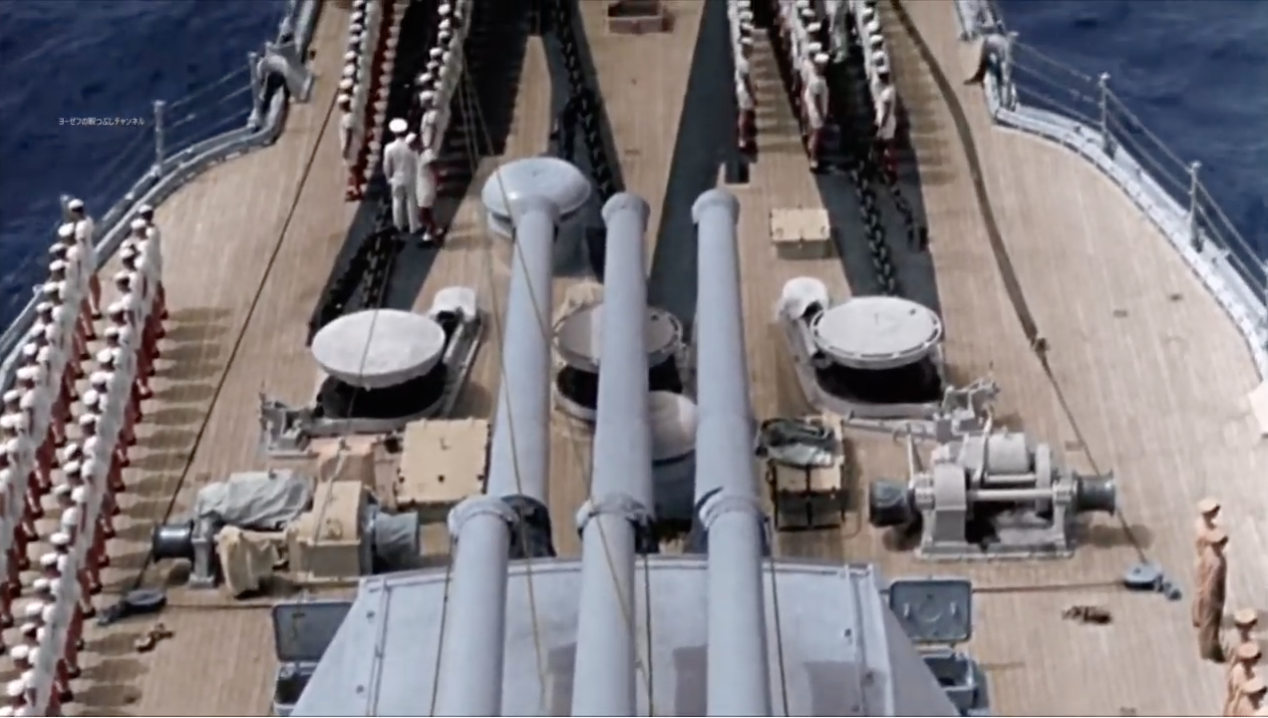
As far as the anchor goes, some had theorized that she lost that anchor during her last refit at Puget Sound in Jan. '41 but this shot from April 1941 clearly shows three sets of anchor chains on the deck. Two going to the port side of the ship and one to the starboard side.
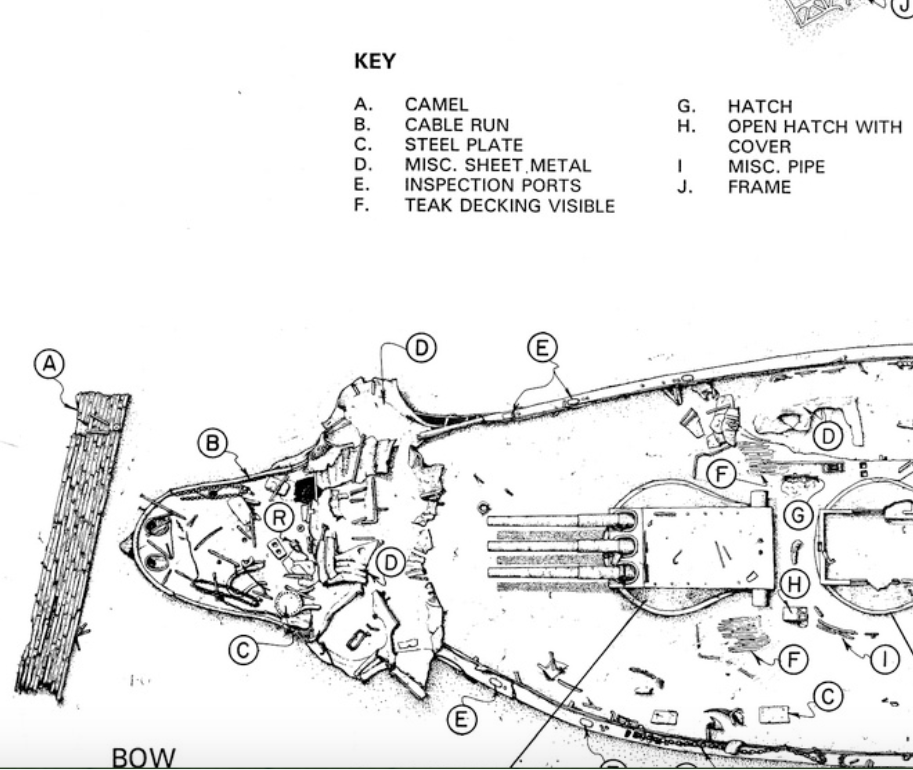
But, if you look at the drawings of the wreck, you can see that the aftermost hawse opening on the port side of the deck has a circular steel plate (C) over it.
It's very possible that one of the anchors was removed between April and December but we don't know for sure. If it was removed, then it more than likely went into the reserve stock of anchors in the yard.
Jon,
As far as your second question, it appears from this shot aboard USS Idaho that it was brass. Notice the railing looping over the sailors head on the far right.
From personal experience, the 'ship's boats' would have brass / bronze fittings whereas the captain's / admiral's gigs would commonly have chromed fittings (easier to keep clean and bright).
Additionally, on the 'ship's boats', those fittings would not necessarily be polished, just kept free of grime and verdigris.
Does anyone have any photo or video-still references that indicate whether or not the roof of the vegetable locker was planked in 1941?
This photo tends to indicate that ten years earlier, in 1931 just after reconstruction, it was not planked. The roof appears distinctly much lighter than the boat deck and 01 deck and looks like painted steel.
The vegetable locker roof may or may not have been planked later but my references don't show it well enough to know.