Page 3 of 6
Re: 1/48 German Torpedo boat V105 (1914)
Posted: Thu Mar 21, 2013 3:02 am
by PICKETBOAT
Hi all
Hope the internal arrangements were understandable. There will be more on this subject later.
For the moment lets get back to the deck detail.
The smaller features were added to the top of the boiler room roof at this point. The flat, oblong sky lights were again cut from the printed sheet of plastic card. Hinges were again made from wire.
The circular flat topped man-hole covers were cut from plastic card and mounted on short lengths of plastic tube turned off on the lathe. I found making these a bore, so I subsequently made moulds and cast some resin ones to this design for the next model, which has lots more of them. The plus side to doing this is they all end up identical. There is nothing worse than scratch building lots of identical fittings, only to find that a couple of them are about 0.25mm out. You can get away with it if they are on opposite sides of the ship but if they are next to each other any small difference stands out and drives you �bonkers� every time you subsequently look at it!
I already had moulds for resin casting the circular dome topped man holes, so they were easy to install. I know these are available as white metal castings, but they are incredibly heavy and fitting 8 or 10 adds considerably to the top weight which is "bad news".
Some of the smaller detail was also added to the top of the WT room. Again the oblong hinged sky lights were cut from the printed plastic card sheet. Small brass wire eye bolts were fitted to secure the stay wires for the funnel and the stove chimney. A black plastic collar has just been installed on the roof to take the stove chimney.
The strange �pudding basin� shaped cast resin fitting is the (pottery or glass) insulator for the wireless aerial. You will see later how it is wired up. This is the first model I have built of a prototype vessel that was fitted with WT, gear so I had to figure out how to make the festoon of wires associated with this equipment dismantle so I could lift off the deck and gain access to the internals. Tricky but not impossible and a bit of fore thought was required. More on this later.
Re: 1/48 German Torpedo boat V105 (1914)
Posted: Thu Mar 21, 2013 5:00 pm
by PICKETBOAT
Hi all
The next features to be dealt with were the funnels. One is circular in cross section the other is oval. Still trying hard to keep the top weight down I decided not to use aluminium or thick walled plastic tube for their construction, but to start from scratch. I designed a former so that the eight individual components of both funnels could be produced in thin plastic using a vac forming machine. This also enabled me to �design in� the correct angle for the funnels to slope backwards.
The picture shows these eight components before they are trimmed.
The funnel halves are in fact slightly more than a half radius. The vac forming process creates a small web around the base which has to be trimmed off so I added an extra 3 or 4 mm to allow for this.
USEFUL TIP
When trimming any vac formed fittings use a fine toothed mini circular saw blade (about 50mm dia) mounted on an arbour shaft. This should be fitted into a pillar drill. ENSURE THE BLADE IS RUNNING THE WRONG WAY TO REDUCE ITS ABILITY TO BITE INTO THE PLASTIC, OR IT WILL DAMAGE THE VAC FORMING. Sit the vac forming on the flat work surface and lower the drill to the previously marked correct height. With the drill running at a fairly fast speed carefully rotate the vac forming, allowing the blade to slice off the section you need. Take great care as the blade will cut your fingers even if it is running backwards.
The funnel components were assembled with solvent weld.
So that you can understand what I was aiming towards, I have inserted a picture showing the completed forward funnel in place on the model.
Adding the funnel detail to the basic shape will be dealt with in the next post.
Re: 1/48 German Torpedo boat V105 (1914)
Posted: Fri Mar 22, 2013 9:40 am
by PICKETBOAT
Hi all
As the funnels and main ventilator were, to a certain extent, to be functional (the funnels would emit smoke and the ventilator would allow air to be drawn in for the blower fan) holes had to be cut through to connect them to the hull.
I probably should have cut these holes earlier, before adding any detail. In fact in the end it was very easy. I simply chain drilled round the hole using a mini drill, popped out the centre and tidied up using a miniature sander drum, also in the mini drill. As the boiler room roof was plastic card and balsa it was straight forward.
The basic vac formed funnel shapes were opened up, top and bottom, using the same procedure. It�s easier to carry out this task after assembling the vac formings rather than trying to do it while they are flimsy components, as they are difficult to hold in this latter form.
The reinforcing bands, ladders, steam pipes etc. were made up and fitted to the funnel body. The trumpet shaped steam whistles had been made up as part of the vac formed components. All this paid off as the finished funnels had little or no weight and would therefore not drastically effect the models stability.
Fine nylon mono filament was used as the support wires for the funnels.
Assembling and installing the large ventilator in the next post.
Re: 1/48 German Torpedo boat V105 (1914)
Posted: Sat Mar 23, 2013 9:05 am
by PICKETBOAT
Hi all
The huge boiler room ventilator cowl, so much a feature of these vessels, was like the funnels, made up from a set of vac formings. I had previously made ventilators, slightly smaller than this, for HMS Velox (1904) so had worked out the procedure.
This ventilator cowl on V105 obviously ran (swivelled) on a slightly raised up deck race, and I wanted to model this as close as possible to the plans I had. The race was made up from two vac formings and a simple 40mm diameter plastic card disc.
The cowl was marked at the cutting line, and the method, previously described above for the funnels, was again used to cut off the waste. The two halves were stuck together first, before the mouth was very carefully opened using a scalpel. Care was taken not to cut into the lip around the mouth, as it was there for a purpose.
The deck race was assembled from the three components and then the centre hole was cut through all the three parts together using a sheet metal ream on the drill stand.
The cowl was trimmed to the correct height and the centre line seam made good with a small amount of filler.
Photos of these vessels show the ventilator cowls were covered with a mesh guard.
For this I first formed a 0.5mm wire ring (soft soldered together) which fitted neatly inside the lip around the cowl mouth. I next laid this ring on some fine nylon mesh and CA glued it in place. When set I trimmed away the surplus mesh and popped the finished guard into place in the cowl mouth, securing it with CA glue.
Re: 1/48 German Torpedo boat V105 (1914)
Posted: Sat Mar 23, 2013 10:14 am
by russclark
hello picket boat,i realy like your vacuforming work.one day i will have to give it a try.
Re: 1/48 German Torpedo boat V105 (1914)
Posted: Sat Mar 23, 2013 1:21 pm
by PICKETBOAT
Hi russclark
Thanks for following the build.
I was very very luck being able to buy a second hand, British made, small, industrial quality vac forming machine from a fellow modeller who was moving abroad. It's about the size of a cooker, is a bit old, but works wonderfully.
The learning curve for using these things is a bit shallow and I did bin a whole load of "failures" before I figured out how to use the thing efficiently, however, the possibilities are fairly endless. If you come across a reasonably priced second hand machine in good order it's well worth thinking about investing in it. Mine will work plastic sheets up to a maximum size of 15 inches square so even small hulls are possible. A machine that copes with smaller sheets would still be very useful for ships boats, ventilators, etc. etc.
Re: 1/48 German Torpedo boat V105 (1914)
Posted: Sun Mar 24, 2013 3:12 am
by PICKETBOAT
Hi all
With the boiler room ventilator and the two funnels in place there was now only minor detail to be added to this section of the model.
Photographs showed the route of two voice pipes up the front port side of the deck house, one leading to the wheel house, the other to the search light position (arrowed). Using soft wire these were installed in sections. This whole part of the model was primed to give a good base for the eventual paint finish. The ventilator had been previously sprayed black inside and the mouth masked over.
A small brass tube was installed at the correct angle in the WT room roof to accept the forward mast, also arrowed.
A small wooden cask was kept on deck for crew drinking water. This was a resin casting mounted on a plastic card cradle. It will eventually be painted flat brown and given a wash of drown ink to pick out the fine detail of the hoops and staves.
Re: 1/48 German Torpedo boat V105 (1914)
Posted: Sun Mar 24, 2013 8:20 am
by PICKETBOAT
Hi all
The main deck house structure was placed on the, as yet, un-decked hull to get an idea of positioning. I had already carefully worked out where the main removable deck section would be and drawn it onto the plans.
The factors affecting the limits of this removable deck were as follows:-
Maximum access area was needed to the internal equipment.
Avoiding splitting any main deck detail.
The aft of the two masts was to remain in place when the deck area was removed.
The forward limit of the deck access would be the bridge, leaving the forward torpedo tubes in place.
The small curved tracks along the deck (for wheeling about torpedo reloads) were to be used to disguise the deck access joint.
Indicated on the picture (arrowed) is the limit of the deck access. The gently curved deck support timbers, running fore and aft, follow the position of the torpedo moving tracks. These timbers will produce a register for the removable deck section to sit on.
The removable deck sections on models need not be geometric shapes, any shape is fine and I have made them very odd shapes to steer round deck detail to help disguise the joint.
Re: 1/48 German Torpedo boat V105 (1914)
Posted: Mon Mar 25, 2013 12:20 pm
by PICKETBOAT
Hi all
From the plans I transcribed the shape of the large removable deck section onto a sheet of plastic card, the same thickness (1.5mm) as that used for the deck. Onto the underside of this were glued two long wooden strips to give it some rigidity (arrowed). Plastic card was used to install transverse supports, again curved on their top edge to match the deck camber. A plastic strip edge support was also fitted, set in slightly, so that the end result was a neat panel that fitted the deck aperture and sat onto the small register around the edge.
The three holes for the funnels and ventilator were also cut out.
The underside of the boiler room roof/deck house structure had to be gently shaped (by rubbing it along a wooden formed covered with medium grade sandpaper) so that it conformed to the shape (camber) of the removable deck section. With this done the two parts were glued together.
SECURING THE REMOVABLE DECK SECTION.
I fitted a small aluminium tab at the front edge which slotted under the fixed part of the deck as the removable deck section is pushed forward. This held the front down well.
Two small holes were then drilled to take short M3 countersunk brass bolts (arrowed). These screwed into threaded, captivated brass tubes glued into the deck beams below, and clamped down the centre and stern end of the deck section. The screw heads will not be seen. You will see later how they are disguised.
This section of the deck is only removed at home, for maintenance and charging. I never remove it at the waters edge. A smaller more easily removable deck aperture (under the aft 88mm gun) covers all the power switches.
Re: 1/48 German Torpedo boat V105 (1914)
Posted: Mon Mar 25, 2013 12:24 pm
by sandy
Still fascinating, Steve.
Re: 1/48 German Torpedo boat V105 (1914)
Posted: Mon Mar 25, 2013 3:06 pm
by JIM BAUMANN
>>> ENSURE THE BLADE IS RUNNING THE WRONG WAY TO REDUCE ITS ABILITY TO BITE INTO THE PLASTIC <<<
that is a really good tip!
JIM B

Re: 1/48 German Torpedo boat V105 (1914)
Posted: Tue Mar 26, 2013 3:49 am
by PICKETBOAT
Jim (and anyone else interested in the tip.)
I forgot to say that it is possible to the lower circular saw blade and arbour, in the drill stand, so that the retaining screw or nut on the end of the arbour goes down into the centre hole in the work table. This means it is possible to have the circular saw blade cutting very close to the work table. I was able to slice off vac formings very close to their base, only 0.25mm or so off the work table.
Using a piece of waste plywood (with a hole in the centre), clamped to the table of the drill, reduces the chance of blunting the blade if one is cutting very low down.
I'm sure this technique could be utilised for other projects, like removing resin cast components from a casting base, just mind your fingers!
Re: 1/48 German Torpedo boat V105 (1914)
Posted: Tue Mar 26, 2013 4:56 pm
by PICKETBOAT
Hi all
There is not a lot to say about this part of the deck detail construction. It all just boiled down to putting together a series of plastic card boxes of various shapes and sizes. These made up the boiler/engine room sky lights, and various companion ways.
This task was again made easier by having all the components printed onto the plastic card sheets, and as the plastic was only 1.5mm, they were easy to cut out using a scalpel and safety rule.
I did find that giving the companion ways a balsa wood base made them easier to construct and handle, less likely to distort and easier to glue down to the deck. Solvent weld was used to assemble them and CA glue was used for sticking them down.
Re: 1/48 German Torpedo boat V105 (1914)
Posted: Wed Mar 27, 2013 6:43 am
by PICKETBOAT
Hi all
The fore deck has a breakwater part way along. This was also reproduced on the printed sheets of plastic so it was easy to cut out, however, not being a mathematician, calculating the shape from the plans of the underside curve (to fit the fore deck) was a bit trial and error.
Fortunately I had drawn and printed this component onto the plastic a little too deep, so I could keep trimming it till it fitted. The top edge curve was fine. The location marks, mounting flange and associated rivets for fixing it in place were moulded into the GRP fore deck. Small reinforcing triangles supported it from the rear and some 0.5mm wire was used to reproduce the supports on the forward side. Again the location points for these supports were moulded into the fore deck.
Along the deck edge there are quite a few circular coaling scuttles. I hate seeing these features modelled with white metal or plastic fittings just stuck onto the deck. This gives a scale lip around their edge of about 3inches on a 1/48th scale model and would have been a massive �trip hazard�! They should of course be flush.
This would entail machining recesses into the deck. I thought this would be messy, so I therefore came up with an alternative. Having turned a metal master/punch for the coaling scuttle, I popped it into a small press and embossed some self adhesive aluminium foil. These thin foil coaling scuttles were then punched out using the correct sized hole punch.
Fitting these was easy. Having pealed off the backing they were positioned and pressed down with the end of my finger, not too hard as this would flatten the embossed detail. When painted and varnished they are permanent AND FLUSH.
Historic note.
Interestingly the prototype vessel was mixed fuel, carrying both coal and oil. One assumes additional steam pressure could be raised by spraying oil onto the burning coals in the furnace. This, together with the forced draught from the blower fan must have created a seriously frightening sight and noise for the stokers.
Re: 1/48 German Torpedo boat V105 (1914)
Posted: Wed Mar 27, 2013 6:37 pm
by Richard J OMalley
This is a excellent build on a interesting subject .I like the historical backround you have given us .I wish more builders would post more backround on the projects they are working on .
Torpedo boats of that era are very sleak looking .I have plans for the Russian Torpedo Boat " Buiny " and your build might influence me to make it .
Re: 1/48 German Torpedo boat V105 (1914)
Posted: Wed Mar 27, 2013 11:23 pm
by DrPR
Picketboat,
Several times you have referred to "printing on the plastic" or "printed sheets of plastic."
Are you actually printing on the plastic with a printer, or are you drawing on the plastic? Can you give us some details of your printing process (type of printer, etc.)?
Phil
Re: 1/48 German Torpedo boat V105 (1914)
Posted: Thu Mar 28, 2013 3:44 am
by PICKETBOAT
Phil
THE SECRET PROCESS
I traced (by hand)the components I needed from the plans onto three sheets of A4 tracing paper, adding location points, names etc. These parts filled all three sheets. I then scanned them into the computer and turned them into mirror images with the software. Obviously you could use Autocad.
With the ink jet printer I then printed out these reversed images onto three more sheets of good quality tracing paper.
Off to the workshop for the next stage. I cut sheets of plastic card a little bigger than A4 and tacked one down to an old mirror or thick glass (a metal sheet would work, anything non absorbent that does not react with solvent) with a little masking tape on each corner.
For the next bit you need good ventilation! You also need to put your cigarette out and extinguish naked flames.
Using a clean new 2 inch soft paintbrush I QUICKLY painted the plastic card with cellulose thinner (I have not tried it but acetone might work) so that the surface is wet. While its still wet I very quickly laid the printed tracing paper, printed side down, onto the plastic card and used a 3 inch rubber roller to work from the centre removing air bubbles. Keep rolling till the tracing paper bonds to the surface of the plastic. It does not take too long. The surplus solvent also gets squeezed out. Don't move the tracing paper or the image will smudge.
Lift off the plastic sheet with the tracing paper stuck to the top and put it between two sheets of polythene and put a heavy weight on top overnight.
The following day peel off the tracing paper. The ink jet ink is now bonded into the surface of the plastic (it's water proof too).
The process somehow makes the plastic curl. I found that laying it on a metal baking sheet in a hot (200C) domestic oven briefly (2mins) was enough to make it lie flat. I took the tray out of the oven and slid the plastic onto a cool flat surface.
I think you can print directly onto the plastic with a laser printer (I have not tried this) but getting the plastic to feed through could be problematic. This process above works on most thickness's from 0.5mm up. Very thin plastic might dissolve and turn into a big sticky mess.
Here is the fun bit which some of you guys might want to pick up on. The process above picks up every last pixel in the printing process. It also works for colours. I should be possible to scan in some detail (a ships crest for example) reduce it in size and print/transfer it to plastic ready to be used on the model. I think you could even print wooden decks on smaller models!
This is all "kitchen table" technology so expect to put a few sheets of plastic in the bin before you get the hang of it.
Re: 1/48 German Torpedo boat V105 (1914)
Posted: Thu Mar 28, 2013 4:00 am
by PICKETBOAT
Richard
Glad you find the build interesting.
I'm also intrigued and fascinated by the late 19th early 20th C Russian vessels, and the next build will be the German built Kazarski class torpedo gun boat of 1890. The plans for this are finished and plug construction is well under way.
Re: 1/48 German Torpedo boat V105 (1914)
Posted: Thu Mar 28, 2013 9:37 am
by sandy
PICKETBOAT wrote:
I think you can print directly onto the plastic with a laser printer (I have not tried this) but getting the plastic to feed through could be problematic.
I wouldn't try this. The fuser would object.

Re: 1/48 German Torpedo boat V105 (1914)
Posted: Thu Mar 28, 2013 1:26 pm
by Richard J OMalley
Picketboat or any one else
I am trying to find tech. information on the Russian torpedo boat [ destroyer ] Buiny but cant find any .All I can come up with is it's use at the battle of Tsushima .The plans I have are in Russian .This is a photo of a model made from those plans .
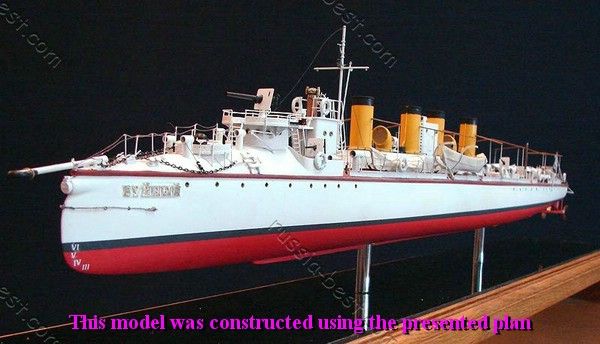
Please help !