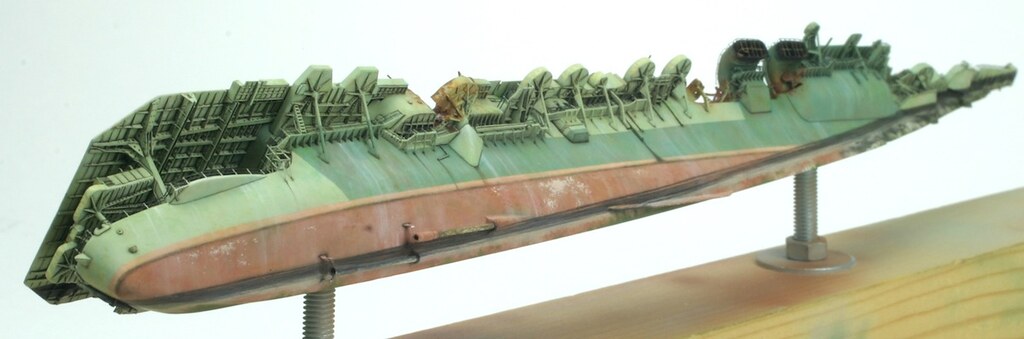
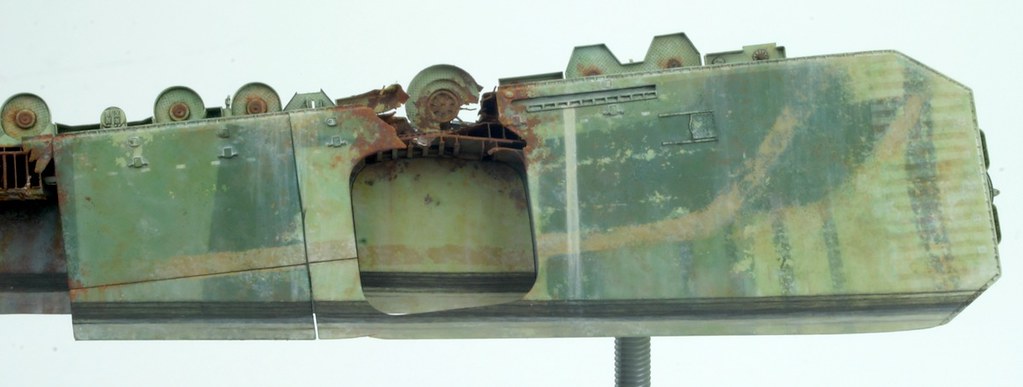
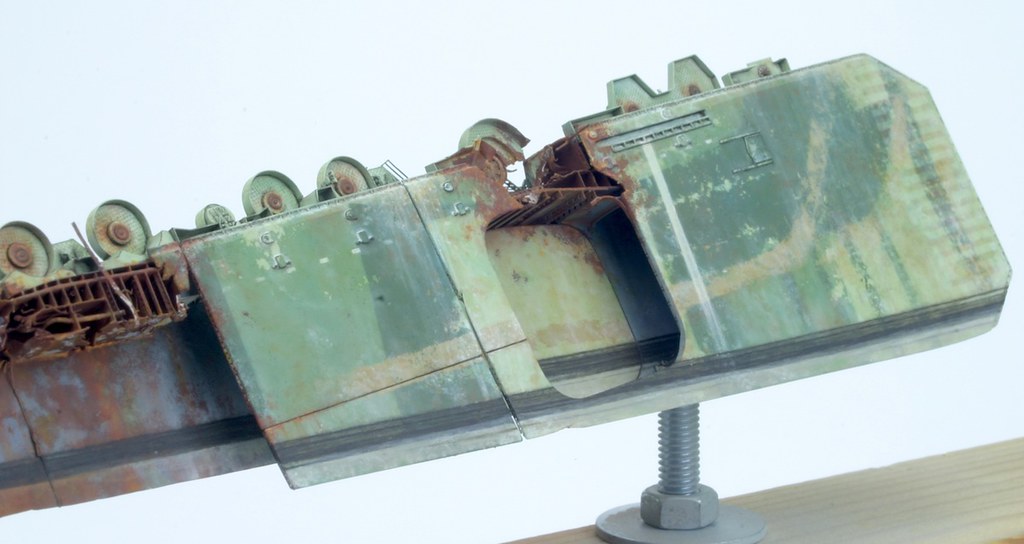
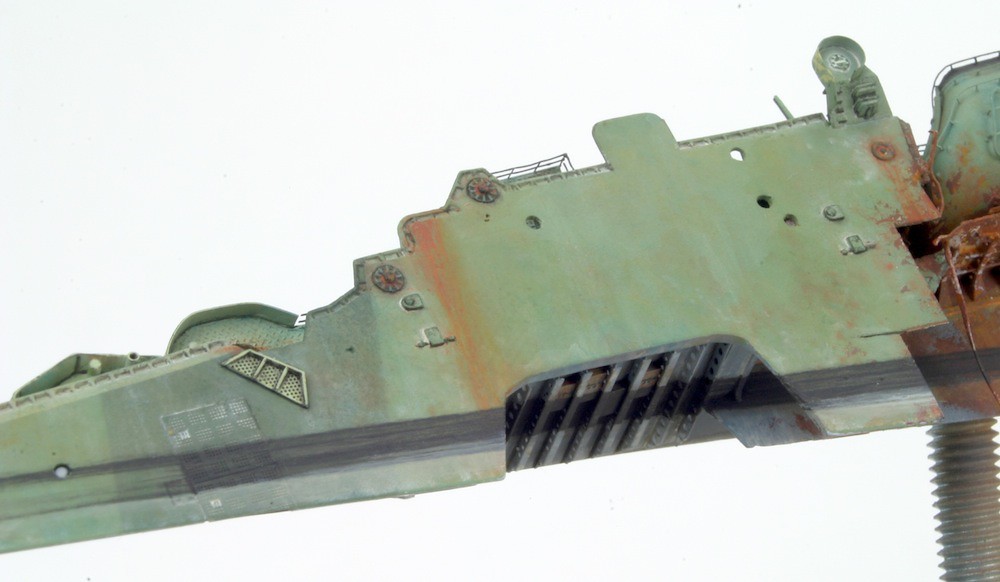
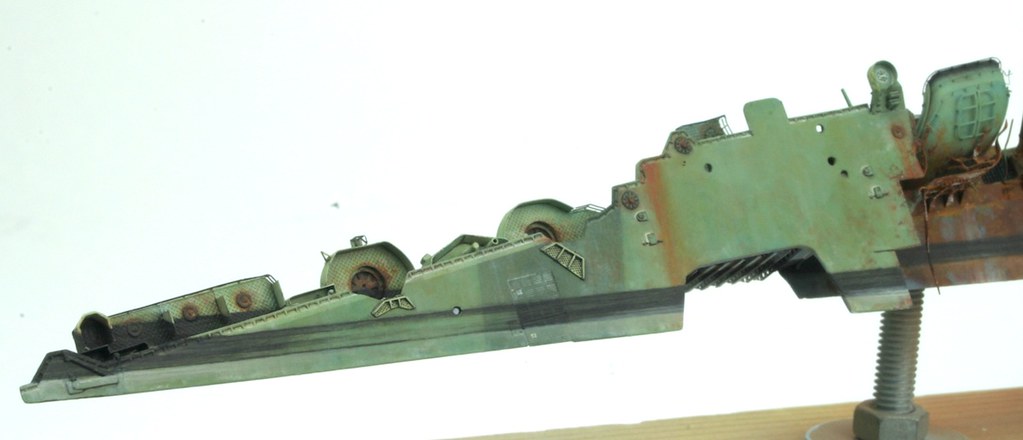
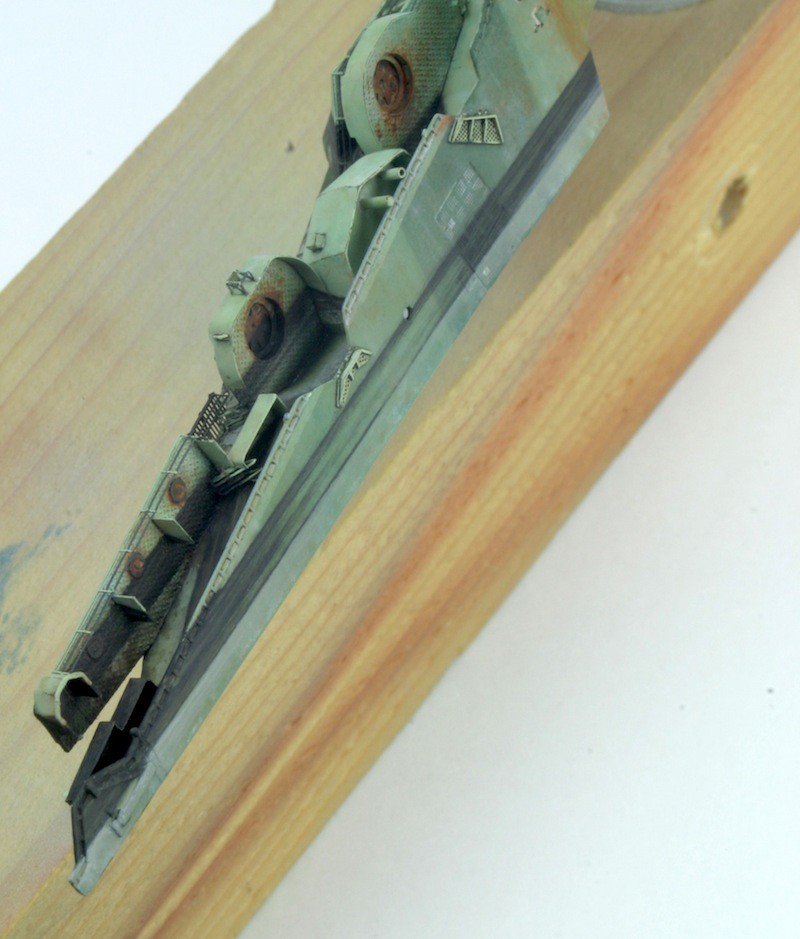
Page 23 of 33

Re: 1/700 Amagi diorama

Posted: Mon Nov 06, 2017 6:48 pm
by dafi
Where can one buy those nice big fingers for the pictures ?

XXXDAn

Re: 1/700 Amagi diorama

Posted: Mon Nov 06, 2017 8:40 pm
by Dan K
I'm up to "astounding". The rust effect especially so.

Re: 1/700 Amagi diorama

Posted: Tue Nov 07, 2017 4:13 am
by marijn van gils
Many thanks guys! :)
dafi wrote:Where can one buy those nice big fingers for the pictures ?
I'm not sure... I grew this one myself. Organic is always the best! :)

Cheers,

Marijn

Re: 1/700 Amagi diorama

Posted: Tue Nov 07, 2017 3:21 pm
by zs180
Mightily impressive work, just what I expected from you!

Re: 1/700 Amagi diorama

Posted: Tue Nov 07, 2017 3:26 pm
by Strategos Augustus
I have stickied your thread Marijn for future reference.

I feel a wholesale, blatant borrowing of ideas is in the pipeline.

I wish I could see this in person, it looks like you may have hit a very happy aggregate surface finish. Very plausible for an outdoor lump of wrecked metal.

The dark drybrushing in particular looks like a real success.

I am curious as to what inspired you to do the shadow effect after the other weathering? I have always implemented this type of effect very early in the process where the lack of control with an enamel pinwash is not a problem.

Re: 1/700 Amagi diorama

Posted: Tue Nov 07, 2017 5:28 pm
by EJFoeth
The interesting part about lining in shadows (and adding highlights) by brush, is that you have much more control than a pin wash; the colour is more concentrated and there's little (or no) risk for flooding adjacent parts. When you make an error you can correct it very easily with a wet brush, or remove a bit of the wash if the effect is too strong. It takes more time but in the end the effect is much better. If you add the shadows first, then subsequent washes that are also present fade out the effect a bit, especially lighter washes.

I tried applying Marijn's painting technique with shadows and highlights and I encourage everyone to try it. I'm not expecting to get the same level of quality (because this takes some practice :smallsmile: ), but I did get much better results than with pinwashes. Adding highlights works much better than drybrushing; if you're not careful you can add that 'faded' , sun-bleached look that is very difficult to undo.

Re: 1/700 Amagi diorama

Posted: Tue Nov 07, 2017 5:38 pm
by Bangor lad
Outstanding!

Re: 1/700 Amagi diorama

Posted: Tue Nov 07, 2017 9:21 pm
by MartinJQuinn
Fantastic work! Your attention to detail is astounding!

Re: 1/700 Amagi diorama

Posted: Wed Nov 08, 2017 4:05 am
by marijn van gils
Many thanks guys! :)
Strategos Augustus wrote:I am curious as to what inspired you to do the shadow effect after the other weathering? I have always implemented this type of effect very early in the process where the lack of control with an enamel pinwash is not a problem.
Evert-Jan already wrote the most important part:
EJFoeth wrote:If you add the shadows first, then subsequent washes that are also present fade out the effect a bit, especially lighter washes.
I do apply the shading as early as possible, as it is an important defining aspect in my painting style and gives a good bases to continue work on.
But I always apply filters before shading, as the colours of the thinned paints also run into the corners and details like a wash, obliterating the shading in places. I can apply some extra dusty or rusty filters or washes after the shading, but the more general main work is done before.

With Amagi, an important weathering effect is the flaked and rusted areas. As the chipped effect was mostly done with hairspray technique, it was part of the airbrushing process and therefore had to precede shading too. Because of the dusty and rusty effects, the filters also provide a lot of 'effect'. Therefore it may look like I did the shading very late in the weathering process, but in fact it is not.

Other effects follow after the shading: highlighting, reverse drybrushing, dark and rusty streaks and spots, local paint chipping, plate effect, ... while in fact only the filters precede it.
The island didn't receive some of the above effects (simulation of plate seams, paint chipping, rusty streaks) or only very little (dark streaks), so I could finish it more quickly than the rest of the model.

Evert-Jan is also correct about the nature of the control I mean, which is more about the result than about the process: to get the shadows painted exactly where I want them to be, as finely as possible, while having as much contrast as possible.
But there is nothing wrong with a pinwash when done properly, and it does take a lot less time. Lining the shadows with more opaque paint just enables one to go that last 5% further in finesse and contrast, but the time it requires is certainly not for everyone.

Cheers,

Marijn

Re: 1/700 Amagi diorama

Posted: Wed Nov 08, 2017 11:06 am
by GewoonWouter
Amazing work again Marijn, and the before and after photos clearly show the effectiveness of the methods used. This is just godsmackingly good I must say. I will try to incorporate some of those techniques on my Yamato once I find the time again to continue.

Needless to say I'm looking forward to see your next update :thumbs_up_1:

Cheers

Re: 1/700 Amagi diorama

Posted: Thu Nov 09, 2017 12:08 am
by Aop Aur
...........(no words).... :faint: :faint:

Re: 1/700 Amagi diorama

Posted: Sat Nov 11, 2017 4:46 am
by SilverGhost
Great job!
Respect!

Re: 1/700 Amagi diorama

Posted: Sat Nov 11, 2017 8:04 am
by marijn van gils
Many thanks guys! :)

Cheers,

Marijn

Re: 1/700 Amagi diorama

Posted: Sat Nov 11, 2017 2:08 pm
by LE BOSCO
HI Marijn

at each progress, I take a big slap in the face :big_eyes: just sublim ...your are the "Werner" of our hobby :thumbs_up_1:
bravo maitre :worship_1:
cheers
Nicolas

Re: 1/700 Amagi diorama

Posted: Mon Dec 04, 2017 4:48 am
by marijn van gils
Merci beaucoup Nicolas! :)

Again some time since the last update� I have been busy though! But the painting effect was pretty time-consuming�

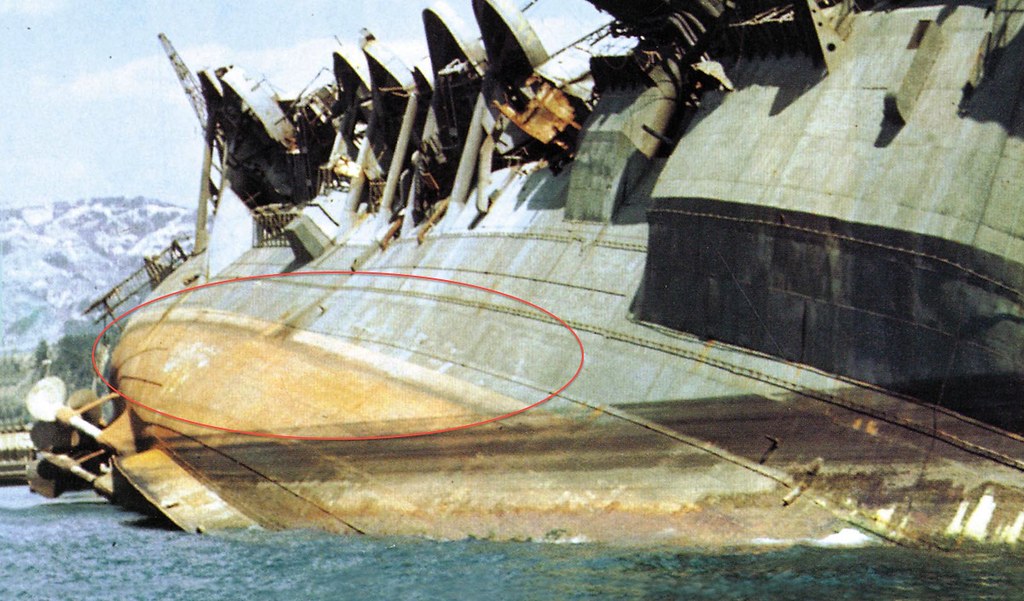
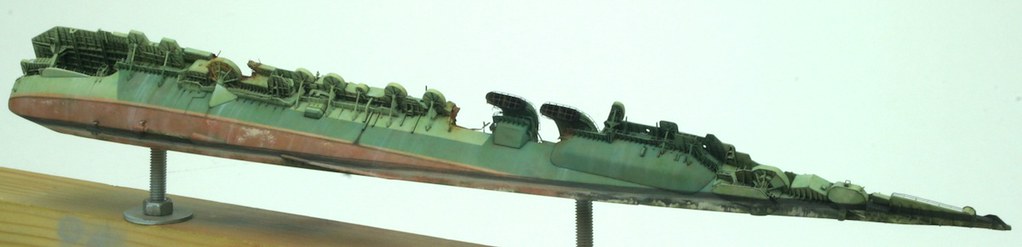
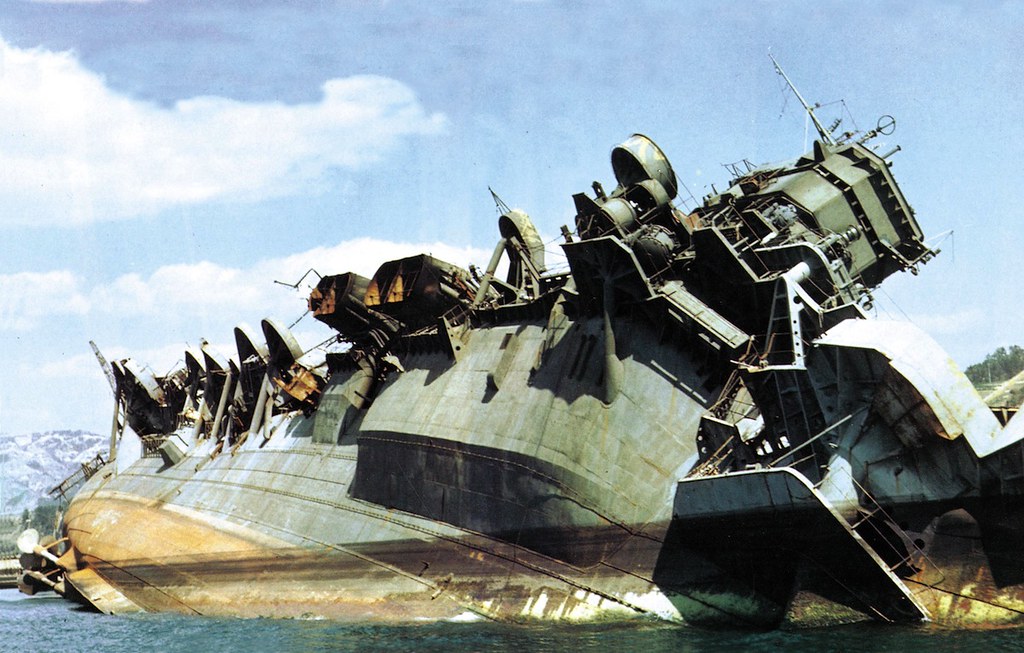
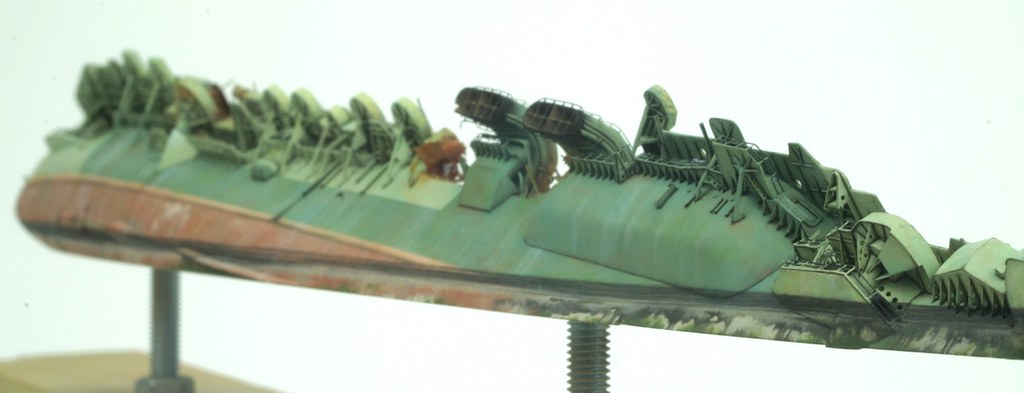
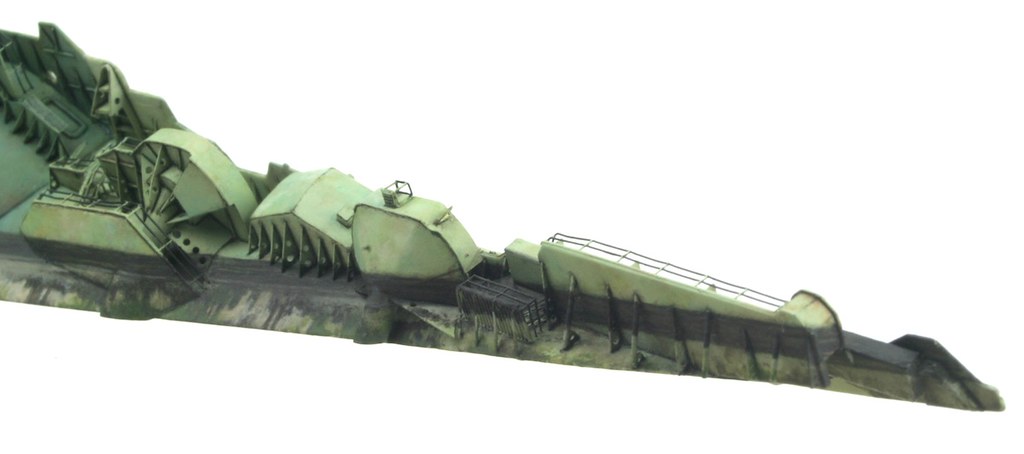
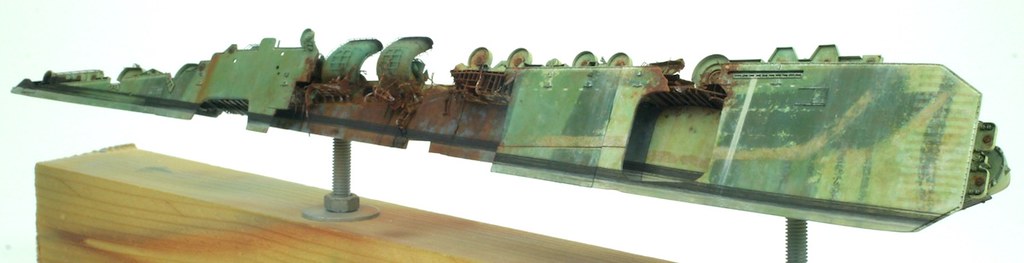
I finished the dirty tidal lines all around the ship, as clearly seen here:
Image

But I followed the (darker) colours of the video, as I used the video as the main reference for the rest of the colours too:

Image

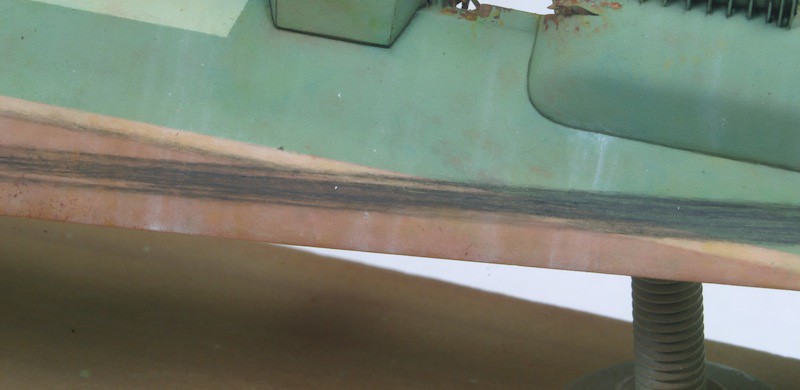
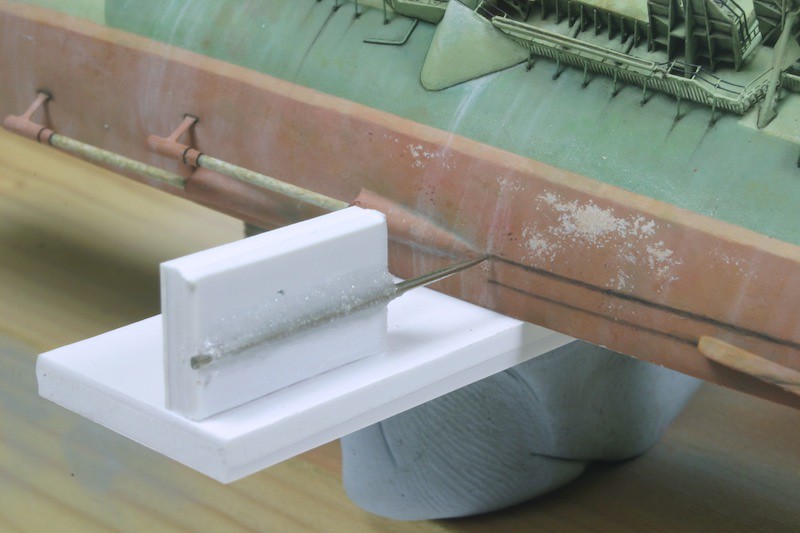
I started by painting a thin line at the top. With a simple homemade device to keep the exact level, I painted tiny faint dots. Then, I connected these dots to a line, eyeballing to get it strait and checking with the device. The edges of the line were blended for soft transitions.
Image

The lower line was painted by eye, using the top line as a visual reference. Next, more lines were painted in between, and the remaining space darkened to varying levels.
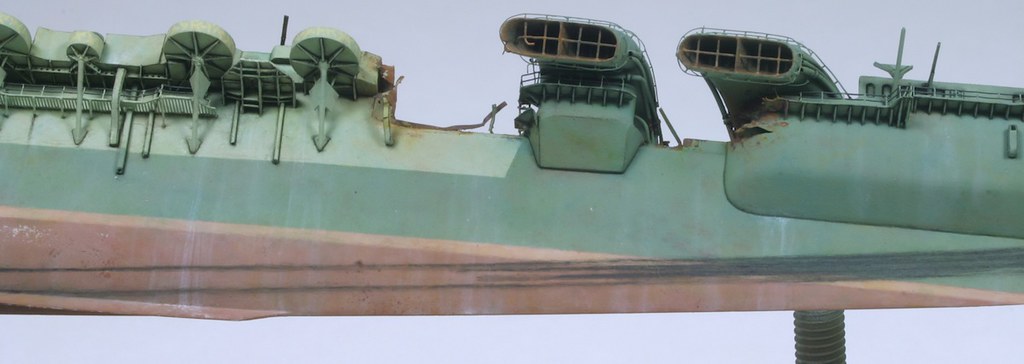
Image

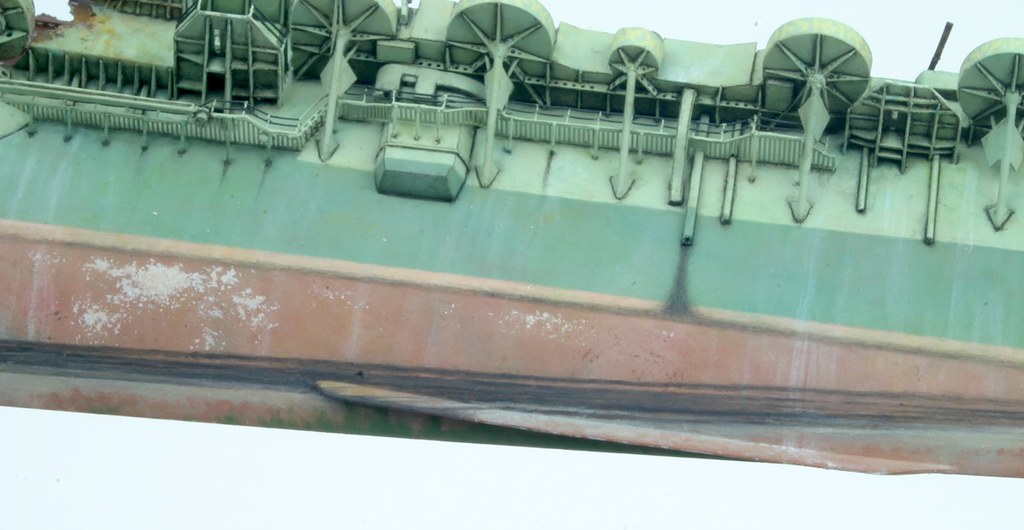
The dark lines finished. Note that the intensity is varied a bit, so the effect doesn�t become too uniform. All of this was hand painted around the entire model. That was very time-consuming (about 25 hours I think?), but the only way I could achieve my desired level of control and finesse.
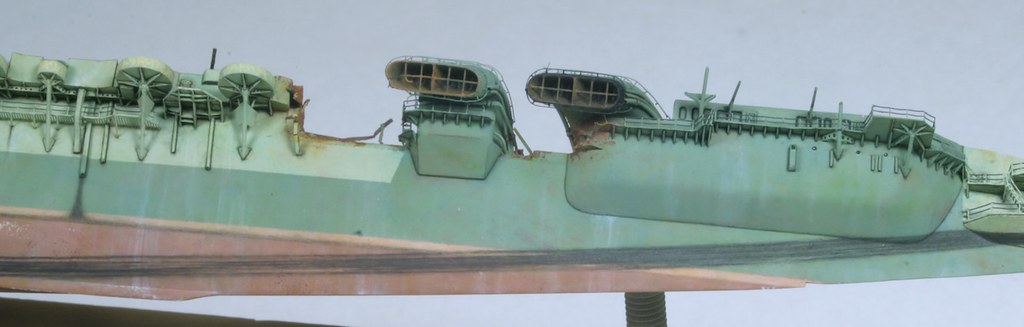
Image

Next, more dirt was painted below the dark lines. I didn�t take step-by-step photo�s of this, as I had to mess around to find what works.
But I will try to summarize:
- Paint a more or less transparent brownish grey zone below dark lines, often overlapping the dark lines too. Blend downwards. Locally paint some transparent ochre and flesh over it to break uniformity.
- Locally paint some base colour (anti-fouling red for example) in irregular line and splodges below the grey zone. Blend downwards, but leave sharp transition to the grey.
- Paint green growth and dirt to the bottom edge, but only here and there. Blend the edges a bit.
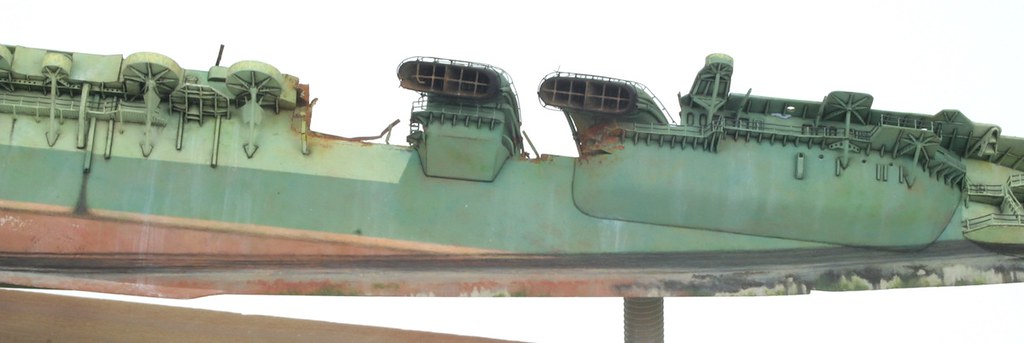
Image

Close-up with only the dark lines:
Image

And with the dirt below.
Towards the starboard bow, the photos show some heavier wear, where the paint seems to have been worn away completely. This was painted with light grey paint, with several filters over it (flesh, ochre, brown) to vary the tones. Very dark brown (the same as the dark lines) was used for the dirty �transition� to the grey zone.
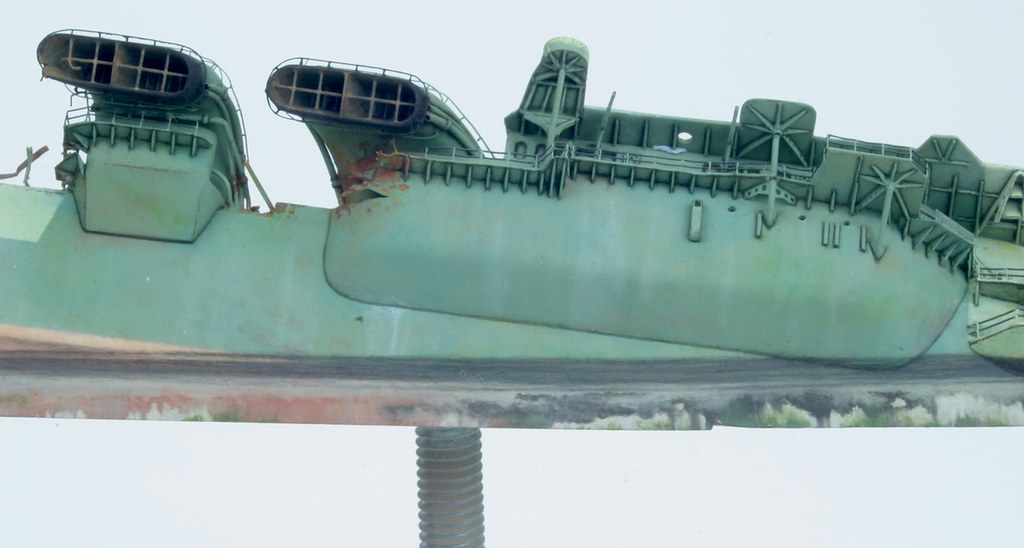
Image

Note I also added the dirty waterline stain, from when the ship was still floating upright (compare with historical photos below). Now the sun-bleached anti-fouling red above this line makes more visual sense.
Image

Image

Image

Working around these kind of details while keeping level lines was especially time-consuming:
Image

Image

Image

Image

The decks are only tacked in place with Blu-Tack, necessary to get the levels correct for both flight deck and hangar deck.
Image

Image

Image

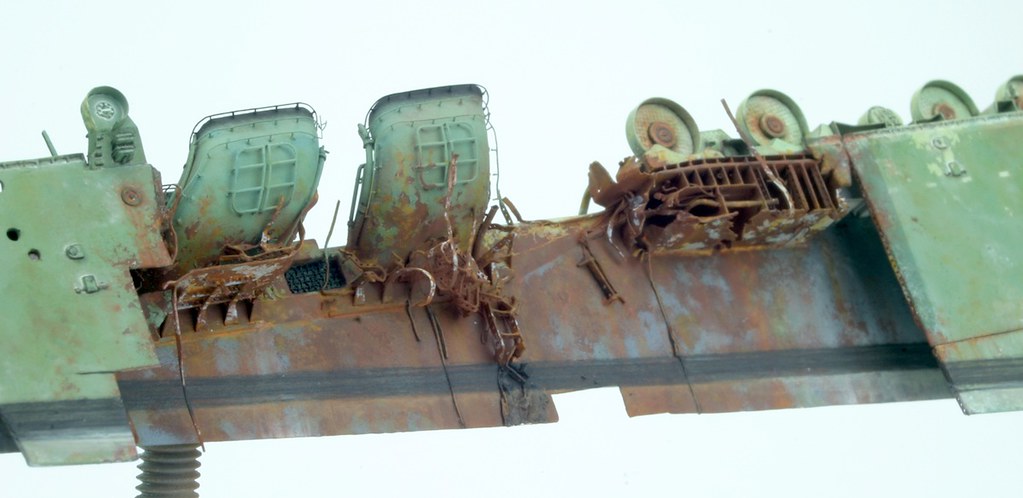
The rusted areas didn�t receive a grey zone below the dark lines, but rather a light rusty zone:
Image

Image

Image

Image

Everything was done with Humbrol enamels by the way.

In between, I also finished the stacks.
On the photographs, their interior looks rusted while there is some black soot around the outside edge. I have no idea why it is like that, but I painted accordingly.
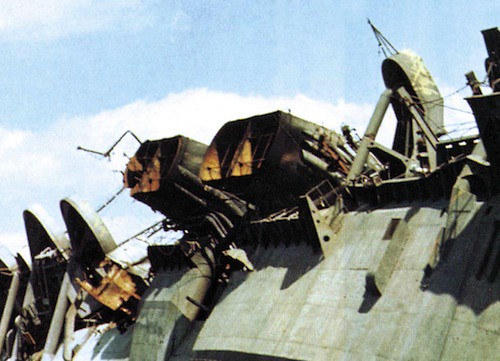
Image

First some rust inside with Humbrol enamels:
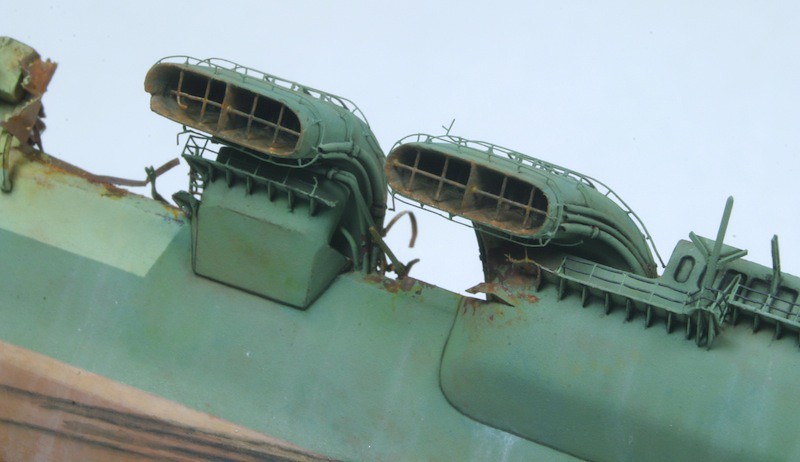
Image

And soot with black enamel and some black pigment powders:
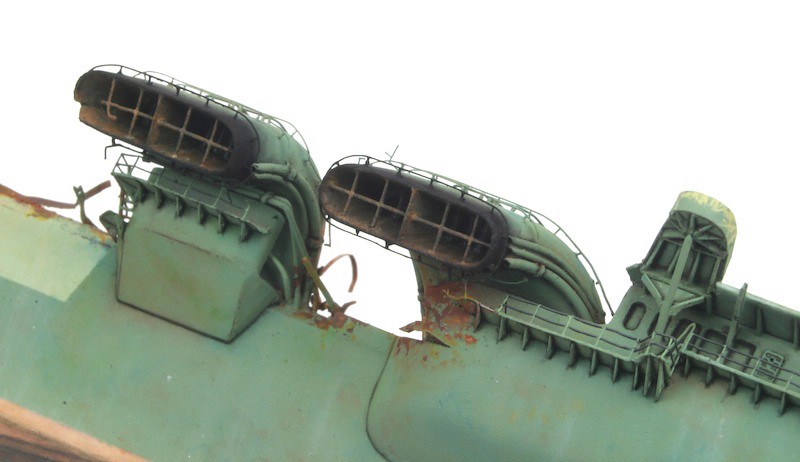
Image

Cheers!

Marijn

Re: 1/700 Amagi diorama

Posted: Mon Dec 04, 2017 6:42 am
by Goodwood
Image

Re: 1/700 Amagi diorama

Posted: Mon Dec 04, 2017 7:14 am
by Vladi
Really hard to find the right word... absolutely wonderfull!

Re: 1/700 Amagi diorama

Posted: Mon Dec 04, 2017 8:00 am
by pascalemod
Will you mount it on water? Kinda feel like it deserves some perfect water base...

Re: 1/700 Amagi diorama

Posted: Mon Dec 04, 2017 9:20 am
by EJFoeth
Nice progress! Is the dust applied per brush and left there? Does it need fixation?

And 25 hours on the lines? :big_grin:

Re: 1/700 Amagi diorama

Posted: Mon Dec 04, 2017 10:05 am
by Koppalakki
Oh yes, this gets me going!

These are those small things that separate you from the rest (putting 25h into painting some black lines :heh: )!
Not many realize how long such small things take if you really want to pull them off!

Damn :big_grin: