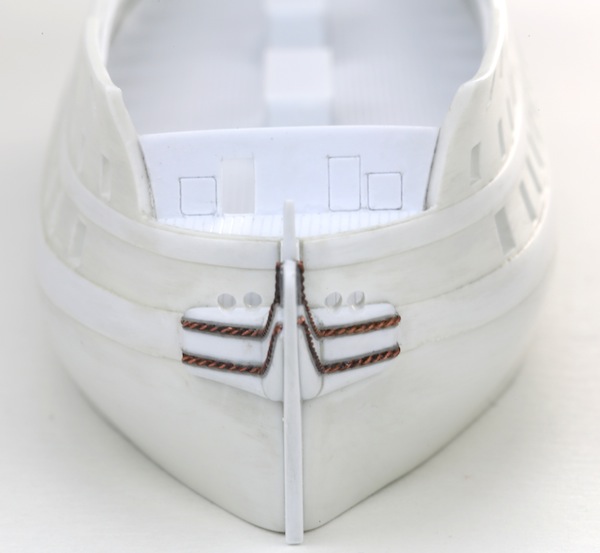
Many thansk everyone!

Maarten Sch�nfeld wrote:Your brass modelling skills surpass everything you do in plastic!
Many thanks Maarten! It is more time-consuming than plastic, and there is less room for error. Also, on plastic I can do fine stuff with the scalpel that is not possible on brass. But I find brass a very nice material to work with, and of course here I need it for its strength and stifness. But when I have the choice, I'll take styrene (like the mizzen mast)!

wefalck wrote:You should really try to get yourself a watchmakers lathe, if you are going to continue with such stuff. Much safer to use, because it has a tailstock and you can fashion yourself wooden steadies for filing. These lathes also come with so-called filing-rests and have an indexing ring in their main pulley, so that filing regular squares, hexagons or octgons is made very easy.
I have tried turning on my Proxxon lathe, but the pieces are too long and thin, causing them to flex too much, even with the tailstock, and even with a fixed steady. A travelling steady might be a solution, buth then I would have to get the PD400 lathe instead of the PD250/E which costs about 1000 euro's more (and I'm not even sure a travelling steady would actually work well for this...). Maybe a watchmakers lathe would work better than the Proxxon, but turning long thin pieces with the Dremel works very well too, and it is quite easy and fast.
And indexing ring would be very helpfull though. Now I had to position the piece by eye in the clamp, which is of course not so precise. Maybe something like exists that can be used without a late?
A milling machine would also work much more precisely for the square and hexagone sections. Maybe someday in the future...

wefalck wrote:As a safety measure, I run all my machines from foot-switches, including the transformer for the hand-held drill. In this way you have both hands free for work and just lifting the foot stops the machine without having to look for the on-off switch.
That's a great tip! The Dremel Micro is quite handy, as my thumb naturaly rests on the on/off button while using it. But I 'll be getting myself a footswitch anyway...
wefalck wrote:YBTW, what cement did you use for the styrene sheet/brass bonds ?
I first meld the plastic to the brass with regular thin plastic glue (Tamiya super thin). This way, I have as much time to position the piece as I need, the plastic part conforms perfectly to the brass, and I have no added thickness from glue. But of course the bond is not very strong (I make sure to roughen the brass a bit though), so I reinforce the joint by running some thin superglue along it.
But if a joint really needs some strenght, I glue with superglue directly. First gel superglue for easier positioning, then reinforcing with thin superglue.
If even more strength would be needed, I would use two-part epoxy, but I rarely need to.
wefalck wrote:Just to mention: cross-drilling of 0.6 mm rod with say a 0.2 mm is quite possible, given the right equipment. Just did this last night - well actually 1 mm brass rod that then will be taper-turned down to 0.6 mm
That is true! But I don't have the right equipment. I don't even have a simple drill press...
(That's on my list though, but maybe I should immediately get a mill instead?)
Also, the upper (thick) end of the dolphin stryker is 0,6mm. The lower end, through which the stays would have to go, is only about 0,3mm...
Still possible of course, but again a bit more difficult...
Thanks for all the advices wefalck! Very interesting!