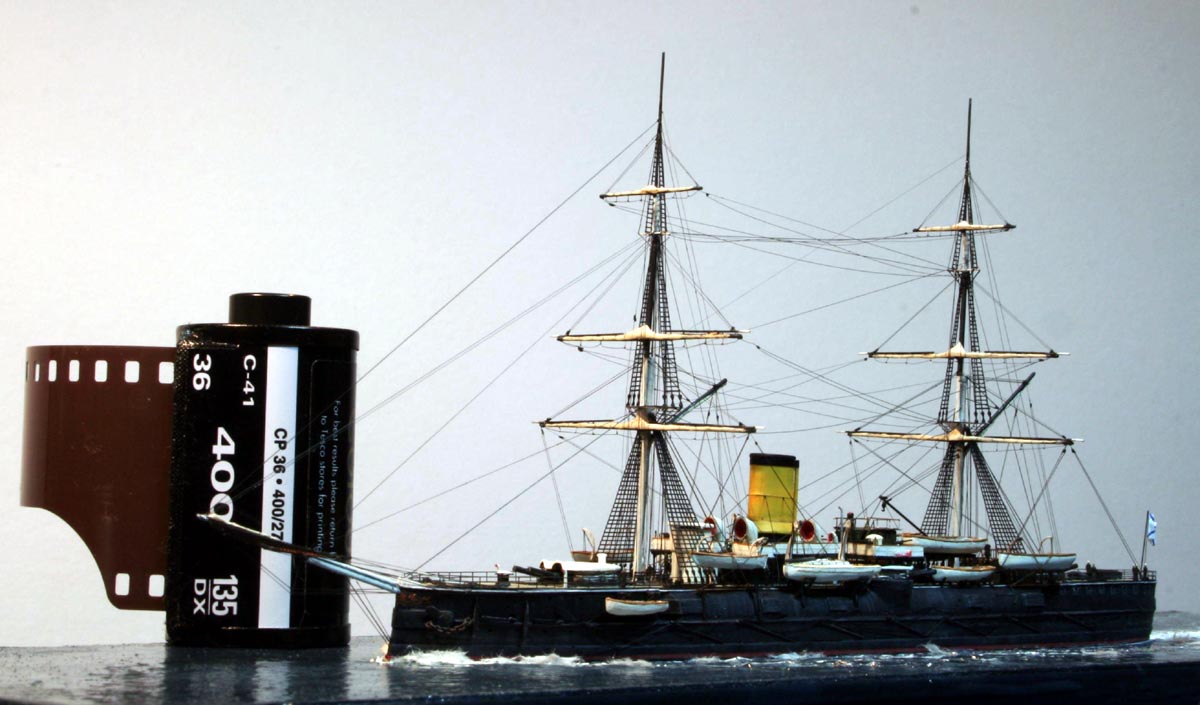
The Vladimir Monomakh in 1/700...
Posted: Sun Dec 05, 2010 4:28 pm
Having a temporary stall on my KuK Planet build due to needing a bit more info....
so as to keep the production and the momentum going ...,
-I thought I would build an easy, quick , precise and sharp modern Kombrig kit--WW1 RN..
--alas all my RN WW1 books, Burt, Trotter etc etc are lent out at the moment--and anyhow--I seem like doing things the hard way?? ..!?
so I got an older kit out of my stash.........
Now this model built some years ago by Vladimir Yabukov to show the ship as at the time of Tsushima with cut down masts...
http://www.modelshipgallery.com/gallery ... index.html
http://www.modelshipgallery.com/gallery ... index.html
Of course I want her with full sailing rig...
bit of background (from WIKIPEDIA)
The Vladimir Monomakh was laid down in 1880. She was originally equipped with a heavy full rig of sail on three masts and bowsprit. Completed in 1885, she was modernized in 1897-1898 with new armament, as her original armament was by then obsolete. A searchlight platform was placed atop the mainmast. As built on sea trials, the 5,593-ton cruiser reached 15.2 knots (28.2 km/h) but she was far slower 25 years later, despite the refit, as a result of overaged and worn out machinery.
During the Russo-Japanese war, Vladimir Monomakh was assigned to the Third Pacific Squadron, which was sent to reinforce Zinovy Rozhestvensky's Second Pacific Squadron. The Third Pacific Squadron was equipped with overaged warships and was unfit for in modern naval warfare despite the insistence of the Russian Admiralty. The Vladimir Monomakh was a quarter of a century old at the time of the conflict.
On May 27, 1905, at Tsushima, Vladimir Monomakh was positioned to the right side of the Russian line, guarding the fleet train and so avoided the pounding that the Second Pacific Squadron received. However, at nightfall, the Japanese torpedo boats engaged the Russians. Vladimir Monomakh, mistaking one of her attackers for a Russian destroyer, collided with the Japanese vessel and was later hit by a single torpedo. The damage was severe but her crew kept her afloat and her engines operational. The next morning, however, the cruiser was scuttled by the crew and sank at 14:30.
------------------------------------------------------------------------------------------------------------------
Firstly spent time and assessed differences and inaccuracies as far as I could ascertain ...
I wanted my gun apertures open, and had to move them and symmetrise the sizes according to photos from Navsource Russia...
To enable the apertures to be repeatable the same size and perfectly square I lined them with brass-cut from 1/350 handrail.
Having a large stock of PE helps as I could pick and choose the right size...
The closed in gun embrasures for and aft were also opened --as the deck would cover my 'freestyle' drilling.
The funnel and vent bases that ( wrongly) were cast level with the top deck in the kit had to be lowered, as well as the fwd conning tower removed-and the event base made smaller-with consequent making good of deck...
All 'Aztec' cast on staircases were also removed and the deck 'repaired' and re-scored.
The twin staircases for stairs fwd and aft down below were also opened up--as well as the large engine room skylight.
The deck also needed work- with parts being removed, slimmed down, and the whole deck being thinned at the edges,
The pilot house needed be moved aft on the bridge deck--so the deck was repaired with a previously removed section of resin deck to match!
The kit surface of the skylight was wrongly simplified with a few portholes--the real thing - according to my drawings-had two sets of hinged skylight hatches per side with 4 port-holes per hatch...
This was going to be tricky to make exactly right without a piece of custom relief etched PE!
I elected to represent the outer set of hatches open--and represented the 4 portholes per hatch with some fine mesh--with the hatches being cut from old stock 350 scale stairs.
The hull sides were a bit dished--so I removed the cast-on strake( neatly done but overscale and wrong profile)
This allowed me to pared away the resin with a blade to give a flat side and replaced the missing strake with some fine nickel silver wire.
After some paint on the deck and the new funnel bases made using CA -infused paper it started looking better
The new strake was much finer--and the case-mates now had a round profile with a completely flat bottom. as per photos
That is it so far... more progress soon!
Jim Baumann
so as to keep the production and the momentum going ...,
-I thought I would build an easy, quick , precise and sharp modern Kombrig kit--WW1 RN..
--alas all my RN WW1 books, Burt, Trotter etc etc are lent out at the moment--and anyhow--I seem like doing things the hard way?? ..!?
so I got an older kit out of my stash.........
Now this model built some years ago by Vladimir Yabukov to show the ship as at the time of Tsushima with cut down masts...
http://www.modelshipgallery.com/gallery ... index.html
http://www.modelshipgallery.com/gallery ... index.html
Of course I want her with full sailing rig...
The Vladimir Monomakh was laid down in 1880. She was originally equipped with a heavy full rig of sail on three masts and bowsprit. Completed in 1885, she was modernized in 1897-1898 with new armament, as her original armament was by then obsolete. A searchlight platform was placed atop the mainmast. As built on sea trials, the 5,593-ton cruiser reached 15.2 knots (28.2 km/h) but she was far slower 25 years later, despite the refit, as a result of overaged and worn out machinery.
During the Russo-Japanese war, Vladimir Monomakh was assigned to the Third Pacific Squadron, which was sent to reinforce Zinovy Rozhestvensky's Second Pacific Squadron. The Third Pacific Squadron was equipped with overaged warships and was unfit for in modern naval warfare despite the insistence of the Russian Admiralty. The Vladimir Monomakh was a quarter of a century old at the time of the conflict.
On May 27, 1905, at Tsushima, Vladimir Monomakh was positioned to the right side of the Russian line, guarding the fleet train and so avoided the pounding that the Second Pacific Squadron received. However, at nightfall, the Japanese torpedo boats engaged the Russians. Vladimir Monomakh, mistaking one of her attackers for a Russian destroyer, collided with the Japanese vessel and was later hit by a single torpedo. The damage was severe but her crew kept her afloat and her engines operational. The next morning, however, the cruiser was scuttled by the crew and sank at 14:30.
------------------------------------------------------------------------------------------------------------------
Firstly spent time and assessed differences and inaccuracies as far as I could ascertain ...
I wanted my gun apertures open, and had to move them and symmetrise the sizes according to photos from Navsource Russia...
To enable the apertures to be repeatable the same size and perfectly square I lined them with brass-cut from 1/350 handrail.
Having a large stock of PE helps as I could pick and choose the right size...
The closed in gun embrasures for and aft were also opened --as the deck would cover my 'freestyle' drilling.
The funnel and vent bases that ( wrongly) were cast level with the top deck in the kit had to be lowered, as well as the fwd conning tower removed-and the event base made smaller-with consequent making good of deck...
All 'Aztec' cast on staircases were also removed and the deck 'repaired' and re-scored.
The twin staircases for stairs fwd and aft down below were also opened up--as well as the large engine room skylight.
The pilot house needed be moved aft on the bridge deck--so the deck was repaired with a previously removed section of resin deck to match!
The kit surface of the skylight was wrongly simplified with a few portholes--the real thing - according to my drawings-had two sets of hinged skylight hatches per side with 4 port-holes per hatch...
This was going to be tricky to make exactly right without a piece of custom relief etched PE!
I elected to represent the outer set of hatches open--and represented the 4 portholes per hatch with some fine mesh--with the hatches being cut from old stock 350 scale stairs.
This allowed me to pared away the resin with a blade to give a flat side and replaced the missing strake with some fine nickel silver wire.
After some paint on the deck and the new funnel bases made using CA -infused paper it started looking better
The new strake was much finer--and the case-mates now had a round profile with a completely flat bottom. as per photos
That is it so far... more progress soon!
Jim Baumann