NucSub wrote:Turrets had the gun deck and equipment including all side armor as part of the rotating mass. Hooded barbettes have the heavy side armor stationary surrounding a sunken gun deck. The hood was much lighter due to less mass, side armor, and smaller due to not having everything rotate.
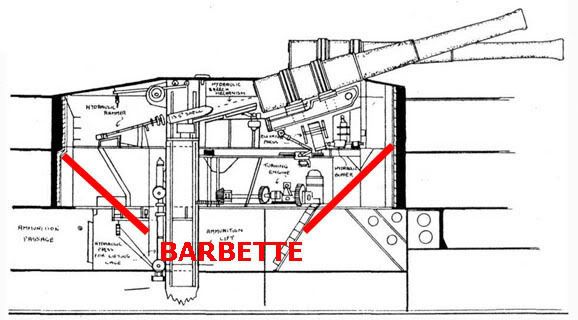
The early turrets, yes, but towards the end of the era of the old round turrets, they had almost become like the later hooded barbette. The protective armour which had previously been part of the rotating mass had now become a fixed redoubt protecting the guns' turntable, effectively becoming a barbette in all but name. Look at this cross-section of the main turret of HMS Victoria (from Hovgaard):

If we look at the Royal Sovereign, we see:
The real difference between the 'Royal Sovereign' and the 'Hood' was that the 'Royal Sovereign' had
open barbettes which were lighter simply because they had no turret
or hood on top; HMS Hood's turrets were basically
on top of the same barbettes her sisters possessed, that extra weight meaning the whole arrangement had to be a deck lower. The early barbettes (e.g. the Admiral class) could be higher simply because the turret was eliminated from the armoured redoubt. The first hooded barbettes had small, lightweight hoods - they were light because they were only splinter-proof. By the time the hoods had metamorphosed into modern type shell-proof turrets, as in the 'Majestic' class, the reason the ships could carry them on a high freeboard was
partly because the ships had grown large enough to do so, but
more important was that by the time of the 'Majestic' class, the old, very thick compound armour had given way to much thinner nickel steel and KC armour.
That is what made the turrets lighter, not any inherent superiority of the hooded barbette which had effectively, as we have seen, evolved into much the same arrangement as the last of the old type round turrets.
There is a very interesting drawing in the 'Transactions of the Institution of Naval Architects' of 1888 which accompanies a paper by Lord Armstrong and Mr Vavasseur. It shows a cross-section of a pair of 68-ton guns (13.5") on an 'Admiral' class type barbette:
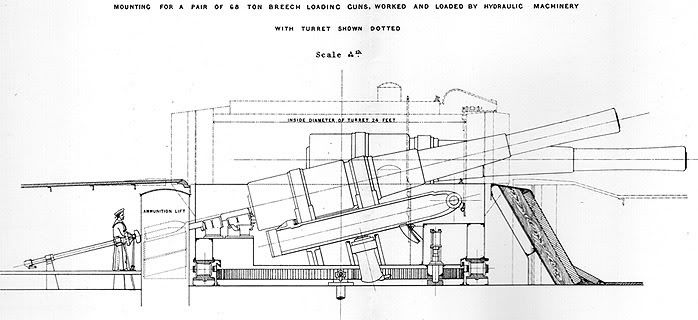
The armoured sides of the barbette are, of course, sloped. But in dotted lines is shown the same arrangement for a turret on a 'Nile' class battleship; the only difference to the barbette (or redoubt) is that it has straight sides. In Armstrong & Vavasseur's paper, they even state that 'in either case the base of the turret is practically the same... The gun slides, carriages, elevating gear, ammunition hoists, &c., &c., are also similar in both instances.'
What I'm basically saying is that the late round turrets were hooded barbettes in all but name.
[quote="NucSub"]Turrets had the gun deck and equipment including all side armor as part of the rotating mass. Hooded barbettes have the heavy side armor stationary surrounding a sunken gun deck. The hood was much lighter due to less mass, side armor, and smaller due to not having everything rotate.[/quote]
The early turrets, yes, but towards the end of the era of the old round turrets, they had almost become like the later hooded barbette. The protective armour which had previously been part of the rotating mass had now become a fixed redoubt protecting the guns' turntable, effectively becoming a barbette in all but name. Look at this cross-section of the main turret of HMS Victoria (from Hovgaard):
[img]http://i11.photobucket.com/albums/a172/GrandLunar/Maritime/Victoriaturretandredoubtb.jpg[/img]
If we look at the Royal Sovereign, we see:
[img]http://i11.photobucket.com/albums/a172/GrandLunar/Maritime/Royal_Sovereign_a.jpg[/img]
The real difference between the 'Royal Sovereign' and the 'Hood' was that the 'Royal Sovereign' had [i]open[/i] barbettes which were lighter simply because they had no turret [i]or [/i]hood on top; HMS Hood's turrets were basically [i]on top of[/i] the same barbettes her sisters possessed, that extra weight meaning the whole arrangement had to be a deck lower. The early barbettes (e.g. the Admiral class) could be higher simply because the turret was eliminated from the armoured redoubt. The first hooded barbettes had small, lightweight hoods - they were light because they were only splinter-proof. By the time the hoods had metamorphosed into modern type shell-proof turrets, as in the 'Majestic' class, the reason the ships could carry them on a high freeboard was [i]partly [/i]because the ships had grown large enough to do so, but [i]more [/i]important was that by the time of the 'Majestic' class, the old, very thick compound armour had given way to much thinner nickel steel and KC armour. [i]That [/i]is what made the turrets lighter, not any inherent superiority of the hooded barbette which had effectively, as we have seen, evolved into much the same arrangement as the last of the old type round turrets.
There is a very interesting drawing in the 'Transactions of the Institution of Naval Architects' of 1888 which accompanies a paper by Lord Armstrong and Mr Vavasseur. It shows a cross-section of a pair of 68-ton guns (13.5") on an 'Admiral' class type barbette:
[img]http://i11.photobucket.com/albums/a172/GrandLunar/Maritime/68-tongunTINA1888b.jpg[/img]
The armoured sides of the barbette are, of course, sloped. But in dotted lines is shown the same arrangement for a turret on a 'Nile' class battleship; the only difference to the barbette (or redoubt) is that it has straight sides. In Armstrong & Vavasseur's paper, they even state that 'in either case the base of the turret is practically the same... The gun slides, carriages, elevating gear, ammunition hoists, &c., &c., are also similar in both instances.'
What I'm basically saying is that the late round turrets were hooded barbettes in all but name.