
At what point did warships change over from round gunhouses to the current shaped turrets? Which nation was first?
Kurt
Gun turrets
Moderators: Timmy C, Gernot, Olaf Held, JWintjes
-
Roger T
- Posts: 89
- Joined: Fri Mar 25, 2005 3:03 pm
- Location: London, England
Hmmm, not so straightforward, because it depends on what you mean by 'current shaped turrets'...
The first British battleships to have hooded barbettes (as they were originally termed) were the second-class battleships of the 'Barfleur' class of 1888 (all dates are the year of laying-down). After that, the 'Majestic' class (1893) were the first first-class battleships so equipped.
But you could say they have ancestors in the form of the Italian 'Re Umberto' class of 1883, which although they had the 'tall' barbettes similar to the British 'Admiral' class, did have steel hoods over the guns. The German coast-defence battleships of the 'Siegfried' class (also 1883) had dome-shaped hoods on their single barbettes, forerunners of the twin-mountings of the 'Brandenburg' class. Various Russian vessels also had barbettes with hoods, too numerous to mention, though 'Chesma' (1882) springs to mind.
However, all the above, with the exception of the 'Majestics', had only splinter-proof hoods; I think the 'Majestics' were the first to have heavily armoured hoods designed to keep out shells.
So, not a straightforward answer, I'm afraid, as it depends on just what you mean, and whether you include the earliest splinter-proof hoods (in which case, I'd say 'Chesma', 'Re Umberto' or 'Siegfried', it's hard to say as I don't have exact dates for all of when they were designed), or whether you mean shell-proof protection ('Majestic').
The first British battleships to have hooded barbettes (as they were originally termed) were the second-class battleships of the 'Barfleur' class of 1888 (all dates are the year of laying-down). After that, the 'Majestic' class (1893) were the first first-class battleships so equipped.
But you could say they have ancestors in the form of the Italian 'Re Umberto' class of 1883, which although they had the 'tall' barbettes similar to the British 'Admiral' class, did have steel hoods over the guns. The German coast-defence battleships of the 'Siegfried' class (also 1883) had dome-shaped hoods on their single barbettes, forerunners of the twin-mountings of the 'Brandenburg' class. Various Russian vessels also had barbettes with hoods, too numerous to mention, though 'Chesma' (1882) springs to mind.
However, all the above, with the exception of the 'Majestics', had only splinter-proof hoods; I think the 'Majestics' were the first to have heavily armoured hoods designed to keep out shells.
So, not a straightforward answer, I'm afraid, as it depends on just what you mean, and whether you include the earliest splinter-proof hoods (in which case, I'd say 'Chesma', 'Re Umberto' or 'Siegfried', it's hard to say as I don't have exact dates for all of when they were designed), or whether you mean shell-proof protection ('Majestic').
"Religion is regarded by the common people as true, by the wise as false, and by the rulers as useful." Seneca, 1st century AD
-
Gone Asiatic
- Posts: 836
- Joined: Tue Jan 11, 2005 7:44 pm
- Location: Zipangu - Jipukuo
Turrets
Did not the monitors of the Civil War USN have the first turrets?
No Quarter Asked - None Given

-
Roger T
- Posts: 89
- Joined: Fri Mar 25, 2005 3:03 pm
- Location: London, England
Depends. Do you want American angular, or British angular? Because each nation had their own 'look' for turrets. Basically, the 'Trafalgar' class (1885) were the last British battleships with round turrets, the 'Kearsarge' class (1895) the last Americans. For angular turrets, if British, the 'Majestics' (1893), if American, the 'Illinois' class (1896).
"Religion is regarded by the common people as true, by the wise as false, and by the rulers as useful." Seneca, 1st century AD
-
Roger T
- Posts: 89
- Joined: Fri Mar 25, 2005 3:03 pm
- Location: London, England
I disagree about the conservatism of naval thinking, but that's a whole other argument...
There's actually not a whole lot of difference between the angular turret and the last of the old round turrets, so there is no great shift in thought. The last of the round turrets had virtually evolved into barbettes with a turret on top, but they had descended from the Coles turret. The later hooded barbettes descended, as the name implies, from what were originally open barbettes, but by the 1890s, the two lines of descent had more or less converged. The real shift is from the open barbette to the hooded barbette (as I alluded to above); the later change in shape of the turret, or hood, was a minor development. I suppose the 'Majestic' barbette can be seen as transitional, being of the older pear shape but with a hood/turret atop (though the last two vessels in what was, after all, a huge class of batttleships had round barbettes). But that's to do with barbette arrangements, rather than turret shape, which is what you're asking after.
There's actually not a whole lot of difference between the angular turret and the last of the old round turrets, so there is no great shift in thought. The last of the round turrets had virtually evolved into barbettes with a turret on top, but they had descended from the Coles turret. The later hooded barbettes descended, as the name implies, from what were originally open barbettes, but by the 1890s, the two lines of descent had more or less converged. The real shift is from the open barbette to the hooded barbette (as I alluded to above); the later change in shape of the turret, or hood, was a minor development. I suppose the 'Majestic' barbette can be seen as transitional, being of the older pear shape but with a hood/turret atop (though the last two vessels in what was, after all, a huge class of batttleships had round barbettes). But that's to do with barbette arrangements, rather than turret shape, which is what you're asking after.
"Religion is regarded by the common people as true, by the wise as false, and by the rulers as useful." Seneca, 1st century AD
-
NucSub

- Posts: 36
- Joined: Thu May 25, 2006 7:10 pm
- Location: Houston, Texas
Original Turrets were very heavy. A good example of that would be the RN's Royal Soviergn Class. All but one were built with open barbettes and one (HMS Hood) with turrets. The result were fine seaboats except the Hood. Due to weight, her hull was one deck lower, and she had other top weight issues. She ended her days as a breakwater in Scapa where she sits today.
The hooded barbettes are far lighter.
Turrets had the gun deck and equipment including all side armor as part of the rotating mass. Hooded barbettes have the heavy side armor stationary surrounding a sunken gun deck. The hood was much lighter due to less mass, side armor, and smaller due to not having everything rotate.
The hooded barbettes are far lighter.
Turrets had the gun deck and equipment including all side armor as part of the rotating mass. Hooded barbettes have the heavy side armor stationary surrounding a sunken gun deck. The hood was much lighter due to less mass, side armor, and smaller due to not having everything rotate.
-
Roger T
- Posts: 89
- Joined: Fri Mar 25, 2005 3:03 pm
- Location: London, England
The early turrets, yes, but towards the end of the era of the old round turrets, they had almost become like the later hooded barbette. The protective armour which had previously been part of the rotating mass had now become a fixed redoubt protecting the guns' turntable, effectively becoming a barbette in all but name. Look at this cross-section of the main turret of HMS Victoria (from Hovgaard):NucSub wrote:Turrets had the gun deck and equipment including all side armor as part of the rotating mass. Hooded barbettes have the heavy side armor stationary surrounding a sunken gun deck. The hood was much lighter due to less mass, side armor, and smaller due to not having everything rotate.

If we look at the Royal Sovereign, we see:
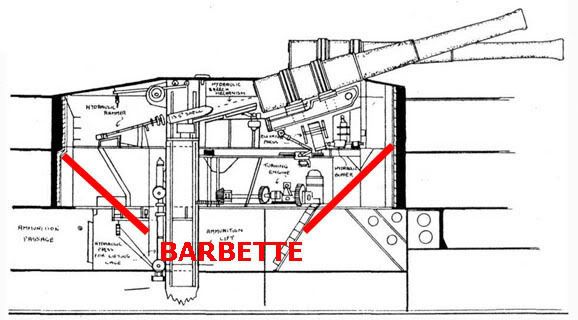
The real difference between the 'Royal Sovereign' and the 'Hood' was that the 'Royal Sovereign' had open barbettes which were lighter simply because they had no turret or hood on top; HMS Hood's turrets were basically on top of the same barbettes her sisters possessed, that extra weight meaning the whole arrangement had to be a deck lower. The early barbettes (e.g. the Admiral class) could be higher simply because the turret was eliminated from the armoured redoubt. The first hooded barbettes had small, lightweight hoods - they were light because they were only splinter-proof. By the time the hoods had metamorphosed into modern type shell-proof turrets, as in the 'Majestic' class, the reason the ships could carry them on a high freeboard was partly because the ships had grown large enough to do so, but more important was that by the time of the 'Majestic' class, the old, very thick compound armour had given way to much thinner nickel steel and KC armour. That is what made the turrets lighter, not any inherent superiority of the hooded barbette which had effectively, as we have seen, evolved into much the same arrangement as the last of the old type round turrets.
There is a very interesting drawing in the 'Transactions of the Institution of Naval Architects' of 1888 which accompanies a paper by Lord Armstrong and Mr Vavasseur. It shows a cross-section of a pair of 68-ton guns (13.5") on an 'Admiral' class type barbette:
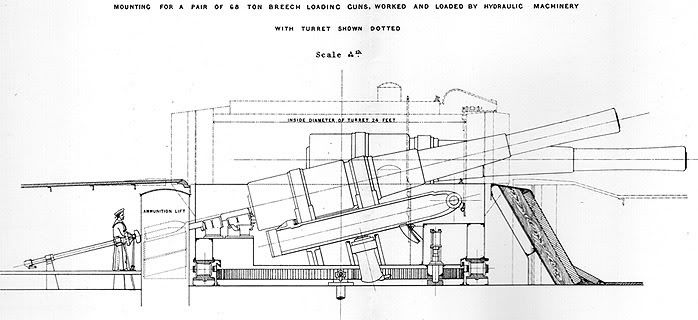
The armoured sides of the barbette are, of course, sloped. But in dotted lines is shown the same arrangement for a turret on a 'Nile' class battleship; the only difference to the barbette (or redoubt) is that it has straight sides. In Armstrong & Vavasseur's paper, they even state that 'in either case the base of the turret is practically the same... The gun slides, carriages, elevating gear, ammunition hoists, &c., &c., are also similar in both instances.'
What I'm basically saying is that the late round turrets were hooded barbettes in all but name.
"Religion is regarded by the common people as true, by the wise as false, and by the rulers as useful." Seneca, 1st century AD
-
Lesforan

- Posts: 559
- Joined: Sun Feb 19, 2006 7:22 pm
- Location: Ogallala, Nebraska, USA
Round Turrets
Another point about the round turrets is that they, being round, require larger, and therefore heavier structures than the "modern" style.
The American "Indiana" class, equipped with round turrets (round secondary turrets as well), had a less than optimal freeboard. The round turrets had to contribute to this. These turrets were an obsolete design when built (1893), yet were retained and used on the subsequent "Kearsarge" class. At least in the USN, then, this does represent an influence of "naval conservatism".
I may point out also that the round turret was not confined to battleships, but were also found on protected cruisers of the same era.
The American "Indiana" class, equipped with round turrets (round secondary turrets as well), had a less than optimal freeboard. The round turrets had to contribute to this. These turrets were an obsolete design when built (1893), yet were retained and used on the subsequent "Kearsarge" class. At least in the USN, then, this does represent an influence of "naval conservatism".
I may point out also that the round turret was not confined to battleships, but were also found on protected cruisers of the same era.
Les Foran
On the Oregon Trail
On the Oregon Trail
-
chuck

- Posts: 3384
- Joined: Mon Jan 10, 2005 1:21 pm
- Location: equidistant to everywhere
Re: Gun turrets
kurt wrote:At what point did warships change over from round gunhouses to the current shaped turrets? Which nation was first?
Kurt
Might I beg to point out that the rounded "gunhouse" were in fact real turrets?
While the current shaped "turrets" are in fact not real turrets but Hooded barbettes?

Sorry for being pedantic.
Assessing the impact of new area rug under modeling table.
-
Roger T
- Posts: 89
- Joined: Fri Mar 25, 2005 3:03 pm
- Location: London, England
First, I disagree with Lesforan that the round turrets were inherently heavier due to their shape or the supporting structure being larger; it wasn't, and the suporting structure needs to be round at the very least whatever the shape of the turret or hood on top. The round turret was generally heavier but, as I mentioned before, only because it was protected with very thick compound armour. It simply didn't survive long enough into the age of nickel or KC armour. The later, 'modern' shell-proof hoods of the hooded barbettes were of much thinner, hence lighter, nickel or KC armour. And yes, the round turrets were generally larger than the hoods of early hooded barbettes, but the latter soon became large enough (e.g. the large overhang at the rear) so as to cancel this out. As for the 'Indiana' class, they were low freeboard because they were simply too small for their large armament of four 13" and eight 8" guns. As for the turret shape indicating conservatism, I disagree; the earliest draft plans for the Indianas and the Maine show truncated conical turrets, the sloped sides being intended to deflect shot and shell, but American industrial techniques weren't up to making that shape of turret. Therefore, it was the immaturity of US industry, not any lack of imagination on the part of the navy or its designers, which led to the round turret being retained.
Chuck, yes, you are right to be pedantic, but I think the people on this thread have, on the whole, managed to maintain the distinction! Also, as I have been at pains to point out, the 'hooded barbette' was structurally not very much different from the last examples of the old style round turrets; too much is made of the difference between them, which is, I feel, somewhat of a myth.
Chuck, yes, you are right to be pedantic, but I think the people on this thread have, on the whole, managed to maintain the distinction! Also, as I have been at pains to point out, the 'hooded barbette' was structurally not very much different from the last examples of the old style round turrets; too much is made of the difference between them, which is, I feel, somewhat of a myth.
"Religion is regarded by the common people as true, by the wise as false, and by the rulers as useful." Seneca, 1st century AD
-
Werner

- Posts: 2299
- Joined: Mon Jan 10, 2005 1:10 am
- Location: (42.24,-87.81)
If I recall correctly, Cowper Cole's design for round turrets in the 1860s aboard converted British wooden ships had a central axis upon which the armored structure was literally "jacked up" before rotation. Usually, the weight of the turret damaged the keel and threatened to punch a hole below the waterline.
If an unfriendly power had attempted to impose on America the mediocre educational performance that exists today, we might well have viewed it as an act of war.
-- "A Nation at Risk" (1983)
-- "A Nation at Risk" (1983)
-
Roger T
- Posts: 89
- Joined: Fri Mar 25, 2005 3:03 pm
- Location: London, England
Afraid not, Werner, you're thinking of the American Civil War monitors (from Hovgaard):

Hovgaard notes that 'The Ericsson turret stood entirely above the deck... It was pivoted on a spindle, which carried the entire weight of the turret, the mounting, and the gun, and rested on a bearing in the hold... When not in use, the turret was let down to rest along its periphery on the armor deck, and in order to make it free to turn, the spindle had to be wedged up.'
Coles' turrets were mounted on rollers (again from Hovgaard):
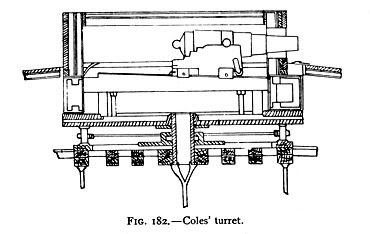
Hovaggard notes that 'The Coles turret revolved on a roller-path on the lower deck...'
Oddly enough, after abandoning barbettes French pre-dreadnoughts' turrets (and they were true turrets, not hooded barbettes) were mounted on hydraulic pivots in the bottom of the hull. How characteristically odd of the French...
Hovgaard notes that 'The Ericsson turret stood entirely above the deck... It was pivoted on a spindle, which carried the entire weight of the turret, the mounting, and the gun, and rested on a bearing in the hold... When not in use, the turret was let down to rest along its periphery on the armor deck, and in order to make it free to turn, the spindle had to be wedged up.'
Coles' turrets were mounted on rollers (again from Hovgaard):
Hovaggard notes that 'The Coles turret revolved on a roller-path on the lower deck...'
Oddly enough, after abandoning barbettes French pre-dreadnoughts' turrets (and they were true turrets, not hooded barbettes) were mounted on hydraulic pivots in the bottom of the hull. How characteristically odd of the French...
"Religion is regarded by the common people as true, by the wise as false, and by the rulers as useful." Seneca, 1st century AD