by Build Mon$ter » Fri Mar 10, 2017 2:23 pm
The Graf Zeppelin, Germany's first and only aircraft carrier during World War 2.
Laid down on December 28th 1936 she was to be the first of Germany's aircraft carriers in an attempt to make a well balanced naval fleet.
Like the Japanese the German Engineer Wilhelm Hadeler modeled his design for the Graf Zeppelin after the British Courageous class carriers built in 1921 to 1929, like the British Hadeler realized the importance of an armored flight deck to protect the carriers vital interior from dive bombers, along with a 100mm (3.6 in) armored belt to defend against torpedos.
At this point the vital role of the aircraft carrier had not yet been fully realized by any navy, who where still convinced that the battleship was the ultimate power on the sea.
It wouldn't be until December 7th 1941 when Japan launched a daring attack on the US Pacific fleet using mostly aircraft carriers that the full potential of the power of aircraft carriers would be realized.
Unfortunately for the rivalry between the German Navy and Herman Goering the head of the Luftwaffe (Air Force) the construction of the Graf Zeppelin would hindered by delays and her eventual cancelation. Goering had Hitler convinced that his Luftwaffe could handle any mission with absolute superiority, and yes at the time and with the experience gained in the Spanish civil war the Luftwaffe was a force to be reckoned with. Goerings big mistake was not realizing the physical limitations of his aircraft, crossing the English Channel was easy but missions beyond that where not possible due to range.
Had the Graf Zeppelin been given the priority it needed and completed on time may naval engagement would have ended very differently, the slow lumbering British Swordfish would never have scored the fatal hit that crippled the Bismarck. The impact of operational aircraft carriers in the German navy is a debate left for historians, enthusiasts and the imagination of many talented model builders who have waited years for a 1/350 scale kit of this ship.
Technical stats:
Displacement: 33,550 long tons (34,088.4 t)
Length: 262.5 m (861 ft 2.6 in)
Beam: 36.2 m (118 ft 9.2 in)
Draft: 8.5 m (27 ft 10.6 in)
Installed power: 200,000 shaft horsepower (149,140.0 kW)
Propulsion: 4 geared turbines
Speed: 33.8 kn (62.6 km/h; 38.9 mph)
Range: 8,000 nmi (14,816.0 km; 9,206.2 mi) at 19 kn (35.2 km/h; 21.9 mph)
Complement: 1,720
Armament:
16 � 15 cm SK C/28 guns
12 � 10.5 cm SK C/33 guns
22 � 3.7 cm SK C/30 guns
28 � 2 cm FlaK guns
Armor:
Belt: 100 mm (3.9 in)
Flight deck: 45 mm (1.8 in)
Aircraft:
During the development stage of the carrier the German war ministry presented two aircraft manufacturers with requirements for a carrier based aircraft that can function as a dive bomber and a torpedo bomber Fieseler and Arado produced two aircraft the Arado AR195 and Fieseler Fi 156 Storch. Fieselers entry was vastly superior, it had double the weapons load and its low speed capability almost made it capable of vertical landing on the carrier deck. The other two aircraft where marine versions of the JU 87 and the ME 109. As production and development continued however the final air wing was to consist primarily of JU87 and ME109s.
So now with out further delay here is the open box review of Trumpeters 1/350 scale Graf Zeppelin.
On first impression of the box is that it seems a little small.
The kit:
- Attachments
-
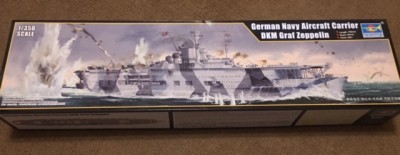
- Interesting combat scene, nice typical German navy paint scheme.
-
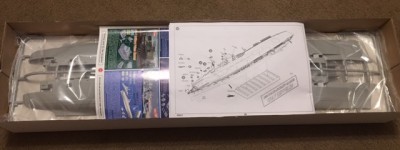
- This is why the box seems small, everything is tightly packed.
-
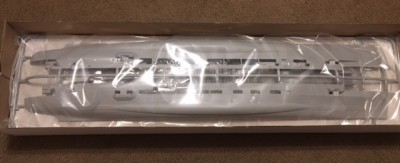
-
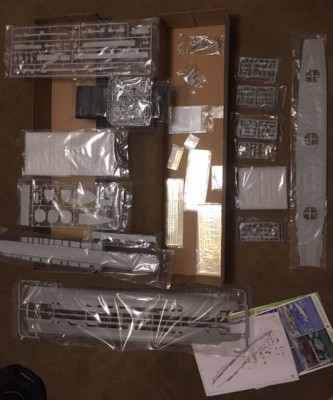
- Everything is packed in its own sealed bag.
-
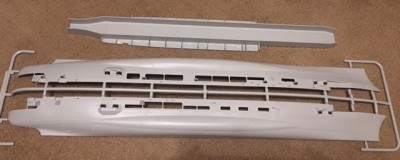
- The two hull halves and the hangar deck.
Detailing is very nice, crisp and clean, it does not appear that there will be a lot of cleaning.
-
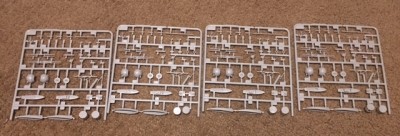
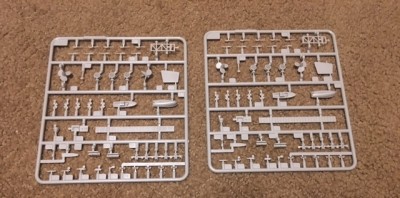
- sprues D as shown there are four of these that have the main body of boats main weapons including shaft and rudder for the boats, detailing here is good as well just like the other line of German ships they offer.
-
-
-
-
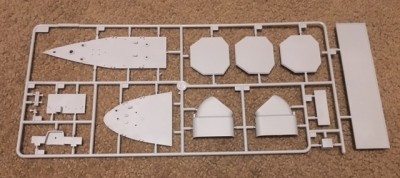
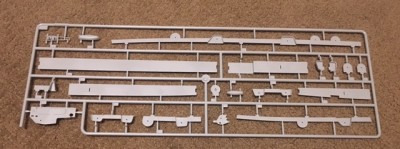
- This is sprue E that had the fore deck and stern deck along with the stack and the hangar elevators, detailing is nice except for one thing, they left out wood deck lines that are usually molded into the deck, this is unfortunate, so now I'm stuck with the debate of wether I include the lines myself or not!
The Graf Zeppelin, Germany's first and only aircraft carrier during World War 2.
Laid down on December 28th 1936 she was to be the first of Germany's aircraft carriers in an attempt to make a well balanced naval fleet.
Like the Japanese the German Engineer Wilhelm Hadeler modeled his design for the Graf Zeppelin after the British Courageous class carriers built in 1921 to 1929, like the British Hadeler realized the importance of an armored flight deck to protect the carriers vital interior from dive bombers, along with a 100mm (3.6 in) armored belt to defend against torpedos.
At this point the vital role of the aircraft carrier had not yet been fully realized by any navy, who where still convinced that the battleship was the ultimate power on the sea.
It wouldn't be until December 7th 1941 when Japan launched a daring attack on the US Pacific fleet using mostly aircraft carriers that the full potential of the power of aircraft carriers would be realized.
Unfortunately for the rivalry between the German Navy and Herman Goering the head of the Luftwaffe (Air Force) the construction of the Graf Zeppelin would hindered by delays and her eventual cancelation. Goering had Hitler convinced that his Luftwaffe could handle any mission with absolute superiority, and yes at the time and with the experience gained in the Spanish civil war the Luftwaffe was a force to be reckoned with. Goerings big mistake was not realizing the physical limitations of his aircraft, crossing the English Channel was easy but missions beyond that where not possible due to range.
Had the Graf Zeppelin been given the priority it needed and completed on time may naval engagement would have ended very differently, the slow lumbering British Swordfish would never have scored the fatal hit that crippled the Bismarck. The impact of operational aircraft carriers in the German navy is a debate left for historians, enthusiasts and the imagination of many talented model builders who have waited years for a 1/350 scale kit of this ship.
Technical stats:
Displacement: 33,550 long tons (34,088.4 t)
Length: 262.5 m (861 ft 2.6 in)
Beam: 36.2 m (118 ft 9.2 in)
Draft: 8.5 m (27 ft 10.6 in)
Installed power: 200,000 shaft horsepower (149,140.0 kW)
Propulsion: 4 geared turbines
Speed: 33.8 kn (62.6 km/h; 38.9 mph)
Range: 8,000 nmi (14,816.0 km; 9,206.2 mi) at 19 kn (35.2 km/h; 21.9 mph)
Complement: 1,720
Armament:
16 � 15 cm SK C/28 guns
12 � 10.5 cm SK C/33 guns
22 � 3.7 cm SK C/30 guns
28 � 2 cm FlaK guns
Armor:
Belt: 100 mm (3.9 in)
Flight deck: 45 mm (1.8 in)
Aircraft:
During the development stage of the carrier the German war ministry presented two aircraft manufacturers with requirements for a carrier based aircraft that can function as a dive bomber and a torpedo bomber Fieseler and Arado produced two aircraft the Arado AR195 and Fieseler Fi 156 Storch. Fieselers entry was vastly superior, it had double the weapons load and its low speed capability almost made it capable of vertical landing on the carrier deck. The other two aircraft where marine versions of the JU 87 and the ME 109. As production and development continued however the final air wing was to consist primarily of JU87 and ME109s.
So now with out further delay here is the open box review of Trumpeters 1/350 scale Graf Zeppelin.
On first impression of the box is that it seems a little small.
The kit: