But it seems that the two-hoist system is sometimes used on 36-pound guns.
https://forummarine-forumactif-com.tran ... r_pto=wapp


24 and 12 canons
Bernard Huc
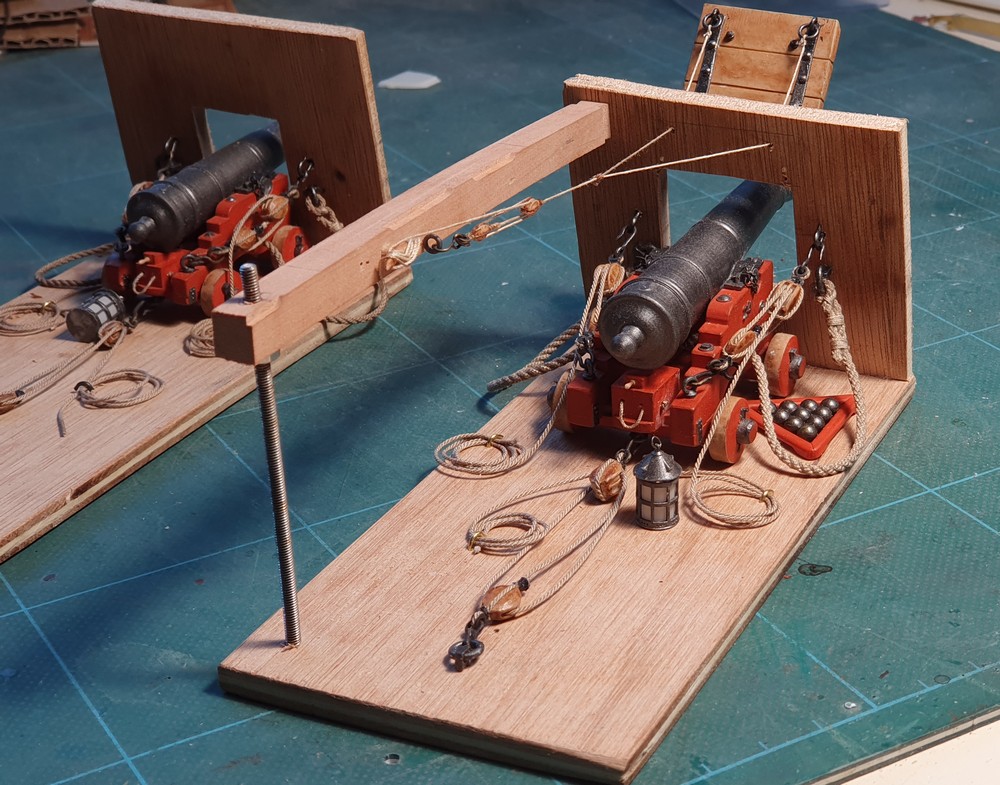
https://youtu.be/1ckViyihO34
Allan16, work in progress.
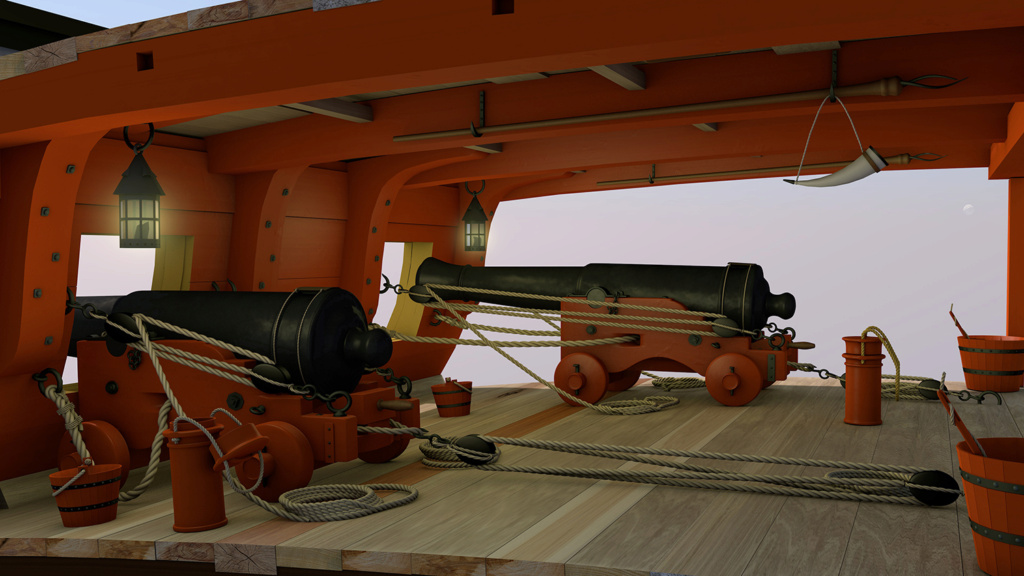
FredP, Hermione replica.

Moderators: BB62vet, MartinJQuinn, JIM BAUMANN, Jon, Dan K


 simply amazing the information that is detailed ....and via the internet ( and iceman!) readily available






Yes... one wants to avoid the proverbial 'loose cannon.'wefalck wrote:Well, you want to make sure that half a ton or more of cast iron does not roll around unconstrained - once it's moving out of control, a gun is very difficult to rope in again without risking your limbs or more...



I agree! But from a modeller viewpoint, I prefer the much easier French style...Martocticvs wrote:I was completely unaware that French practice for the 'breach' ropes differed so much from the British. Interesting variation. From an engineer's point of view, I prefer the British version, since it is restraining the thing that needs restraining, rather than the thing merely holding the thing needing the restraining, but intersting nonetheless!


Makes much more sense from an engineering perspective. Engineers are taught to avoid asymmetrical loads, as they place large strains on constructions, in this case the gun carriages. At least try to avoid them as much as possible, so a center tackle is absolutely preferred.So I carefully detached the ends that were glued to the carriages, bent it a little and re-attached to the centre of the carriages. Much better!

EJ, the Uschi elastic thread loses most of its elastic properties when soaked in Ca. I have discovered it when i dealt with the maiale breakwater ribbing. But I agree with you, keeping the elastic thread at bay before fixing it w Ca would be a nightmare.here's no need to use brass wire for all the loose ends, so elastic rigging wire could be used, but, a) may be too thin (Uschi's ends at 0.03) and b) may be maddeningly elastic and refusing to stay rolled up?
I have to find me some of that varnish! Mine dries quite fast but still too slow to keep to springy copper wire down.wefalck wrote:I prefer fast-drying varnish (Zaponlack in Germany), also because it can be loosened again with a drop of acetone. Incidentally, a light brush with acetone seems to take away much of the 'shine'. Otherwise, sprayed matt varnish takes care of that.
That's a good technique too. But in this case I still have apply a lot of matt varnish: to glue buckets and other equipment in place, and to hide glue spots after supergluing the figures in place. Anyway, I try to avoid pastels and pigment powders on my models because they are so fragile to any liquid that touches the model afterwards.wefalck wrote:I may have accentuated the ropes on the deck with some dark pastel powder, rather than a washing. That seems to also pull together a lot of details. But it needs to be applied after the last matt varnish, because otherwise it just turns into a wash.
Yes, and the references show it too!Maarten Sch�nfeld wrote:Makes much more sense from an engineering perspective. Engineers are taught to avoid asymmetrical loads, as they place large strains on constructions, in this case the gun carriages. At least try to avoid them as much as possible, so a center tackle is absolutely preferred.