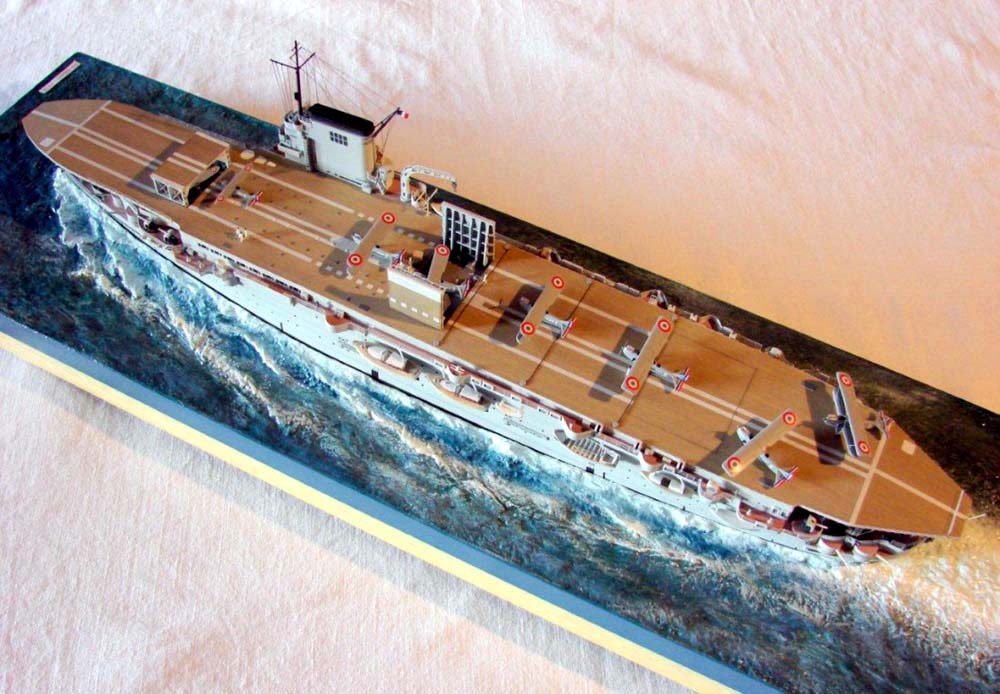
MN B�arn was a repurposed "Normandie"-class battleship from the WW1-era. She was launched in 1920. This French battleship provenance caused problems in performance as a carrier, reducing speed and dimensions. On the wl she measured 175 meters and overall 182 x 35 meters with a 22 501 tonnage and a performance of 29 000 kw. The max speed of 21 knots caused her to lag behind her own escort. The three elevators were very peculiar in their operation and had a reduced speed. The front lift had an extra deck level to facilitate airplane launching during descent. The middle and rear lifts had giant trap doors opening outward to the deck, taking to 5 minutes to operate one cycle. A massive island and funnel ventilation structure extended to the starboard side with one airplane/aquaplane crane. Parts of the deck could not be used due to an excessive angle. This part was later changed. Armament was 8 155mm cannons in casemates, like some other early carriers. AA-weapons included 6x 75mm, 8 x 37mm and a dozen Browning guns. Torpedo tubes were provided.

An airwing of up to 32 was used. L'Ars�nal includes planes for 1939, I think I even got some extras.
Vought 156 F (French version of Vindicator)


Loire Nieuport LN 40


Dewoitine D373 (marine version of D371), Levasseur PL7, Levasseur PL101


B�arn was stationed in Toulon and would have to shadow Graf Spee with Dunkerque, being a non-event. Then she had to bring 147 tons of French payment in gold to the VS via Canada, along with airplanes. This was delivered in Canada. After this the ship was interned at Martinique, a French Caribbean island. Her grounded airplane cargo was scavenged for the armament that was installed on deck and it got totally derelict.

After the armistice the carrier was refurbished in the USA, exchanging guns and AA-weapons, getting radar and a shorter flight deck and it lost the middle elevator. A disruptive camo scheme was added. It would not be intended as an escort carrier, but rather an airplane transport. It was commissioned in French-Indochina operations and was later used as a sub crew tender, until it was decommisssioned in the sixties and scrapped.

In 2002 this L'Ars�nal multimedia kit sported a polystyrene hull and flight deck with basic detail, resin parts and planes and three PE sheets. This looks as follows.


Some people have planked the deck, but this will have to be scratchbuilt.


PE looks quite sturdy and should be straightened out.


Resin parts like casemates with guns, bridge structure, funnel exhaust, boats, rear elevator doors and crane. There are also props and shafts.

Quite a collection of deck and plane decals. A decent looking A5 manual booklet.


The kit got quite rare soon after production halted. I hope it can spur some interest in this undebated topic. Some reference can be found in French literature, I bought a nice book.

It also deviates to B�arn's part-time hydroplane-carrying escort Commandant Teste. Their history, construction info and plane types used are illustrated with a lot of pictures and pften true to scale plans. I was amazed about the amount of crashed and recovered crews, or about the failed autogyro test due to wind strength.


A long time before starting this build I had been observing some interesting objects on Ebay related to the topic, like the book I bought last year. But some items would be useful in the showcase I was obliged to provide with a full-hull version of the model. One is an embroidered scarf described as dating from the WW2 period. Another is a deahorse-styled badge from Escadrille de Chasse 7C1 with slight crackling of the clear enamel. Let's hope these arrive safely next week. Because of the resin prop and shaft detail and none personnel provided I think again full hull is preferred here, and it can be shown close to the Dunkerques. The only downside is the scale difference.