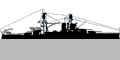
Years ago I poured over the CamAirBatFor files at the archives, mostly for 1942 but also back as far as summer 1941. It was very common during the period in mid-late 1941 and early 1942 for aircraft, especially those in the overhead, to be marked for the "wrong" ship or squadron.
The PacFlt was short of aircraft with all the type changes, etc. and the need for overhauls at CASU-1 at Ford Island NAS. Whenever the squadrons flew ashore when the ships came into port, there would be a mad shuffle of planes to outbound squadrons. CASU-1 had no time for re-painting codes, especially with the differences between the two carriers divisions styles. Once they got to the ship and in the hangar, the wing undersides of aircraft with folding wings and all parts of those placed in reserve or out of service in the overhead were inaccessible and could not be repainted.
Tracy White wrote:Ermm my bad.
I was thinking of the photo in this thread and thinking that extended out into December
BUt I still think it describes why VF-3 would be abard another carrier.
Nice shot of the degaussing cable as it wraps around the stern!
Martin
"Tomorrow is the most important thing in life. Comes into us at midnight very clean. It's perfect when it arrives and it puts itself in our hands. It hopes we've learned something from yesterday." John Wayne
That particular photo has me wondering. Lex repainted into MS-12 at some point, apparently before Dec '41. Could she have been in the scheme at the time that photo was taken? According to the photo at the top of pg 16 of Steve Wiper's Lexington class book, the sea blue extended a bit above the dg cables. Perhaps the gray is just above the area visible in the drydock photo.
As for the bow, Tracy, the same Steve Wiper photo seems to show the dg cable curving upward just aft of the anchor, just as the one on Enterprise did. This would make sense, since both were installed in the Pacific (at Pearl?) and Yorktown's was probably installed during her stint in the Atlantic. If this is true, the cables most likely went around the bow (or terminated just short of it) just above the anchors.
Have either of you seen the shot of Lexington on the History Channel, in the "Gunny does WWII" segment? There is a short motion picture segment of Lex's port side taken from a plane flying past. She is clearly in MS-12, and the row of rafts on the funnel's inner side is visible. (She still had these rafts on the inner side at coral Sea.) My brother taped it, but I can't get a clear enough image on pause to pick out the details. Perhaps if it were transferred to DVD, I could get a clearer picture. (The History Channel hasn't yet offered that DVD for sale - darn it.) Martin, a still from this might answer your 1.1" director question.
Dick,
No, I haven't seen that video...surprised it wasn't on the recent "First Flattops" DVD from Aircraft Films. That DVD did include color footage of Lex in SF Bay (you can see her going under the Oakland Bay Bridge) and she looks like she is freshly painted. I believe it was shot the same time as the footage in the drydock.
I've always been surprised that there aren't cleared pictures of the Lex on her last day...with people taking pictures from the nearby ships, there has to be a view of the bridge out there...somewhere!
Perhaps Mr. Wiper has discovered something - hope to see his Lex book sooner than later.
Martin
"Tomorrow is the most important thing in life. Comes into us at midnight very clean. It's perfect when it arrives and it puts itself in our hands. It hopes we've learned something from yesterday." John Wayne
I was there when Don Montgomery made the final determination that there were no clear photos of Lex's forward 1.1" gun tub. You can see a piece of it in a photo posted at Navsource, but that's a scan of a photo taken of a copy negative that is a crop of the original, which is now lost.
There is a very real possibility that there are no clear photos of the bridge.
I don't know if your last response was to my previous post, but I was not referring to the "new" 1.1" tubs by the bridge. I was referring to the 1.1 directors which Trumpy chose to place between the .50's on the corner sponsons. Martin asked, in an earlier post, if the kit directors should have been used.
If a clear frame could be taken from the film segment I saw on the History Channel, it might be possible to get a good view of the port-forward 1.1/.50 cal sponson. My impression from the quick pass was that there were no directors amongst the .50's. Pausing the VHS tape blurrs the image. The film used in the HC segment was shot while Lex was in MS-12, and therefore, while the 8" guns were still in place.
I'm new on this forum and this is my first post. I'm from Belgium so please excuse my less than perfect English.
Since I just started building the Trumpeter 1/700 Lex, this tread has already been very interesting to me. I want to build it in a diorama, showing Lex being abondoned by its' crew( as in the pic below), so I will certainly have lots of fun with the tiny figures!
But since I am not very knowledgable on destroyers, I have an additional questions:
-Which ship is lying alongside the Lexington? If not the specific ship, the class would already help a lot.
-Are there kits available of it (or any other of it's class) in 1/700th?
Welcome aboard! You have already made the right choice in working in 1:700, the devine scale. First rule: ask anything!
As for the DD next to the dying Lex, I can't help you much. Several are listed on the site you got the picture, a caption of another picture reads: Smoke rises soon after an explosion amidships on USS Lexington (CV-2), 8 May 1942. This is probably the explosion at 1727 hrs that took place as the carrier's abandonment was nearing its end.
Ships standing by include the cruiser Minneapolis (CA-36) and destroyers Morris (DD-417), Anderson (DD-411) and Hammann (DD-412).
Hope this helps, but there are wiser men in this place than me! Good luck!
If all else fails, a complete pig-headed refusal to see facts in the face will see us through. - General Melchett
I don't have my references in front of me, so I can't be absolutely certain which ship is in the photograph, but I believe it's probably the USS Morris, DD-417. Task Force 17, under the command of Admiral Frank Fletcher, consisted of several Task Groups, including TG 17.5, which was the Carrier Group under Admiral Aubrey Fitch on board the Lexington. This consisted of the two carriers (Lexington and Yorktown) and 4 screening destroyers, including the Morris, the Anderson (DD-411), the Hammann (DD-412), and the Russell (DD-414). According to what I could find on-line at least three of the screening destroyers picked up survivors from the water, (between 350 to 500 each) but the only one which specifically stated came alongside the Lexington was the Morris.
The GOOD news is that regardless, ALL 4 of the destroyers are Sims Class, so it probably wouldn't matter which hull number you used. But the BAD news is, while I know there are a couple of options to build a Sims class in 1/350, I don't know if there is a 1/700 kit available.
I don't know if your last response was to my previous post, but I was not referring to the "new" 1.1" tubs by the bridge. I was referring to the 1.1 directors which Trumpy chose to place between the .50's on the corner sponsons. Martin asked, in an earlier post, if the kit directors should have been used.
If a clear frame could be taken from the film segment I saw on the History Channel, it might be possible to get a good view of the port-forward 1.1/.50 cal sponson. My impression from the quick pass was that there were no directors amongst the .50's. Pausing the VHS tape blurrs the image. The film used in the HC segment was shot while Lex was in MS-12, and therefore, while the 8" guns were still in place.
Ah - I thought you were talking about the 1.1 gun director just forward of the island. After reading this, I realized you were talking about the forward gun tubs... my bad!
Martin
"Tomorrow is the most important thing in life. Comes into us at midnight very clean. It's perfect when it arrives and it puts itself in our hands. It hopes we've learned something from yesterday." John Wayne
It actually calls the port bomb hit that Captain Sherman and the Air Officer said hit either the boat pocket or just aft of the #2 20mm gallery a near miss, and details the damage. It also details the damage to the .50 cal gallery on the port side of the stack.
Maybe Tracy has a source that can confirm either the hit or the near miss. The location of the near miss described in this report is also forward of where I put the dot on my Lex. Probably on the forward side of the #2 20mm gallery.
This is the only pic I can find of the port side. It looks like there's some damage at the aft end of the .50 cal gallery, but it's hard to tell exactly what it might look like. I don't see any damage on the stbd side in the pic you posted originally.
Thanks for the compliment! The pic's a little blurry, but that's OK because I'm still touching up the waterline!
There are some earlier in progress one's farther back in the thread.
Elvis965 wrote:Maybe Tracy has a source that can confirm either the hit or the near miss.
You can take this as a frustrating comment, but the quality of knowledge here is such that we very quickly run into territory where the only recourse or answer involves serious archival research. Ron Smith could probably point someone in the right direction but it would take time to go through the documentation.
I haven't won the lottery yet so I can't hand out grants to fund research....
Bob, thanks for that report! I've also been confused because of some sources stating 3 direct hits and others only 2. Since this is an "official" report that is clearly based on many first hand accounts, and it is by far the most detailed source about the damage I've seen, I'll go with it's information.
Tracy, I'm working as a stone-age archaeologist for my dayjob (so let me know when you start giving grants! ), so I'm very familiar with lack of sources for any kind of historical research!
Don't worry, I'd rather finish a good looking model with some "gizmology" than put it on the shelf forever because of lack of sources. I just want to tell a strong story with my models. I try my best to get things historically accurate, but there is always a limit.
I have documentation that Lexington was testing non-skid decking I found at Puget Sound Naval Shipyard but no more than the fact that she was... no description of WHERE and what type (there were three listed in the report I believe). So I'm keeping my eyes open, but it's one of those deals that we may never know for sure.