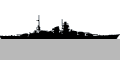
Recently I had this discussion with a fellow modeler about HMS Blake. Assuming that HMS Blake would still have been available in 1982, would she have made a difference?
Points in favour of her we came up with were:
- 6in gun gives considerable punch in bombardment missions
- additional command and communications facilities make life easier for the CO invasion forces
- additional helo platform allows ASW duties to be undertaken mainly by Blake
- additional amphibious attack capability (capable of carrying a company-sized marine force)
Points against her were:
- additional strain on logistics (6in shells, machinery parts etc)
- maintenance-intensive
- another potentially high-profile target (personally I'm not sure about that, though)
What do you think?
Jorit
Falklands What-If
Moderators: Timmy C, Gernot, Olaf Held, JWintjes
-
JWintjes

- Posts: 1223
- Joined: Mon Jan 10, 2005 11:41 am
- Location: turning into a power-hungry Yamato-models-munching monster... buahahahaha...
-
Seasick

- Posts: 1550
- Joined: Thu Sep 22, 2005 8:58 pm
- Location: Houston, Texas
The HMS Blake would contribute, however she would be in considerable danger if used to bombard the airfield at Port Stanley.
She could take over part of the helecoptor operations and enable a few more Sea Harriers to be placed on the HMS Hermes.
She would need to have her AAW built up before she went: replace the Sea Cat with Sea Wolf.
She could take over part of the helecoptor operations and enable a few more Sea Harriers to be placed on the HMS Hermes.
She would need to have her AAW built up before she went: replace the Sea Cat with Sea Wolf.
???????
? Seasick?
???????
? Seasick?
???????
-
Laurence Batchelor

- Posts: 1376
- Joined: Sun Jan 23, 2005 6:20 am
- Location: Warwickshire, England
She also had:
2 seacat quad missile launchers.
2 x 3inch AA guns.
She could operate 4 Wessex's or Sea King's.
I'm not sure if her hangar/heli pad space was big enough to support a Chinook, if it was that would have been a significant advantage.
Another thing which would have likely been done as they were roomy ships was to augment with much light AA on her upperdecks before leaving Portsmouth.
Problems with her included her large crew which made her very draining for the RN to maintain in monetary and manpower terms.
Also she would be a juicy large target to any Argentian aircraft if she was in any of the confined waters of the Falklands.
She could still make 30knts though in an emergency
2 seacat quad missile launchers.
2 x 3inch AA guns.
She could operate 4 Wessex's or Sea King's.
I'm not sure if her hangar/heli pad space was big enough to support a Chinook, if it was that would have been a significant advantage.
Another thing which would have likely been done as they were roomy ships was to augment with much light AA on her upperdecks before leaving Portsmouth.
Problems with her included her large crew which made her very draining for the RN to maintain in monetary and manpower terms.
Also she would be a juicy large target to any Argentian aircraft if she was in any of the confined waters of the Falklands.
She could still make 30knts though in an emergency
Last edited by Laurence Batchelor on Tue Aug 21, 2007 5:56 pm, edited 1 time in total.
-
Walt

- Posts: 250
- Joined: Wed Apr 06, 2005 7:02 pm
- Location: Connecticut
I always wondered what ifs about that situation too like if the Argentines had more than 3 Exocets, and if they possessed any type of longer range fighter bombers like A-6s or even F-4s. or inflight refueling which would have allowed their Mirages and A-4s much more loiter time over the islands. Lucky for the British fleet the Argentines were using 30 year old iron bombs that many of which did not work as designed and their strike aircraft were short legged.I think this conflict showed the world once again that a warship is very vulnerable to a much weaker foe,s strike aircraft especially when it is not protected by it's own fighter screen or not an effective fighter screen,, It's amazing what great work was done by the RN and RAF Harriers... both of which were overworked and at times very lucky.
Many changes in fleet defence resulted in most Navys after this brawl.
Many changes in fleet defence resulted in most Navys after this brawl.
"When you shoot at a Destroyer and miss. It's like hit'in a wildcat in the A-- with a banjo" !
Lt. Joe Willingham Skipper USS Tautog SS-199
Life is Good/ DBF
Walt
Lt. Joe Willingham Skipper USS Tautog SS-199
Life is Good/ DBF
Walt
-
Jack Ray

- Posts: 1098
- Joined: Wed Jan 12, 2005 10:23 am
- Location: Northern Virginia

This is a very neat 1/72 diecast Argentine A-4 from Hobby Master which was just delivered to me. Armed with a single "iron" bomb and drop tanks.
It must have been thrilling for those Argie pilots popping up over the fleet and getting direct hits with these. They must be pretty good.
Apparently the bombs were fused to become active after falling a certain distance. 13 iron bombs hit the RN ships and, if their fuses had been appropriate, British losses may have been much greater.
Jack
Edited for image size- Sean
-
Deckard

- Posts: 74
- Joined: Sun Feb 26, 2006 2:54 am
- Location: Adelaide,Sth Australia
Argentina actually possessed at least 6 Exocets - five air-launched missiles for each of their CANA Super Etendards and one ground launched - and all were fired in combat.
Mission 1 - was aborted.
Mission 2 (4th May) - was flown by Captain Bedacarratz (3-A-202)
and Lt. Mayora (3-A-203). The former's struck HMS Sheffield while the latter's failed to find its target.
Mission 3 - failed to make contact.
Mission 4 (25th May) - flown by Capt. Curilovic (3-A-203) and Lt. Barraza (3-A-204). Both missiles successfully launched, one striking the MV Atlantic Conveyor and the other failing to find its target.
Mission 5 (30th May) - flown by Capt. Francisco (3-A-202) who launched the final AM39 at what he thought was HMS Invincible but was most likely Exeter. The missile's fate remains unknown, but it was thought to be decoyed by Corvus chaff rockets fired by the Task Force.
The one land-launched MM38 Exocet was fired from the outskirts of Pt. Stanley on 12th June and hit HMS Glamorgan, destroying the ship's Wessex helio and killing 13 sailors.
The Etendard missions were all in-flight refuelled, some twice, and the Skyhawks recieved refueling from a KC-130 on the way out and most needed a top up from the same again to make it back.
The Mirages were only used twice in combat, both on the same day 1st of May. The morning engagement was uneventful but the afternoon sortie resulted in the loss of two Mirages to AIM-9L Sidewinders fired from Harriers. The Mirages were pulled from the front line after this, not because of their poor performance, but because on the same day an RAF Vulcan had bombed the airfield at Stanley and the Argentinians reasoned that mainland targets were thus vulnerable, so for the rest of the conflict they were reserved for mainland CAP.
The brunt or the air war was undertaken by the very courageous A4 pilots of the FAA. The majority of their a/c did not have a remotely modern navigation system, none had radar, radar warning, ECM or guided weapons of any kind. They had just enough fuel for a single pass on the target and they were up against guns, SAMs and the very latest Sidewinders. Against the latter they were completely defencless and suffered 7 (some say eight) losses.
In all, FAA Skyhawks flew 219 combat sorties, sinking four warships and damaging many others. They lost 19 a/c and 17 pilots. CANA (navy) losses were three A4's and two pilots, with fatal damage claimed on two warships.
Of the aerial losses, British pilots reported that though the Argentinians were never lacking in determination, their skills and tactics were appalling, failing even in the basics of flying 'wing', and relying mainly on high speed for evasion which turned out to be hopeless against the AIM-9L.
Mission 1 - was aborted.
Mission 2 (4th May) - was flown by Captain Bedacarratz (3-A-202)
and Lt. Mayora (3-A-203). The former's struck HMS Sheffield while the latter's failed to find its target.
Mission 3 - failed to make contact.
Mission 4 (25th May) - flown by Capt. Curilovic (3-A-203) and Lt. Barraza (3-A-204). Both missiles successfully launched, one striking the MV Atlantic Conveyor and the other failing to find its target.
Mission 5 (30th May) - flown by Capt. Francisco (3-A-202) who launched the final AM39 at what he thought was HMS Invincible but was most likely Exeter. The missile's fate remains unknown, but it was thought to be decoyed by Corvus chaff rockets fired by the Task Force.
The one land-launched MM38 Exocet was fired from the outskirts of Pt. Stanley on 12th June and hit HMS Glamorgan, destroying the ship's Wessex helio and killing 13 sailors.
The Etendard missions were all in-flight refuelled, some twice, and the Skyhawks recieved refueling from a KC-130 on the way out and most needed a top up from the same again to make it back.
The Mirages were only used twice in combat, both on the same day 1st of May. The morning engagement was uneventful but the afternoon sortie resulted in the loss of two Mirages to AIM-9L Sidewinders fired from Harriers. The Mirages were pulled from the front line after this, not because of their poor performance, but because on the same day an RAF Vulcan had bombed the airfield at Stanley and the Argentinians reasoned that mainland targets were thus vulnerable, so for the rest of the conflict they were reserved for mainland CAP.
The brunt or the air war was undertaken by the very courageous A4 pilots of the FAA. The majority of their a/c did not have a remotely modern navigation system, none had radar, radar warning, ECM or guided weapons of any kind. They had just enough fuel for a single pass on the target and they were up against guns, SAMs and the very latest Sidewinders. Against the latter they were completely defencless and suffered 7 (some say eight) losses.
In all, FAA Skyhawks flew 219 combat sorties, sinking four warships and damaging many others. They lost 19 a/c and 17 pilots. CANA (navy) losses were three A4's and two pilots, with fatal damage claimed on two warships.
Of the aerial losses, British pilots reported that though the Argentinians were never lacking in determination, their skills and tactics were appalling, failing even in the basics of flying 'wing', and relying mainly on high speed for evasion which turned out to be hopeless against the AIM-9L.
Last edited by Deckard on Wed Aug 22, 2007 5:18 am, edited 1 time in total.
-
Walt
- Posts: 250
- Joined: Wed Apr 06, 2005 7:02 pm
- Location: Connecticut
Deckard wrote:Argentina actually possessed 6 Exocets - five air-launched missiles for each of their CANA Super Etendards and one ground launched - and all were fired in combat.
Mission 1 - was aborted.
Mission 2 (4th May) - was flown by Captain Bedacarratz (3-A-202)
and Lt. Mayora (3-A-203). The former's struck HMS Sheffield while the latter's failed to find its target.
Mission 3 - failed to make contact.
Mission 4 (25th May) - flown by Capt. Curilovic (3-A-203) and Lt. Barraza (3-A-204). Both missiles successfully launched, one striking the MV Atlantic Conveyor and the other failing to find its target.
Mission 5 (30th May) - flown by Capt. Francisco (3-A-202) who launched the final AM39 at what he thought was HMS Invincible but was most likely Exeter. The missile's fate remains unknown, but it was thought to be decoyed by Corvus chaff rockets fired by the Task Force.
Argentina also fired one land-launched MM38 Exocet. It was fired from the outskirts of Pt. Stanley on 12th June and hit HMS Glamorgan, destroying the ship's Wessex helio and killing 13 sailors.
The Etendard missions were all in-flight refuelled, some twice, and the Skyhawks recieved refueling from a KC-130 on the way out and most needed a top up from the same again to make it back.
The Mirages were only used twice in combat, both on the same day 1st of May. The morning engagement was uneventful but the afternoon sortie resulted in the loss of two Mirages to AIM-9L Sidewinders fired from Harriers. The Mirages were pulled from the front line after this, not because of their poor performance, but because on the same day an RAF Vulcan had bombed the airfield at Stanley and the Argentinians reasoned that mainland targets were thus vulnerable, so for the rest of the conflict they were reserved for mainland CAP.
The brunt or the air war was undertaken by the very determined A4 pilots of the FAA. The majority of their a/c did not have a remotely modern navigation system, none had radar, radar warning, ECM or guided weapons of any kind. They had just enough fuel for a single pass on the target and they were up against guns, SAMs and the very latest Sidewinders. Against the latter they were completely defencless and suffered 7 (some say eight) losses.
In all, FAA Skyhawks flew 219 combat sorties, sinking four warships and damaging many others. They lost 19 a/c and 17 pilots. CANA (navy) losses were three A4's and two pilots, with fatal damage claimed on two warships.
Of the aerial losses, British pilots reported that though the Argentinians were never lacking in courage, their skills and tactics were appalling, failing even in the basics of flying 'wing', and relying mainly on high speed for evasion which turned out to be hopeless against the AIM-9L.
The Argentine Tactics were dictated by the very short time they had over target.. If the range to the Islands was 200 miles less the tactics would have been much different. As for skills,, how many "Green" piliots perform as planned on their first combat mission? Especially against a formidable foe armed with the latest in air defence equipment. Many experts were surprised to the contrary of the published RN reports, by how well the FAA actually did..
I thought the most interesting naval history result was the first and only ( as far as we know)
 SSN kill...
"When you shoot at a Destroyer and miss. It's like hit'in a wildcat in the A-- with a banjo" !
Lt. Joe Willingham Skipper USS Tautog SS-199
Life is Good/ DBF
Walt
Lt. Joe Willingham Skipper USS Tautog SS-199
Life is Good/ DBF
Walt
-
Deckard
- Posts: 74
- Joined: Sun Feb 26, 2006 2:54 am
- Location: Adelaide,Sth Australia
Yes Walt the Argentinian pilots were seriously handicapped by range. They had a long way to fly to reach the combat zone, and faced an equally long flight home. For the Mirages, they could remain in the Falkland combat area for only 12 minutes at high altitude (preferred) or a mere five at low level (dangerous against the Harriers). Once the Mirages were pulled out - the very first day - the Skyhawks and Daggers lost any chance of fighter cover and they knew it well, yet they kept up their attacks for another 43 odd days. Very brave indeed.
But what was apparent to the British was that the Argentine pilots had little idea of how members of a good flight formation could give each other mutual cover when attacked, and although green to start with, their tactics did not improve with experience - fatal. And though their a/c and weapons were inferior they always outnumbered the British.
The air war must be regarded as being won (and it was) by superior aircraft coupled with sound tactics and good training. Usually always a winner.
But what was apparent to the British was that the Argentine pilots had little idea of how members of a good flight formation could give each other mutual cover when attacked, and although green to start with, their tactics did not improve with experience - fatal. And though their a/c and weapons were inferior they always outnumbered the British.
The air war must be regarded as being won (and it was) by superior aircraft coupled with sound tactics and good training. Usually always a winner.
-
Gone Asiatic
- Posts: 836
- Joined: Tue Jan 11, 2005 7:44 pm
- Location: Zipangu - Jipukuo
Falklands War
Some pretty good videos - combinations of CG, actual footage, photographs, and an interview with a Argentinian pilot.
http://www.youtube.com/watch?v=HCIQHNPCRWM
http://www.youtube.com/watch?v=689eOgHM6XA
http://www.youtube.com/watch?v=T_nYB2CrdjU
http://www.youtube.com/watch?v=HCIQHNPCRWM
http://www.youtube.com/watch?v=689eOgHM6XA
http://www.youtube.com/watch?v=T_nYB2CrdjU
No Quarter Asked - None Given

-
Dustermaker
- Posts: 119
- Joined: Wed Mar 14, 2007 7:08 am
- Location: Nebraska, USA
I agree that the SSN kill was something that really helped the Brits, nobody really brings that up. The Argentine navy really never left port after that happened.Walt wrote:
The Argentine Tactics were dictated by the very short time they had over target.. If the range to the Islands was 200 miles less the tactics would have been much different. As for skills,, how many "Green" piliots perform as planned on their first combat mission? Especially against a formidable foe armed with the latest in air defence equipment. Many experts were surprised to the contrary of the published RN reports, by how well the FAA actually did..
I thought the most interesting naval history result was the first and only ( as far as we know)
How do you tell a communist? Well, it's someone who reads Marx and Lenin. How do you tell an anti-Communist? It's someone who understands Marx and Lenin. - Ronald Reagan
-
FrancisMcN
- Posts: 275
- Joined: Mon Jan 15, 2007 12:03 pm
- Location: Plymouth UK
In response to the original question, BLAKE would not have been a particularly useful asset to the Task Force as her primary role as an ASW Helo carrier was adequately covered already and if more deck space was needed it could be found on RFAs instead I suspect. Her AA defence was little better than the Leander frigates (presumably Seacat was more capable than the twin 3" which it replaced) so she would not have contributed to the AAW in the way that the T42s and T22s could. Most important is the large manpower requirement which would prevent bringing other ships out from reserve - I think BULWARK was being seriously considered at one stage as it was the loss of a carrier that would have brought the whole Task Force to a halt.
While I have no doubt that the Argentinian pilots were individually brave in making their attacks, I (and no doubt plenty of the other 20-30% of this Forum that hail from UK) would be a bit happier if some mention was made of the collective courage and resolve of the RN, RFA and merchant ship's companies of the units who were in "Bomb Alley" for the first few days after the San Carlos landings. They continued to man the remaining distinctly dated 4.5", 20 & 40mm guns and Seacat when the supposedly modern missile systems had largely failed to defend them from repeated waves of attack. Since no-one else is I will.
Francis Macnaughton
While I have no doubt that the Argentinian pilots were individually brave in making their attacks, I (and no doubt plenty of the other 20-30% of this Forum that hail from UK) would be a bit happier if some mention was made of the collective courage and resolve of the RN, RFA and merchant ship's companies of the units who were in "Bomb Alley" for the first few days after the San Carlos landings. They continued to man the remaining distinctly dated 4.5", 20 & 40mm guns and Seacat when the supposedly modern missile systems had largely failed to defend them from repeated waves of attack. Since no-one else is I will.
Francis Macnaughton
-
Jack Ray
- Posts: 1098
- Joined: Wed Jan 12, 2005 10:23 am
- Location: Northern Virginia
I don't believe anyone on this forum is purposely leaving out the RN on praise. This whole episode was a great morale booster for the UK and ensured the survival of the RN as a world class navy. The saga of the Task Force would make a very good film in the tradition of "The Cruel Sea" and "In Which We Serve".FrancisMcN wrote:In response to the original question, BLAKE would not have been a particularly useful asset to the Task Force as her primary role as an ASW Helo carrier was adequately covered already and if more deck space was needed it could be found on RFAs instead I suspect. Her AA defence was little better than the Leander frigates (presumably Seacat was more capable than the twin 3" which it replaced) so she would not have contributed to the AAW in the way that the T42s and T22s could. Most important is the large manpower requirement which would prevent bringing other ships out from reserve - I think BULWARK was being seriously considered at one stage as it was the loss of a carrier that would have brought the whole Task Force to a halt.
While I have no doubt that the Argentinian pilots were individually brave in making their attacks, I (and no doubt plenty of the other 20-30% of this Forum that hail from UK) would be a bit happier if some mention was made of the collective courage and resolve of the RN, RFA and merchant ship's companies of the units who were in "Bomb Alley" for the first few days after the San Carlos landings. They continued to man the remaining distinctly dated 4.5", 20 & 40mm guns and Seacat when the supposedly modern missile systems had largely failed to defend them from repeated waves of attack. Since no-one else is I will.
Francis Macnaughton
By the way, could somebody recommend a well written history of this operation?
Regards,
Jack
-
Gone Asiatic
- Posts: 836
- Joined: Tue Jan 11, 2005 7:44 pm
- Location: Zipangu - Jipukuo
Correct, I`ve worked with RN on a few occasions and was most impressed with their professionalism - and the UK armed forces did prevail victorious. Still, the Argentinian view probably hasn`t been much explored outside Buenos Aires.Jack Ray wrote:I don't believe anyone on this forum is purposely leaving out the RN on praise. This whole episode was a great morale booster for the UK and ensured the survival of the RN as a world class navy. The saga of the Task Force would make a very good film in the tradition of "The Cruel Sea" and "In Which We Serve".FrancisMcN wrote:In response to the original question, BLAKE would not have been a particularly useful asset to the Task Force as her primary role as an ASW Helo carrier was adequately covered already and if more deck space was needed it could be found on RFAs instead I suspect. Her AA defence was little better than the Leander frigates (presumably Seacat was more capable than the twin 3" which it replaced) so she would not have contributed to the AAW in the way that the T42s and T22s could. Most important is the large manpower requirement which would prevent bringing other ships out from reserve - I think BULWARK was being seriously considered at one stage as it was the loss of a carrier that would have brought the whole Task Force to a halt.
While I have no doubt that the Argentinian pilots were individually brave in making their attacks, I (and no doubt plenty of the other 20-30% of this Forum that hail from UK) would be a bit happier if some mention was made of the collective courage and resolve of the RN, RFA and merchant ship's companies of the units who were in "Bomb Alley" for the first few days after the San Carlos landings. They continued to man the remaining distinctly dated 4.5", 20 & 40mm guns and Seacat when the supposedly modern missile systems had largely failed to defend them from repeated waves of attack. Since no-one else is I will.
Francis Macnaughton
By the way, could somebody recommend a well written history of this operation?
Regards,
Jack
No Quarter Asked - None Given
-
FrancisMcN
- Posts: 275
- Joined: Mon Jan 15, 2007 12:03 pm
- Location: Plymouth UK
-
JWintjes
- Posts: 1223
- Joined: Mon Jan 10, 2005 11:41 am
- Location: turning into a power-hungry Yamato-models-munching monster... buahahahaha...
Hmmm, can't agree 100%.FrancisMcN wrote:Admiral Sandy Woodward's "The Hundred Days" is as good an account of the conflict and generally of modern naval warfare as you can get.By the way, could somebody recommend a well written history of this operation?
Woodward's account certainly has its merits, but also some, well, problems, particularly on the amphibious part of the operation.
Reading Woodward is indeed a good idea, but you should counterbalance it with one of the books about the amphibious side of the operation (like Clapp/Southby-Tailors Amphibious Assault Falklands) to get a balanced view of it.
Jorit
