A colleague I used to eat lunch with (and who retired a few years ago) began his career as a junior USN officer assigned to the Atom Bomb tests called "Crossroads". He was assigned to the former Nagato, promptly named Old Nag by her scratch crew. When they took command of the ship, her funnel had been disassembled, and she had been anchored without power for months.
The effort to get the worn-out ship to Bikini was hair-raising and dangerous. At more than one point she completely broke down, and nearly sank of her own accord. Even unmooring was a major exercise, since her anchor capstain had not worked (they learned) since around the beginning of the war. They had to raise her anchors using the old-fashioned "stamp-and-go" method with capstain bars and several rows of sailors.
On the voyage, engine room crews were relieved every 10 to 15 minutes because the temperature in the boiler rooms was 125 degrees or more. I assume this was because of the combination of broken downtake fans and the removed funnel.
The other interesting thing was evidently a substantial amount of railroad track was laid below the weather decks to act as additional bomb protection. My colleague thought this was added in the 1930s, but I can see no reference to it in the literature, and my own guess is it was added in the final months of the war when the ship was immobilized for want of fuel.
I am wondering if anyone has pictures of Old Nag underway or at Bikini without her funnel, or if there are any pictures of the supplemental armor my colleague spoke of?
Japanese ships at Operation Crossroads
Moderators: Timmy C, Gernot, Olaf Held, JWintjes
-
Werner

- Posts: 2299
- Joined: Mon Jan 10, 2005 1:10 am
- Location: (42.24,-87.81)
Japanese ships at Operation Crossroads
If an unfriendly power had attempted to impose on America the mediocre educational performance that exists today, we might well have viewed it as an act of war.
-- "A Nation at Risk" (1983)
-- "A Nation at Risk" (1983)
-
Werner
- Posts: 2299
- Joined: Mon Jan 10, 2005 1:10 am
- Location: (42.24,-87.81)
N.B., I found a photo of her alongside a USN tender without her funnel...
You can see they were reluctant to drop anchors in the lagoon!
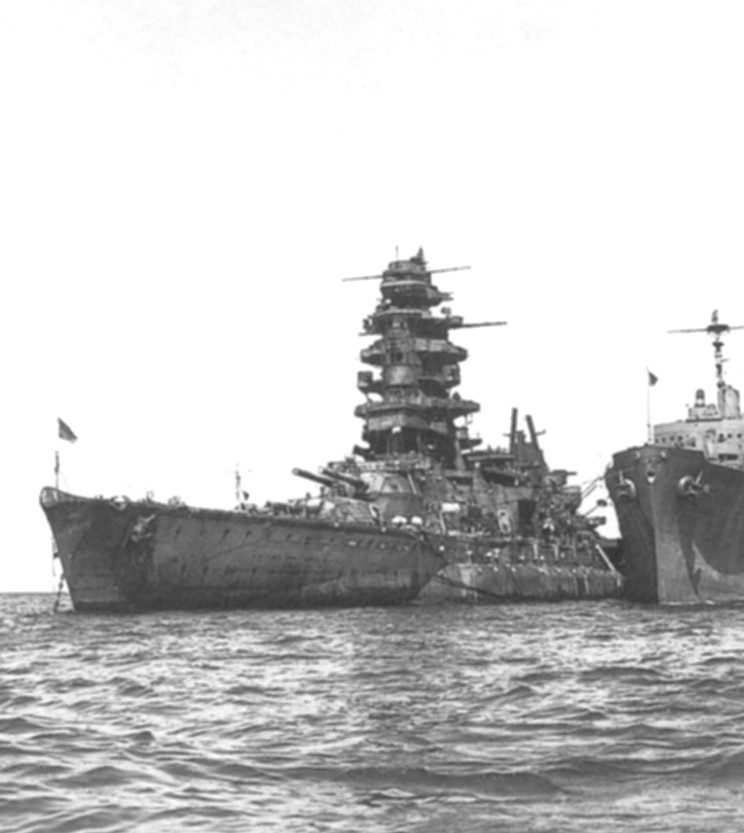
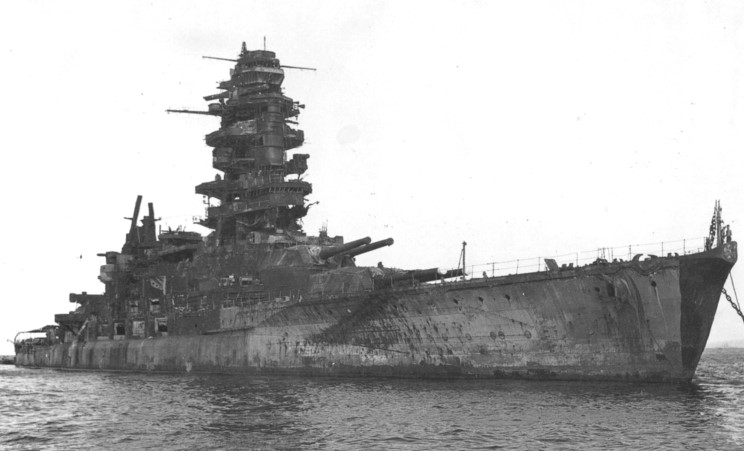
You can see they were reluctant to drop anchors in the lagoon!
If an unfriendly power had attempted to impose on America the mediocre educational performance that exists today, we might well have viewed it as an act of war.
-- "A Nation at Risk" (1983)
-- "A Nation at Risk" (1983)
-
Dan K
- Posts: 9090
- Joined: Tue Jan 11, 2005 10:56 am
- Location: New York City
Good shots, Werner. I'm certain the rail lines were added close to the end.
The Sakawa was in similarly poor condition by the time she participated in Bikini, though, IIRC, more from lack of maintenace than damage. She had been used for repatriation duty and was enroute to Bikini when she broke down. Needed a tow, first from Nagato, then from a tanker.
I believe several USN sailors were caught in the act of sabotaging her at Eniwetok to avoid duty on board her.
The Sakawa was in similarly poor condition by the time she participated in Bikini, though, IIRC, more from lack of maintenace than damage. She had been used for repatriation duty and was enroute to Bikini when she broke down. Needed a tow, first from Nagato, then from a tanker.
I believe several USN sailors were caught in the act of sabotaging her at Eniwetok to avoid duty on board her.
-
Tiornu
- Posts: 124
- Joined: Tue Jan 11, 2005 11:53 pm
Re: Japanese ships at Operation Crossroads
Are there any photos or documentation regarding the rails on her deck? Her midships would have been especially vulnerable to bombs due to the lack of anything more resistant than laminations of D steel. Her magazines had remarkably thick armor, but the machinery was neglected. I have never understood this approach.
-
Guest
There is at least one very famous photo of the funnel-less Nagato, amongst other ships, silhouetted against the initial spout of the water from one of the Bikini explosions, before the plume overtook the ships.
There is at least one aerial photo of the funnel-less Nagato underway on her own power, as indicated by the screw wakes behind her, presumably on her way to Bikini.
There is also a series of aerial photos of the Nagato sometime after the second test but before she foundered, listing about 20 degrees to starboard but otherwise apparently intact.
There is at least one aerial photo of the funnel-less Nagato underway on her own power, as indicated by the screw wakes behind her, presumably on her way to Bikini.
There is also a series of aerial photos of the Nagato sometime after the second test but before she foundered, listing about 20 degrees to starboard but otherwise apparently intact.
-
Guest
-
Werner
- Posts: 2299
- Joined: Mon Jan 10, 2005 1:10 am
- Location: (42.24,-87.81)
My friend said the task of exploring the ship's pitch dark compartments, many partially flooded with foul seepage was unbelievably scary and was never completed because of the dangers involved. By the time the ship was surrendered it was unbelievably squalid, filled with the stench of human waste and death.
If an unfriendly power had attempted to impose on America the mediocre educational performance that exists today, we might well have viewed it as an act of war.
-- "A Nation at Risk" (1983)
-- "A Nation at Risk" (1983)
-
Lesforan

- Posts: 559
- Joined: Sun Feb 19, 2006 7:22 pm
- Location: Ogallala, Nebraska, USA
Nagato
Even without her funnel and in her dismal condition, she still makes an imposing sight.
Her torpedo bulges are very apparent. They are more visible than I thought they would be.
With 60+ years hindsight, it seems to me too bad that she was "wasted" this way, along with many other historical ships. If any of the Bikini ships would have been spared, I think the Saratoga should have been. It would not have hurt to have saved both Nagato and Prinz Eugen as examples of enemy ships we had defeated.
I can see the necessity of testing "the bomb" against aircraft carriers like Saratoga. The purpose of sacrificing battleships seems less clear. They were clearly obsolete weapons at the end of the war. Did the Navy actually feel we may be engaging an enemy battle line with nuclear weapons in a future war?
I realize this would have been counter to the sentiments of the time, but can you imagine a restored Nagato on display alongside her contemporary, USS Texas? How about the old Sara anchored at Patriots' Point with Yorktown? Prinz Eugen at Battleship Cove?
Her torpedo bulges are very apparent. They are more visible than I thought they would be.
With 60+ years hindsight, it seems to me too bad that she was "wasted" this way, along with many other historical ships. If any of the Bikini ships would have been spared, I think the Saratoga should have been. It would not have hurt to have saved both Nagato and Prinz Eugen as examples of enemy ships we had defeated.
I can see the necessity of testing "the bomb" against aircraft carriers like Saratoga. The purpose of sacrificing battleships seems less clear. They were clearly obsolete weapons at the end of the war. Did the Navy actually feel we may be engaging an enemy battle line with nuclear weapons in a future war?
I realize this would have been counter to the sentiments of the time, but can you imagine a restored Nagato on display alongside her contemporary, USS Texas? How about the old Sara anchored at Patriots' Point with Yorktown? Prinz Eugen at Battleship Cove?
Les Foran
On the Oregon Trail
On the Oregon Trail
-
Guest
-
Werner
- Posts: 2299
- Joined: Mon Jan 10, 2005 1:10 am
- Location: (42.24,-87.81)
These bomb tests were actually very important. They brought out the strongpoints and shortcomings of warships under nuclear attack. The experiences brought forward ways to keep fallout from accumulating or concentrating in spots on the decks and sides. This information changed the design and implementation of next generation ships and hulls, and doctrine for deck crews for action under and after nuclear attack.
The ships used were worth the expense.
You also have to remember, the man in the street does not have the sentimental attachment to the ships as do we.
The ships used were worth the expense.
You also have to remember, the man in the street does not have the sentimental attachment to the ships as do we.
If an unfriendly power had attempted to impose on America the mediocre educational performance that exists today, we might well have viewed it as an act of war.
-- "A Nation at Risk" (1983)
-- "A Nation at Risk" (1983)
-
Guest
-
Werner
- Posts: 2299
- Joined: Mon Jan 10, 2005 1:10 am
- Location: (42.24,-87.81)
Whether they were "hot" or not, many of the ships, especially subs and transports away from the blast were re-occupied by their crews within days, and they remained for weeks until the monitors came aboard and determined the post-explosion wash techniques were relatively ineffective.Anonymous wrote:The value of the tests were somewhat diminished by the fact that most of the target ships became too radio active for any thorough on board inspection of their damage to be done.
A vast number of the target ships were brought back home for examination; Salt Lake City & Pensacola spent time at Mare Island in '47 & '48. These ships were ultimately sunk not because they were an immediate radiation hazard, but to keep their mildly radioactive structures from entering the scrap steel market.
If an unfriendly power had attempted to impose on America the mediocre educational performance that exists today, we might well have viewed it as an act of war.
-- "A Nation at Risk" (1983)
-- "A Nation at Risk" (1983)
-
Guest
The ships receiving the most dramatic damages were not habitable after the tests. Those ships likely offer the most in terms of insight into damage resistance.Werner wrote:Whether they were "hot" or not, many of the ships, especially subs and transports away from the blast were re-occupied by their crews within days, and they remained for weeks until the monitors came aboard and determined the post-explosion wash techniques were relatively ineffective.Anonymous wrote:The value of the tests were somewhat diminished by the fact that most of the target ships became too radio active for any thorough on board inspection of their damage to be done.
A vast number of the target ships were brought back home for examination; Salt Lake City & Pensacola spent time at Mare Island in '47 & '48. These ships were ultimately sunk not because they were an immediate radiation hazard, but to keep their mildly radioactive structures from entering the scrap steel market.
-
Guest
BTW, steel itself does not become radioactive. Its circulation in the economy would present no danger, especially after smelting eliminates any trace of radioactive dust upon them. The danger would be from radioactive material contaminating the lagoonal debris that came onboard during the test, and that would mainly be to the scrappers who would actually be cutting up the ship.

-
chuck

- Posts: 3384
- Joined: Mon Jan 10, 2005 1:21 pm
- Location: equidistant to everywhere
-
Werner
- Posts: 2299
- Joined: Mon Jan 10, 2005 1:10 am
- Location: (42.24,-87.81)
The point is the steel was contaminated with radioactive materials. That is the same reason X-ray tables are not allowed to be recycled.Anonymous wrote:BTW, steel itself does not become radioactive. Its circulation in the economy would present no danger, especially after smelting eliminates any trace of radioactive dust upon them. The danger would be from radioactive material contaminating the lagoonal debris that came onboard during the test, and that would mainly be to the scrappers who would actually be cutting up the ship.
I don't know about your analysis, either. About 20 years ago steel table legs from Mexico were severely contaminated because they were made of steel which contained scrap recycled from a hospital's x-ray ward.
If an unfriendly power had attempted to impose on America the mediocre educational performance that exists today, we might well have viewed it as an act of war.
-- "A Nation at Risk" (1983)
-- "A Nation at Risk" (1983)
-
Werner
- Posts: 2299
- Joined: Mon Jan 10, 2005 1:10 am
- Location: (42.24,-87.81)
They could still initiate fuse action or act as a splinter shield. That would be highly beneficial, especially if they initiated the detonator two decks above the armored deck.chuck wrote:The story of using rails for protection is suspect. Rails whether laid out side by side or welded into some sort of corduroy, would offer little protective value against direct AP bomb hits.
If an unfriendly power had attempted to impose on America the mediocre educational performance that exists today, we might well have viewed it as an act of war.
-- "A Nation at Risk" (1983)
-- "A Nation at Risk" (1983)
-
Guest
Werner wrote: The point is the steel was contaminated with radioactive materials. That is the same reason X-ray tables are not allowed to be recycled.
I don't know about your analysis, either. About 20 years ago steel table legs from Mexico were severely contaminated because they were made of steel which contained scrap recycled from a hospital's x-ray ward.
Hmm, there should be no radioactive material contamination in a normal X-ray ward. Medical X-ray generation uses X-ray tubes that contains no radioactive source. X-ray radiation itself does not make things radioactive.
-
Werner
- Posts: 2299
- Joined: Mon Jan 10, 2005 1:10 am
- Location: (42.24,-87.81)
This is wandering off topic, but at the time in Mexico they frequently used a cesium or cobalt-60 source rather than an emitter.Anonymous wrote:Hmm, there should be no radioactive material contamination in a normal X-ray ward. Medical X-ray generation uses X-ray tubes that contains no radioactive source. X-ray radiation itself does not make things radioactive.
If an unfriendly power had attempted to impose on America the mediocre educational performance that exists today, we might well have viewed it as an act of war.
-- "A Nation at Risk" (1983)
-- "A Nation at Risk" (1983)