Wheelhouse protected by CNC steel plate, 40mm in front, 200m side, 30mm overhead, 16mm Ducol steel rear
Main armament design same as those that equipped secondary armament on Japanese built Kongo Class and Fuso class BBs. Not specific on whether it is the same design or actual armament transferred.
Main mounts are gunhouses (no central trunk per turrets, only a pivot point) with handling rooms underneath. Protection is 19mm steel plate all around.
Would you believe me if i tell you before taking a shower i read about the 16 mm Ducol steel plates on the Takao book too bad that's all it says there is no mention of the other sizes.. 40 mm that is a little less than 2" i don't know if it would've helped stopping .50 GMG AP rounds? 200 mm on the sides that is pretty thick. thanks for taking your time going over this!
chuck wrote:30mm on the side of tanks is plenty for stopping any 50 cal. Generally 10mm of armor steel can reliably stop 50cal rounds.
It's not easy finding a good answer out here on the web about the real penetration level of those .50 cal rounds Chuck , more like an specific and concrete answer .. i did find a pretty interesting website of a guy who tested it's sniper rifle i think with an old round and is pretty impressive http://blog.ryjones.org/2009/01/25/50-b ... ion-tests/ thanks for chiming in now i have a better idea
Dan K wrote:Should have read 20mm, not 200mm. My typo. In a hurry, as always.
What was the reason why type 94 HA director was moved from the robust looking structure at the corner of the aircraft deck to the much flimsier looking strut next to the search light platform?
Also it is rather odd that Agano, with her puny medium caliber AA fire power of 4 76mm guns, should receive 2 of the latest tachymetric HA director when there aren't enough of these to equip most of the battleships, heavy cruisers, and carriers of the Japanese navy, all of which had vastly greater AA firepower to contribute to the fleet.
Assessing the impact of new area rug under modeling table.
chuck wrote:30mm on the side of tanks is plenty for stopping any 50 cal. Generally 10mm of armor steel can reliably stop 50cal rounds.
It's not easy finding a good answer out here on the web about the real penetration level of those .50 cal rounds Chuck , more like an specific and concrete answer .. i did find a pretty interesting website of a guy who tested it's sniper rifle i think with an old round and is pretty impressive http://blog.ryjones.org/2009/01/25/50-b ... ion-tests/ thanks for chiming in now i have a better idea
Hi,
I'm the guy who did this test, so I wanted to let you know a little more about them. The ammo was WW2 repack (1944 production, 1945 or 6 repack) AP ammo I peeled from a belt. It was fired from an 18" barrel at the target from perhaps 30 yards (time fades the memory exactly).
The steel you see is weaker than armor in two ways. One, it is not really hardened to any degree. While it is steel, it's just steel I bought from Home Depot; it's sold for welding & fabrication. It might be comparable to 2" of steel from the pre-Dreadnought era, except - the second weakness - it isn't a unit. If it were 2" of armor plate, I suspect the round I fired may have polished the surface some. AR500 is sold for use as targets for rifle ranges; at ~400 yards, the lifespan of one of these targets (which is much thinner) is much longer. I just searched for "ar500 reactive rifle target" and found one that advertises a lifespan of over 100K rounds.
This lifespan is predicated on not using AP rounds, though, which is what I used.
From what I can gather from L & W, the addition of more 25mm mounts necessitated the change in position of the Type 94 directors. Implied, I guess, is that the firing arcs of the 25mm were best from the original site of the directors.
These ships were spec-ed (sp?) with these directors from the outset, in line with all other new construction, to receieve the most modern equipment. The 80mm mounts were a downsized version of the 100mm mounts, and, according to L & W, seen as good.
RyJones wrote:
Hi,
I'm the guy who did this test, so I wanted to let you know a little more about them. The ammo was WW2 repack (1944 production, 1945 or 6 repack) AP ammo I peeled from a belt. It was fired from an 18" barrel at the target from perhaps 30 yards (time fades the memory exactly).
The steel you see is weaker than armor in two ways. One, it is not really hardened to any degree. While it is steel, it's just steel I bought from Home Depot; it's sold for welding & fabrication. It might be comparable to 2" of steel from the pre-Dreadnought era, except - the second weakness - it isn't a unit. If it were 2" of armor plate, I suspect the round I fired may have polished the surface some. AR500 is sold for use as targets for rifle ranges; at ~400 yards, the lifespan of one of these targets (which is much thinner) is much longer. I just searched for "ar500 reactive rifle target" and found one that advertises a lifespan of over 100K rounds.
This lifespan is predicated on not using AP rounds, though, which is what I used.
To give you an idea of the difference between solid and laminar plate performance, here are three pictures of a block of aluminum of no particular hardness when subjected to the same test: http://www.flickr.com/photos/ryjones/2245753917/http://www.flickr.com/photos/ryjones/2252075465/http://www.flickr.com/photos/ryjones/2245753807/.
You'll notice the round was stopped in the block.
Anyway, just didn't want you to draw too much from a random test some guy did on the internet.
Ry
Isn't this online world of us small i want to thank you personally for dropping by and giving us a more thoroughly explanation on your shooting test Ry i got to see the picture which shows the muzzle deterioration and i was wondering how long until you have to replace the barrel and what's the lifespan on them? TIA
The beam of Agano class cruisers seems quite broad for centerline torpedo tubes. Even when trained abeam, the front end of the torpedo tubes are still well inboard of the sides of the ship. The torpedo has to leap over quite of bit of deck before it would clear the ship. The torpedo tubes are situated at deck level, which also does not give the torpedoes any added clearance when torpedo exits the tube. So what is the range of firing angles of Agano torpedo tubes? I would guess it is quite restricted due to the fear of torpedo hitting the deck before clearing the side of the ship. Do Japanese tubes eject torpedoes at particularly high speed to allow placing torpedo tubes so far inboard?
Assessing the impact of new area rug under modeling table.
I believe you have surmised the answer, Chuck. L & W cites several versions of the twin and quad TT mounts using compressed air (or, if backup needed, a black powder charge) to eject the torpedo from the tube at a speed of approx. 11-12m/second. That's a lot of power behind a Type 93, or even a Type 90, torpedo.
Have a question concerning the structure above the forward quadruple torpedo launchers.
Please find below a shot from the Hasegawa 1-350 Yahagi.
Do you know the purpose of the indicated apertures? The Tamiya 1/700 kit and the Yahagi drawing in the Squadron "Japanese Light Cruisers in Action" book do not include this feature.
The aircraft handling deck was a solid platform for the first two class members, Agano & Noshiro. The reason behind the reduction of the deck area is not clear but probably related to material shortages and the determination that this was a non critical area. So, it was relegated to storage for damage control lumber, and could be coverd by tarps as well.. The last member of the class, Sakawa, has almost no overhead in this area, save for a central walkway. (credit (via A. McGivern collection)
As the AA and electronics aloft increased, there was also a need to reduce the high weights to keep the stability within bounds. This was probably also a part of the reason for the reduction in the material of the platforms.
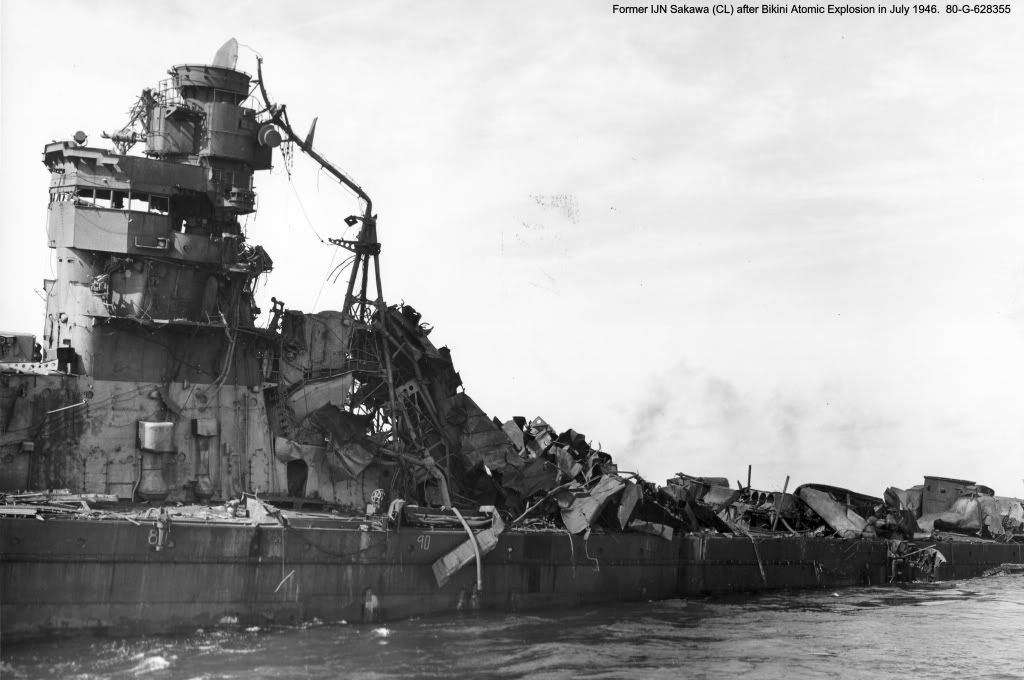
I found this image of SAKAWA at NARA dated July 1946. I think I have seen this photo before, but this copy was pretty sharp and was by its self in the folder, no others views anywhere else in the box. If one really messes up on one of the new AGANO class kits, you could always finish to post Bikini Test.
J. Soca wrote:i got to see the picture which shows the muzzle deterioration and i was wondering how long until you have to replace the barrel and what's the lifespan on them?
Jose,
I'm sorry I missed your question in December. I've put a couple thousand rounds through the 50 BMG and it seems fine, so far. I don't know what the projected life span of the barrel is; I know it is quite a bit less if you run it hot.
I do know people with similar (but not the same) configurations that are at 10k+ rounds. At that point, throat erosion begins to create problems (if you're running hot loads, which everyone does).
I had someone borrowing my rifle hit a 1 MOA target at about 650 yards this year - pretty awesome.
J. Soca wrote:i got to see the picture which shows the muzzle deterioration and i was wondering how long until you have to replace the barrel and what's the lifespan on them?
Jose,
I'm sorry I missed your question in December. I've put a couple thousand rounds through the 50 BMG and it seems fine, so far. I don't know what the projected life span of the barrel is; I know it is quite a bit less if you run it hot.
I do know people with similar (but not the same) configurations that are at 10k+ rounds. At that point, throat erosion begins to create problems (if you're running hot loads, which everyone does).
I had someone borrowing my rifle hit a 1 MOA target at about 650 yards this year - pretty awesome.
Ry
(again, sorry for the extreme delay in replying)
No need to apologize Ry to tell you the truth i forgot about this question too, a couple of thousand rounds still impressive these barrels sure can take alot of punishment!! pardon my ignorance but what is an MOA target? i read your first post but i don't see anything about it. snipers send shivers down my spine not much you can do at 2000 feet away hehe

 too bad that's all it says there is no mention of the other sizes.. 40 mm that is a little less than 2" i don't know if it would've helped stopping .50 GMG AP rounds? 200 mm on the sides that is pretty thick. thanks for taking your time going over this!
 , thanks Dan
 i got to see the picture which shows the muzzle deterioration and i was wondering how long until you have to replace the barrel and what's the lifespan on them? TIA