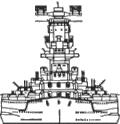
I picked up one of the Hasegawa 1/350 Yahagi's, but I really want an Agano. Are there going to be big differences between them? (anybody want to arrange a trade? )
On Hasagawa's Agano, there are 4 unidentifiable optical instruments about the bridge, each consist of what appears to be 2 widely separated optical tubes mounted on a pedastal. 2 of these are located on the outboard position abreast the armored conning tower, 2 others are near the aft end of the navigation bridge level. They might be a poor representation of (type 14?)secondary gun pedastal director similar to those found on pagoda masts of battleships, but I can't be sure. In any case an additional 4 secondary director in addition to the main one mounted on the top of bridge tower seem like a lot for a ship with only 6 guns. Does any one know what those are?
Also, in the furthermost outboard position behind the navigation bridge, Hasagawa depicts two unusual binoculars, consisting of what appear to be normal binoculars, but mounted on a plinth with 2 instruments cantileverd out to the sides. They look like some sort of measuring device, or torpedo/gun director. Anyone know what those are?
BTW, Hasagawa really need to learn to tone down those weld seams on the superstructure. those seams scale out to 8" wide.
Assessing the impact of new area rug under modeling table.
Another question, did Agano have a set of 13mm machine guns just forward of the main mast at time of commissioning? Hasagawa had that as an optional part.
Incidentally, Agano's original light AA is so puny that she is outgunned by many strafing fighters, and Agano's puny number of original 25mm AA guns have really poor arcs. There is nothing that can fire directly astern, and the 25mm AA director is situated so low behind the B turret that it can't shoot at a low flying torpedo bomber approaching from directly ahead.
Also, The 2 puny 76mm AA mounts hardly seem to justify an advanced techymetric type 94 AA director each, especially when ships equipped with much heavier AA armament still had to do with much more primitive AA fire controls.
Assessing the impact of new area rug under modeling table.
chuck wrote:
Also, The 2 puny 76mm AA mounts hardly seem to justify an advanced techymetric type 94 AA director each, especially when ships equipped with much heavier AA armament still had to do with much more primitive AA fire controls.
The 2 puny 76mm AA mounts was far better than the 12,7 cm gun mounts.The problem was that a larger number (like a second pair) would have been much better.
Yes, Agano was originally equipped with two twin 13mm mounts abreast the main mast when commissioned. These were changed to two triple 25mm mounts when she was refit in June, 1943.
As you know, minimal/poor AA fit was common to many IJN designs that originated pre and early war. The Aganos were upgraded continually, given emerging realities.
The twin 8cm mounts were designed as a weight saving feature for both the Aganos and the Oyodos. It was just a scaled down 10cm mount and considered a good weapon by the IJN, up to a point. Obviously, they didn't use them on Oyodo and there was a late 1943 plan to re-equip Noshiro (and sisters) with 4 10cm mounts in the same layout as Oyodo. Shortages forced abandonment of the plan.
OTOH, the Ibuki conversion to a CVL planned to use the 8cm twin mounts as the main battey.
chuck wrote:
Also, The 2 puny 76mm AA mounts hardly seem to justify an advanced techymetric type 94 AA director each, especially when ships equipped with much heavier AA armament still had to do with much more primitive AA fire controls.
The 2 puny 76mm AA mounts was far better than the 12,7 cm gun mounts.The problem was that a larger number (like a second pair) would have been much better.
How so? The IJN 12.7cm/40 mount were closely comparable to US 5"/37 in ballistics, rate of fire, shell weight, weight of mount, rate of elevation and train, etc. The US 5"/37 were considered a very excellently balanced dual purpose gun, often said to be the best to see service in WWII, so it seems to me the IJN 12.7 cm gun should at least merit a shot at the title of second best all round duel purpose gun.
The 76mm AA, on the other hand, is an semi-automatic weapon of a caliber that, in the case of USN, would have been an fully automatic weapon, with commensurate difference in firing rate.
Assessing the impact of new area rug under modeling table.
That's because 10cm and 8cm guns undeniably have exceptional ballistic properties for their caliber while the 12.7cm/40, like the US 5"/37, had mediocre ballistic properties for their caliber. But both the 12.7 cm/40 and 5"/38 makes up for that by having a high rate of fire in combat, and fast train and elevation. So at least during WWII, the 5"/38 was judged to have a very good practical balance of characteristics.
At the end of the war, of course one would be interested in trying to improve on the 5"/38's ballistics while retaining its other good properties. In any case improvements in aircraft performance, the development of standoff weapons like the Fritz-X, would have changed the relative premium one place on ballistic property and other characterics of the gun. But that wouldn't effect any judgement of how good 12.7CM/40 was for WWII use in the pacific.
Assessing the impact of new area rug under modeling table.
P. 41 makes for good reading. Unlike the 12.7cm50 cal mount used in the DDs, the 12.7cm40cal mount: "... appears in all respects to be a good, sound, dual purpose mount of above average performance. It's maximum speeds of training and elevation, 16*/sec, are adequate for this type of mount using fixed ammunition."
The weak spot appears to ammunition supply arrangements, depending on the type of ship.
Last edited by Dan K on Fri Jul 22, 2011 6:45 am, edited 1 time in total.
Yes, I always thought the Japanese 12.7cm/40 was amongst the most underappreciated of any pacific weapons that saw very widespread use. It is often deemed a mediocre or poor weapon in popular literature despite the fact that it is as good as 5"/38 which most American literature reguard as the best weapon of its type in the whole war.
Assessing the impact of new area rug under modeling table.

 )
)