
My question is, were those still carried in 1944?
Thanks in advance
Moderators: BB62vet, MartinJQuinn, Timmy C, Gernot, Olaf Held, Dan K, HMAS, ModelMonkey





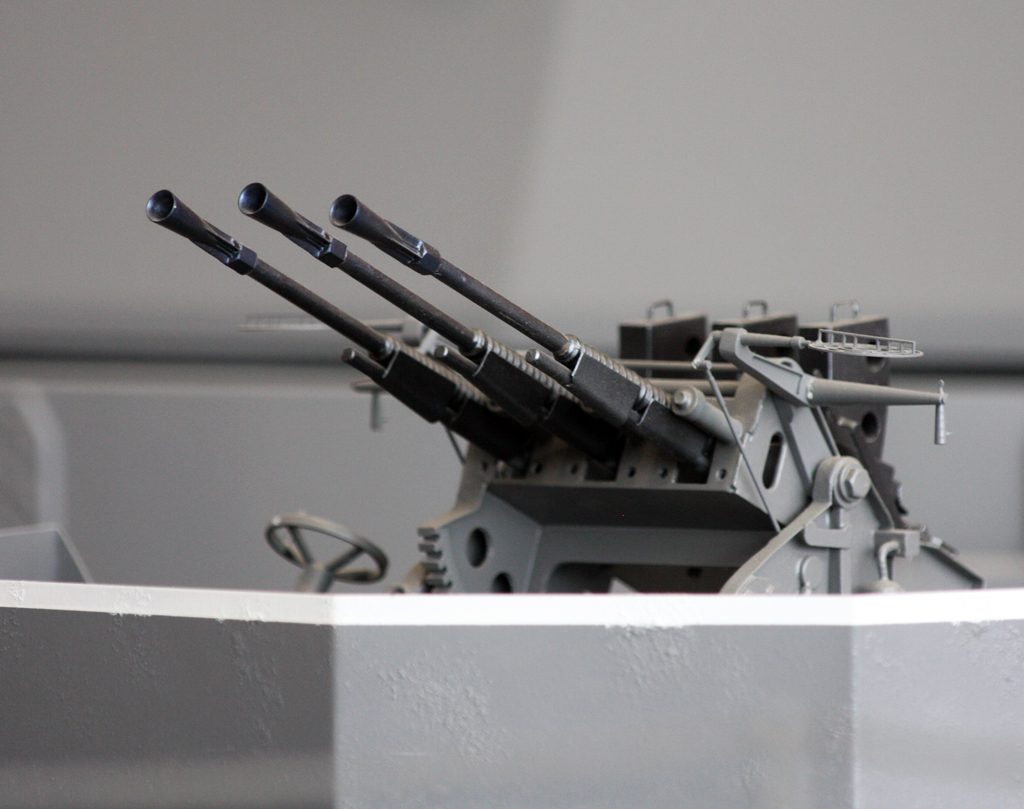





Looking really close, I think I do see hull plate welding joints on it. The ones on the Tamiya kit are exaggerated for purposes of bringing out the detail, like many details on models are.mermaid wrote:Model in Kure does not show any hull plating corresponding to the Tamiya version.


Most of Yamato's hull was riveted with overlapping joints. I think Kure model simply omitted the joints.Thomas E. Johnson wrote:Looking really close, I think I do see hull plate welding joints on it. The ones on the Tamiya kit are exaggerated for purposes of bringing out the detail, like many details on models are.mermaid wrote:Model in Kure does not show any hull plating corresponding to the Tamiya version.
I used Northeast Scale lumber's strips to plank the deck, plank by plank. They are superior to pre-scribed wooden sheets or styrene sheets for the following reasons:Thomas E. Johnson wrote:As a rule I don't like to lay wooden decks on 1/350 models because it looks out of scale to me once its cut so it will fit around all of the molded deck details, which then look like they are to small. The new 1/350 Yamato kit however there is little choice. The sides of the main deck don't make even clean joints with the middle main deck section, and sanding it down will destroy the molded deck planks, and it would be next to impossible to rescribe them properly. The only way to have an even deck is to use an after market wooden one.
Yeah I know they are exaggerated planks and caulk joints. But so many other details on models of various themes are exaggerated also to make them stand out. I live with it. It does make the model look more interesting, and in my opinion, there is no such thing as a perfectly accurate model to begin with.chuck wrote:I used Northeast Scale lumber's strips to plank the deck, plank by plank. They are superior to pre-scribed wooden sheets or styrene sheets for the following reasons:Thomas E. Johnson wrote:As a rule I don't like to lay wooden decks on 1/350 models because it looks out of scale to me once its cut so it will fit around all of the molded deck details, which then look like they are to small. The new 1/350 Yamato kit however there is little choice. The sides of the main deck don't make even clean joints with the middle main deck section, and sanding it down will destroy the molded deck planks, and it would be next to impossible to rescribe them properly. The only way to have an even deck is to use an after market wooden one.
1. The seams and joints are very subtle, as they should be in your care about accuracy. The lines on pre-scribed wooden deck sheets are far too thick, and the grooves on plastic sheets far to consipicuous, compare to true scale. You can never tell there are seams on a real-ship's wooden deck if you were to place your eyes the same scale distance away from the real ship as you would when you view your model.
2. The strips are thin enough so the planks are almost scale width. I did this on my Yamato. The planks came out to be about 8" wide in scale, they were 5" wide on the real Yamato. Fancy deck sheets so in vogue now draw in massive deck plank seams that are each 2" wide, with badly off color yellow deck planks almost 2 feet wide.
 and i wanted to know where the small tubes are positioned.