Jim, I would (and have) done the same when sailing and on other models.
On the botter (and other Dutch boats of the time) they used these peculiar half-cleats that do not have a horn pointing upwards. In consequence, you cannot hang anything there. I gather they would have tucked the coil behind the standing halliard, when at sea. On small boats it always makes sense to be able to let go halliards easily so that you can take the pressure out of the sail quickly. On the other hand, according to my literature references, certain ropes where belayed on top of each other (as is the practice for some ropes on the large sailing ships).
Having them coiled up on deck, as I have shown, may not be safe practice at sea, but is good enough when moored, I think.
Otherwise, photographs show a lot of clutter on working sailing craft (at least) when in harbour. They are not that often kept 'ship-shape and Bristol-fashion' as we tend to think with yachts and naval vessels in mind. Its this workday appearance I am intending to recreate.
wefalck
Zuiderzee-Botter
Moderators: BB62vet, MartinJQuinn, JIM BAUMANN, Jon, Dan K
-
wefalck

- Posts: 2079
- Joined: Wed Sep 28, 2011 12:04 pm
- Location: Paris
- Contact:
Re: Zuiderzee-Botter
Eberhard
Former chairman Arbeitskreis historischer Schiffbau e.V. (German Association for Shipbuilding History)
--------------------------------------------------------------------------------------------------------------------------------------------------------------------------------------------




Former chairman Arbeitskreis historischer Schiffbau e.V. (German Association for Shipbuilding History)
--------------------------------------------------------------------------------------------------------------------------------------------------------------------------------------------
-
Pieter
- Posts: 1602
- Joined: Sat Sep 17, 2005 9:19 am
Re: Zuiderzee-Botter
One of the things that set a Botter apart from a Volendam based "Kwak" was this use of half-cleats instead of full cleats. A "Kwak" would use full cleats. This picture shows half-cleats in use on the (currently) Delft based botter "Trui", Bu 130.
http://www.flikr.com/photos/bu130/11289319813
http://www.flikr.com/photos/bu130/11289319813
-
wefalck
- Posts: 2079
- Joined: Wed Sep 28, 2011 12:04 pm
- Location: Paris
- Contact:
Re: Zuiderzee-Botter
I have also seen pictures of reconstructed botters (not kwaks with the 'kwakerol', a small net-windlass, in the stern) that had been fitted with 'normal' cleats. However, that may have been a preservation rather than an original feature.
wefalck
wefalck
Eberhard
Former chairman Arbeitskreis historischer Schiffbau e.V. (German Association for Shipbuilding History)
--------------------------------------------------------------------------------------------------------------------------------------------------------------------------------------------
Former chairman Arbeitskreis historischer Schiffbau e.V. (German Association for Shipbuilding History)
--------------------------------------------------------------------------------------------------------------------------------------------------------------------------------------------
-
wefalck
- Posts: 2079
- Joined: Wed Sep 28, 2011 12:04 pm
- Location: Paris
- Contact:
Re: Zuiderzee-Botter
Slowly the work on the Botter itself draws to a close. Small and unspectacular steps in which the previously made parts are assembled to give the �whole�. The rigging work is rather difficult to photograph � one�s three hands are already busy and there is no free hand for the camera.
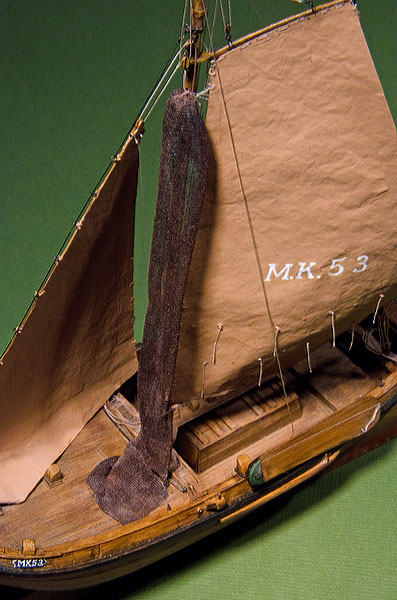
Net hauled out up the mast for drying
The Botter is a fishing boat and a fishing boat needs a net. But just this caused me some headache. In accordance with the �story� that is to be told in this scene, the net will be shown hauled out up the mast for drying. This can be seen on many old photographs.
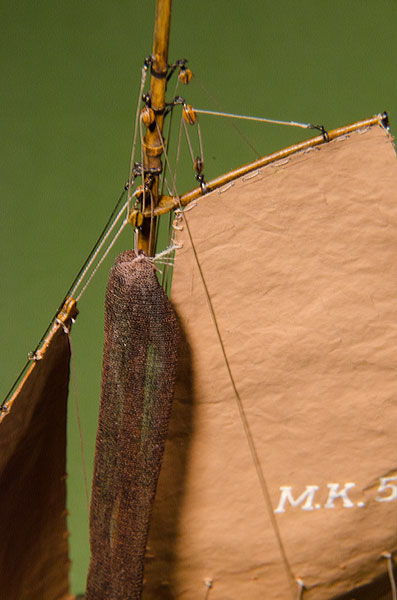
Detail of the net hauled out up the mast
In these old photographs one also notes the fineness of the yarn from which such nets were made. There is not really any material that can convincingly represent a fishing net in the 1:87 scale. The second best solution are the finest ladies tights one can put one�s hand on. Unfortunately, these don�t have quite the reddish-brown colour of a tanned fishing net. In order to improve their resistance against the elements, fishing nets were �tanned�, i.e. they were boiled in a brew made from oak bark.
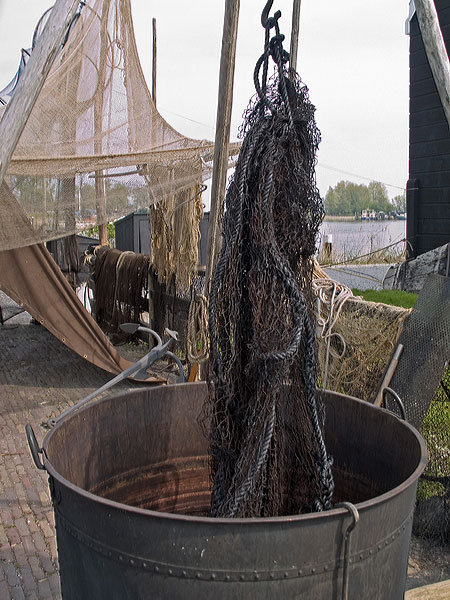
Tanning of nets (in the Zuiderzeemuseum, Enkhuizen)
An additional problem was, that I didn�t have any detail information on what kind of nets a Botter would have used in the winter fisheries on the Zuiderzee and how these nets were constructed � Van Beylen just devotes half a page to the subject. There is a book by Pieter Dorleijn, that apparently treats the subject in some detail, but I found it too expensive to buy this book, just for the one net I had to make. Therefore, I cheated a bit.
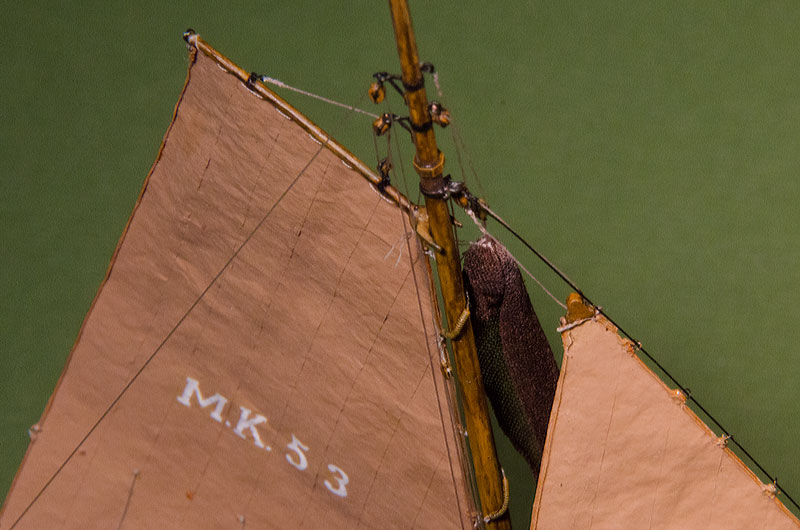
Detail of the net hauled out up the mast
As the tights didn�t have quite the right colour, I somehow had to dye them, which turned out rather difficult to do. First I pulled the tight over a round-bellied bottle to open the meshes. A try with mahagoni-coloured woood-stain failed, the material just didn�t take up the stain. In the end I stabilised the tight with thinned matt acrylic varnish applied with the airbrush. After cutting it out, the �net� was coloured using Sepia-ink, again applied with the airbrush. The acrylic varnish allows the net to be draped in an acceptably realistic way. The net then was glued with solvent-based matt varnish onto the fore-deck. A few drops of this fast-drying varnish also kept the draping in shape.
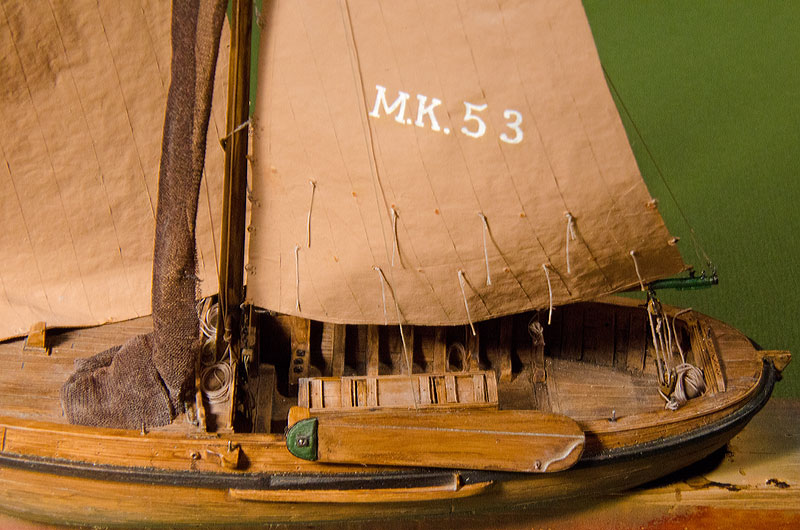
The net draped on the fore-deck
The lee-boards were brought on board too. They are fastened with small round-headed nails. In reality the lee-board would have been secured on the pin with a wedge in a rectangular slot in its outboard end. As on the model this pin has a diameter of only 0.4 mm, I gave up on the idea to recreated this arrangement The lee-boards are raised by a simple tackle. A block with a hole, fastened to the rail, redirects the pulling force and acts as a stop. The lee-board halliard is belayed on the aftermost half-cleat.
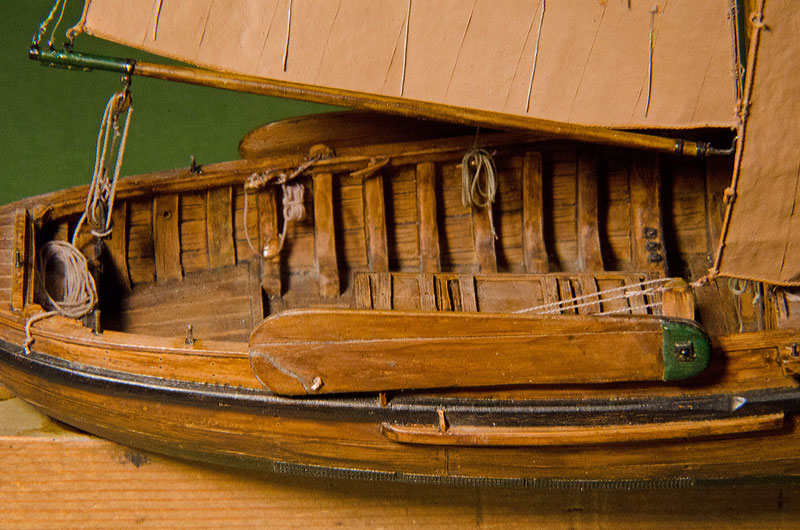
The raised lee-boards
Also the various belaying pins found their right places. The pins, turned from steel, were heated using a hot-air soldering gun until they changed their colour to brown and almost blue. This, in my opinion, looks quite like forged iron that is slightly rusted.
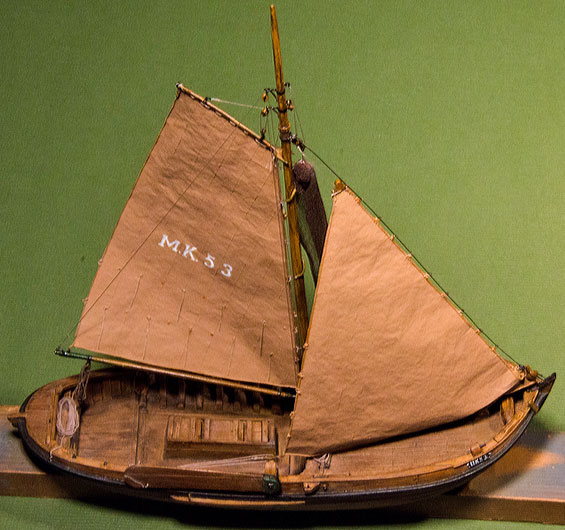
An overall view of the model
Other fittings will follow suit ...
wefalck
Net hauled out up the mast for drying
The Botter is a fishing boat and a fishing boat needs a net. But just this caused me some headache. In accordance with the �story� that is to be told in this scene, the net will be shown hauled out up the mast for drying. This can be seen on many old photographs.
Detail of the net hauled out up the mast
In these old photographs one also notes the fineness of the yarn from which such nets were made. There is not really any material that can convincingly represent a fishing net in the 1:87 scale. The second best solution are the finest ladies tights one can put one�s hand on. Unfortunately, these don�t have quite the reddish-brown colour of a tanned fishing net. In order to improve their resistance against the elements, fishing nets were �tanned�, i.e. they were boiled in a brew made from oak bark.
Tanning of nets (in the Zuiderzeemuseum, Enkhuizen)
An additional problem was, that I didn�t have any detail information on what kind of nets a Botter would have used in the winter fisheries on the Zuiderzee and how these nets were constructed � Van Beylen just devotes half a page to the subject. There is a book by Pieter Dorleijn, that apparently treats the subject in some detail, but I found it too expensive to buy this book, just for the one net I had to make. Therefore, I cheated a bit.
Detail of the net hauled out up the mast
As the tights didn�t have quite the right colour, I somehow had to dye them, which turned out rather difficult to do. First I pulled the tight over a round-bellied bottle to open the meshes. A try with mahagoni-coloured woood-stain failed, the material just didn�t take up the stain. In the end I stabilised the tight with thinned matt acrylic varnish applied with the airbrush. After cutting it out, the �net� was coloured using Sepia-ink, again applied with the airbrush. The acrylic varnish allows the net to be draped in an acceptably realistic way. The net then was glued with solvent-based matt varnish onto the fore-deck. A few drops of this fast-drying varnish also kept the draping in shape.
The net draped on the fore-deck
The lee-boards were brought on board too. They are fastened with small round-headed nails. In reality the lee-board would have been secured on the pin with a wedge in a rectangular slot in its outboard end. As on the model this pin has a diameter of only 0.4 mm, I gave up on the idea to recreated this arrangement
The lee-boards are raised by a simple tackle. A block with a hole, fastened to the rail, redirects the pulling force and acts as a stop. The lee-board halliard is belayed on the aftermost half-cleat.The raised lee-boards
Also the various belaying pins found their right places. The pins, turned from steel, were heated using a hot-air soldering gun until they changed their colour to brown and almost blue. This, in my opinion, looks quite like forged iron that is slightly rusted.
An overall view of the model
Other fittings will follow suit ...
wefalck
Eberhard
Former chairman Arbeitskreis historischer Schiffbau e.V. (German Association for Shipbuilding History)
--------------------------------------------------------------------------------------------------------------------------------------------------------------------------------------------
Former chairman Arbeitskreis historischer Schiffbau e.V. (German Association for Shipbuilding History)
--------------------------------------------------------------------------------------------------------------------------------------------------------------------------------------------
-
JIM BAUMANN

- Posts: 5678
- Joined: Mon Jan 10, 2005 5:30 pm
- Location: Nr Southampton England
Re: Zuiderzee-Botter
great ingenuity at work with the recolouring of ladies tights...
the effect is very convincing.

a teeny critique if I may...
the rope > exiting > the mainsheet blocks i sa little loose...- or is it intended..?
I na currently in the " Oberlausitz " in germany- with very limited e-access
and dealing with a german keyboard full of ����s..., �����...s and �����...s... and lots of differen quirks !
Cheers
JIM B
the effect is very convincing.
a teeny critique if I may...
the rope > exiting > the mainsheet blocks i sa little loose...- or is it intended..?
I na currently in the " Oberlausitz " in germany- with very limited e-access
and dealing with a german keyboard full of ����s..., �����...s and �����...s... and lots of differen quirks !
Cheers
JIM B
....I buy them at three times the speed I build 'em.... will I live long enough to empty my stash...?
http://www.modelshipgallery.com/gallery ... index.html
IPMS UK SIG (special interest group) www.finewaterline.com
http://www.modelshipgallery.com/gallery ... index.html
IPMS UK SIG (special interest group) www.finewaterline.com
-
wefalck
- Posts: 2079
- Joined: Wed Sep 28, 2011 12:04 pm
- Location: Paris
- Contact:
Re: Zuiderzee-Botter
Well, the loose in the sheets is sort of intentional, as the sails are depicted as being dried. A slight breeze (a cold easterly one actually) may catch the sails from time to time. You may have noticed that the main-sail sheet has been tied to one of the pins in the rails in order to prevent the boom from swinging around. Normally the main-sail sheet is belayed onto the 'hook-block', the lower block in the tackle.
To continue: A fishing boats needs some fish-baskets to store the sorted catch in.
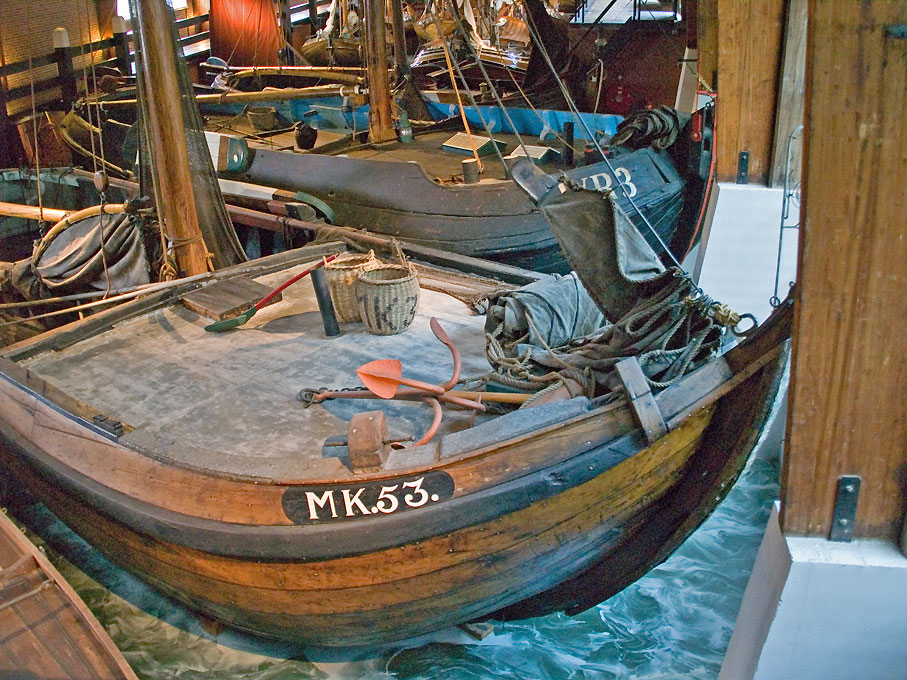
Fish-baskets on the Marker botter in the Zuiderzeemuseum
I could not think a convincing method to fake such baskets and dropped ideas of using fabric or wire mesh � there would always be an unrealistic seam. If you have a closed or filled basket, you may sculpt it from something and imprint the woven pattern, but this does not work for empty ones. In the end, I decided to weave real baskets, well almost.
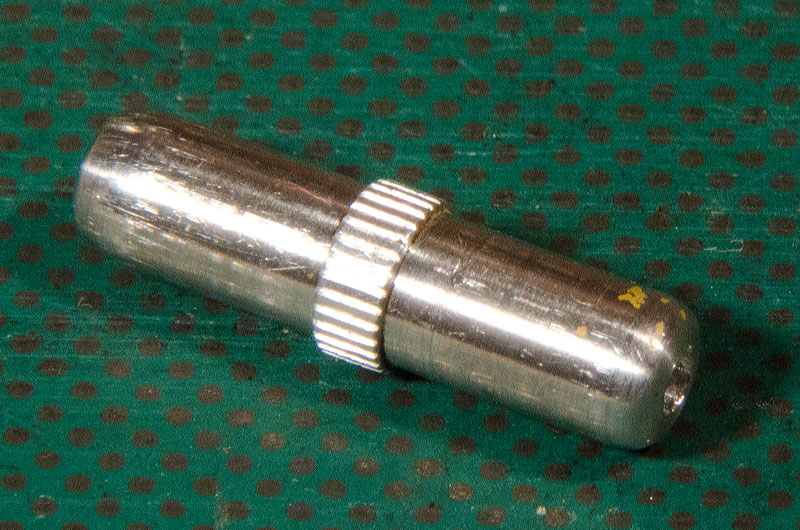
Tool for making (fish-)baskets
For this I needed a tool that would give the basket its shape and allow me to handle it while weaving. So I turned the little implement above from a piece of 5 mm diameter aluminium and drilled a 2 mm hole all the way through it. It will allow me make two baskets simultaneously. The material for weaving is another issue. I would have like to use wire, but it would have been difficult to actually weave with wire. So I used some thin cotton thread for the stakes and fly-tying yarn for the weave.
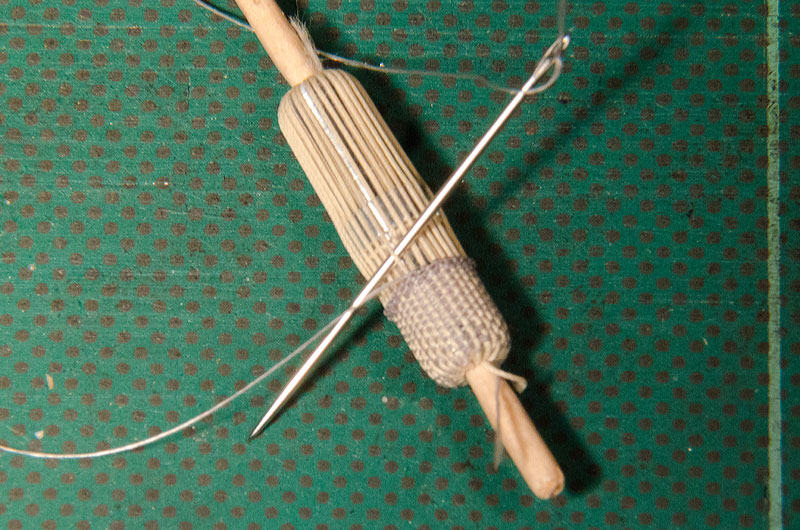
Weaving fish-baskets
First the �stakes� were put into place by wind the thread around the form tool in a continuous series of loops, passing the return part through the middle of the center bore of the tool. This then was woven out with the fly-tying yarn using a sewing needle. The rim is a bit of a fake: normally the stakes would be bent back one over each other to produce a stable and decorative finishing. Here I made a double row of half-hitches with the weave, i.e. the fly-tying thread. Once this was finished, the �basket� was soaked in wood stain and then a few dabs of matt varnish were applied to secure the weaving. The stakes with the exception of two on each side then were cut off flush with the rim. The remaining stakes were twisted into looped handles. Finally the stakes were cut around the hole in the bottom of tool. A bottom of the basket was faked by closing the hole with a good drop of white glue.
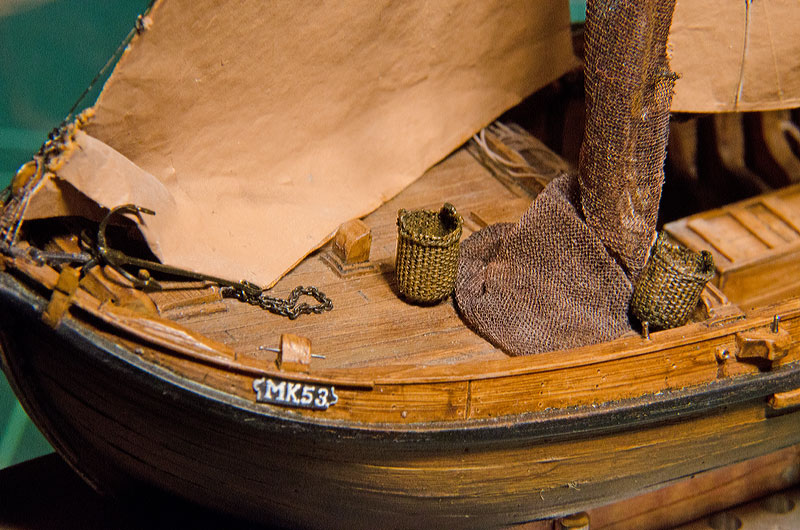
The finished fish-baskets
The baskets then were weathered using acrylics paint (umbra). After looking at the museum-picture, I noticed that I should paint onto the baskets the registration number of the boat - so that catch can be identified at the fish auction.
One may notice on the above photograph that in the meantime also the anchor, a grab, has been installed. Finding such small chain is a challenge, but I got something suitable from a Bavarian model railway supplier. While the links were nicely soldered and blackend, they were actually round. Anchor chains, however, have oval links. With a pair of pliers I slightly squashed the links into an oval shape.
wefalck
P.S. I love the German keyboard (at least on my Mac) as I have easy access to all those weird German characters (�,�,�,�) as well as other folks' around Europe, e.g. �,�,�,�,�,�,�,�, etc.
To continue: A fishing boats needs some fish-baskets to store the sorted catch in.
Fish-baskets on the Marker botter in the Zuiderzeemuseum
I could not think a convincing method to fake such baskets and dropped ideas of using fabric or wire mesh � there would always be an unrealistic seam. If you have a closed or filled basket, you may sculpt it from something and imprint the woven pattern, but this does not work for empty ones. In the end, I decided to weave real baskets, well almost.
Tool for making (fish-)baskets
For this I needed a tool that would give the basket its shape and allow me to handle it while weaving. So I turned the little implement above from a piece of 5 mm diameter aluminium and drilled a 2 mm hole all the way through it. It will allow me make two baskets simultaneously. The material for weaving is another issue. I would have like to use wire, but it would have been difficult to actually weave with wire. So I used some thin cotton thread for the stakes and fly-tying yarn for the weave.
Weaving fish-baskets
First the �stakes� were put into place by wind the thread around the form tool in a continuous series of loops, passing the return part through the middle of the center bore of the tool. This then was woven out with the fly-tying yarn using a sewing needle. The rim is a bit of a fake: normally the stakes would be bent back one over each other to produce a stable and decorative finishing. Here I made a double row of half-hitches with the weave, i.e. the fly-tying thread. Once this was finished, the �basket� was soaked in wood stain and then a few dabs of matt varnish were applied to secure the weaving. The stakes with the exception of two on each side then were cut off flush with the rim. The remaining stakes were twisted into looped handles. Finally the stakes were cut around the hole in the bottom of tool. A bottom of the basket was faked by closing the hole with a good drop of white glue.
The finished fish-baskets
The baskets then were weathered using acrylics paint (umbra). After looking at the museum-picture, I noticed that I should paint onto the baskets the registration number of the boat - so that catch can be identified at the fish auction.
One may notice on the above photograph that in the meantime also the anchor, a grab, has been installed. Finding such small chain is a challenge, but I got something suitable from a Bavarian model railway supplier. While the links were nicely soldered and blackend, they were actually round. Anchor chains, however, have oval links. With a pair of pliers I slightly squashed the links into an oval shape.
wefalck
P.S. I love the German keyboard (at least on my Mac) as I have easy access to all those weird German characters (�,�,�,�) as well as other folks' around Europe, e.g. �,�,�,�,�,�,�,�, etc.
Eberhard
Former chairman Arbeitskreis historischer Schiffbau e.V. (German Association for Shipbuilding History)
--------------------------------------------------------------------------------------------------------------------------------------------------------------------------------------------
Former chairman Arbeitskreis historischer Schiffbau e.V. (German Association for Shipbuilding History)
--------------------------------------------------------------------------------------------------------------------------------------------------------------------------------------------
-
JIM BAUMANN
- Posts: 5678
- Joined: Mon Jan 10, 2005 5:30 pm
- Location: Nr Southampton England
Re: Zuiderzee-Botter
SENSATIONAL
Your innovation and thought behind the fishbaskets is simply sublime
I am more than speechless--I can barely breathe
Your innovation and thought behind the fishbaskets is simply sublime
I am more than speechless--I can barely breathe
....I buy them at three times the speed I build 'em.... will I live long enough to empty my stash...?
http://www.modelshipgallery.com/gallery ... index.html
IPMS UK SIG (special interest group) www.finewaterline.com
http://www.modelshipgallery.com/gallery ... index.html
IPMS UK SIG (special interest group) www.finewaterline.com
-
wefalck
- Posts: 2079
- Joined: Wed Sep 28, 2011 12:04 pm
- Location: Paris
- Contact:
Re: Zuiderzee-Botter
Please, please ! 
What I really need is an idea to reproduce such bellied baskets as on the museum boat. I have confounded with the same problem when trying to find a way to reproduce a spherical spark-arrester for a steam-engine, made from wire mesh. May be I could make a former tool from wax and melt this out, but then I have the wax soaking the thread � ideas most welcome.
wefalck
What I really need is an idea to reproduce such bellied baskets as on the museum boat. I have confounded with the same problem when trying to find a way to reproduce a spherical spark-arrester for a steam-engine, made from wire mesh. May be I could make a former tool from wax and melt this out, but then I have the wax soaking the thread � ideas most welcome.
wefalck
Eberhard
Former chairman Arbeitskreis historischer Schiffbau e.V. (German Association for Shipbuilding History)
--------------------------------------------------------------------------------------------------------------------------------------------------------------------------------------------
Former chairman Arbeitskreis historischer Schiffbau e.V. (German Association for Shipbuilding History)
--------------------------------------------------------------------------------------------------------------------------------------------------------------------------------------------
-
EJFoeth
- Posts: 2907
- Joined: Wed Jan 21, 2009 1:51 pm
Re: Zuiderzee-Botter
Excellent work! Very inspiring to follow your progress
-
wefalck
- Posts: 2079
- Joined: Wed Sep 28, 2011 12:04 pm
- Location: Paris
- Contact:
Re: Zuiderzee-Botter
Thanks again �
***
Time has come to release the botter into its natural habitat ...
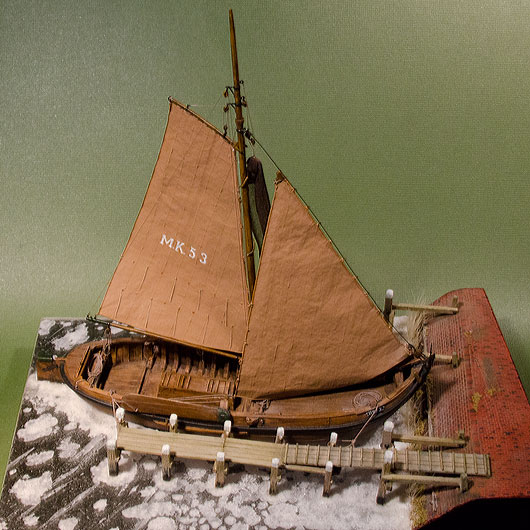
The model was fixed to the baseboard by a screw with countersunk head. Where necessary, the loosened ice around the boat was touched up with the same sugar-acrylic gel mixture with which the rest of the ice-scape was modelled.
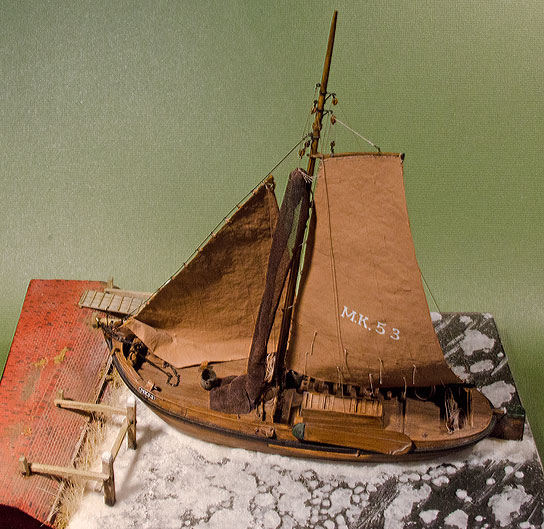
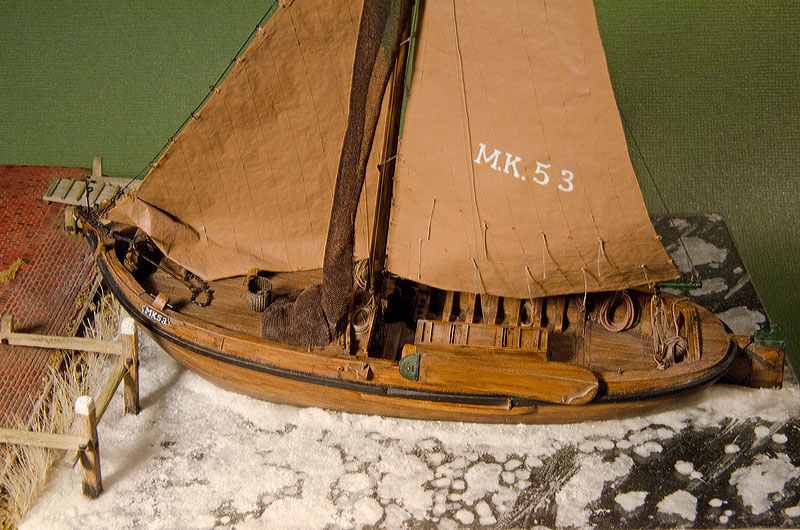
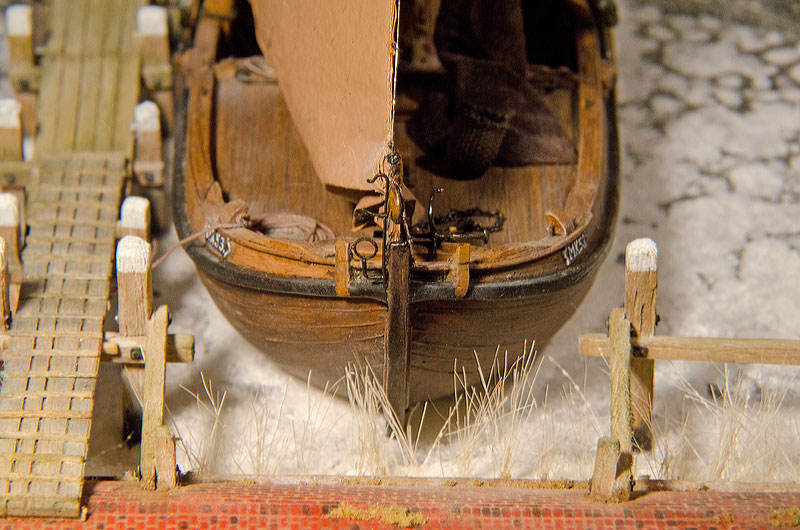
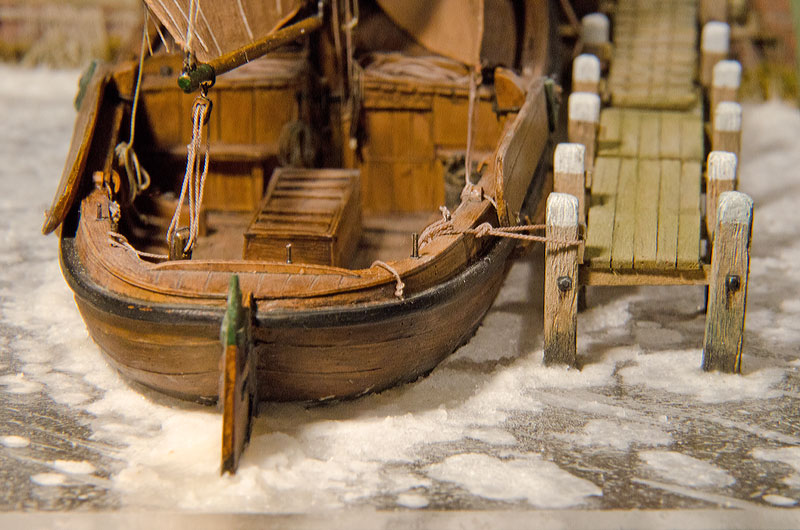
The next step will be to complete the vitrine. Then, work on population of the scenery will continue and a some �loose� equipment for the botter will also have to be made.
wefalck
***
Time has come to release the botter into its natural habitat ...
The model was fixed to the baseboard by a screw with countersunk head. Where necessary, the loosened ice around the boat was touched up with the same sugar-acrylic gel mixture with which the rest of the ice-scape was modelled.
The next step will be to complete the vitrine. Then, work on population of the scenery will continue and a some �loose� equipment for the botter will also have to be made.
wefalck
Last edited by wefalck on Sun Feb 02, 2014 3:13 pm, edited 1 time in total.
Eberhard
Former chairman Arbeitskreis historischer Schiffbau e.V. (German Association for Shipbuilding History)
--------------------------------------------------------------------------------------------------------------------------------------------------------------------------------------------
Former chairman Arbeitskreis historischer Schiffbau e.V. (German Association for Shipbuilding History)
--------------------------------------------------------------------------------------------------------------------------------------------------------------------------------------------
-
Pieter
- Posts: 1602
- Joined: Sat Sep 17, 2005 9:19 am
Re: Zuiderzee-Botter
My ankles felt sore as soon as I saw your ice. Very nice ice to look at, terrible to skate on....
Nice work as always.
Nice work as always.
-
wefalck
- Posts: 2079
- Joined: Wed Sep 28, 2011 12:04 pm
- Location: Paris
- Contact:
Re: Zuiderzee-Botter
Still, there will be some skaters �
***
The edges of the vitrine are to be covered by L-shaped brass profiles. These are cut to length a bit longer than needed and then the mitre is ground on. In order not to let the sanding disc work too much, I pre-cut the mitre rough with a cutter. My first investment into machinery in the mid-1980s was the purchase of a PROXXON pillar drill. It served me well ever since, not only as a drilling machine, but also as disc sander and (occasionally) as a wood lathe. At that time a longer pillar, a tool rest, a sanding disc/face-plate and a revolving centre were available as extras. The tool rest has a mitre guide. Together with a grind stone, I also used it to shape and sharpen lathe tools.
With a sanding disc one can grind the mitres very precisely.
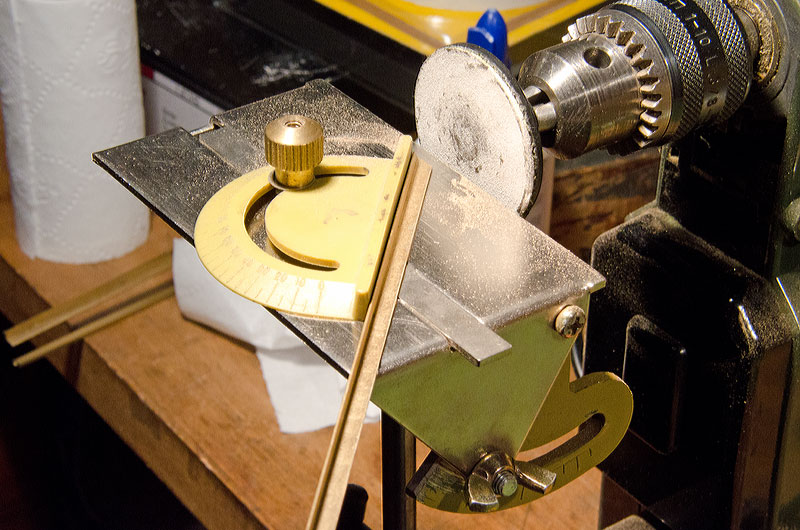
Grinding of the mitres into the brass L-profiles
For a good fit, a certain sequence of fitting the brass profiles is advisable. First the parts for the top are roughly cut to length and the mitres ground on at both ends. Then two profiles are mated in one corner and, say, part 1 taped down with Sellotape. Part 2 and 3 are mated at the next corner and part 3 taped down. Next part 2 can be ground to an exact fit between part 1 and 3. One continues with mating part 3 and 4 in the next corner, and so forth. The brass profiles at the bottom, that sit on the wood, are fitted in the same way.
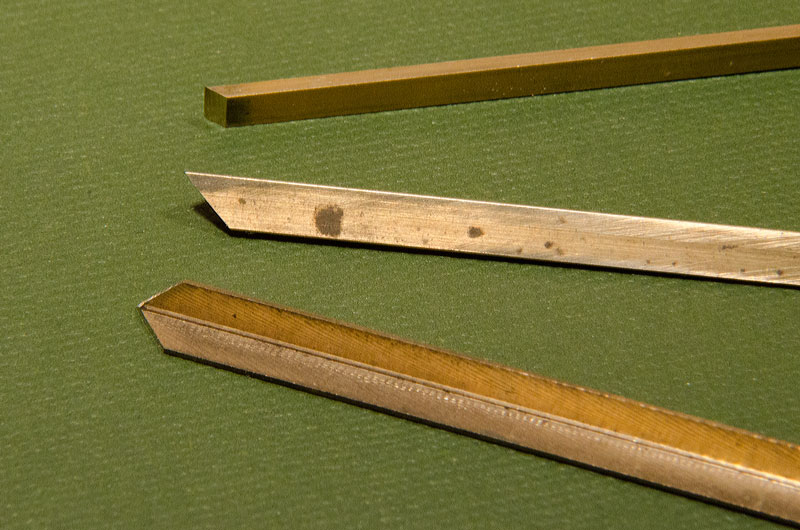
Prepared brass profiles
The brass is ground finely, polished with steelwool (0000), and then degreased with white spirit. The profiles are now glued on one by one. For this I use a clear general purpose glue (German brand: UHU Alleskleber). Until the glue is set, the profiles are taped down again.
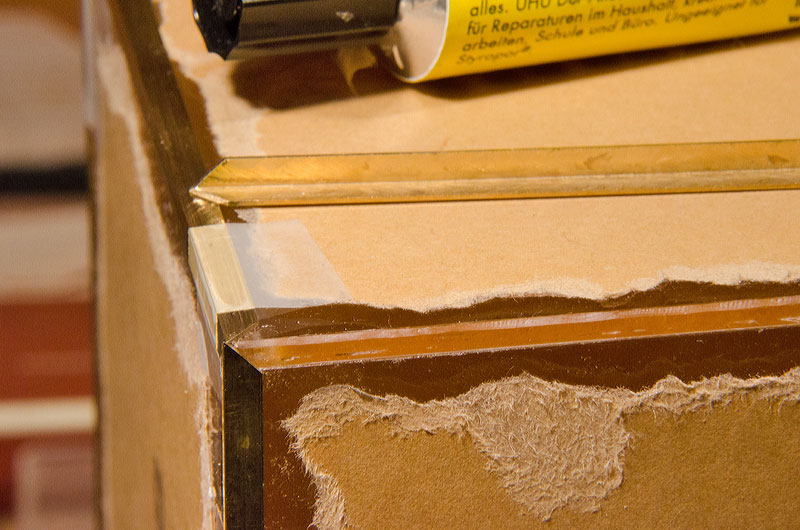
Mitred corner at the top of vitrine
The four uprights are the last parts to go on. They are roughly cut to length and the mitres are ground on at one side. The exact fitting is done at the square end. Here we only need to fit one edge. When grinding on the mitres, one can also compensate slight unevenness of the other mitres and thus achieve a perfect fit.
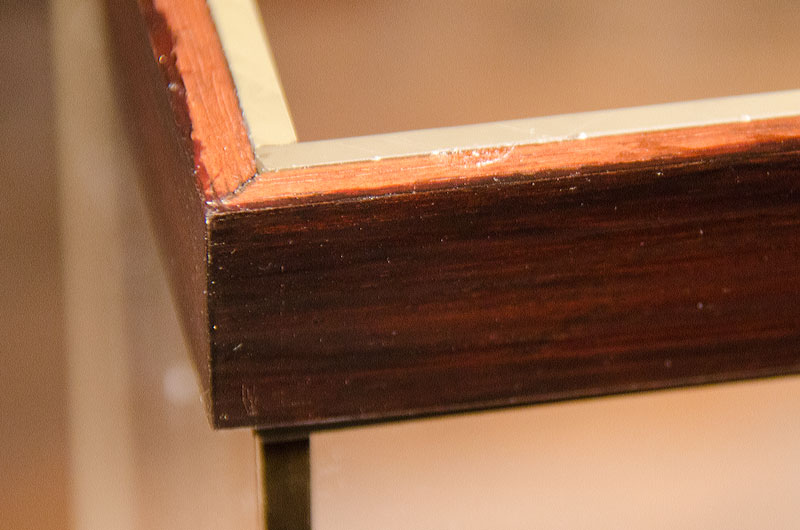
View from below showing how the parts fit together
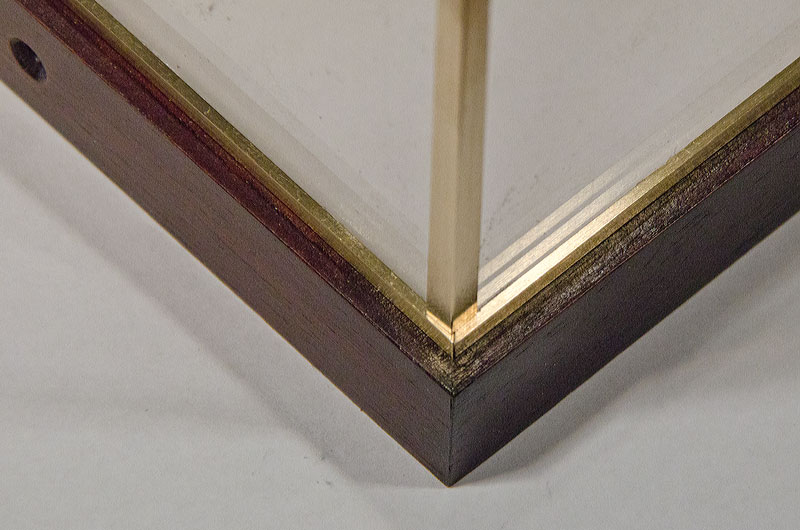
View onto the wooden frame and brass edging
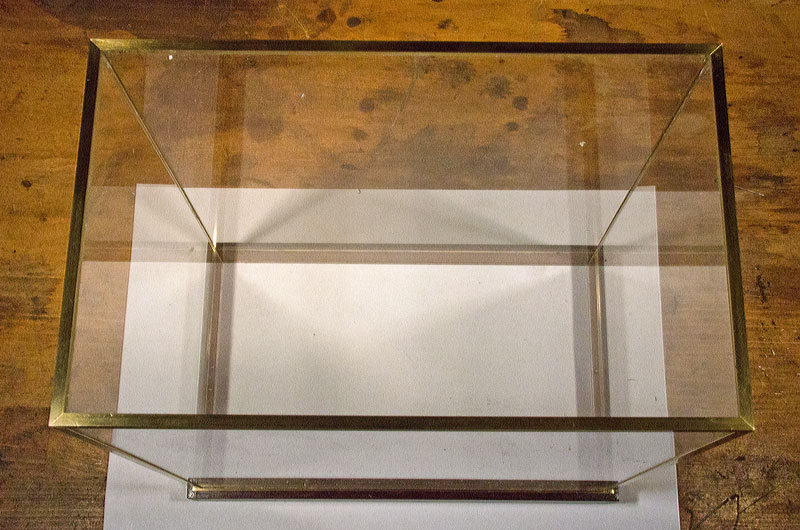
View onto the vitrine
This was the first vitrine I constructed from Plexiglas, rather than silicate glass. As noted before, Plexiglas as a number of advantages and disadvantages compared to mineral glass. An advantage certainly is its shock resistance and that it can be worked easily at home. A big disadvantage is its low scratch resitance and one has to take extra care during construction. Thus a working over of the brass profiles once glued on is rather tricky.
Plexiglas can be glued, or rather chemically welded, almost invisibly. However, the recommende glue (Acrifix 90) has a rather short open time, which makes adjusting the parts with the necessary precision quite tricky. Also the dosage of the glue was difficult. Any sequeezed out glue is impossible to remove without damage to the Plexiglas panels.
If I compare the most recent job, with the vitrines I built in the past from mineral glass, I am not as happy with my result. Perhaps I will return to mineral glass in the future.
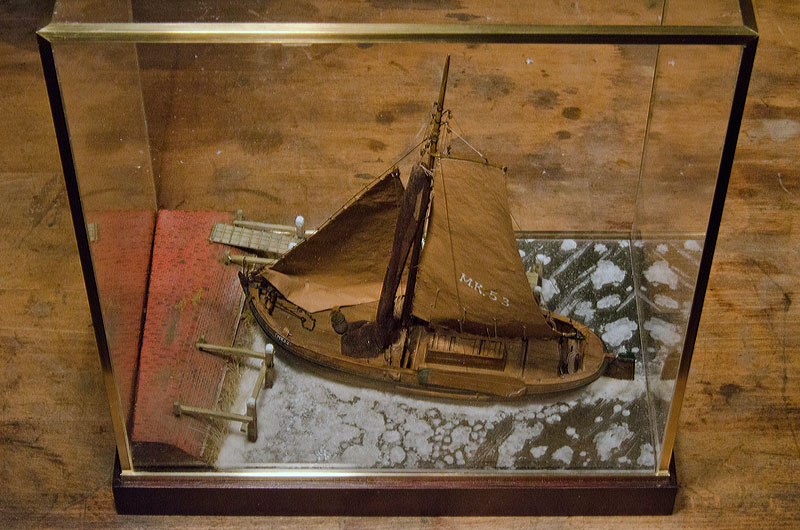
Vitrine and model united provisionally
wefalck
***
The edges of the vitrine are to be covered by L-shaped brass profiles. These are cut to length a bit longer than needed and then the mitre is ground on. In order not to let the sanding disc work too much, I pre-cut the mitre rough with a cutter. My first investment into machinery in the mid-1980s was the purchase of a PROXXON pillar drill. It served me well ever since, not only as a drilling machine, but also as disc sander and (occasionally) as a wood lathe. At that time a longer pillar, a tool rest, a sanding disc/face-plate and a revolving centre were available as extras. The tool rest has a mitre guide. Together with a grind stone, I also used it to shape and sharpen lathe tools.
With a sanding disc one can grind the mitres very precisely.
Grinding of the mitres into the brass L-profiles
For a good fit, a certain sequence of fitting the brass profiles is advisable. First the parts for the top are roughly cut to length and the mitres ground on at both ends. Then two profiles are mated in one corner and, say, part 1 taped down with Sellotape. Part 2 and 3 are mated at the next corner and part 3 taped down. Next part 2 can be ground to an exact fit between part 1 and 3. One continues with mating part 3 and 4 in the next corner, and so forth. The brass profiles at the bottom, that sit on the wood, are fitted in the same way.
Prepared brass profiles
The brass is ground finely, polished with steelwool (0000), and then degreased with white spirit. The profiles are now glued on one by one. For this I use a clear general purpose glue (German brand: UHU Alleskleber). Until the glue is set, the profiles are taped down again.
Mitred corner at the top of vitrine
The four uprights are the last parts to go on. They are roughly cut to length and the mitres are ground on at one side. The exact fitting is done at the square end. Here we only need to fit one edge. When grinding on the mitres, one can also compensate slight unevenness of the other mitres and thus achieve a perfect fit.
View from below showing how the parts fit together
View onto the wooden frame and brass edging
View onto the vitrine
This was the first vitrine I constructed from Plexiglas, rather than silicate glass. As noted before, Plexiglas as a number of advantages and disadvantages compared to mineral glass. An advantage certainly is its shock resistance and that it can be worked easily at home. A big disadvantage is its low scratch resitance and one has to take extra care during construction. Thus a working over of the brass profiles once glued on is rather tricky.
Plexiglas can be glued, or rather chemically welded, almost invisibly. However, the recommende glue (Acrifix 90) has a rather short open time, which makes adjusting the parts with the necessary precision quite tricky. Also the dosage of the glue was difficult. Any sequeezed out glue is impossible to remove without damage to the Plexiglas panels.
If I compare the most recent job, with the vitrines I built in the past from mineral glass, I am not as happy with my result. Perhaps I will return to mineral glass in the future.
Vitrine and model united provisionally
wefalck
Eberhard
Former chairman Arbeitskreis historischer Schiffbau e.V. (German Association for Shipbuilding History)
--------------------------------------------------------------------------------------------------------------------------------------------------------------------------------------------
Former chairman Arbeitskreis historischer Schiffbau e.V. (German Association for Shipbuilding History)
--------------------------------------------------------------------------------------------------------------------------------------------------------------------------------------------
-
JIM BAUMANN
- Posts: 5678
- Joined: Mon Jan 10, 2005 5:30 pm
- Location: Nr Southampton England
Re: Zuiderzee-Botter
I am a fan of 'proper' glass... visual clarity and longevity ( without dropping!)
nevertheless --fine quality workmanship on the brasswork !!
JIM B
nevertheless --fine quality workmanship on the brasswork !!
JIM B
....I buy them at three times the speed I build 'em.... will I live long enough to empty my stash...?
http://www.modelshipgallery.com/gallery ... index.html
IPMS UK SIG (special interest group) www.finewaterline.com
http://www.modelshipgallery.com/gallery ... index.html
IPMS UK SIG (special interest group) www.finewaterline.com
-
wefalck
- Posts: 2079
- Joined: Wed Sep 28, 2011 12:04 pm
- Location: Paris
- Contact:
Re: Zuiderzee-Botter
Actually, Plexiglas GS, the original cast one, rather than their cheaper XT, the extruded one (and similar acrylics by other manufacturers), has glass-like properties. If you weren't told, it would be difficult to tell the difference in the first instance.
wefalck
wefalck
Eberhard
Former chairman Arbeitskreis historischer Schiffbau e.V. (German Association for Shipbuilding History)
--------------------------------------------------------------------------------------------------------------------------------------------------------------------------------------------
Former chairman Arbeitskreis historischer Schiffbau e.V. (German Association for Shipbuilding History)
--------------------------------------------------------------------------------------------------------------------------------------------------------------------------------------------
-
LE BOSCO

- Posts: 2261
- Joined: Thu Aug 27, 2009 11:05 am
- Location: Paris France
Re: Zuiderzee-Botter
beautiful realization wefalk ! ship and showcase ,welle done
I like it
Nicolas
I like it
Nicolas
-
silvershadow

- Posts: 283
- Joined: Mon Nov 04, 2013 2:17 am
- Location: _/\/�����\/\_ Cape Town
Re: Zuiderzee-Botter
OMG, you have some serious skill, awesome craftsmanship and superb talent as usual!!!!!!
Jacques
_________________
Currently working on:
1/350 CVN 65 - Project Enterprise
viewtopic.php?f=59&t=210966
_________________
Currently working on:
1/350 CVN 65 - Project Enterprise
viewtopic.php?f=59&t=210966
-
wefalck
- Posts: 2079
- Joined: Wed Sep 28, 2011 12:04 pm
- Location: Paris
- Contact:
Re: Zuiderzee-Botter
I realise that I haven't posted any updates for a while. Well, mainly because not so much happened in the last few months, being 'distracted' by a workshop re-organisation and make some more machine tools.
******
The crew of the botter also consists usually of a boy, often a young relative of the master or the mate. The set of Preiser figurines used also comprises a smart hotel bell-boy, who now has to get used to much lesser sweet life in the rough outfit of a fisherman. Instead of carrying the hat-box of an elegant lady he now carries to freshwater back to the boat in two buckets suspended from a joke.
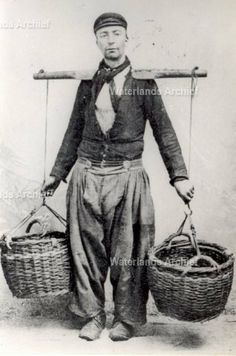
Volendam fisherboy carrying a joke (� http://www.geheugenvannederland.nl)
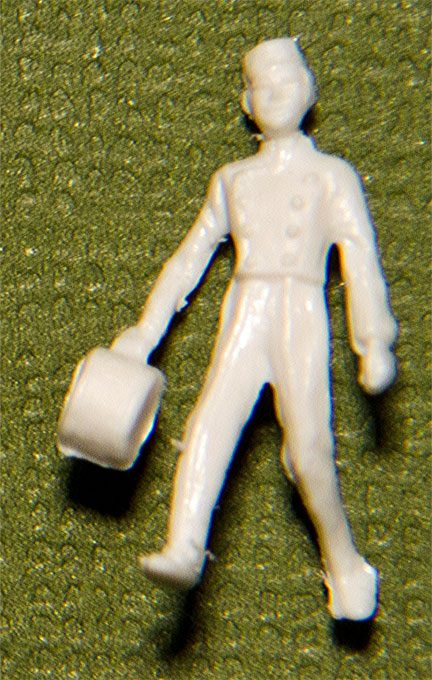
The original Preiser figurine of a bell-boy
The Preiser figurine was worked over by carving and by adding details in Milliput clay, such as the typical wide Marker �knicker-bockers� and the clogs. The spencer-like jacket remained almost unaltered. The joke was carved from a strip of phenolic resin.
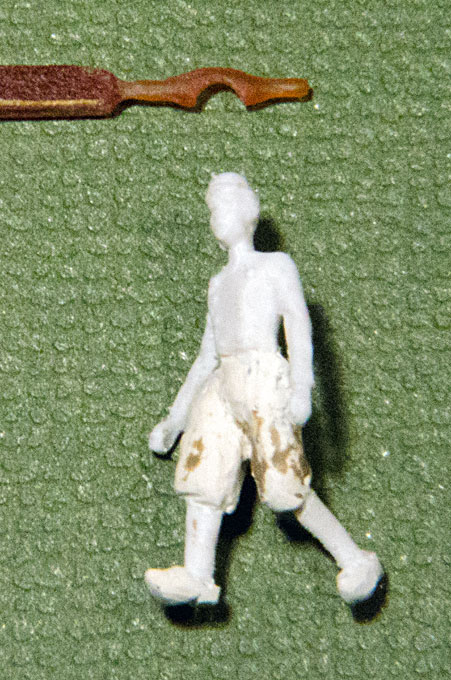
The joke
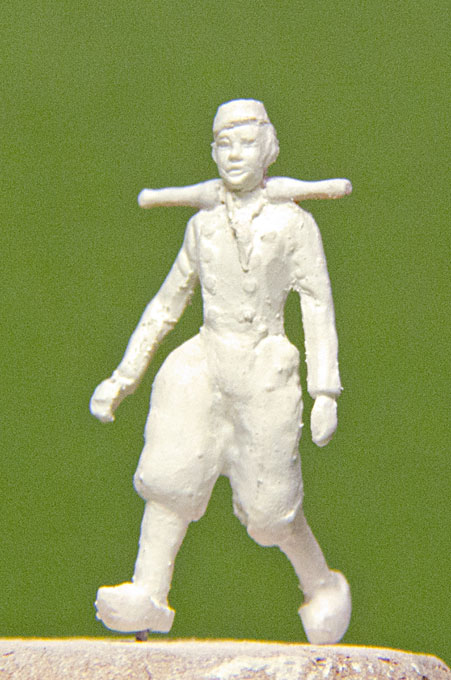
The boy in base-coat
The figure was given a base coat in white acrylics. The macro-photo shows in frightening clarity all the imperfections. When you hold the figure in your hand in normal viewing distance it actually doesn�t look too bad. Still, it has to be worked over at various places.
BTW, the figurine is about 15 mm high.
******
The crew of the botter also consists usually of a boy, often a young relative of the master or the mate. The set of Preiser figurines used also comprises a smart hotel bell-boy, who now has to get used to much lesser sweet life in the rough outfit of a fisherman. Instead of carrying the hat-box of an elegant lady he now carries to freshwater back to the boat in two buckets suspended from a joke.
Volendam fisherboy carrying a joke (� http://www.geheugenvannederland.nl)
The original Preiser figurine of a bell-boy
The Preiser figurine was worked over by carving and by adding details in Milliput clay, such as the typical wide Marker �knicker-bockers� and the clogs. The spencer-like jacket remained almost unaltered. The joke was carved from a strip of phenolic resin.
The joke
The boy in base-coat
The figure was given a base coat in white acrylics. The macro-photo shows in frightening clarity all the imperfections. When you hold the figure in your hand in normal viewing distance it actually doesn�t look too bad. Still, it has to be worked over at various places.
BTW, the figurine is about 15 mm high.
Last edited by wefalck on Sat Mar 13, 2021 12:59 pm, edited 1 time in total.
Eberhard
Former chairman Arbeitskreis historischer Schiffbau e.V. (German Association for Shipbuilding History)
--------------------------------------------------------------------------------------------------------------------------------------------------------------------------------------------
Former chairman Arbeitskreis historischer Schiffbau e.V. (German Association for Shipbuilding History)
--------------------------------------------------------------------------------------------------------------------------------------------------------------------------------------------
-
NCMac

- Posts: 602
- Joined: Wed Apr 14, 2010 5:41 pm
- Location: North Carolina, USA
Re: Zuiderzee-Botter
I've been watched this build, initially due to its unusual subject, and then for its exceptional quality. Spectacular work, simply stunning techniques and demonstrated skills. I am awed, sir.
Best Regards,
Mac
Best Regards,
Mac
-
wefalck
- Posts: 2079
- Joined: Wed Sep 28, 2011 12:04 pm
- Location: Paris
- Contact:
Re: Zuiderzee-Botter
Thanks
********
The traditional dress of the Volendam people is somewhat different from that of Marken. The men wear long baggy black trousers, which gives them a very distinctive silhouette. The upper body is covered by a shirt and a tight-fitting jacket, which is often of some pale red colour, but can also be black. In winter a sort of pea-jacket may be worn, which is black with blue lining. During the winter a fur-cap is worn.
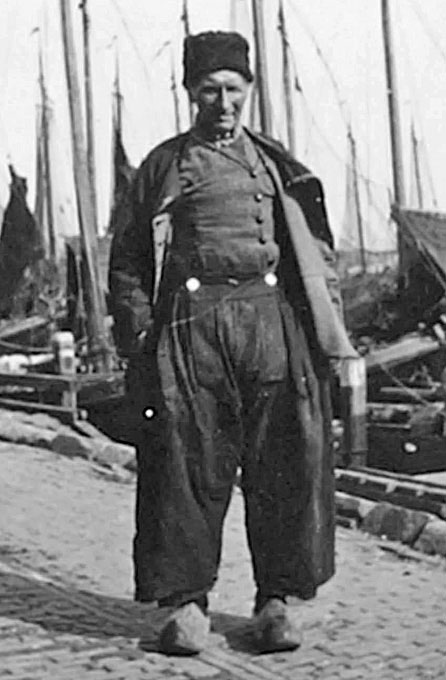
Volendam fisherman in winterdress (� http://www.geheugenvannederland.nl)
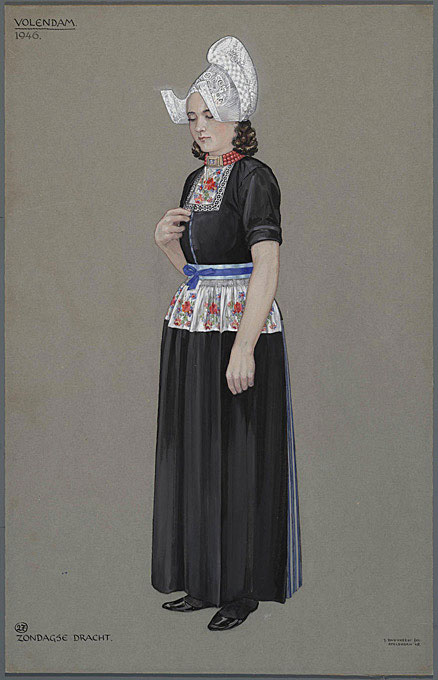
Young woman from Volendam (� http://www.geheugenvannederland.nl)
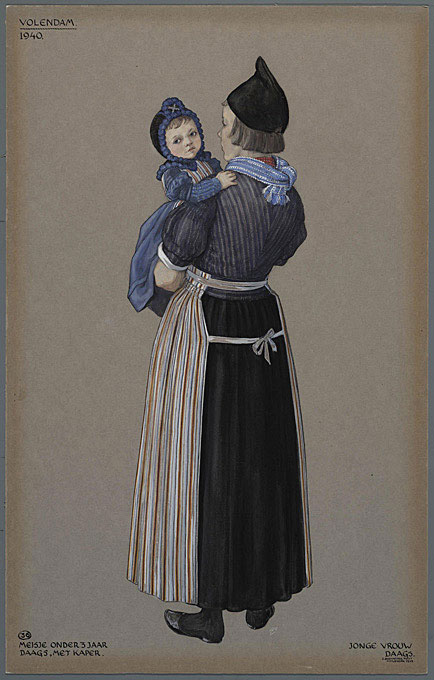
Young woman with baby (� http://www.geheugenvannederland.nl)
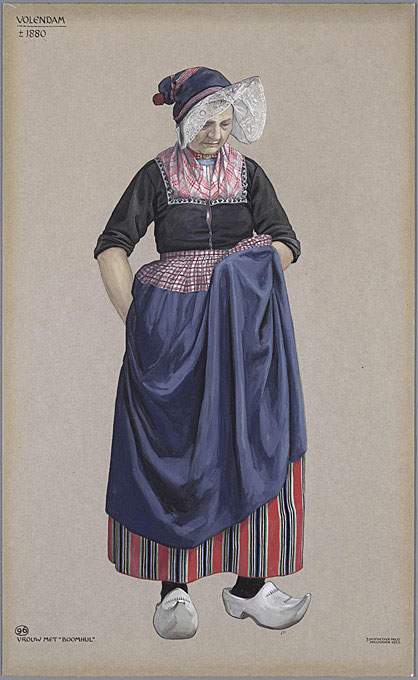
Old woman from Volendam (� http://www.geheugenvannederland.nl)
The women wear long skirts over which a full-length apron is tied. The skirt is either dark and then a white or striped apron is used, or the other way around. The upper body is covered by a tight-fitting jacket under which a shirt is worn, that may be visible at the decollt�e. According to photographs and drawings there are many variations, particularly for work-day dresses. The sleeves of the jacket for adult women were only 3/4 length and pushed back to the elbows. In winter knitted pull-on sleeves may be worn, put the fisherfolks were a hardy folk. The most distinctive feature in the women's dress was the white lace bonnet with starched and turned-up flaps at the sleeve.
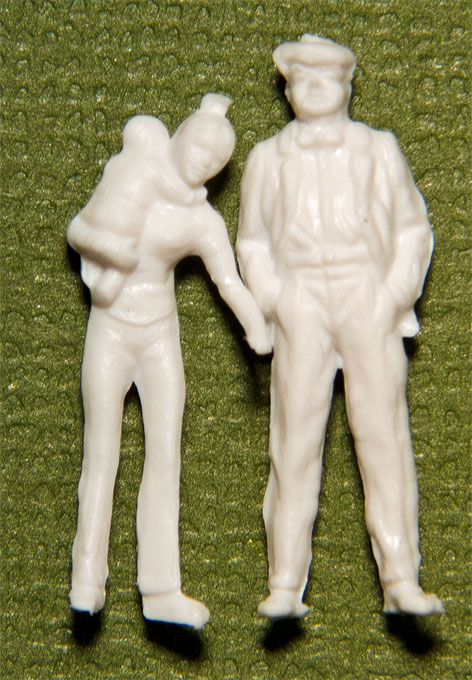
The original Preiser-figurines for the young couple with baby
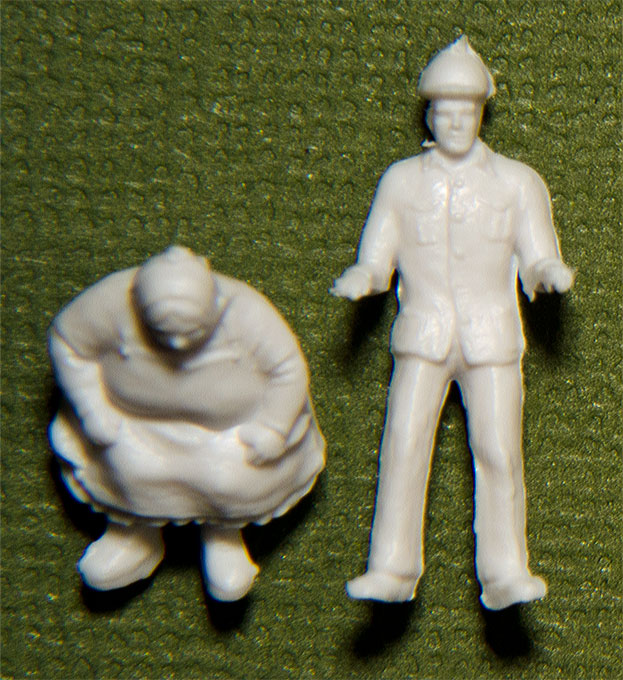
The original Preiser-figurines with the woman on the sleigh
Both sexes wore wooden clogs � the shape of which varied between villages - as everyday footwear, but leather slippers and pantolettes were also used, particular to church on Sunday (BTW, Volendam is an oddity, being a catholic village in a largely protestant country).
Due to the fact that picturesque village and its equally picturesque inhabitants drew many artists and tourists from the late 19th onward, the Volendam costume became the best known and 'typical' Dutch folk costume.
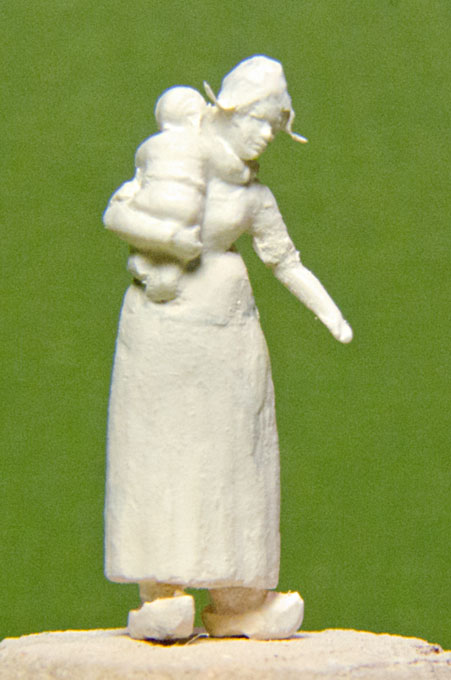
The young mother from Volendam in base-coat
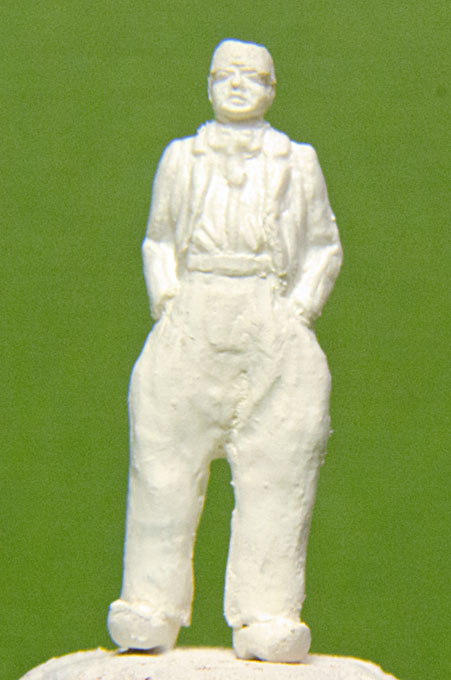
The young father from Volendam in base-coat
The first pair of Volendam folks is a young couple that has a stroll on the dyke, while she is carrying their baby. The second pair will be a younger man who pushes an elderly woman (his grandmother ?) on a sleigh across the ice. A quite common and convenient mode of transport in cold winters, as seen on paintings from the time of Brueghel and well into the 20th century on photographs.
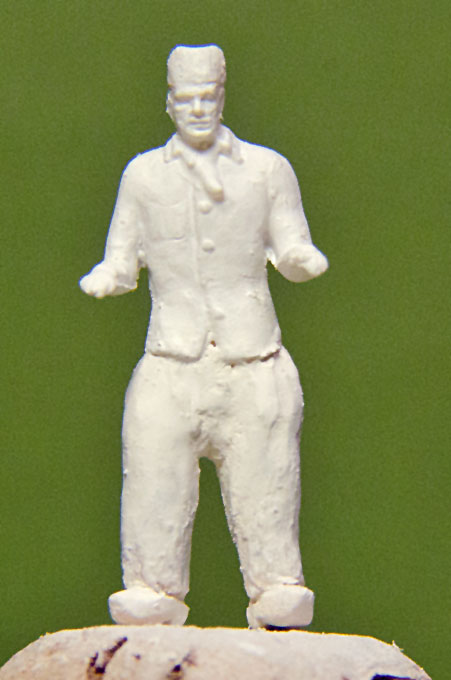
The young Volendam man, who will be pushing the sleigh
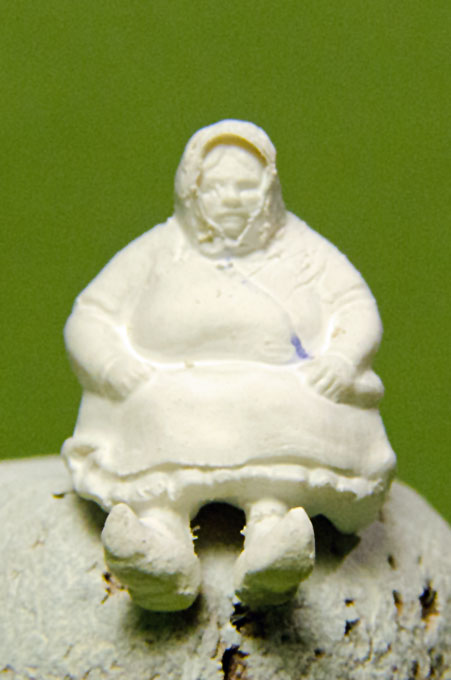
The elderly Volendam woman who will be sitting on the push-sleigh
The close-up photographs reveal again that the figurines still have to worked over and cleaned up.
********
The traditional dress of the Volendam people is somewhat different from that of Marken. The men wear long baggy black trousers, which gives them a very distinctive silhouette. The upper body is covered by a shirt and a tight-fitting jacket, which is often of some pale red colour, but can also be black. In winter a sort of pea-jacket may be worn, which is black with blue lining. During the winter a fur-cap is worn.
Volendam fisherman in winterdress (� http://www.geheugenvannederland.nl)
Young woman from Volendam (� http://www.geheugenvannederland.nl)
Young woman with baby (� http://www.geheugenvannederland.nl)
Old woman from Volendam (� http://www.geheugenvannederland.nl)
The women wear long skirts over which a full-length apron is tied. The skirt is either dark and then a white or striped apron is used, or the other way around. The upper body is covered by a tight-fitting jacket under which a shirt is worn, that may be visible at the decollt�e. According to photographs and drawings there are many variations, particularly for work-day dresses. The sleeves of the jacket for adult women were only 3/4 length and pushed back to the elbows. In winter knitted pull-on sleeves may be worn, put the fisherfolks were a hardy folk. The most distinctive feature in the women's dress was the white lace bonnet with starched and turned-up flaps at the sleeve.
The original Preiser-figurines for the young couple with baby
The original Preiser-figurines with the woman on the sleigh
Both sexes wore wooden clogs � the shape of which varied between villages - as everyday footwear, but leather slippers and pantolettes were also used, particular to church on Sunday (BTW, Volendam is an oddity, being a catholic village in a largely protestant country).
Due to the fact that picturesque village and its equally picturesque inhabitants drew many artists and tourists from the late 19th onward, the Volendam costume became the best known and 'typical' Dutch folk costume.
The young mother from Volendam in base-coat
The young father from Volendam in base-coat
The first pair of Volendam folks is a young couple that has a stroll on the dyke, while she is carrying their baby. The second pair will be a younger man who pushes an elderly woman (his grandmother ?) on a sleigh across the ice. A quite common and convenient mode of transport in cold winters, as seen on paintings from the time of Brueghel and well into the 20th century on photographs.
The young Volendam man, who will be pushing the sleigh
The elderly Volendam woman who will be sitting on the push-sleigh
The close-up photographs reveal again that the figurines still have to worked over and cleaned up.
Eberhard
Former chairman Arbeitskreis historischer Schiffbau e.V. (German Association for Shipbuilding History)
--------------------------------------------------------------------------------------------------------------------------------------------------------------------------------------------
Former chairman Arbeitskreis historischer Schiffbau e.V. (German Association for Shipbuilding History)
--------------------------------------------------------------------------------------------------------------------------------------------------------------------------------------------
-
wefalck
- Posts: 2079
- Joined: Wed Sep 28, 2011 12:04 pm
- Location: Paris
- Contact:
Re: Zuiderzee-Botter
The Marker fisherboy also needed a couple of wooden buckets to carry suspended from the joke. These were turned from clear Plexiglas and only hollowed down to the assumed water-level. The buckets are suspended from rope made from fly-tying yarn on my own ropery.
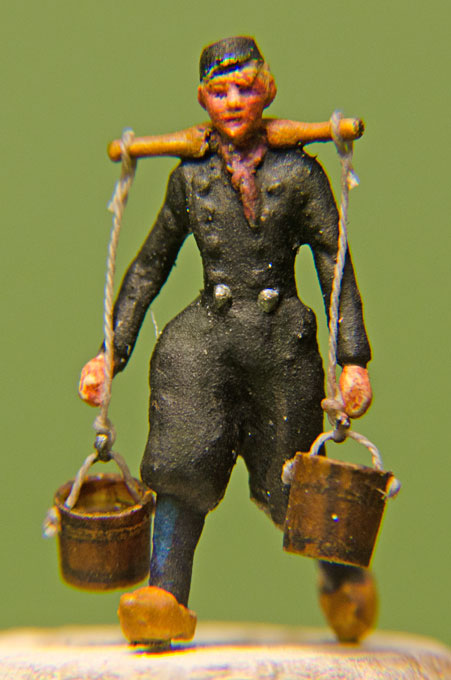
The painted fisherboy
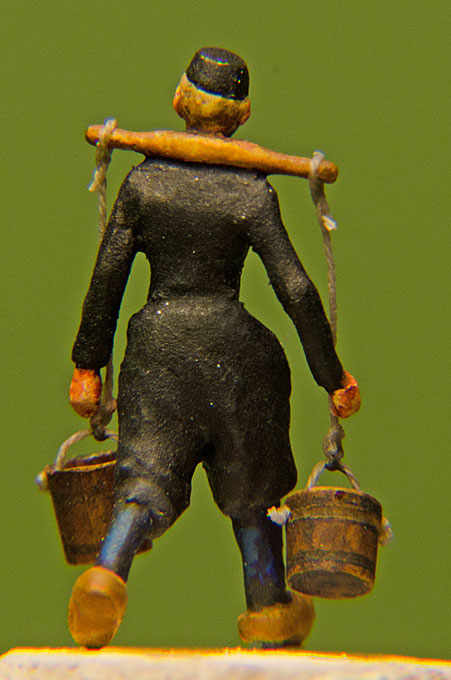
The painted fisherboy
The painting was carried out in Schmincke AeroColour, Vallejo and Prince August acrylic paints. Some of these paints are meant for application by airbrush, but give nice washes, when applied by brush. Also the uncovered parts of the bodies, such as the faces were painted in acrylics. In the past, I used artists� oils on 1:35 scale figurines successfully, but it didn�t work here. Perhaps the oil paints had been oxidised already somewhat, considering that they already spent several decades in their respective tubes. Sinces the heads are only about 2 mm high, painting the faces was quite a challenge.
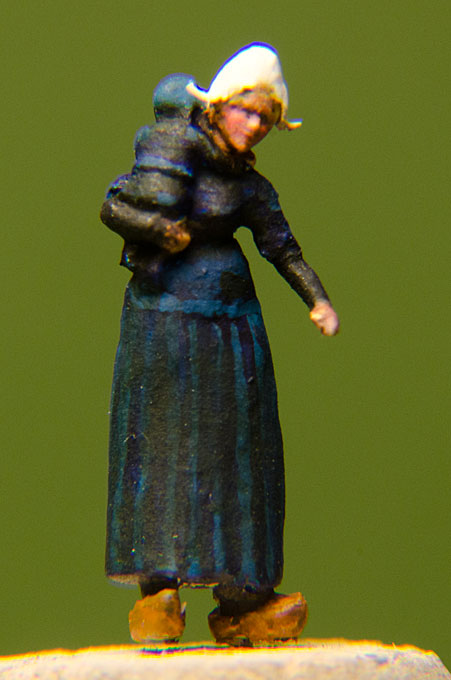
The painted young mother from Volendam
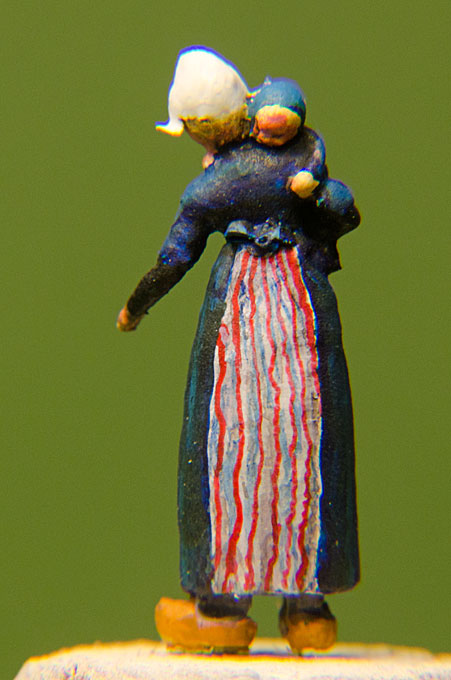
The painted young mother from Volendam
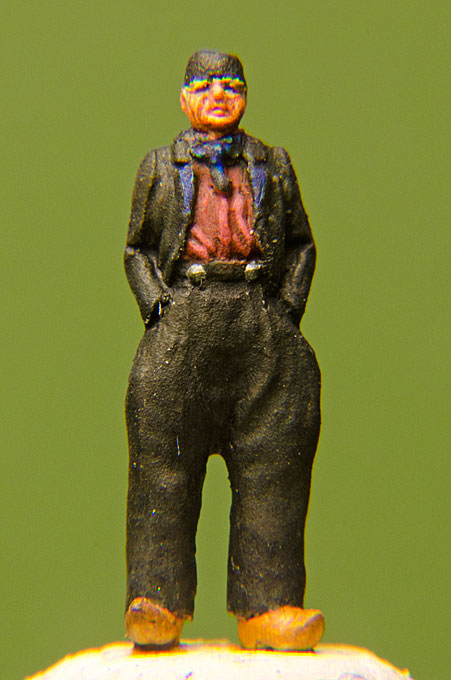
The painted young father from Volendam
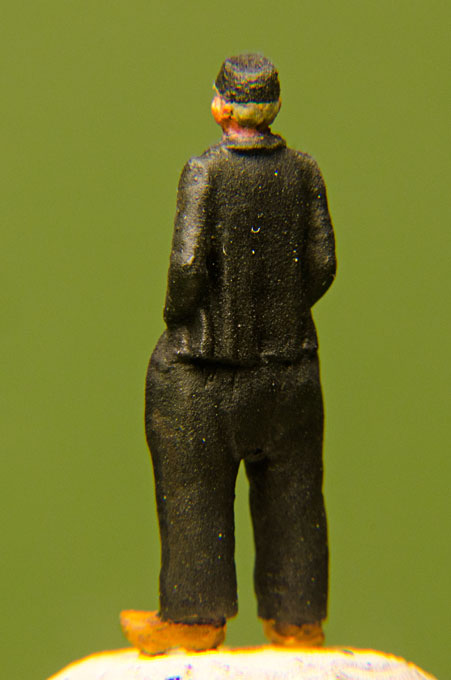
The painted young father from Volendam
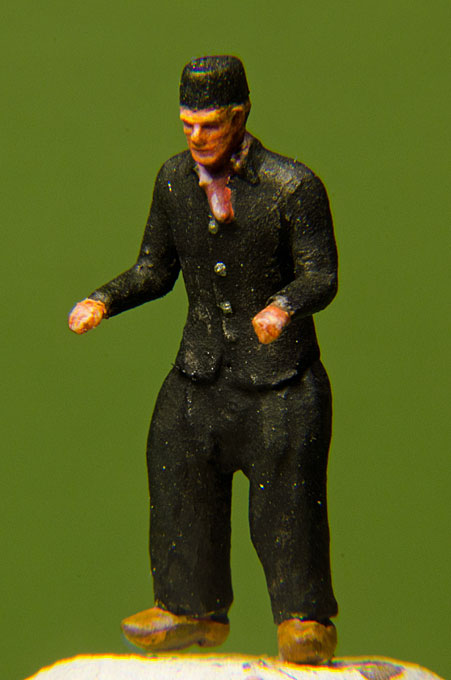
The painted man pushing a sleigh from Volendam
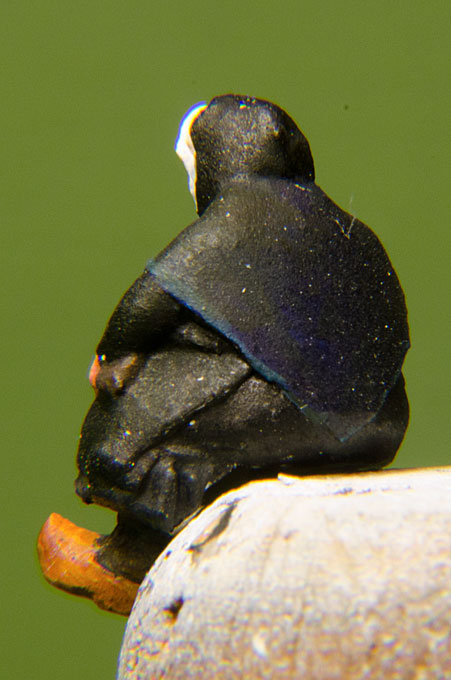
The painted old woman on a sleigh from Volendam
For the last two figurines a push-sleigh was fashioned from 0,5 mm polystyrene sheet, based on the examples from the Zuiderzeemuseum in Enkhuizen. Such push-sleighs were cobbled together by there owner according to their needs, to be used to transport goods, equipment for ice-fishing and also for transporting people. They can already be seen on Dutch paintings from the 16th century. In fact, a winter-themed exhibition in 2009 in the museum gave me the idea for this scenic setting..
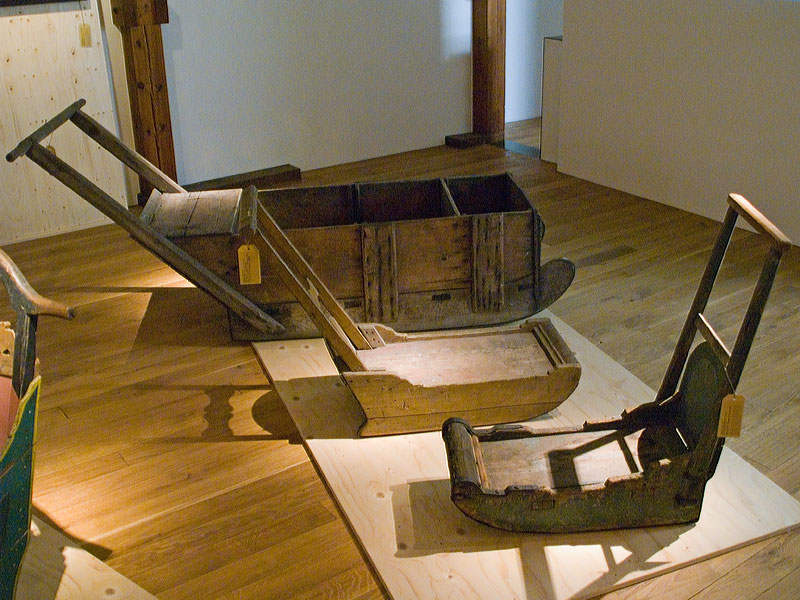
Push-sleighs in the Zuiderzeemuseum Enkhuizen
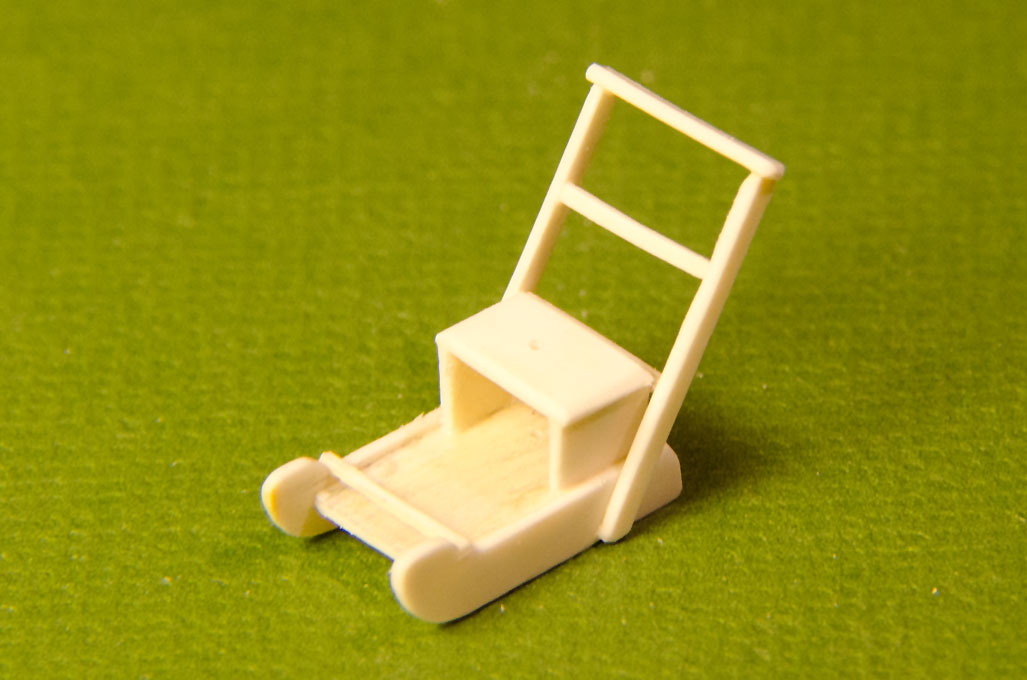
The unpainted push-sleigh
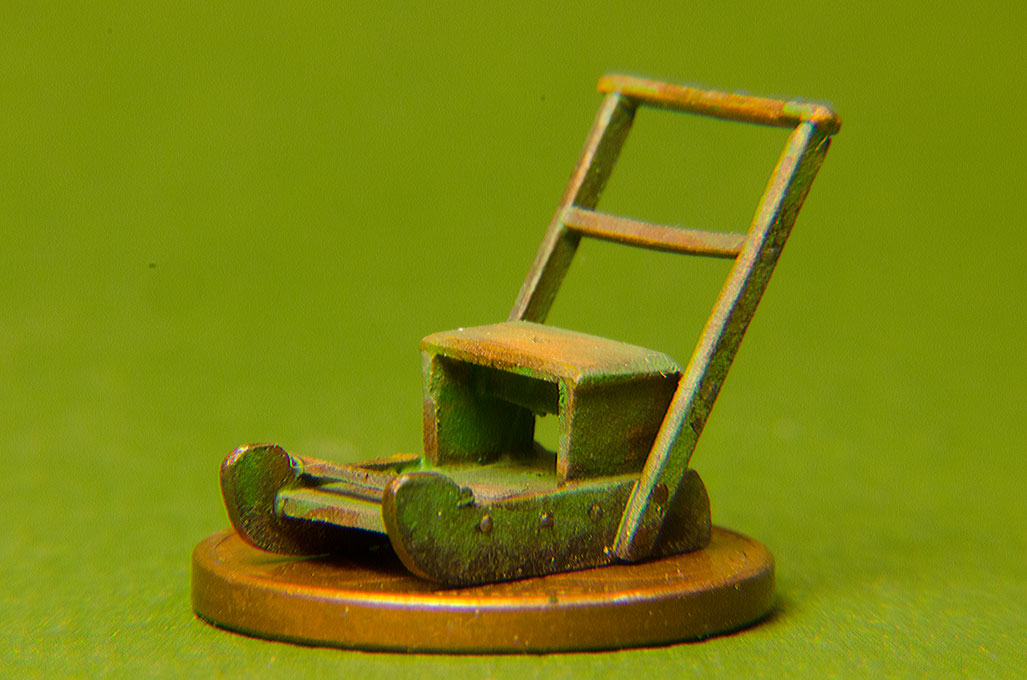
The painted push-sleigh sitting on a 1 Euro-Cent coin
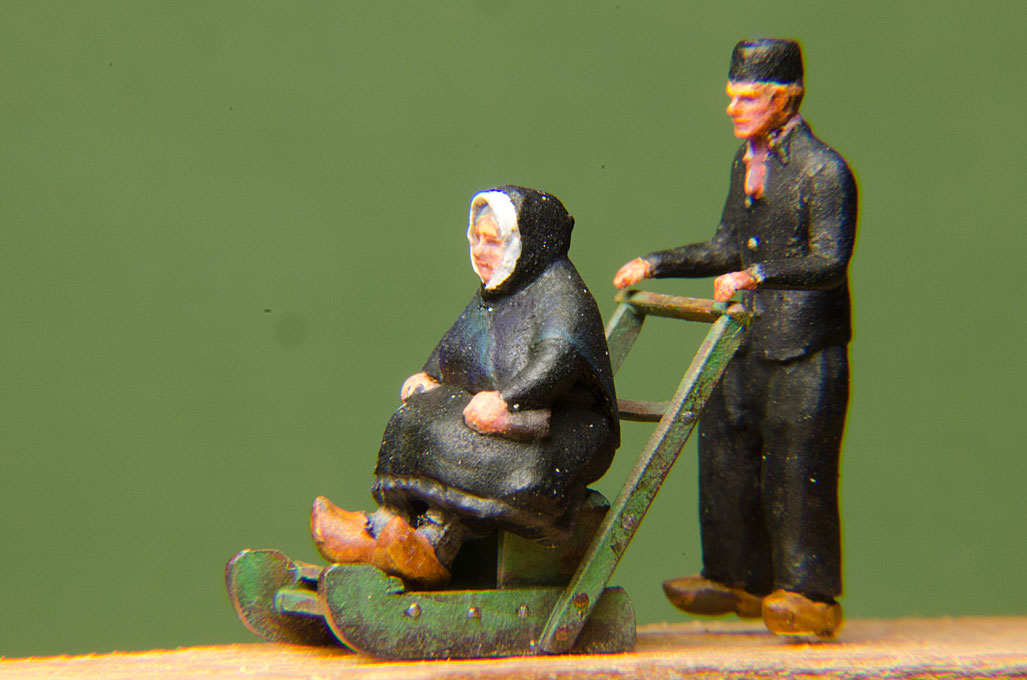
The push-sleigh in use
As always macro-photos show in unforgiving and glaring clarity all imperfections and the dust that had already settled on the figurines
Looking at them from a normal viewing distance of 20 to 30 centimetres is much kinder to them �
Just to remind you, the figurines stand about 18 mm tall !
The painted fisherboy
The painted fisherboy
The painting was carried out in Schmincke AeroColour, Vallejo and Prince August acrylic paints. Some of these paints are meant for application by airbrush, but give nice washes, when applied by brush. Also the uncovered parts of the bodies, such as the faces were painted in acrylics. In the past, I used artists� oils on 1:35 scale figurines successfully, but it didn�t work here. Perhaps the oil paints had been oxidised already somewhat, considering that they already spent several decades in their respective tubes. Sinces the heads are only about 2 mm high, painting the faces was quite a challenge.
The painted young mother from Volendam
The painted young mother from Volendam
The painted young father from Volendam
The painted young father from Volendam
The painted man pushing a sleigh from Volendam
The painted old woman on a sleigh from Volendam
For the last two figurines a push-sleigh was fashioned from 0,5 mm polystyrene sheet, based on the examples from the Zuiderzeemuseum in Enkhuizen. Such push-sleighs were cobbled together by there owner according to their needs, to be used to transport goods, equipment for ice-fishing and also for transporting people. They can already be seen on Dutch paintings from the 16th century. In fact, a winter-themed exhibition in 2009 in the museum gave me the idea for this scenic setting..
Push-sleighs in the Zuiderzeemuseum Enkhuizen
The unpainted push-sleigh
The painted push-sleigh sitting on a 1 Euro-Cent coin
The push-sleigh in use
As always macro-photos show in unforgiving and glaring clarity all imperfections and the dust that had already settled on the figurines
Looking at them from a normal viewing distance of 20 to 30 centimetres is much kinder to them �
Just to remind you, the figurines stand about 18 mm tall !
Last edited by wefalck on Sat Mar 13, 2021 12:57 pm, edited 1 time in total.
Eberhard
Former chairman Arbeitskreis historischer Schiffbau e.V. (German Association for Shipbuilding History)
--------------------------------------------------------------------------------------------------------------------------------------------------------------------------------------------
Former chairman Arbeitskreis historischer Schiffbau e.V. (German Association for Shipbuilding History)
--------------------------------------------------------------------------------------------------------------------------------------------------------------------------------------------