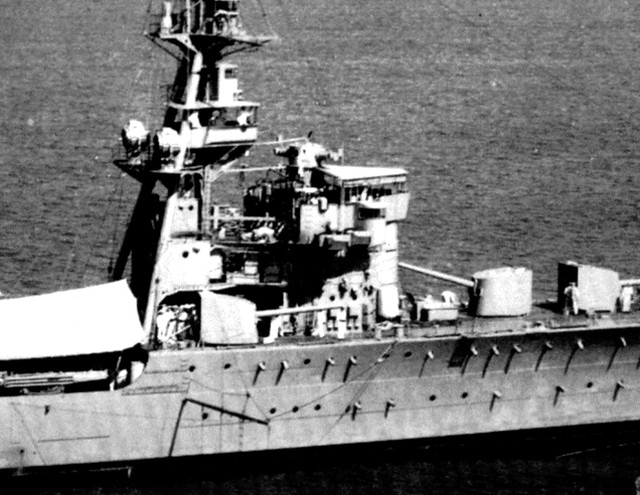
L & W says only that the foremast was shortened, with a single spar. This is true of all the Group II & III 5,500 tonners. While there is no clear photo of Nagara in this rig, attached is one of Yura in this rig.
Hi Dan, this is really an interesting photo - do you have a date attached to it? Will it be from the same period as known photos of Tama and Kiso in a similar camo, i.e. January 1942 (before the start of the actual Aleutian campaign)?
Also what is it stretching from most scuttles? Sleeping matts being ventilated?
I agree that it is an interesting, and rare, clear, photo of an infrequently discussed 5,500 tonner in its prewar fit. Setting aside that Yura did not serve in any of the Aleutian campaigns, the lack of a degaussing cable plus the modified foremast indicates to me that it was probably taken in the 1939-early 1941 timeframe.
Those are scoops that can be attached to the rim of an open porthole, to increase airflow into the interior spaces.
Interesting. I checked the TROM of Yura and it does not mention any trip to "Northern waters" either before the war or later. Neither the seaplane tender in the background seems to help much - the only common presence of Yura and any of this type I found were during the Guadalcanal campaign, which is too late considering the cruiser's fit (and a "strange" area for this type of camouflage, too ).
Here's a question about the 5500 ton cruisers, prompted by reading Squadron's IJN Light Cruisers in Action book. The book quotes various Heavy AA guns fitted late in the war, mentioning 8cm and 4.7 inch guns but I was under the impression that the only heavy AA fitted would be the standard twin 5 inch guns, that a lot of other IJN warships carried.
Am I right and have I spotted some of Squadron's infamous errors?
I fancy making one or more of my IJN Light Cruiser models and the first 2 I'm looking at are Nagara and Isuzu. Both kits are Tamiya 1/700 kits.
Regarding Nagara, I'm looking at her TROM on the Nihon Kaigun site and it states in late January 1944, she docked in Maizuru for a major refit, which included replacing 2 5.5 inch guns with a twin 5 inch, extra 25mm AA, revised torpedo tubes etc etc. My question is about the 25mm AA fit, the TROM states she had 2 triple 25mm, 6 twin 25mm and 4 single 25mm guns. The kit agrees in terms of triples and twins but has 8 single guns. So if the TROM is correct, where were the singles mounted? The kit has singles on a platform at the front of the bridge and a pair of singles on platforms in front of each funnel.
I have a similar question about Isuzu. Her TROM says she had 38 25mm guns after conversion to an AA cruiser but the kit has 11 triples. What combination of mounts did she have on completion of her conversion? Also she was converted at Yokohama and I remember reading which of the 4 main Greys Yokohama used but I can't remember where I read it, so which Grey would she have been painted in?
I fancy making one or more of my IJN Light Cruiser models and the first 2 I'm looking at are Nagara and Isuzu. Both kits are Tamiya 1/700 kits.
Regarding Nagara, I'm looking at her TROM on the Nihon Kaigun site and it states in late January 1944, she docked in Maizuru for a major refit, which included replacing 2 5.5 inch guns with a twin 5 inch, extra 25mm AA, revised torpedo tubes etc etc. My question is about the 25mm AA fit, the TROM states she had 2 triple 25mm, 6 twin 25mm and 4 single 25mm guns. The kit agrees in terms of triples and twins but has 8 single guns. So if the TROM is correct, where were the singles mounted? The kit has singles on a platform at the front of the bridge and a pair of singles on platforms in front of each funnel.
I have a similar question about Isuzu. Her TROM says she had 38 25mm guns after conversion to an AA cruiser but the kit has 11 triples. What combination of mounts did she have on completion of her conversion? Also she was converted at Yokohama and I remember reading which of the 4 main Greys Yokohama used but I can't remember where I read it, so which Grey would she have been painted in?
thanks
Mike
Can anyone help me at all?
Also, does anyone think it might be good to split this section in 2? 1 for the 5500 ton classes and one for the smaller classes and one offs? (Oyodo, Yubari, Tenryu and Katori classes).
Dan K wrote:L & W says only that the foremast was shortened, with a single spar. This is true of all the Group II & III 5,500 tonners. While there is no clear photo of Nagara in this rig, attached is one of Yura in this rig.
According to her TROM, this was taken in 1938. No other info is known as to why she carried this scheme at this time, or if any other ships were camouflaged like this.
a colleque of mine is building IJN Tama. We have a dilema.. Here is a model of Tama:
What's the purpose of this things (I don't know the name...sorry) on the sides of main superstructure? with brass circulars....
on real picture (here is IJN Kuma) I cannot find them....
I don't know what they are for certain, but there is a similar grouping on the Fletcher class on the starboard side superstructure bulkhead under the forward stack, and Tokkotai was asking about some similar ones on the Akagi island for his diorama.
According to another forum, the ones on the Fletcher class are steam line control valves, I'm guessing as a remote damage control station in case a steam line ruptured in one of the engine rooms. The plan book from the Floating Drydock identifies them only as "valve wheel." For a long time I thought they were fuel control valves so they could direct fuel to various tanks from a single supply input hose from a tanker. It will be interesting if someone with more definitive information can reveal their true purpose.
Here's a wild guess. I do suspect the wheels are damage control features.
They could be magazine flooding controls.
The steam line control idea is also a possibility. On smaller ships where the engineering spaces occupy everything below the main deck it is necessary to place the emergency shutoff controls somewhere above the main deck.
They could be fire suppression system controls.
Phil
A collision at sea will ruin your entire day. Aristotle

 ).
).