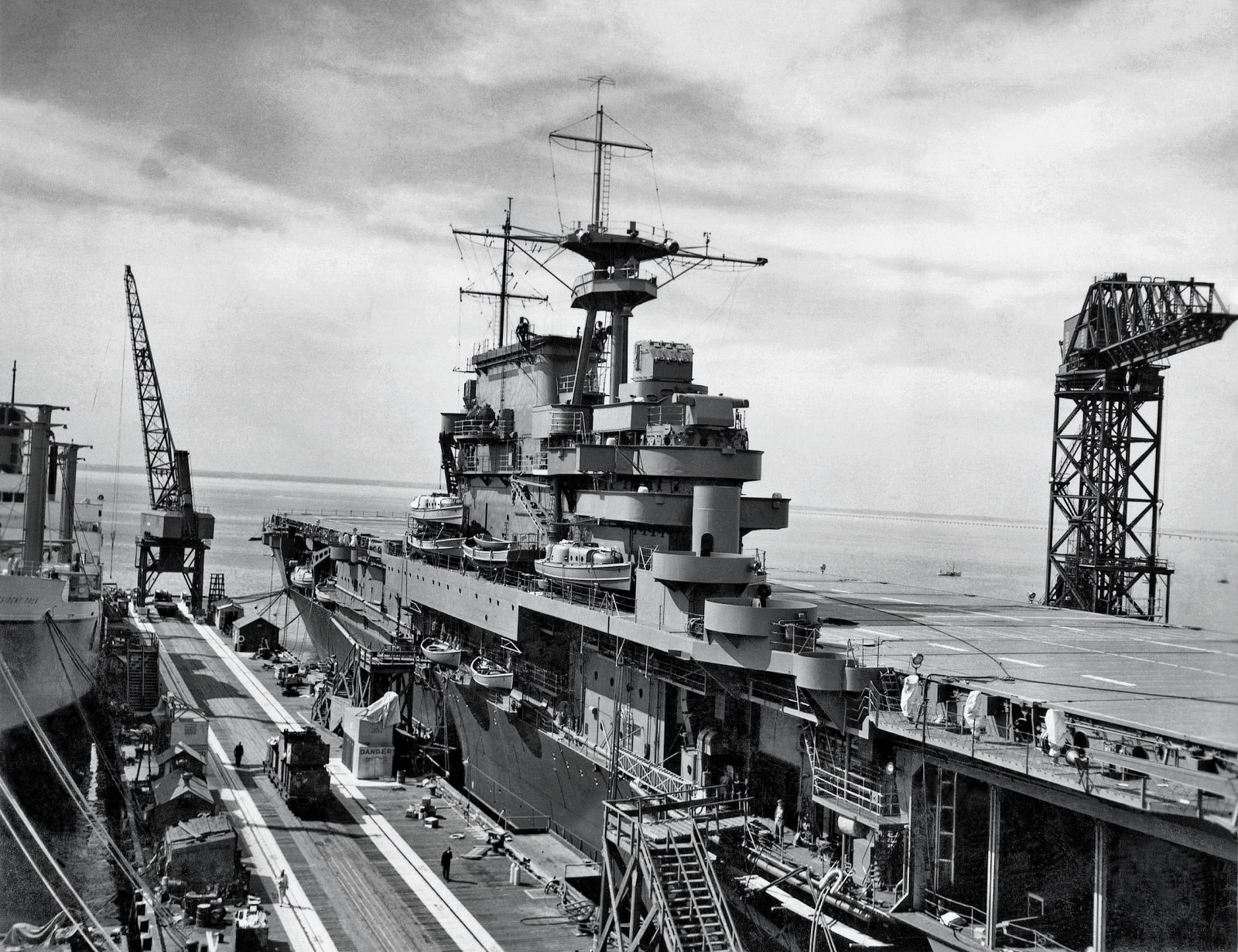
Dick J wrote:A photo of Yorktown at Norfolk in late '41 clearly shows the top to be a lighter color than the rest of the superstructure. (The photo can be seen in the book That Gallant Ship.) However, in this famous photo of the ship at the end of May of '42 ( http://www.navsource.org/archives/02/020503.jpg ) there is no evidence of a color differentiation. In my opinion, the top was repainted to match the rest of the upperworks. But the question is when?
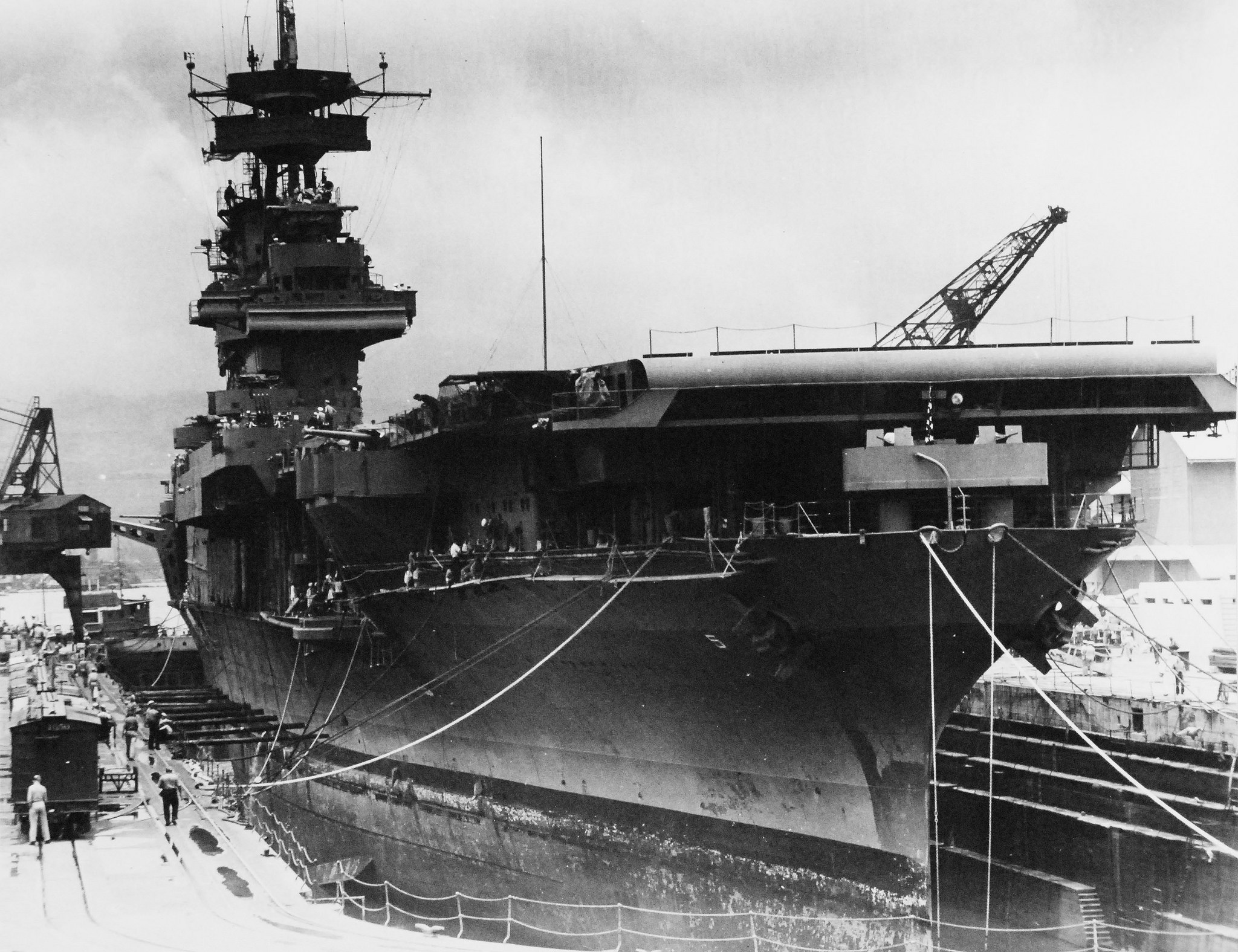
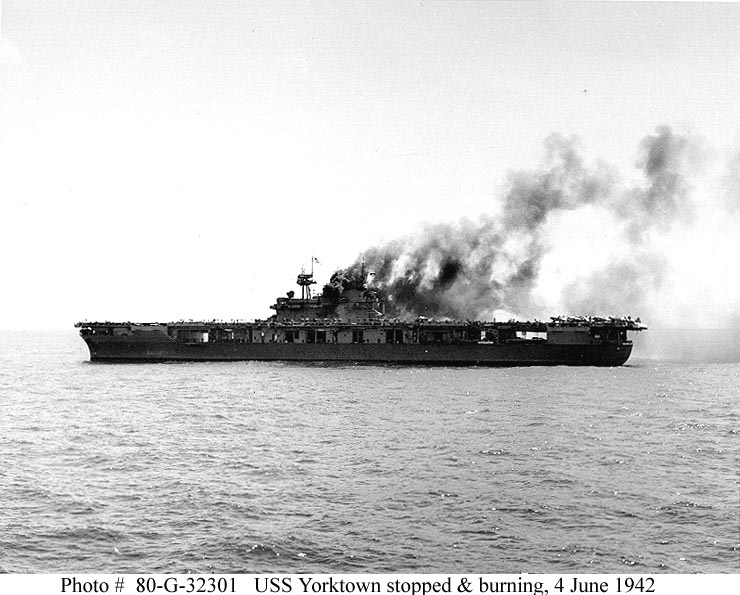
In the Yorktown shot in the Pearl drydock, I notice the demarcation between the 5-O and 5-S is rather less distinct than we see it in other shots - this one of her burning for example: http://www.navsource.org/archives/02/020524.jpg
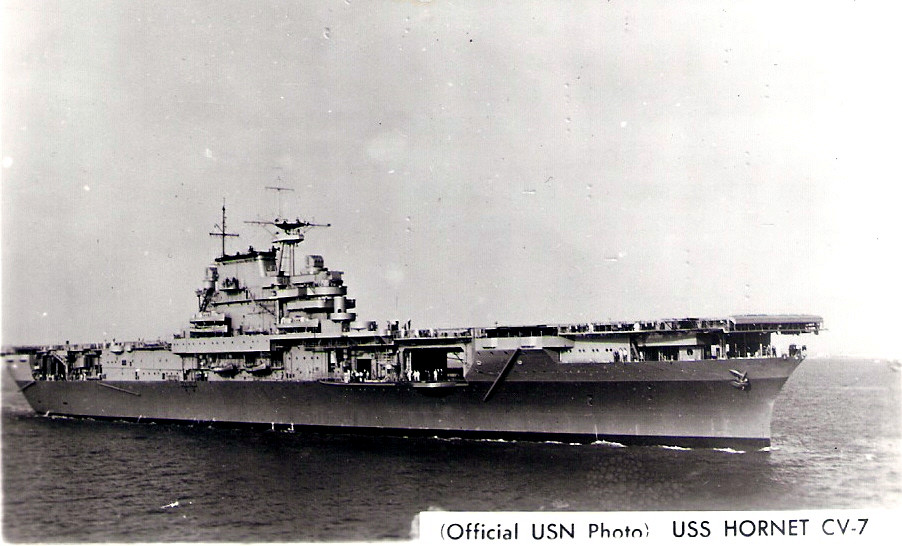
With that 5-S/5-O demarcation so faint in the Pearl drydock photo, and given how hard it is to pick out the 5-O/5-H demarcation in most of the Hornet photos under various lighting conditions... is there justification to paint it all 5-O since you can't tell it isn't? Sure, it's plausible. Proof that it was repainted? Not from that photo alone, I don't think.
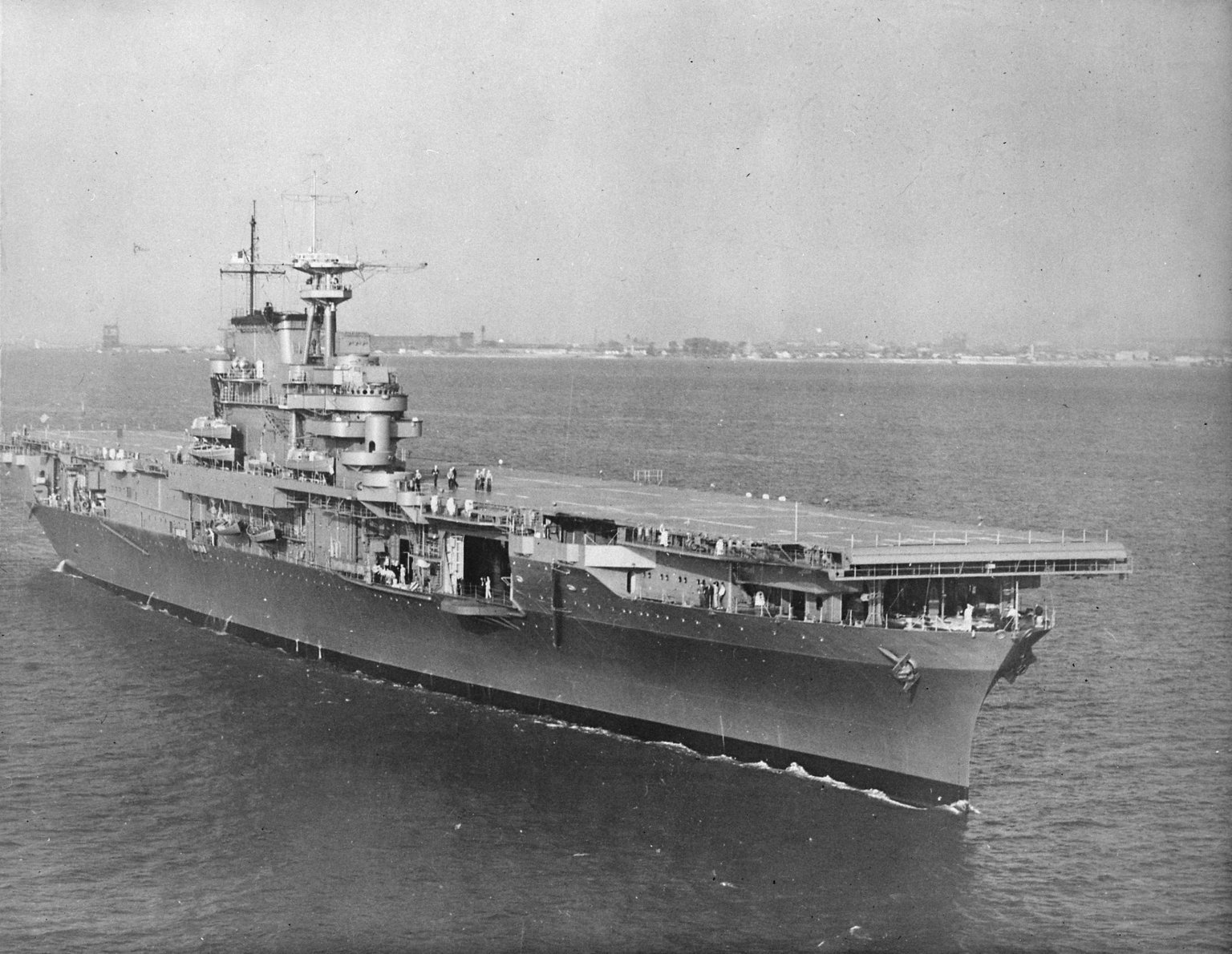
Here's Yorktown (from earlier in this thread) entering Pearl just prior to Midway. Yorktown in background, Enterprise in foreground:
I don't see any differentiation in the fighting top here, either.
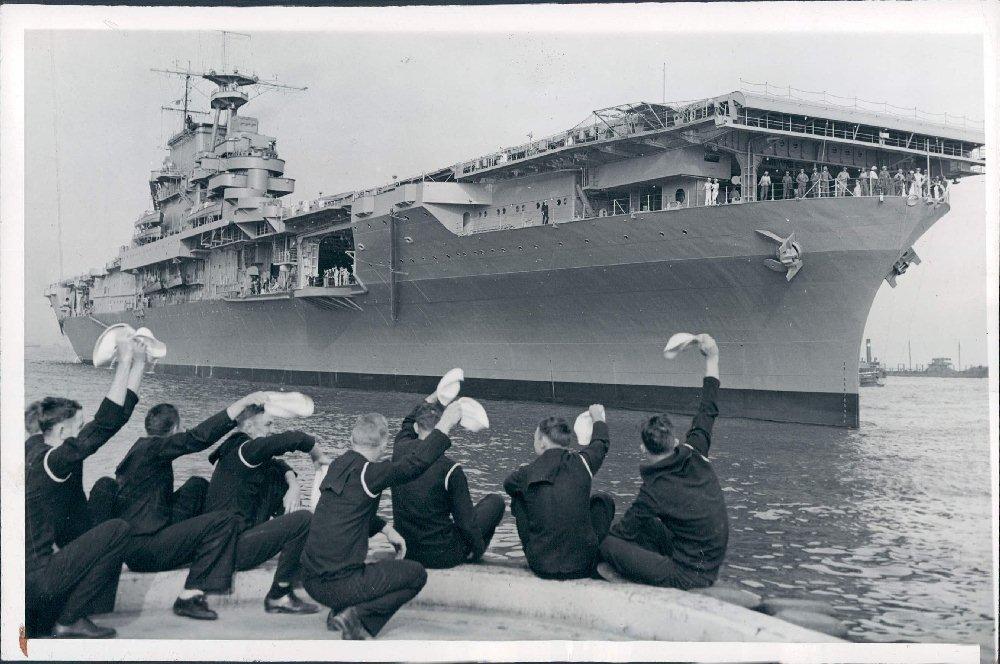
There's also a very large photo of Yorktown entering Pearl, shot from a small boat, with the tug Hoga in the foreground. That may show this even better. But, as has been stated, if the fighting top isn't lighter, then WHEN did they change it?
We like our history sanitized and theme-parked and self-congratulatory, not bloody and angry and unflattering. - Jonathan Yardley
Looking at the photo that Devin posted of Yorktown entering PH above, it appears that Enterprise's CXAM is noticeably lighter than the rest of the ship. Could it possibly be 5H?
I don't see a difference in color between Yorktown's fighting top and the rest of the ship above the hangar, but her CXAM is also much lighter than her fighting top. I used to believe that it was just a reflection on the CXAM frame due to lighting, but now I'm beginning to wonder if it too may be 5H.
i wish the angle of CV5 CXAM in the PH dry dock picture was where we could get a better look.
I'm convinced that the difference is indeed sunlight reflection. Remember, there would be no painting done of radar equipment like that on a regular basis. You paint it, it doesn't work as it should. Even when I was in the Navy working on fire control directors, we'd paint the direct bases on a regular basis, but never the radar reflector dish or waveguides. I wouldn't be surprised if the CXAM apparatus themselves, the "bed springs" weren't unpainted aluminum or something similar. And if they were painted, it would have been prior to the time of install and not changed during its lifetime onboard Yorktown.
We like our history sanitized and theme-parked and self-congratulatory, not bloody and angry and unflattering. - Jonathan Yardley
I am very sure the radars on both ships was much lighter. Photos of a Measure 1 CV-6 from November 1941 show the CXAM-1 was very light then too. Whether it was due to the fact that radar antenna should not be painted, or as a camouflage measure designed to fade them into a light background if being observed from the surface at range is open to question. This was the reason the tops above the stack were 5-H in any event. Maybe radar, being secret was much lighter on purpose.
This is just my .02cents. When I zoomed in on the pic Devin posted, I could faintly make out the lattice work on Enterprises radar and it was a lighter almost white color. I lost my copy of 'That Gallant Ship' but I seem to recall a picture of CV-5 that showed the lighter radar. I believe it was close to the same page that showed the drawing that called out the camouflage measure. Just my .02 cents.
So in this PH pic, which I think is prior to Coral Sea, it looks like the CXAM "U" shaped-frame (not talking about the bedspring apparatus) which is in the shadows looks a lot lighter than the fighting top and island.
Sorry guys, got another paint question.... this one has been bothering me for awhile, but you guys may have a simple answer.
In many pics of CV5, the flight deck 'round-downs' (for lack of a better term) and 50cal. positions have always seem much lighter than 5-O. I had always assumed lighting (again) but I'm not sure.
In another cropped section of the CV5 PH pic (I believe taken before Coral Sea), the round-down looks like it could be 5-H as compared to the 5-O and the 5-S as seen in the pic.
Tom, this photo is Yorktown between Coral Sea and Midway. Your picture was taken as she rounded Ford Island just prior to the shot that Devin posted above, when she was headed toward the drydock.
Dick J wrote:Tom, this photo is Yorktown between Coral Sea and Midway. Your picture was taken as she rounded Ford Island just prior to the shot that Devin posted above, when she was headed toward the drydock.
DickJ, yes, your are right. The picture is just prior to Midway. Sorry, been looking at too many CV6 and 5 PH pics this evening!!!
Does anyone have a better detailed picture of the hanger deck catapult than what is shown on the HNSA plans. I think Merit got the horizontal shape right but I question the vertical aspect of it. Looking at what pictures I have, it appears to be two different platforms (a base and a separated catapult platform). Hope I'm not confusing anyone. Also, HNSA's inboard cross section notes a ramp on both sides of the catapult but does not list any dimension for how high it rises from the hanger deck. I would guess 6-12"'s.
Last question and this pertains to the elevators. From what I gather, each elevator is made up from three parts. But when looking at pictures, I only see a fully planked elevator with no separation for the two auxiliary elevators. If I am wrong, should I take it that the auxiliary elevators only purpose was to be a back up for lifting the whole elevator?
(Edited) I made some time for me to play around with HNSA inboard cross section plans with Photoshop. I resized a copy to 1/350 and then cropped the area of the ramp. I came up with a dimension of .0024" in height from hanger deck to top of catapult which, if I am right comes out to some where between 8 and 9 inches. Does this sound right?
Jon -
If you have Steve Wiper's Warship Pictorial #9 YORKTOWN Class Carriers, on page 46 there is a shot of HORNET's hangar deck taken just forward of the hangar deck cat track. You can see in it the bevel of the plate which ramps down from the track to the (cambered) hangar deck proper. Conveniently placed in the picture is a five gallon paint can which appears to be the same height as the hangar deck cat sponson just outside the roller curtain and the ledge just inside the roller curtain. Assuming it is a five gallon can, similar to today's cans, the height of the track id about 8 or so inches just as you said. Blueprints show this ramp and how it fits onto the cambered hangar deck clearly.
There are also several pics of HORNET at the Norfolk Navy Yard in Feb 42 that show a closeup of the outside of the platform / guard - yes it is stepped.
Some people make you happy, then they leave.
Others make you happy when they leave. (apologies to Oscar Wilde if he ever said anything similar, of which there is some doubt . . .)
Here's the photo I was speaking of, and that Tom posted the cropped versions of. I think it's also the photo Tracy posted some years ago. I've upped the fill-light in Photoshop so that the details pop out clearly. I've put a very large version of this shot on the CV5Yorktown.com website, linked http://cv5yorktown.com/yorkpress/wp-con ... /pearl.jpg.
A couple of things I notice looking at this photo once more: the color demarcation of the 5-S and 5-H is quite noticeable on the forward hull, and I do not see any differentiation between the island and the upperworks/fighting top colors, so when I build mine I'll just shoot them the same color. I think the base/structure of the radar is still up in the air, which I'll need to research and see if they did paint the bases at all or not. The round-down, I'd be willing to say it's lighter due to sun reflection.
Finally, on the really large version of the photo, does it look like there's massive streaking and chalking of the 5S below the flight deck? Sure looks like it to me, and that must have been repainted before Midway, as I haven't seen anything that made the paint look in that bad of repair on June 4th.
Attachments
Last edited by Devin on Sat Mar 21, 2015 3:32 pm, edited 1 time in total.
We like our history sanitized and theme-parked and self-congratulatory, not bloody and angry and unflattering. - Jonathan Yardley
Thanks John W. I used to have that Warship Pictorial but somehow it has disappeared just like my copy of 'That Gallant Ship' and a couple of my Gakken books that pertained to the Yamato. Sadly, besides the internet, all I have is the Shipcraft book and The AJ Press Yorktown class Vol 1. for references.
A couple other things I have been researching are the degaussing cable and the shell plating. I believe I have the degaussing cable 90% figured out but trying to get the Merit kit, Paul Budzig's shell plating diagram and the HNSA's plans to match up is a major PIA. Wish I was better with Photo Shop and computers in general.
Thanks Devin.
I do have that pic and I believe that I saved copies of all pictures on your website. BTW, really enjoy your website. I have been going through all 15 pages of this thread and seem to recall (can't recall the page #) some one mentioning life rafts forward of the port crane. Are they just below and to the right of the island at hanger deck level in the picture you posted? I don't see them in the picture taken from a plane or ship off the port bow which leads me to believe they are rafts.
Devin, I am pretty sure they did not take the time to repaint the hull just before Midway. Pearl would probably have replaced the 5S with 5N had that been the case. I am not sure that what you are seeing is chalking. It could be partly sunlight reflecting off the water, an effect I have seen elsewhere.
Jon C Ryckert wrote:
Last question and this pertains to the elevators. From what I gather, each elevator is made up from three parts. But when looking at pictures, I only see a fully planked elevator with no separation for the two auxiliary elevators. If I am wrong, should I take it that the auxiliary elevators only purpose was to be a back up for lifting the whole elevator?
Looking forward to your answers, Jon
Jon, the other guys have covered the hangar deck cat. I am going to tackle the auxiliary elevator. The main elevator is one section wood planked, as you noted. The auxiliary elevator is not a part of it, but a separate platform one level lower at all times. When the main elevator is at flight deck level, the auxiliary elevator rises up from the elevator pit below the hangar deck and forms a platform across the open pit on the hangar deck. When the main elevator drops down from flight deck, the auxiliary elevator simultaneously drops from hangar deck into the elevator pit below the hangar deck and the main elevator comes flush with the hangar deck. The purpose was to allow use of the hangar deck while the main elevators were at flight deck level. Note the midship unit is aligned to port while the forward and aft ones were centered in the elevator wells. That was to allow movement of planes over the midship elevator pit on the hangar deck. Trust this helps.
Hi Mike,
Thanks for clearing that up for me. It's interesting what you find out about in regards to the construction of these ships. Maybe it's a good thing I don't have the Maryland Silver set of plans.