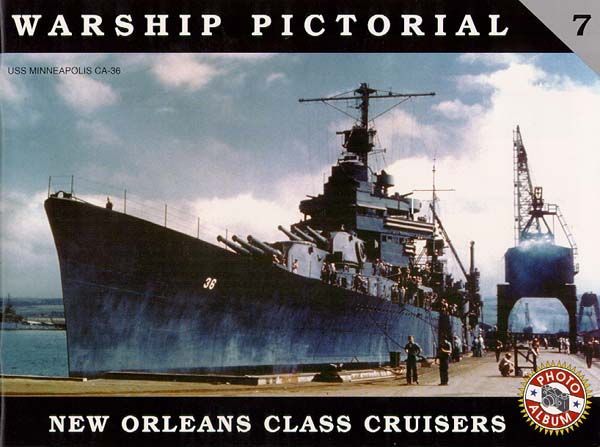
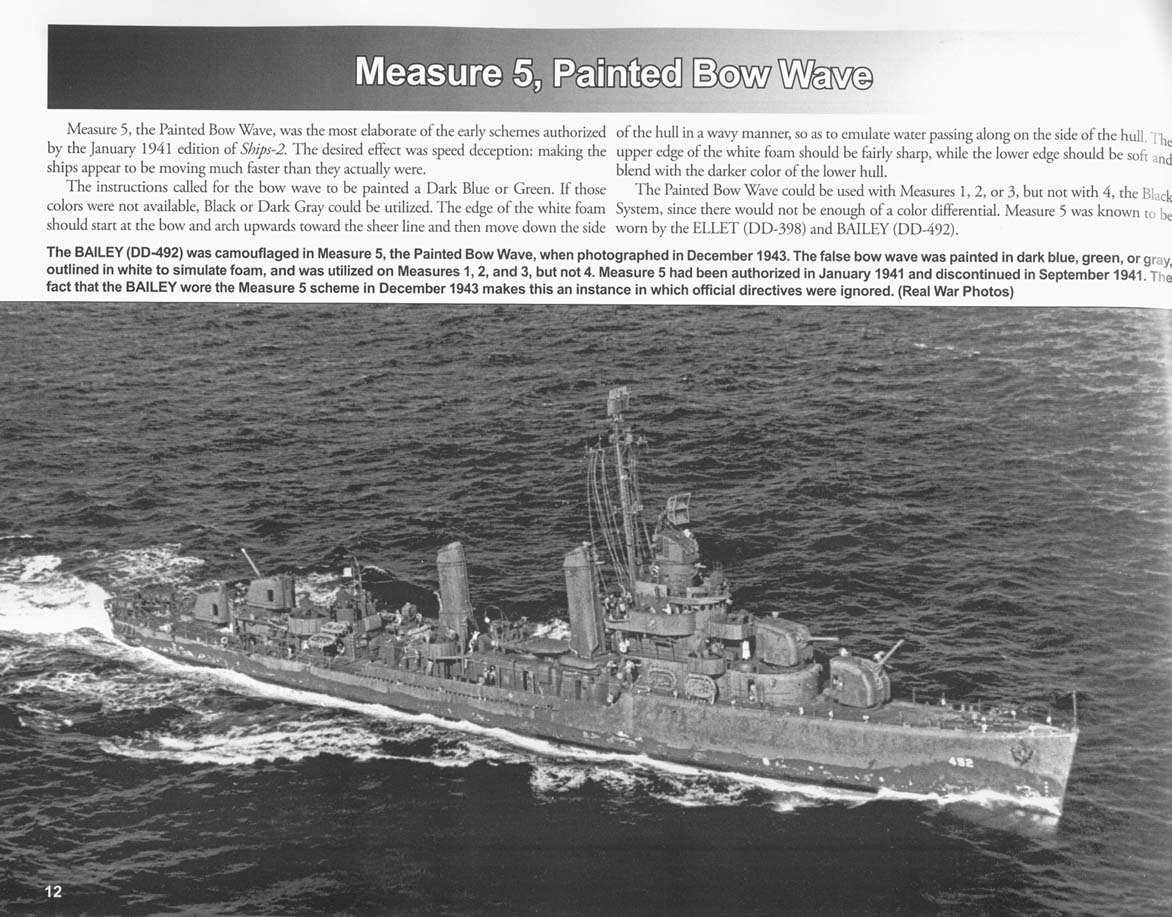
But in looking over photographs in my Warship Pictorials books, and various online photos of ships in Ms 11 or Ms 21, I am getting a feeling that there is likely a great deal of variation in the paints used for these measures (5-S and 5-N).
One of the reasons is that I have found photos (in both B/W and Color) that show a marked range of gray-range, and of blue-value in the photos.
In the B/W photos, I cannot measure the Value (the color of blue), but I CAN measure the Value and/or Saturation ratios.
And it looks as if some ships in Measures 11/21 were markedly darker than others.
One specifically that comes to mind is USS Pringle DD-454, March 1943, and the USS Halford DD-480, April 1943.
Based upon a contrast study of the white values in the photo, compared against likely Blacks (The inside of the funnel, or men wearing black slacks), and then doing a Value Adjustment to bring the whites and blacks to the same Value (Value here being the specific numerical value in Photoshop), the hulls remain starkly different in Value, and thus would have been starkly different in color (the "Hue" - for example, the Munsell Hue number - may or may not be the same here, depending upon the B/W images, but I'll get back to that in a second, when I get to the color images, but in the case here, I am assuming them to be the same, even though a different Hue COULD account for a portion of the shade difference).
But, when I look at different color photographs:
http://www.modelwarships.com/reviews/bo ... wp7-01.jpg
(Ms. 21)
Or
https://upload.wikimedia.org/wikipedia/ ... y_1941.jpg
(Ms. 11)
https://en.wikipedia.org/wiki/World_War ... :Bb-38.jpg
(Ms. 21)
https://upload.wikimedia.org/wikipedia/ ... d_2015.jpg
(Ms. 22)
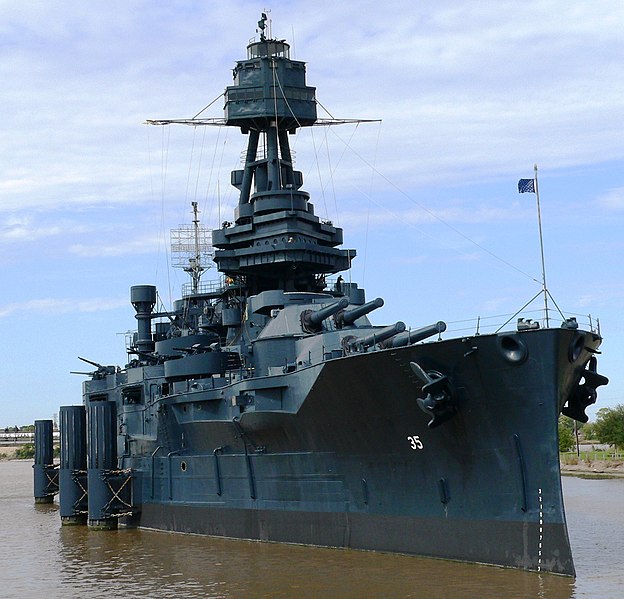
https://upload.wikimedia.org/wikipedia/ ... _BB-35.jpg
(Ms. 21)
And so on...
When I look at the Navy Blues (whether 5-S or 5-N), they are LARGELY the same Munsell value for Hue, yet even in these photographs (when corrected for white-black balance), they show that the Saturation (amount of color) and Value (amount of black) is not constant.
Thus, SOME ships during WWII painted the same Measure, would have had differing colors of 5-S or 5-N.
I even see different colors on the same ship.
If you look at DD-551, USS David Taylor (a Fletcher DD):

You can see Amidships, several very subtly different shades of 5-N, where likely touchup work was done. Irregular rectangular patches, with lighter values in between.
So, while it is not contentious especially that different batches of 5-N should be used, the degree of difference I am seeing is rather broad; by as much as 20% Value shift (�20% in the white/black range - 20% darker or 20% lighter).
I am especially seeing this on Destroyers, where smaller batches of paint would have been mixed up than for Battleships or Cruisers. For a BB or Cruiser, you would likely have used 200 - 1,000 gallons of paint (maybe twice that on the larger BBs, or CVs).
But for a DD, you could get by with 50 to 100 gallons of paint (one or two 50 gallon drums).
This is based upon the usual painters rule-of-thumb that one gallon of paint covers 300 - 500 square feet.
Any thoughts on this?
Because I want some more variation in my Ms 11/Ms 21 Ships, so they will look more interesting when deployed as fleets.
MB