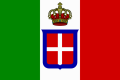
We are at the end of the road. It has been a fun journey, starting in early July, until late September when the model was finished. And now we must conclude our storytelling of this build here. There will be other to come for certain, but my Roma has sailed.
I thought I would add a few words on the subject of the Roma and the Littorio class in general. This class of ships as been neglected in English language materials and suffers from, in my view, a somewhat poor reputation. This is most certainly undeserved. Until recently, there have been only a handful of very thin publications on the Littorio class. Many dedicated works suffer from inaccurate information, improper historiography, and sometimes pure projection. Fortunately, there is now a superlative monograph published by Naval Institute Press: The Littorio Class, Italy's Last and Largest Battleships 1937-1948 by ERminio Bagnasco and Augusto De Toro. I highly encourage anyone with an interest in these ships to get hold of a copy. It is worth every penny.
These ships represent a high point in the naval tradition of Italy and Europe in general. Elegant, graceful, and immensely powerful they are representative of a bygone era when large guns, thick plate steel, and powerful steam turbines together acted as the keystone predator of the seas.
The Littorios were the third largest type of battleship completed in Europe behind the Bismarcks and the sole Vanguard.
The Roma was a delight to build and I am happy to have as my new flagship. She was also relatively inexpensive for a modern 1:350 kit; I scored the kit on a sale and the only aftermarket used was Trumpeter's own upgrade set. I think I am into the build for less than $120 including my base, paint used, and other supplies.

First some history.
The Littorio class was born as the result of a pair of treaties. First the Washington and second the London. The first treaty set a proportion for tonnage allocation between the five victorious naval powers of the Great War. The United States, the United Kingdom, the Empire of Japan, the French Republic, and the Kingdom of Italy were allocated a ratio at 5:5:3:1.75:1.75 respectively. This translated into practical terms as 15 BBs displacing 525,000 tons standard each for the U.S. and the U.K., nine BBs at 305,000 tons for Japan, and five (initially) BBs at 175,000 tons each for France and Italy. There were also restrictions on other combatants (including aircraft carriers) outside of scope. Obviously there was some wiggle room in this treaty at least intially, and France and Italy were allowed some grace as neither navy was in any good position with regards to heavy units. France was permitted to retain two pre-dreadnoughts for a time to keep strength up.
The Regia Marina (RM), Italian for Royal Navy, built six dreadnought battleships in the years leading up to the Great War. This included the first in the world to enter service with three-gun turrets: the 12x12inch armed Dante Alighieri. There were also three Cavours and two Dorias. The Leonardo da Vinci detonated in port in 1916 and was a total loss.
So by the time of the Washington treaty Italy has its five battleships. These ships were acceptable, advanced designs in 1914, but were very poor companions to the American standards, the British 15 inch armed ships, or any of the Japanese capital ships.
Fortunately for the time being, the chief concern of Italian naval planners was the Marine Nationale of France. A navy that suffered greatly along with its host nation in the war. Since Entente Cordiale, the primary strength of France's fleet was concentrated on the Mediterranean. Its battlefleet was neglected as French naval resources were poured into more immediately useful destroyers, cruisers, avisos, and submarines. France had seven battleships (one was wrecked in 1922, the France). All of these Italian and French designs were smaller and lighter than their foreign counterparts. None came near the new 35,000 ton limitation on standard displacement.
All navies were permitted to upgrade their existing designs to modern standards and Italy chose to upgrade, at great expense and energy, its four remaining Cavour and Duilio ships in two periods producing essentially new ships. These upgrades were as far reaching as any of the more radical post-Pearl Harbor rebuilds done in the '40s. At a cost equal to new ships of greater power, the newly rebuilt battleships were effective within their limitations but could not compare with practically any foreign designs.
[placeholder]

These images were taken at one of my local I.P.M.S. shows where it placed first in theme.


I have divided my own photographs into categories to display particular features of the design. There are approximately 80 images. The quality is not ideal, but it is with my best camera (a phone, of course).
 ) resulted in a very satisfactory gun. Indeed, the Italian 381mm system was not the worst offender in the dispersion struggle: both the French 15 inch and British 14 inch programs faced greater challenges on the road to 'perfection'. Of Italian weapons, the 381mm was more accurate and had less dispersion than the 'new' 320mm mounted on the four legacy battleships.






 There are 19 new photographs relating to the underside of the ship.