
I recently became aware that my school, the University of Arizona, operates 2 rapid prototyping machines that are offered for use to the public for private or commercial projects. Cost of the operations are minimum $50/hr for a student and maximum $150/hr for a non-UA affiliate. Cost of materials for any UA or non-UA project are $0.30/g for part material and $0.15/g for support material. Now the maximum size possible for parts is somewhat small, 11.75 X 7.3 X 8 inches. Just thought this might be of interest to the CAD people here. More details can be found here:
http://3dimaging.cfa.arizona.edu/print/
3D rapid prototyping
Moderator: ArizonaBB39
-
kennylibben

- Posts: 1065
- Joined: Tue Jan 11, 2005 7:25 am
- Location: I live in Off-Topic...
- Contact:
-
Werner

- Posts: 2299
- Joined: Mon Jan 10, 2005 1:10 am
- Location: (42.24,-87.81)
We operate several. Mostly the Invision devices, but some others as well.
They integrate well with MRI scans and other CT data.
They integrate well with MRI scans and other CT data.
If an unfriendly power had attempted to impose on America the mediocre educational performance that exists today, we might well have viewed it as an act of war.
-- "A Nation at Risk" (1983)
-- "A Nation at Risk" (1983)
-
DrPR

- Posts: 1689
- Joined: Sun Mar 07, 2010 12:01 am
- Location: Corvallis, Oregon, USA
- Contact:
Re: 3D rapid prototyping
robsam,
How smooth is the surface on the prototypes you are getting?
I have worked with several "3D printing" rapid prototyping methods and all have produced a fairly rough or grainy surface, and some with noticable "jaggies" (stairstep or contour line surfaces). Some of the materials are very fragile.
One interesting development is a 3D prototype "lost virtual wax" casting investment technique that allows direct creation of molds for metal castings, with complex internal details that would be almost impossible with traditional lost wax castings.
How smooth is the surface on the prototypes you are getting?
I have worked with several "3D printing" rapid prototyping methods and all have produced a fairly rough or grainy surface, and some with noticable "jaggies" (stairstep or contour line surfaces). Some of the materials are very fragile.
One interesting development is a 3D prototype "lost virtual wax" casting investment technique that allows direct creation of molds for metal castings, with complex internal details that would be almost impossible with traditional lost wax castings.
A collision at sea will ruin your entire day. Aristotle
-
afrodri
- Posts: 5
- Joined: Thu Jan 07, 2010 11:40 pm
Re: 3D rapid prototyping
I've been using Shapeways. With their default White, Strong, and Flexible material the surface is a bit rough. With the 'White Detail' Material, it is smooth, but you still will see some 'jaggies' - they are less than 200 microns in size, but still visible. A bit of paint often smooths over some of the roughness.DrPR wrote:robsam,
How smooth is the surface on the prototypes you are getting?
Here are some 1:2000 ships I've done recently. You can see some of the roughness in the photos below and the enlargement.
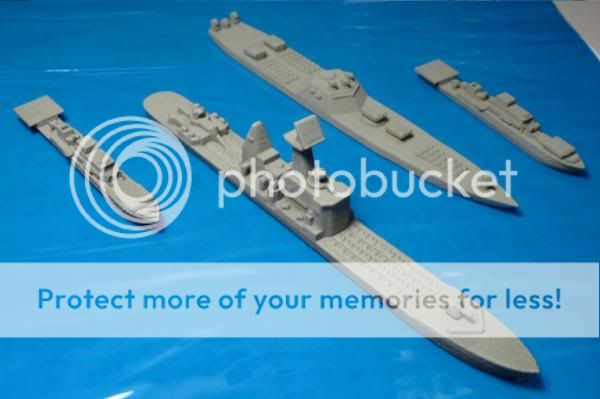

enlarged: http://i871.photobucket.com/albums/ab27 ... 000403.jpg

I've just posted a set of fourteen new models, including oil rigs, sea forts, destroyers, landing craft, frigates, submarines, and a prototype "arsenal ship", all in 1:2000 scale. The ships are based on a variety of modern craft, such as the German Elbe Class, Chinese Type 52 Destroyer, Soviet Tarantul class, and US Wasp-class. It also includes notional designs which never made it past the drawing board, such as the Soviet Project 1165. http://www.shapeways.com/shops/objects? ... %5D=thumbs
Some more photos at:
http://s871.photobucket.com/albums/ab27 ... l%20Ships/
-
EJFoeth
- Posts: 2907
- Joined: Wed Jan 21, 2009 1:51 pm
Re: 3D rapid prototyping
This technique very is interesting, though the roughness in the grain of the model is still large. But I think it will be "the tool" of future non-industrial kit/part makers. Paperlab has been using it from some time and Veteran models too (At least, this is what I expect as their parts are so detailed even I am amazed  . The new Combig kit looks remarkably sharp as well, (perhaps they also use it or have a good watchmaker in their ranks). We also use it at work (we make 40 feet ship models) for small details (thrusters, gridded inlets) but the grain is much coarser and CNC milling is preferred for some parts. But the cost is low!
. The new Combig kit looks remarkably sharp as well, (perhaps they also use it or have a good watchmaker in their ranks). We also use it at work (we make 40 feet ship models) for small details (thrusters, gridded inlets) but the grain is much coarser and CNC milling is preferred for some parts. But the cost is low!-
DrPR
- Posts: 1689
- Joined: Sun Mar 07, 2010 12:01 am
- Location: Corvallis, Oregon, USA
- Contact:
Re: 3D rapid prototyping
Have you experimented to determine the minimum thickness you can get? I mean the minimum thickness of flat or curved surfaces, and the minimum diameter of cylinders.
A collision at sea will ruin your entire day. Aristotle
-
afrodri
- Posts: 5
- Joined: Thu Jan 07, 2010 11:40 pm
Re: 3D rapid prototyping
At Shapeways (the print service I use) they recommend a minimum thickness of .7-1 mm (Depending on the material). I generally stick to 1mm diameter to meet their design rules.DrPR wrote:Have you experimented to determine the minimum thickness you can get? I mean the minimum thickness of flat or curved surfaces, and the minimum diameter of cylinders.
The minimum feature size is about .2 mm for the high detail materials.