HMS Victory and Le Redoutable at Trafalgar (1/300)
Moderators: BB62vet, MartinJQuinn, JIM BAUMANN, Jon, Dan K
-
Dan K
- Posts: 9117
- Joined: Tue Jan 11, 2005 10:56 am
- Location: New York City
-
marijn van gils
- Posts: 2757
- Joined: Tue Feb 06, 2007 10:24 am
- Location: Belgium
Re: HMS Victory and Le Redoutable at Trafalgar (1/300)
Many thanks guys! 
@ Wouter: this technique is certainly not new, but maybe not so popular anymore. It was used a lot in the 80ies and 90-ies for garage aftermarket airplane kits. I never tried, but I hear they were A LOT of work to put together. It was also used for sails in plastic kits of sailing ships. On Youtube, you can find some video's on the process.
But credit goes to my friend: he built his own vacforming machine and acquired the necessary experience with it to do such a good job.
I would build a solid hull simply solid, but this technique is great if your hull has many openings and has a complex shape.
I will not add all the planking to the hull. I will only add the wales. I will simulate the finer planking only with paint, as I feel I can get a finer and more in-scale result that way. For that reason, I have filled the planking on the hull of Victory too.
Cheers,
Marijn
@ Wouter: this technique is certainly not new, but maybe not so popular anymore. It was used a lot in the 80ies and 90-ies for garage aftermarket airplane kits. I never tried, but I hear they were A LOT of work to put together. It was also used for sails in plastic kits of sailing ships. On Youtube, you can find some video's on the process.
But credit goes to my friend: he built his own vacforming machine and acquired the necessary experience with it to do such a good job.
I would build a solid hull simply solid, but this technique is great if your hull has many openings and has a complex shape.
Yes! Marking out the basic cutting lines, just for the outlines of the hull, took me almost 2 hours yesterday. It involved cutting out 'negative' ribs from the scaled plans again, using them as templates to find the hull edges. The details like gunports will take more time even...wefalck wrote:I can imagine that the next steps are actually more difficult, marking out all the cutting lines. I suppose you will add the planking as strips of polystyrene sheet ?
I will not add all the planking to the hull. I will only add the wales. I will simulate the finer planking only with paint, as I feel I can get a finer and more in-scale result that way. For that reason, I have filled the planking on the hull of Victory too.
Cheers,
Marijn
-
GewoonWouter

- Posts: 231
- Joined: Sat Mar 26, 2016 2:58 am
- Location: Belgium
Re: HMS Victory and Le Redoutable at Trafalgar (1/300)
Probably that's why it's new for me. I'm a child of the 80'smarijn van gils wrote:Many thanks guys!
@ Wouter: this technique is certainly not new, but maybe not so popular anymore. It was used a lot in the 80ies and 90-ies for garage aftermarket airplane kits. I never tried, but I hear they were A LOT of work to put together. It was also used for sails in plastic kits of sailing ships. On Youtube, you can find some video's on the process.
 I started modelling in 2010 so everything before that is uncharted territory LOL. Good to see old techniques coming back again. though.
-
wefalck

- Posts: 2149
- Joined: Wed Sep 28, 2011 12:04 pm
- Location: Paris
- Contact:
Re: HMS Victory and Le Redoutable at Trafalgar (1/300)
I have never built one of those vaccum-formed airplane kits, but apart from the initial flimsiness of the body/hull their problem was that they usually did not have the body-plan, so could not precisely determine the shape. In this case one can put a couple of (temporary) bulwarks based on the drawings into the hull that then will be quite stable I think.
The Chinese sell quite cheaply vacuum-forming machines. They have a limited capacity, but would be good for smaller models or ships' boats:
https://www.ebay.com/itm/Dental-Vacuum- ... 1dxYsalI7g
The Chinese sell quite cheaply vacuum-forming machines. They have a limited capacity, but would be good for smaller models or ships' boats:
https://www.ebay.com/itm/Dental-Vacuum- ... 1dxYsalI7g
Eberhard
Former chairman Arbeitskreis historischer Schiffbau e.V. (German Association for Shipbuilding History)
--------------------------------------------------------------------------------------------------------------------------------------------------------------------------------------------




Former chairman Arbeitskreis historischer Schiffbau e.V. (German Association for Shipbuilding History)
--------------------------------------------------------------------------------------------------------------------------------------------------------------------------------------------
-
EJFoeth
- Posts: 2943
- Joined: Wed Jan 21, 2009 1:51 pm
Re: HMS Victory and Le Redoutable at Trafalgar (1/300)
I made my own a few years back; you need an oven and a vacuum cleaner 
-
wefalck
- Posts: 2149
- Joined: Wed Sep 28, 2011 12:04 pm
- Location: Paris
- Contact:
Re: HMS Victory and Le Redoutable at Trafalgar (1/300)
Yes, on ebay they now sell laser-cut kits for such devices. The main problem is the uniform heating of the styrene sheet. You can put it under the grill in the baking oven, but the fumes are difficult to get out afterwards - you may get into trouble with the Admiralty 
Eberhard
Former chairman Arbeitskreis historischer Schiffbau e.V. (German Association for Shipbuilding History)
--------------------------------------------------------------------------------------------------------------------------------------------------------------------------------------------
Former chairman Arbeitskreis historischer Schiffbau e.V. (German Association for Shipbuilding History)
--------------------------------------------------------------------------------------------------------------------------------------------------------------------------------------------
-
marijn van gils
- Posts: 2757
- Joined: Tue Feb 06, 2007 10:24 am
- Location: Belgium
Re: HMS Victory and Le Redoutable at Trafalgar (1/300)
That's a nice one Evert-Jan! Clever construction! 
That should do perfectly for boats, radar domes on modern ships, etc.
Yes Wefalck, I also never built one, but heard many times that doing so was only marginally better than full scratchbuilding. You only got very basic shapes with pretty soft detail, and everything needed to be cut from large sheets to begin with.
Probably more dangerous, but you can also hold the plastic over the cooking fire.
I did it once for heat-forming (the same technique, but simply pushing the soft plastic over the mold, without the vacuum), with success.
But heating it evenly with an electric heating element seems to be the best!
-
wefalck
- Posts: 2149
- Joined: Wed Sep 28, 2011 12:04 pm
- Location: Paris
- Contact:
Re: HMS Victory and Le Redoutable at Trafalgar (1/300)
A hot-air gun does the job as well and probably in a more controlled fashion, as you can regulate the temperature. I have done ventilator cowls in that way over a wooden core. Wax the core and pre-heat it to improve the flow of the styrene sheet over it.
Eberhard
Former chairman Arbeitskreis historischer Schiffbau e.V. (German Association for Shipbuilding History)
--------------------------------------------------------------------------------------------------------------------------------------------------------------------------------------------
Former chairman Arbeitskreis historischer Schiffbau e.V. (German Association for Shipbuilding History)
--------------------------------------------------------------------------------------------------------------------------------------------------------------------------------------------
-
EJFoeth
- Posts: 2943
- Joined: Wed Jan 21, 2009 1:51 pm
Re: HMS Victory and Le Redoutable at Trafalgar (1/300)
For my minihulls I had to make several attempts of getting the sheet out of the hot oven and in one swift move throw it on the vacuum former... so not so much control here. But the results of this technique are very good and you can get a difficult shape in hollow form with ease.
For Redoutable the hull is comfortably large with the cutting being the main difficulty... using more templates and such is usually a good idea! (example http://ontheslipway.com/?p=61 with some efforts of the 4" gun shields and cutting templates; I'd probably do a few things differently now).
For Redoutable the hull is comfortably large with the cutting being the main difficulty... using more templates and such is usually a good idea! (example http://ontheslipway.com/?p=61 with some efforts of the 4" gun shields and cutting templates; I'd probably do a few things differently now).
-
JIM BAUMANN

- Posts: 5723
- Joined: Mon Jan 10, 2005 5:30 pm
- Location: Nr Southampton England
Re: HMS Victory and Le Redoutable at Trafalgar (1/300)
wefalck wrote:
... I have done ventilator cowls in that way over a wooden core.....
thats a good idea !
JB
... I have done ventilator cowls in that way over a wooden core.....
thats a good idea !
JB
....I buy them at three times the speed I build 'em.... will I live long enough to empty my stash...?
http://www.modelshipgallery.com/gallery ... index.html
IPMS UK SIG (special interest group) www.finewaterline.com
http://www.modelshipgallery.com/gallery ... index.html
IPMS UK SIG (special interest group) www.finewaterline.com
-
harristotle
- Posts: 77
- Joined: Fri Feb 22, 2019 8:21 pm
- Contact:
Re: HMS Victory and Le Redoutable at Trafalgar (1/300)
This is incredible!
Michael
Love building and CAD modeling WWII Capital Ships
1/1200 Battle of Hampton Roads diorama in progress
1/1200 1945 USS Pennsylvania CAD model in progress
Love building and CAD modeling WWII Capital Ships
1/1200 Battle of Hampton Roads diorama in progress
1/1200 1945 USS Pennsylvania CAD model in progress
-
marijn van gils
- Posts: 2757
- Joined: Tue Feb 06, 2007 10:24 am
- Location: Belgium
Re: HMS Victory and Le Redoutable at Trafalgar (1/300)
Thanks guys!
Cutting the hull from the vacformed sheet of polystyrene took a lot of measuring indeed, including cutting out �negative� ribs from the scaled plans. I�m sure there must be a better way, but I got the job done� ?
Cutting out all the gun ports started with marking their locations with pencil.
Next, I made 3 simple templates: one for each size of gun port (larger on the lower decks, smaller on the upper).
I used these to scribe the contours of the gun ports in the plastic, using the pencil markings and a piece of tape as a guide. Some Blu Tack helped to keep them in place. The scriber is a simple needle held in a pin vice.


Using these scribed lines as a guide, I carved out the gun ports with a fresh 11P scalpel blade. I first made a start by drilling a hole through each port.

95% of the hole was done with the knife. Only the last 5% was done by sanding.
Since all my needle files are too wide for this, I made my own sanding sticks to size by gluing sand paper on strips of plastic sheet.

Repeated 74 times, this is the result.
Starting to loo like a man �o war!

Cheers,
Marijn
Cutting the hull from the vacformed sheet of polystyrene took a lot of measuring indeed, including cutting out �negative� ribs from the scaled plans. I�m sure there must be a better way, but I got the job done� ?
Cutting out all the gun ports started with marking their locations with pencil.
Next, I made 3 simple templates: one for each size of gun port (larger on the lower decks, smaller on the upper).
I used these to scribe the contours of the gun ports in the plastic, using the pencil markings and a piece of tape as a guide. Some Blu Tack helped to keep them in place. The scriber is a simple needle held in a pin vice.
Using these scribed lines as a guide, I carved out the gun ports with a fresh 11P scalpel blade. I first made a start by drilling a hole through each port.
95% of the hole was done with the knife. Only the last 5% was done by sanding.
Since all my needle files are too wide for this, I made my own sanding sticks to size by gluing sand paper on strips of plastic sheet.
Repeated 74 times, this is the result.
Starting to loo like a man �o war!
Cheers,
Marijn
-
Joe Simon
- Posts: 829
- Joined: Sat Jan 24, 2009 5:16 pm
- Location: Wisconsin
Re: HMS Victory and Le Redoutable at Trafalgar (1/300)
You must come to the US with these models sometime and attend a National contest. Great work as always.
-
GewoonWouter
- Posts: 231
- Joined: Sat Mar 26, 2016 2:58 am
- Location: Belgium
Re: HMS Victory and Le Redoutable at Trafalgar (1/300)
nervewrecking stuff going on here but you did it, well done skipper!
-
JIM BAUMANN
- Posts: 5723
- Joined: Mon Jan 10, 2005 5:30 pm
- Location: Nr Southampton England
Re: HMS Victory and Le Redoutable at Trafalgar (1/300)
well done indeed--
mighty impressive modelmaking!
the gauge of plastic also looks about right for the thickness of the wooden walls.
JIM B
mighty impressive modelmaking!
the gauge of plastic also looks about right for the thickness of the wooden walls.
JIM B
....I buy them at three times the speed I build 'em.... will I live long enough to empty my stash...?
http://www.modelshipgallery.com/gallery ... index.html
IPMS UK SIG (special interest group) www.finewaterline.com
http://www.modelshipgallery.com/gallery ... index.html
IPMS UK SIG (special interest group) www.finewaterline.com
-
wefalck
- Posts: 2149
- Joined: Wed Sep 28, 2011 12:04 pm
- Location: Paris
- Contact:
Re: HMS Victory and Le Redoutable at Trafalgar (1/300)
Clean job on something rather tricky - good preparation pays.
There are 1 mm x 1 mm and 1mm x 2 mm needle files, btw. I prefer, however, diamond-files on plastic. There are 2 mm x 2 mm diamond files (they look like the ubiquitous diamond burrs) for die-filers. Not easy to get though.
Another thing I came across quite recently are diamond-coated paper-thin steel strips. They are used by toolmakers and dental technicians. The latter also use abrasive-coated plastic strips. These can be cut to size and glued onto sticks and give a near-polished surface.
Eberhard
Former chairman Arbeitskreis historischer Schiffbau e.V. (German Association for Shipbuilding History)
--------------------------------------------------------------------------------------------------------------------------------------------------------------------------------------------
Former chairman Arbeitskreis historischer Schiffbau e.V. (German Association for Shipbuilding History)
--------------------------------------------------------------------------------------------------------------------------------------------------------------------------------------------
-
marijn van gils
- Posts: 2757
- Joined: Tue Feb 06, 2007 10:24 am
- Location: Belgium
Re: HMS Victory and Le Redoutable at Trafalgar (1/300)
Many thanks guys! 
I have been to the MFCA show in Valley Forge two times, back in my figure modelling days, and certainly would like very much to visit the US again. But I didn't have children yet that time. The best would be to combine it with a family holiday now, but I'll have a couple of years to wait for the kids to get a bit bigger.
In the meantime, you're welcome to visit one of the great shows we have over here in Europe!
Actually, it is a little too thin when measured, since the plastic got stretched a bit more than anticipated when vacuforming.
I considered gluing some plastic sheet to the inside of the hull. But since this could cause all kind of problems (deformation of the hull, annoying gaps to fill, ...), and most importantly since it looks right to the eye (also when placed next to my Victory hull), I decided to leave it as is. Thanks for confirming my feeling that at least it looks correct to the eye!
@ Welfalk: many thanks for all the tips! I'll certainly keep an eye out for those.
An advantage of the home-made plastic strip with sandpaper is that you can choose the grit of the paper. I also prefer diamond-files over regular files, but find their surface often a bit too course for finishing a plastic surface. With the sandpaper, I can do the shaping with a course grit 'stick' and finish the surface with a finer grit. Still, I would mind finding some narrower needle files for the shaping... And maybe those dental technician strips would be perfect?
Cheers,
Marijn
Thanks Joe!Joe Simon wrote:You must come to the US with these models sometime and attend a National contest. Great work as always.
I have been to the MFCA show in Valley Forge two times, back in my figure modelling days, and certainly would like very much to visit the US again. But I didn't have children yet that time. The best would be to combine it with a family holiday now, but I'll have a couple of years to wait for the kids to get a bit bigger.
In the meantime, you're welcome to visit one of the great shows we have over here in Europe!
Many thanks Jim!JIM BAUMANN wrote: the gauge of plastic also looks about right for the thickness of the wooden walls.
Actually, it is a little too thin when measured, since the plastic got stretched a bit more than anticipated when vacuforming.
I considered gluing some plastic sheet to the inside of the hull. But since this could cause all kind of problems (deformation of the hull, annoying gaps to fill, ...), and most importantly since it looks right to the eye (also when placed next to my Victory hull), I decided to leave it as is. Thanks for confirming my feeling that at least it looks correct to the eye!
@ Welfalk: many thanks for all the tips! I'll certainly keep an eye out for those.
An advantage of the home-made plastic strip with sandpaper is that you can choose the grit of the paper. I also prefer diamond-files over regular files, but find their surface often a bit too course for finishing a plastic surface. With the sandpaper, I can do the shaping with a course grit 'stick' and finish the surface with a finer grit. Still, I would mind finding some narrower needle files for the shaping...
And maybe those dental technician strips would be perfect? Cheers,
Marijn
-
wefalck
- Posts: 2149
- Joined: Wed Sep 28, 2011 12:04 pm
- Location: Paris
- Contact:
Re: HMS Victory and Le Redoutable at Trafalgar (1/300)
Actually, I use nail-files. They have different grits on each side and they come in various sizes, even really large ones - ebay is your (Chinese) friend.
Check out watchmaking supply-houses for the really small needle files.
Check out watchmaking supply-houses for the really small needle files.
Eberhard
Former chairman Arbeitskreis historischer Schiffbau e.V. (German Association for Shipbuilding History)
--------------------------------------------------------------------------------------------------------------------------------------------------------------------------------------------
Former chairman Arbeitskreis historischer Schiffbau e.V. (German Association for Shipbuilding History)
--------------------------------------------------------------------------------------------------------------------------------------------------------------------------------------------
-
JIM BAUMANN
- Posts: 5723
- Joined: Mon Jan 10, 2005 5:30 pm
- Location: Nr Southampton England
Re: HMS Victory and Le Redoutable at Trafalgar (1/300)
it 'looks' about right - if thicker it may look clumsy...
Now... pending what the actual wall thickness is ....
what I might have done... ( great with the retroscope view...)
...to help save all that pernickety risky nerve-wracking filing
is to cut them slightly oversize and line the aperture with a PE brass square
( gleaned from appropriate sized eldery ( ie thick) brass or stainless handrail
Model Railway PE is generally thicker than model ship so useful
ala method here:
this is in 1/700 so apertures are less than half size--and done 7 years ago --I would be better now!! LOL
viewtopic.php?f=59&t=104027#p493163
or here in 1/350 ( Bouvet --in 2009 )
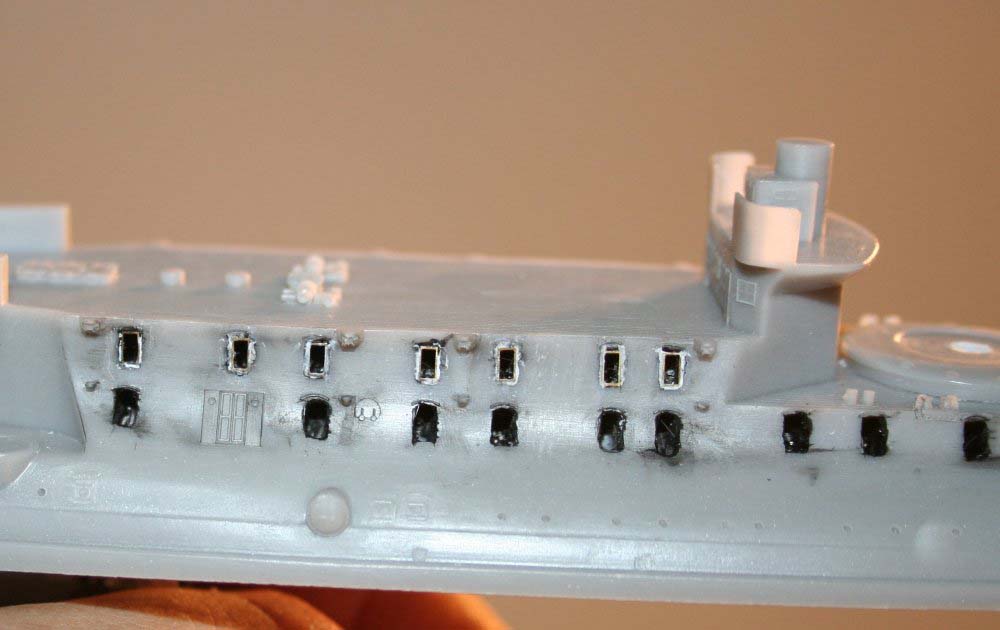
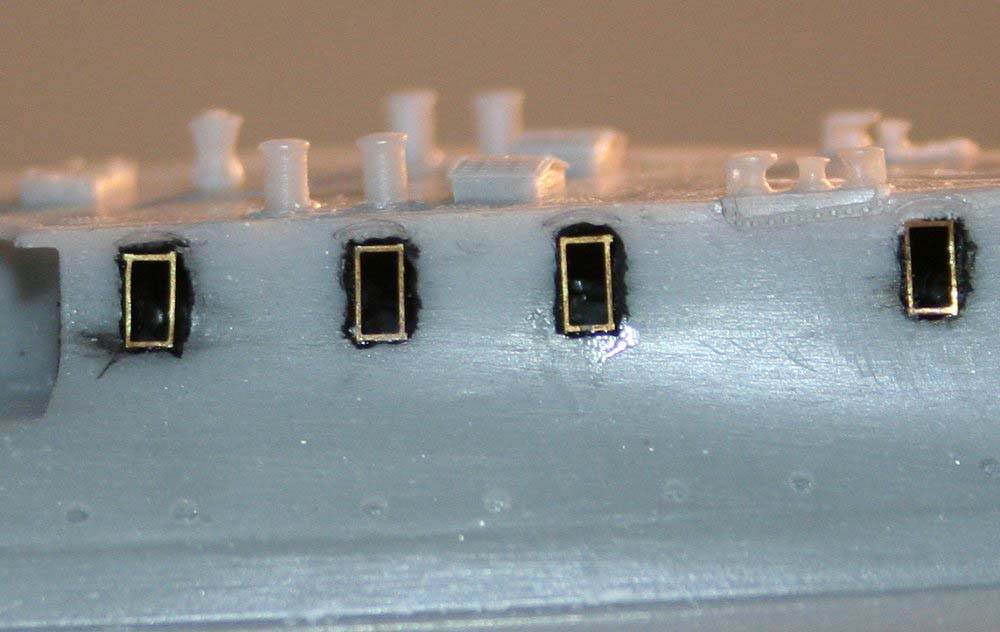
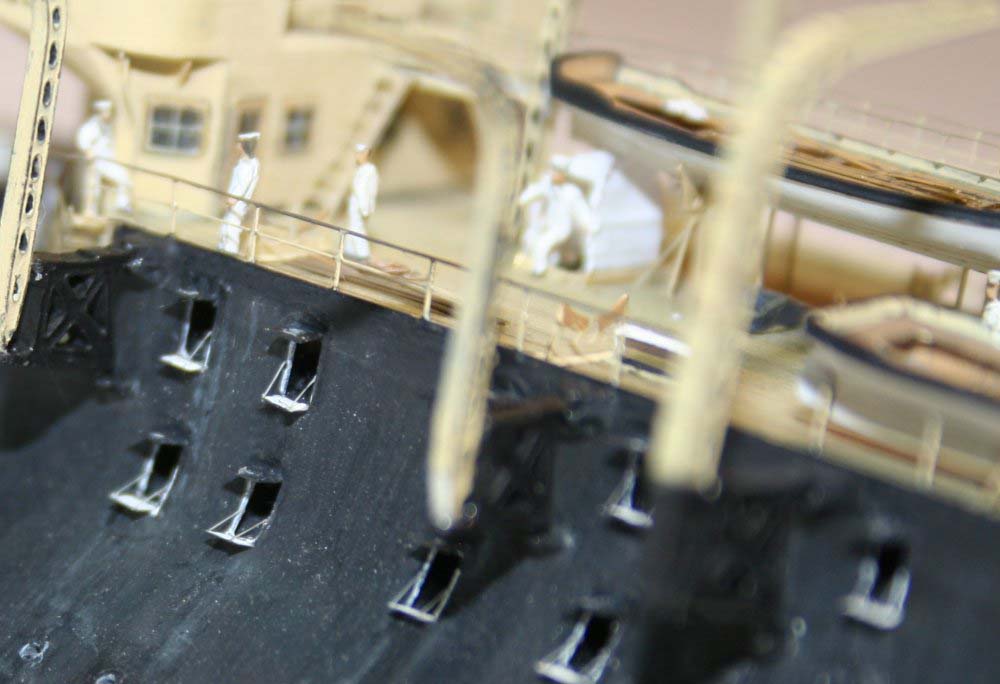
Now... pending what the actual wall thickness is ....
what I might have done... ( great with the retroscope view...)
...to help save all that pernickety risky nerve-wracking filing
is to cut them slightly oversize and line the aperture with a PE brass square
( gleaned from appropriate sized eldery ( ie thick) brass or stainless handrail
Model Railway PE is generally thicker than model ship so useful
ala method here:
this is in 1/700 so apertures are less than half size--and done 7 years ago --I would be better now!! LOL
viewtopic.php?f=59&t=104027#p493163
or here in 1/350 ( Bouvet --in 2009 )
....I buy them at three times the speed I build 'em.... will I live long enough to empty my stash...?
http://www.modelshipgallery.com/gallery ... index.html
IPMS UK SIG (special interest group) www.finewaterline.com
http://www.modelshipgallery.com/gallery ... index.html
IPMS UK SIG (special interest group) www.finewaterline.com
-
marijn van gils
- Posts: 2757
- Joined: Tue Feb 06, 2007 10:24 am
- Location: Belgium
Re: HMS Victory and Le Redoutable at Trafalgar (1/300)
Thanks Jim!
That's a great method indeed!
Quite perfect for 1/700, and also for non-hollow hulls, and/or thin hulls.
Still a big fan of Bouvet BTW!
I learned it from your articles and posts (I probably read all of them! ), but decided not to use it here.
These wooden hulls were quite thick, and the side faces of the ports are quite visible, including their angles at the corners (parallel with the waterline). And these sides were painted red, which makes them stand out very clearly. So in 1/350, no choice but finish all sides smoothly...
But no problem: it is not too difficult to do on a hollow hull, and not too slow. After the locations were scribed, I could carve and sand about 10 ports per hour, so about 7,5 hours for all. 6 minutes for one port is not too bad (faster than one soldered chain-link, E-J! )!
Also mistakes can easily be corrected (glue another piece of plastic, and carve and sand again), but I didn't need to do that.
That's a great method indeed!
Quite perfect for 1/700, and also for non-hollow hulls, and/or thin hulls.
Still a big fan of Bouvet BTW!
I learned it from your articles and posts (I probably read all of them!
), but decided not to use it here. These wooden hulls were quite thick, and the side faces of the ports are quite visible, including their angles at the corners (parallel with the waterline). And these sides were painted red, which makes them stand out very clearly. So in 1/350, no choice but finish all sides smoothly...
But no problem: it is not too difficult to do on a hollow hull, and not too slow. After the locations were scribed, I could carve and sand about 10 ports per hour, so about 7,5 hours for all. 6 minutes for one port is not too bad (faster than one soldered chain-link, E-J!
)! Also mistakes can easily be corrected (glue another piece of plastic, and carve and sand again), but I didn't need to do that.