1/350 HMS Hood (scratchbuild)
Moderators: BB62vet, MartinJQuinn, JIM BAUMANN, Jon, Dan K
-
wefalck

- Posts: 2093
- Joined: Wed Sep 28, 2011 12:04 pm
- Location: Paris
- Contact:
Re: 1/350 HMS Hood (scratchbuild)
You are setting standards for some details I will have to make ...
Eberhard
Former chairman Arbeitskreis historischer Schiffbau e.V. (German Association for Shipbuilding History)
--------------------------------------------------------------------------------------------------------------------------------------------------------------------------------------------




Former chairman Arbeitskreis historischer Schiffbau e.V. (German Association for Shipbuilding History)
--------------------------------------------------------------------------------------------------------------------------------------------------------------------------------------------
-
EJFoeth
- Posts: 2911
- Joined: Wed Jan 21, 2009 1:51 pm
Re: 1/350 HMS Hood (scratchbuild)
Well, perhaps my next model will not have anchors at all to avoid doing this again 
-
marijn van gils
- Posts: 2686
- Joined: Tue Feb 06, 2007 10:24 am
- Location: Belgium
Re: 1/350 HMS Hood (scratchbuild)
Fantastic work!
And just a little crazy...
And just a little crazy...
-
EJFoeth
- Posts: 2911
- Joined: Wed Jan 21, 2009 1:51 pm
Re: 1/350 HMS Hood (scratchbuild)
Just wait for my next image with the chains from hell, the chains from lesser hell, and the chains from special hell
(The latter, Blake's screw stopper, is now placed on deck, as well as some assorted small details...)
(The latter, Blake's screw stopper, is now placed on deck, as well as some assorted small details...)
-
EJFoeth
- Posts: 2911
- Joined: Wed Jan 21, 2009 1:51 pm
Re: 1/350 HMS Hood (scratchbuild)
Hatch replaced, mooring swivel in place, screw stoppers in place, hose manifold destroyed while aligning 
-
EJFoeth
- Posts: 2911
- Joined: Wed Jan 21, 2009 1:51 pm
Re: 1/350 HMS Hood (scratchbuild)
Small blog update, copied in full... making good progress on finishing the ground tackle and I hope to be adding paint really soon
While I was cleaning up the foredeck around B-barbette I noticed a bit of damage at the anchors; the link connecting the anchor to the chain was broken and this was difficult to repair. Just for the fun of it I wanted to find out if soldering studded anchor chain was doable. The studded chain previously installed was a bit over scale, otherwise fine, but why not try. In the end I decided to overhaul the entire ground tackle section of the model. As usual, this took a bit more effort than I anticipated.
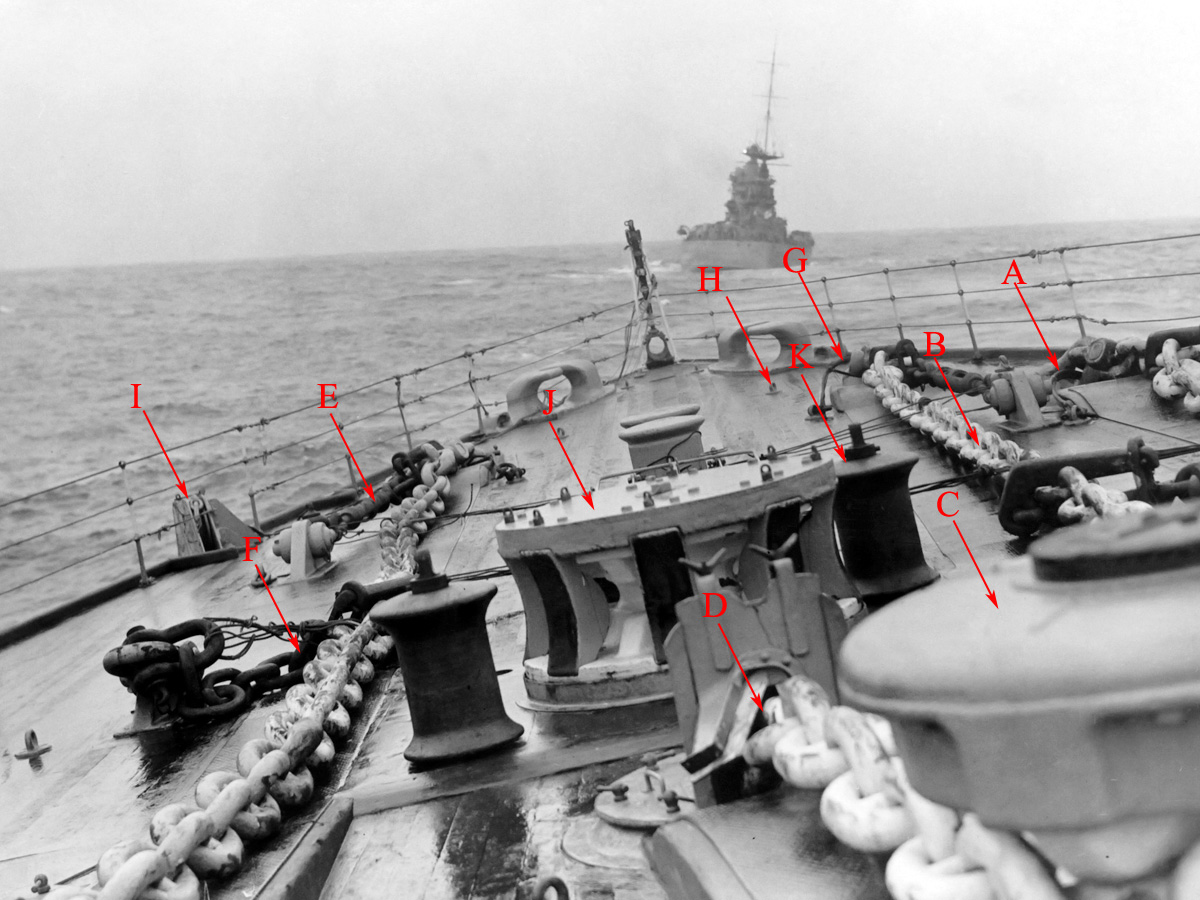
You can find quite some information on anchors & cables in the Manual of Seamanship (1937, volume I) and I�d certainly recommend you find yourself a copy. Here you can see the ground tackle area of HMS Rodney. The anchors themselves are hove into the hawse pipes (A). The main anchor cable (B) runs around a cable holder (C) into the cable locker via a navel pipe (D). Inside this locker the cable is secured (see IWM image A 20535 to get an idea). There are two smaller chains on deck. Blake�s screw stopper is used (E) for heaving in and securing the anchor during sailing using a large bottle screw to apply tension; the main cable no longer carries the weight of the anchor. Blake�s stopper (F) is used only temporarily when the cable is parted at a joining shackle for mooring and other operations. Note that both the main cable and Blake�s stopper are not taut in this photograph and that several smaller lashings are present to prevent lateral movement. Additional securing lashings can be seen (G) joined to the various eyelets scattered in this area (H). When the ship is moored to a buoy, the cable is parted and the anchor is temporarily �catted� at the clump cathead (I). A large capstan (J) is used by the crew to move the cables around, with the aid of a pair of support rollers (K).
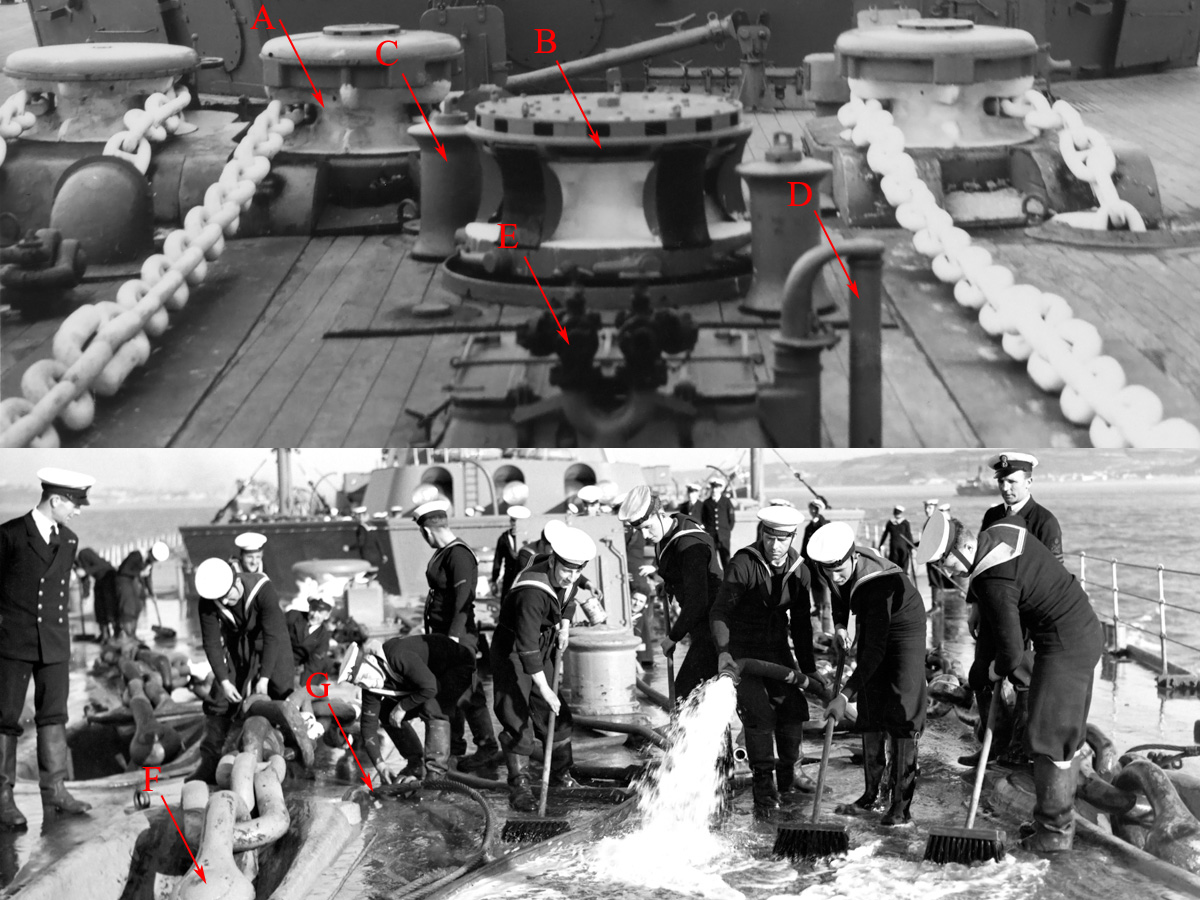
Here we have a good view of HMS Hood showing the cable holders (A), the capstan (B), support rollers (C). In addition, you can see that there is a small (portable) roller next to the hatch coaming (D) and a small hydrant manifold (E). The lower half shows the crew of Rodney hosing the deck after having hoisted the anchor (F) and a crew member about to place a lashing to secure the cable (G).
The Manual of Seamanship lists that chain is supplied in shackles and half shackles; one shackle is 12.5 fathoms (75 ft). Hood carrier 35 shackles and 12 half-shackles with a single cable link diameter of 3 3/8 in. Only a very short length of the cable will be visible on deck with most of the cable stored in its locker. All the parts of the cable including all the stoppers are given in great detail in the manual, except the single cable link and its dimensions. Using the link diameter of 3 3/8 in I estimated the link length at about 18" to 18+3/8" inch; I must have missed that the official Hood site states 20� but that is within tolerance.
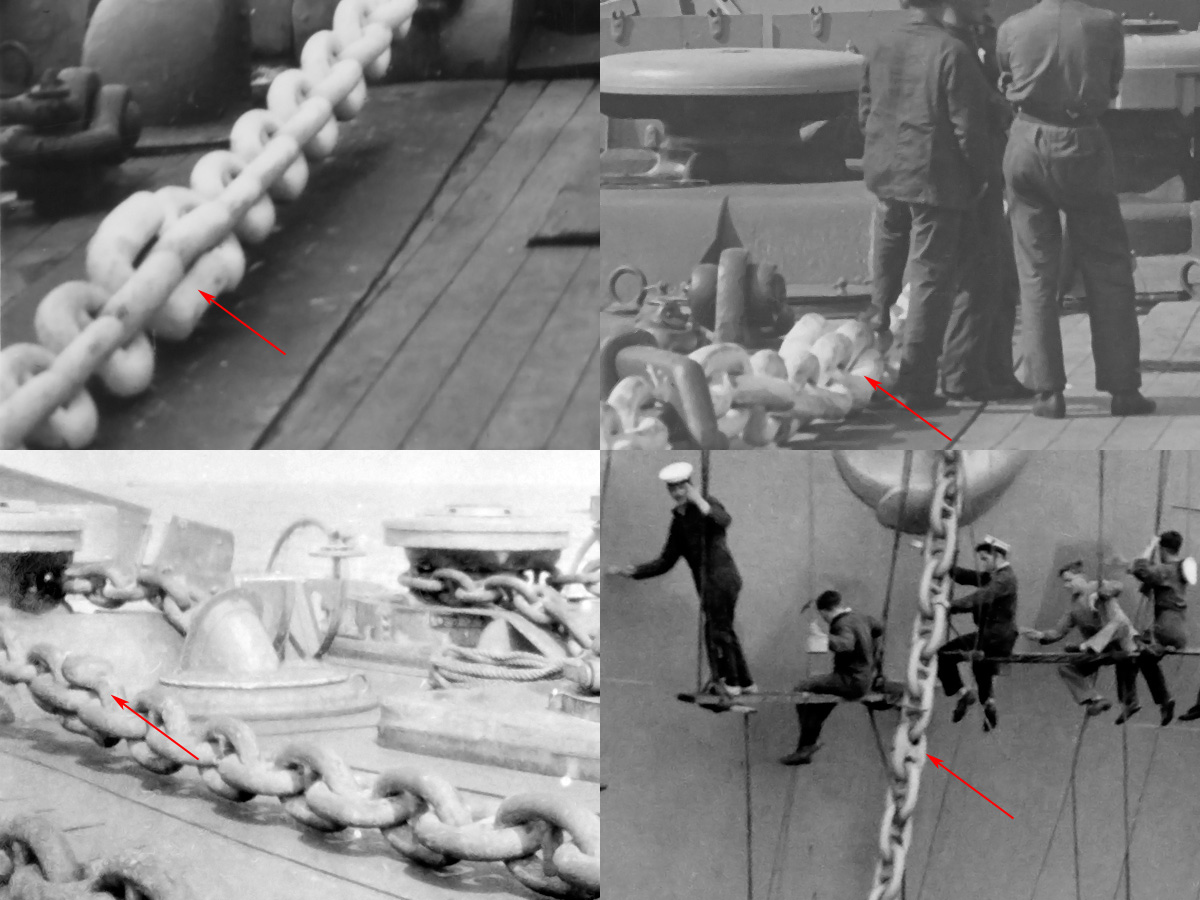
The shackles are joined by a joining shackle, a large U-shaped link with two 'rings' at the end---called lugs---and a pin. Note that the joining shackles must run around the capstans vertically so that the cable does not jump; this is best shown bottom left (HMS Repulse) . With the joining shackle always laying in the vertical the number of links is therefore always odd per either whole or half shackle. The top two images are HMS Hood while she is not at anchor; the position of the joining shackle on deck indicates the first run of cable from the anchor must be a half shackle (slightly more in fact). According to the AOTS Hood there is no stud in all links adjacent to the joining link and I later found a page from a Harland & Wolff ledger showing studless end links for each shackle. I could not find any photograph to confirm this but added them to the list. These studless links are slightly thicker than the common link. For all ships after WWI a lugless joining shackle was used that you can see on the bottom-right corner (HMS Rodney). This is a slightly larger version of the normal link that can be disassembled into several parts and would be less likely to damage the ground tackle or itself during operations (no studless link here adjacent to the joining shackle). The manual of seamanship states that cables must be landed every four years for testing and there must have been an opportunity to replace the joining shackles to the lugless version if this change were critical, but this did not happen.
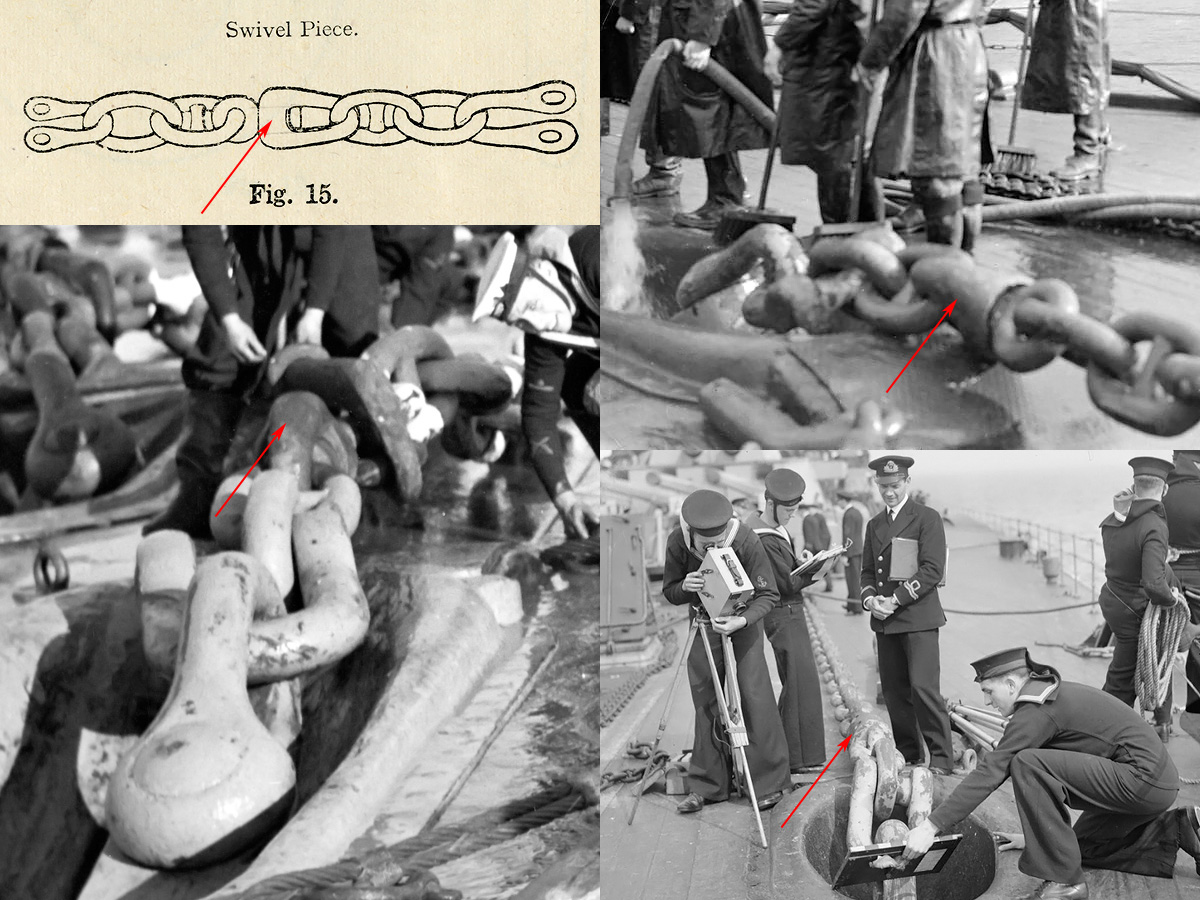
At the anchor�s side there is a swivel piece that allows the anchor to turn relative to the cable. Joining shackles are at either end, a swivelling link is in the centre, plus a few studded and open links. These images are of HMS Rodney and one aboard a KGV-class battleship (IWM image A11507 showing a filming crew preparing a training film called "Anchor Work").
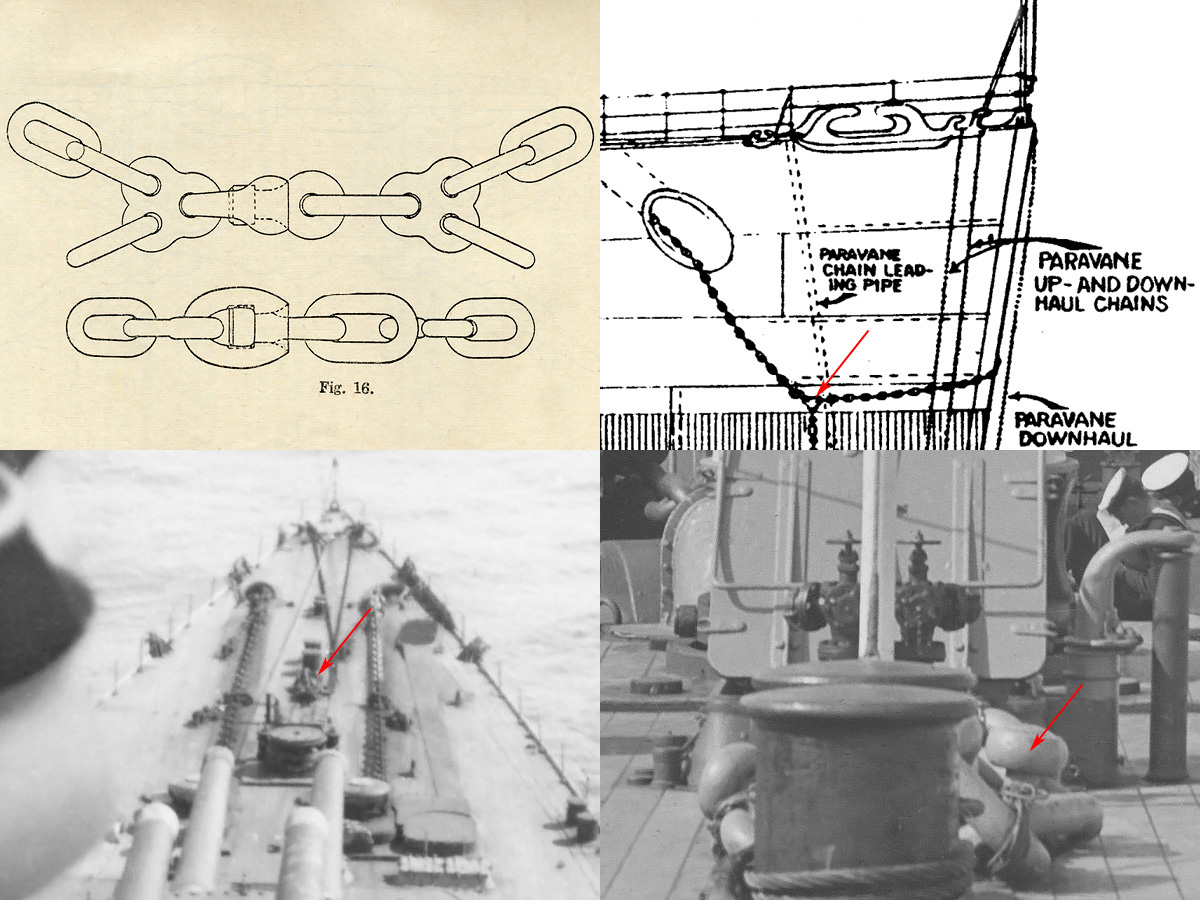
In many cases the ship is moored, that is, using both bow anchors simultaneously, so that the ship requires less room than using a single anchor. To avoid that the cables will become foul (i.e., twist) as the ship drifts around its anchorage a mooring swivel is used. The starboard cable is connected to the single links; the port side cable to the double links. Adding this mooring swivel is a complicated manoeuvrer explained in great detail in the manual. The image above right shows such a mooring swivel in place while laying the cables; this part is usually far submerged or even on the ocean floor. Next to a swivel piece two additional triangular links are present with a series of studless and studded links.
The drawing top-left from the manual does not show joining shackles and images of HMS King George V, with a more modern version of the mooring swivel, do not show joining shackles either. Perhaps they are simply not visible or stored nearby. The mooring swivel is really hard to recognize aboard HMS Hood, but the bottom images indicate its location.
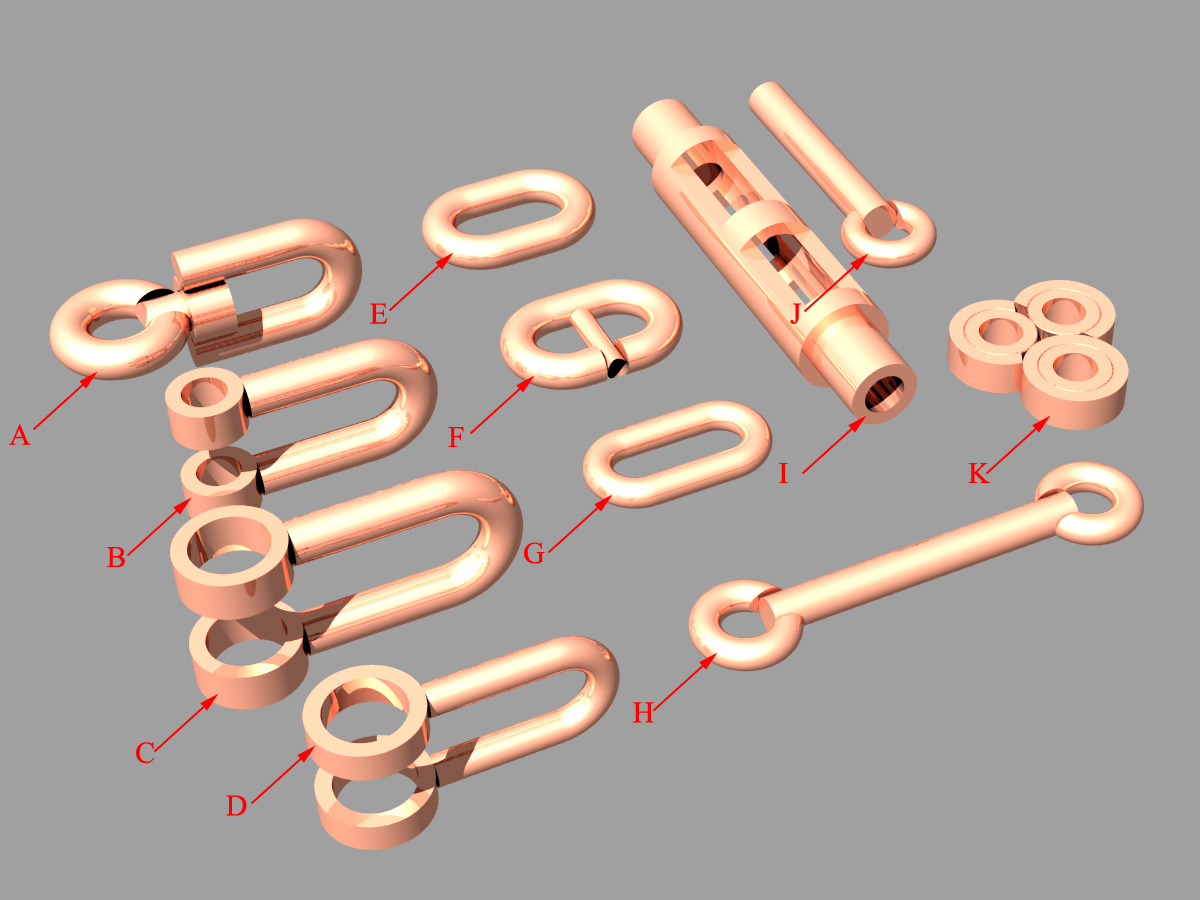
With all ingredients of the cable system identified (and a few more below) I made a small rendering in Rhino of the various components of the cable that may help as a visual reference as the final parts are so very small.
A) 3 x Swivel piece (4 parts)
B) 6 x Joining shackle, main cable
C) 2 x Joining shackle, stoppers
D) 2 x Joining shackle, stoppers
E) 18 x End cable link, no stud
F) 100+ x Common cable link, studded
G) 12 x Stopper link
H) 4 x Blake Slip (3 parts)
I) 2 x Bottle screw base (3 parts)
J) 4 x Bottle screw eyes (2 parts)
K) 2 x Three-eyed plate for the mooring swivel, 6 pieces.
The parts were made from Albion Alloy�s tubes (brilliant material) and copper wire from the Scientific Wire Company. The latter is not coated like winding wire and can be soldered more easily. I used a diameter of 0.15mm (studs), 0.20 (stopper chain links and smaller joining shackle), 0.25mm (common links, joining shackles, slip) and 0.28mm (end links and bottle screw eyelets).
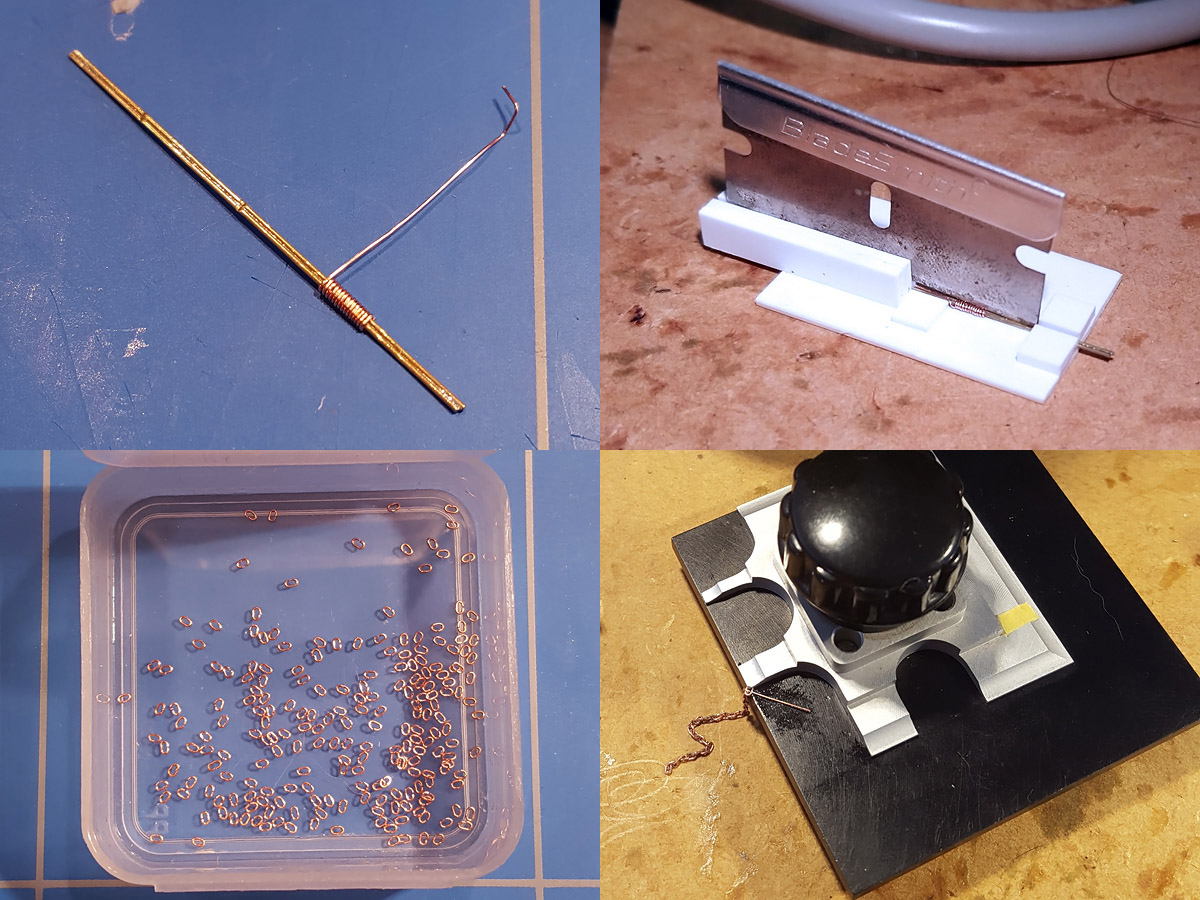
Although a single real link is a heavy piece of metal, the actual links are tiny on 350 scale at about 1.3mm long. Naturally I gave the procedure a bit of thought, first trying out small pieces before going on to making the entire chain. I stared with pliers, bending around wire (drills) and such, even cutting a folded link with two knifes glued together to remove just that one slice to accommodate the centre stud. I also experimented with a series folding jigs whereby a length of brass wire cut to size would be transformed in just the right link, but the results were inconsistent.
The last attempt was much easier; wrapping a wire around a folding template consisting of two 0.4mm brass rods soldered together. The links were cut using a template, flattened, and sorted into good and bad cuts. Usually if the cut isn't centred the entire batch is lost, but otherwise this method had a good production rate. For cutting I (gently!) tapped the back of the razor and repeatedly with a small hammer; the two brass rods only last a few batches. Then the fun part starts: soldering. The procedure is as follows: open a link sufficiently so that you can add it to the chain, close it slightly, fit the receive the stud. Clamp the link in the PE bending tool, add the centre stud wire (0.15mm) and solder away.
Normally for soldering you heat up the object with the iron and add some solder to it (with some flux), but I use the non-recommended method of adding flux to the objects and then briefly touch them with the (overheated) iron with a tiny (so tiny) bead of solder on the tip. This may lead to increased tip degradation and it's difficult to avoid burned flux (and other debris) collecting on the tip. At first I thought that my new best friend Stannol Tippy for tip cleaning would help (and it really does) but now I blame the wetted sponge for causing most of the tip burn. I now use brass shavings to clean the tip and so far the tip remains clean.
The bending tool is a huge heat sink, so after trimming the wire another pass with the soldering iron of the link released from its clamp was required. If the wire is still there (so funny when it sticks to the iron) and the link is fine then continue to the next one. Otherwise, cut it from the chain and start over. If two links are soldered to each other there is no way so save them. The excess wire and solder can now be sanded down. With this recipe it took about 7 to 8 minutes to create a new link, so I moved at a pace of about 8 mm per hour. I actually took my soldering equipment on vacation to Normandy, postponed reading David Hobb�s latest book, put up a parasol, and progressed ever so slowly, thankful that the third anchor chain of HMS Hood was landed and deciding that my next project is better off without anchors altogether.
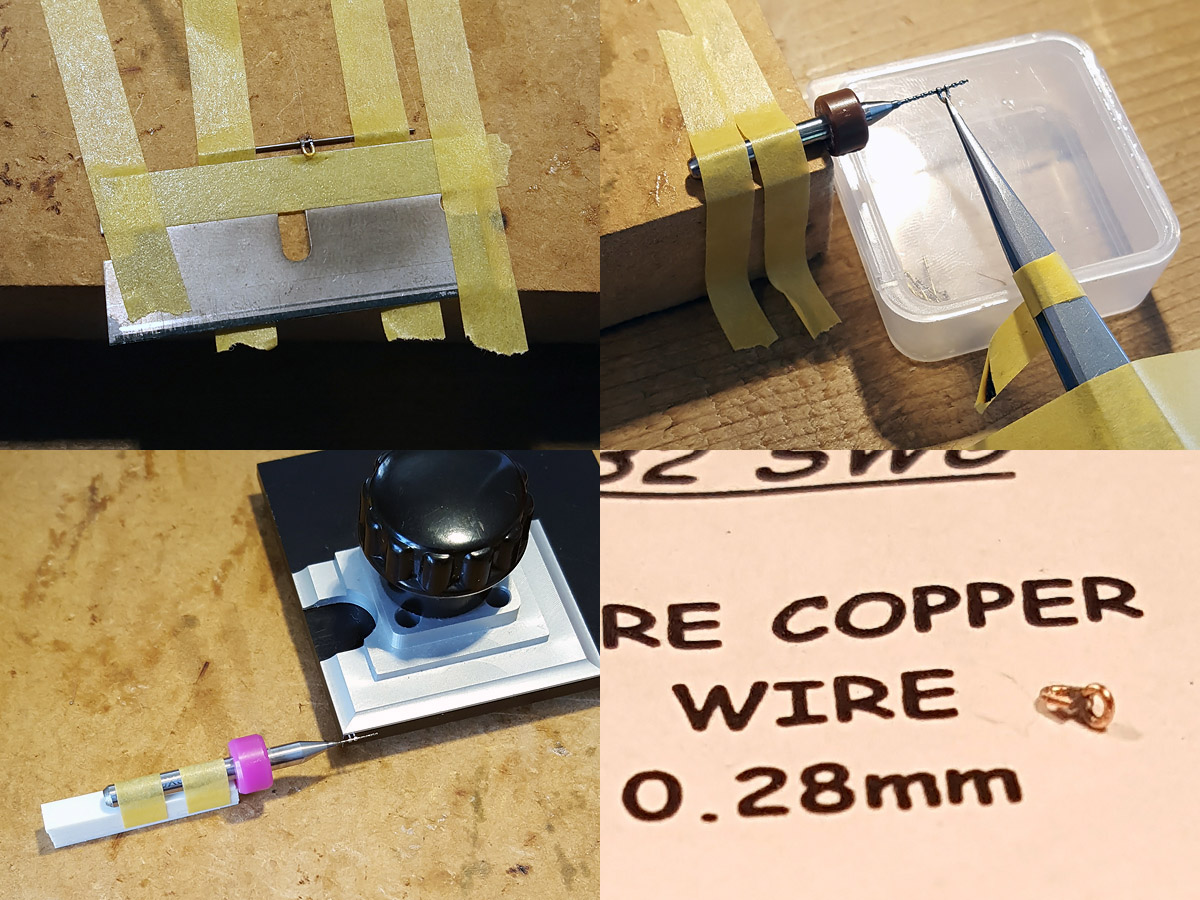
The joining shackles were the most difficult parts to make and I tried several recipes, with the bottom left one working well enough. The lugs are made from Albion Alloys rod. Here the failure rate was really high as it was so very tricky to have the lugs well aligned against the U-shaped wire. The larger shackles were placed on the punch of my punch&die set and soldered without the hold&fold... The swivel piece that consists of four parts was surprisingly easy to make by comparison.
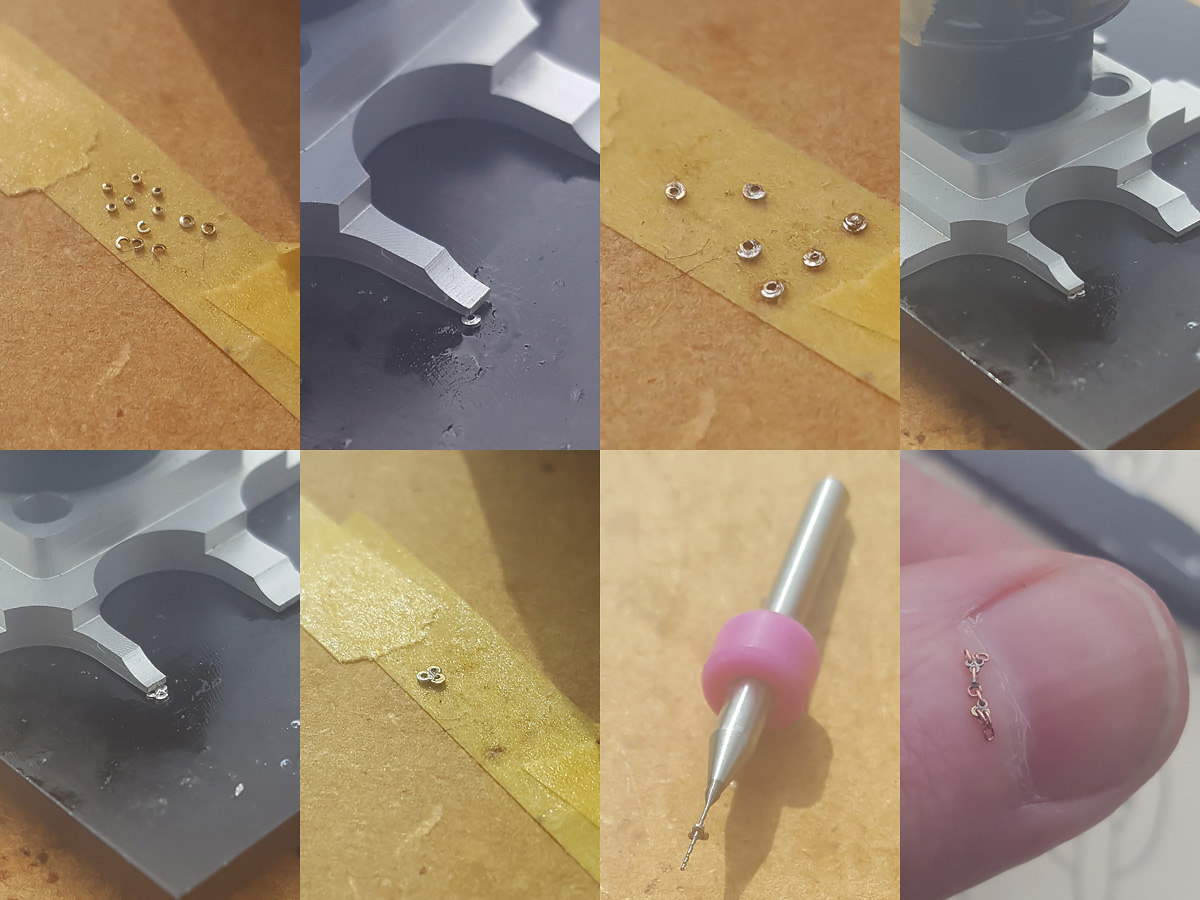
For the mooring swivel I really, really, should have had the three-eyed plate in photo-etch because this was an exercise in impatience and frustration, were it not for a sunny breeze, the sound of the ocean flowing over the dunes and an ample supply of ros�. I made two plates from tube that continuously desoldered itself, broke in half during sanding or redrilling the rings.
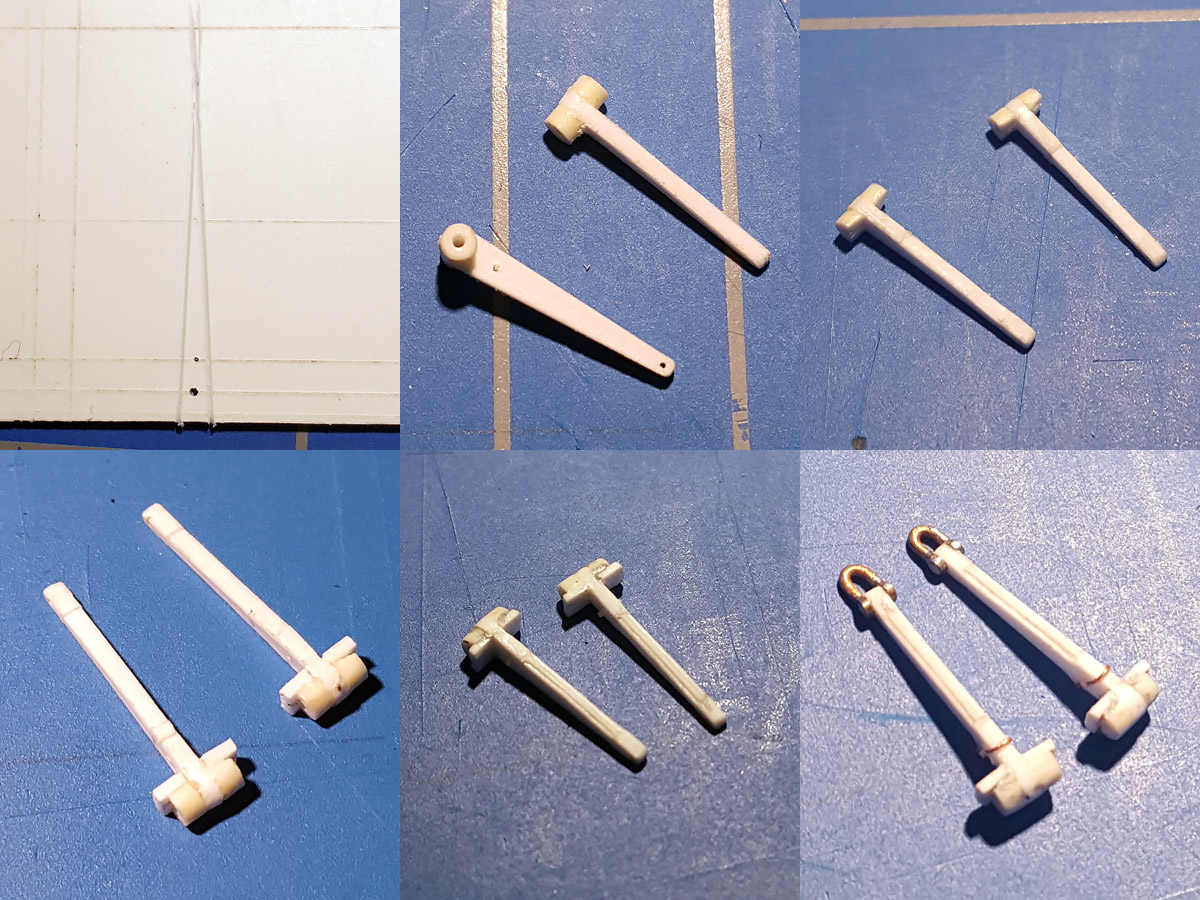
The anchors were also already built but shattered upon removal from the model so I made a new pair. I started from plate, added some rod. A small channel was carved filled with a bit of strip.

With a bit of rod in the shank and flukes the anchor remain moveable, though the flukes to not move together as I simply cannot get the flue to stick to bock at the same time. A bit of magic sculpt was used to make the pattern on the bottom of the flukes.
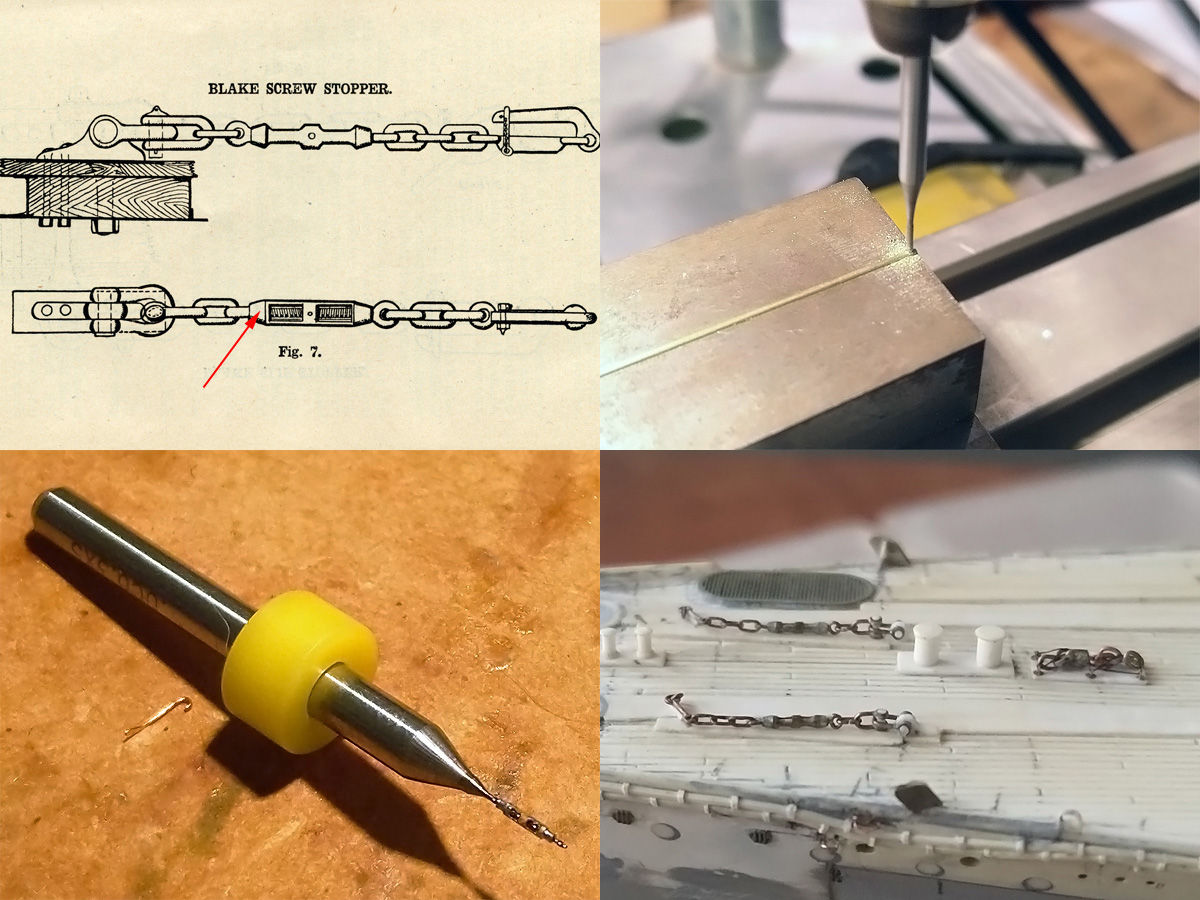
The screw stoppers were the hardest. The bottle screws were made from tube and �milled� using my drill press for which it is not suited. Two smaller tubes were soldered into the ends using a drill as a guide and the chamfered edges were added using superglue. Now, the tricky part was actually making sure that the stoppers were taut and suspended above the deck (1) while the anchor appears snugly fitted against the hull (2) while the clamp holds the main cable properly against a common link (3). The bottle screws could be used to correct for a bit of distance, but I thought that would be too difficult with so many parts to align. So the clamp was glued to the deck first, I hoped for the best and then I cheated by moving one the bolt forward by about 0.5mm and trimming the deck plate to size. The last part of the slip will be added once the main cable is in place. The mooring swivel is also visible bottom right lashed to six small photo-etched eyelets (many more will be added).
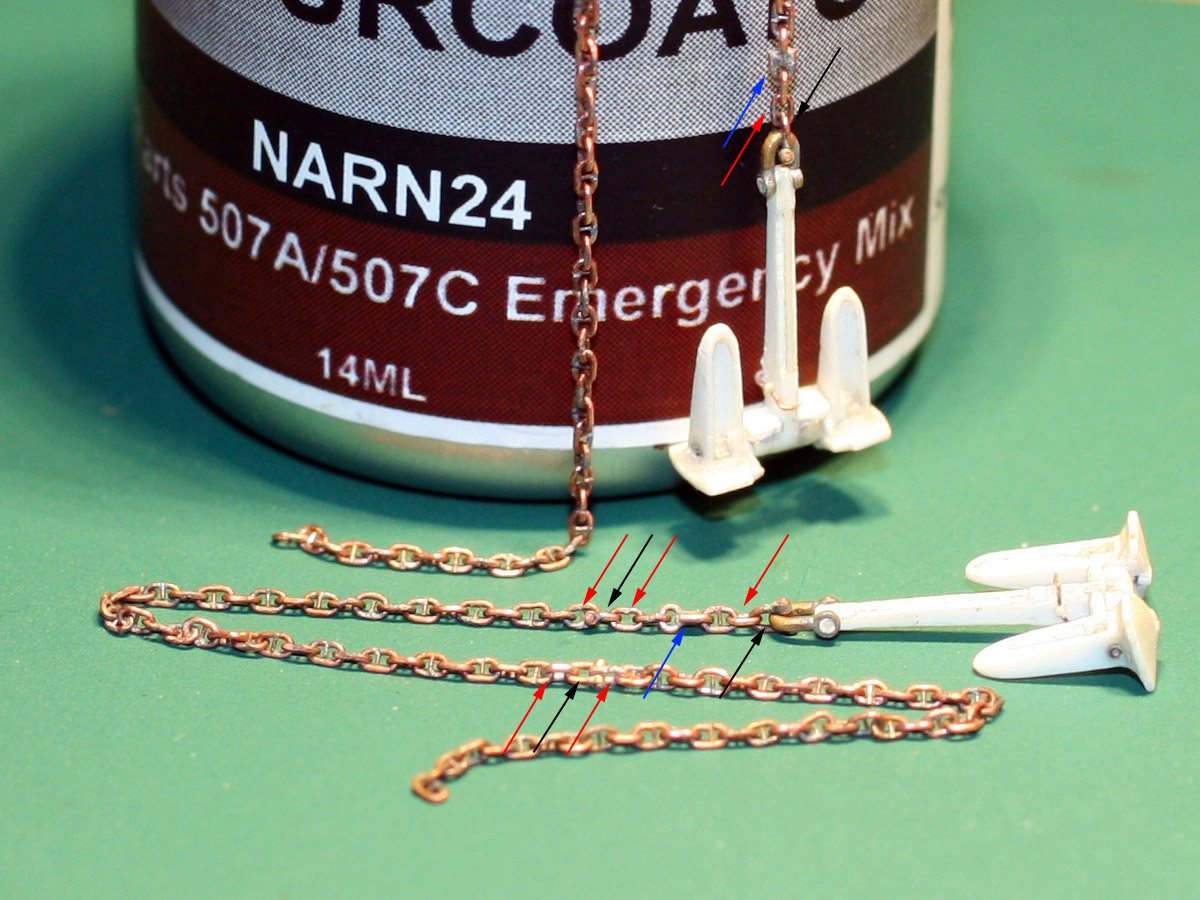
This small pic I took today shows the assembled cable and the anchors. The arrows indicate the position of the joining shackles (black), studless links (red) and the swivel pieces (blue).
While I was cleaning up the foredeck around B-barbette I noticed a bit of damage at the anchors; the link connecting the anchor to the chain was broken and this was difficult to repair. Just for the fun of it I wanted to find out if soldering studded anchor chain was doable. The studded chain previously installed was a bit over scale, otherwise fine, but why not try. In the end I decided to overhaul the entire ground tackle section of the model. As usual, this took a bit more effort than I anticipated.
You can find quite some information on anchors & cables in the Manual of Seamanship (1937, volume I) and I�d certainly recommend you find yourself a copy. Here you can see the ground tackle area of HMS Rodney. The anchors themselves are hove into the hawse pipes (A). The main anchor cable (B) runs around a cable holder (C) into the cable locker via a navel pipe (D). Inside this locker the cable is secured (see IWM image A 20535 to get an idea). There are two smaller chains on deck. Blake�s screw stopper is used (E) for heaving in and securing the anchor during sailing using a large bottle screw to apply tension; the main cable no longer carries the weight of the anchor. Blake�s stopper (F) is used only temporarily when the cable is parted at a joining shackle for mooring and other operations. Note that both the main cable and Blake�s stopper are not taut in this photograph and that several smaller lashings are present to prevent lateral movement. Additional securing lashings can be seen (G) joined to the various eyelets scattered in this area (H). When the ship is moored to a buoy, the cable is parted and the anchor is temporarily �catted� at the clump cathead (I). A large capstan (J) is used by the crew to move the cables around, with the aid of a pair of support rollers (K).
Here we have a good view of HMS Hood showing the cable holders (A), the capstan (B), support rollers (C). In addition, you can see that there is a small (portable) roller next to the hatch coaming (D) and a small hydrant manifold (E). The lower half shows the crew of Rodney hosing the deck after having hoisted the anchor (F) and a crew member about to place a lashing to secure the cable (G).
The Manual of Seamanship lists that chain is supplied in shackles and half shackles; one shackle is 12.5 fathoms (75 ft). Hood carrier 35 shackles and 12 half-shackles with a single cable link diameter of 3 3/8 in. Only a very short length of the cable will be visible on deck with most of the cable stored in its locker. All the parts of the cable including all the stoppers are given in great detail in the manual, except the single cable link and its dimensions. Using the link diameter of 3 3/8 in I estimated the link length at about 18" to 18+3/8" inch; I must have missed that the official Hood site states 20� but that is within tolerance.
The shackles are joined by a joining shackle, a large U-shaped link with two 'rings' at the end---called lugs---and a pin. Note that the joining shackles must run around the capstans vertically so that the cable does not jump; this is best shown bottom left (HMS Repulse) . With the joining shackle always laying in the vertical the number of links is therefore always odd per either whole or half shackle. The top two images are HMS Hood while she is not at anchor; the position of the joining shackle on deck indicates the first run of cable from the anchor must be a half shackle (slightly more in fact). According to the AOTS Hood there is no stud in all links adjacent to the joining link and I later found a page from a Harland & Wolff ledger showing studless end links for each shackle. I could not find any photograph to confirm this but added them to the list. These studless links are slightly thicker than the common link. For all ships after WWI a lugless joining shackle was used that you can see on the bottom-right corner (HMS Rodney). This is a slightly larger version of the normal link that can be disassembled into several parts and would be less likely to damage the ground tackle or itself during operations (no studless link here adjacent to the joining shackle). The manual of seamanship states that cables must be landed every four years for testing and there must have been an opportunity to replace the joining shackles to the lugless version if this change were critical, but this did not happen.
At the anchor�s side there is a swivel piece that allows the anchor to turn relative to the cable. Joining shackles are at either end, a swivelling link is in the centre, plus a few studded and open links. These images are of HMS Rodney and one aboard a KGV-class battleship (IWM image A11507 showing a filming crew preparing a training film called "Anchor Work").
In many cases the ship is moored, that is, using both bow anchors simultaneously, so that the ship requires less room than using a single anchor. To avoid that the cables will become foul (i.e., twist) as the ship drifts around its anchorage a mooring swivel is used. The starboard cable is connected to the single links; the port side cable to the double links. Adding this mooring swivel is a complicated manoeuvrer explained in great detail in the manual. The image above right shows such a mooring swivel in place while laying the cables; this part is usually far submerged or even on the ocean floor. Next to a swivel piece two additional triangular links are present with a series of studless and studded links.
The drawing top-left from the manual does not show joining shackles and images of HMS King George V, with a more modern version of the mooring swivel, do not show joining shackles either. Perhaps they are simply not visible or stored nearby. The mooring swivel is really hard to recognize aboard HMS Hood, but the bottom images indicate its location.
With all ingredients of the cable system identified (and a few more below) I made a small rendering in Rhino of the various components of the cable that may help as a visual reference as the final parts are so very small.
A) 3 x Swivel piece (4 parts)
B) 6 x Joining shackle, main cable
C) 2 x Joining shackle, stoppers
D) 2 x Joining shackle, stoppers
E) 18 x End cable link, no stud
F) 100+ x Common cable link, studded
G) 12 x Stopper link
H) 4 x Blake Slip (3 parts)
I) 2 x Bottle screw base (3 parts)
J) 4 x Bottle screw eyes (2 parts)
K) 2 x Three-eyed plate for the mooring swivel, 6 pieces.
The parts were made from Albion Alloy�s tubes (brilliant material) and copper wire from the Scientific Wire Company. The latter is not coated like winding wire and can be soldered more easily. I used a diameter of 0.15mm (studs), 0.20 (stopper chain links and smaller joining shackle), 0.25mm (common links, joining shackles, slip) and 0.28mm (end links and bottle screw eyelets).
Although a single real link is a heavy piece of metal, the actual links are tiny on 350 scale at about 1.3mm long. Naturally I gave the procedure a bit of thought, first trying out small pieces before going on to making the entire chain. I stared with pliers, bending around wire (drills) and such, even cutting a folded link with two knifes glued together to remove just that one slice to accommodate the centre stud. I also experimented with a series folding jigs whereby a length of brass wire cut to size would be transformed in just the right link, but the results were inconsistent.
The last attempt was much easier; wrapping a wire around a folding template consisting of two 0.4mm brass rods soldered together. The links were cut using a template, flattened, and sorted into good and bad cuts. Usually if the cut isn't centred the entire batch is lost, but otherwise this method had a good production rate. For cutting I (gently!) tapped the back of the razor and repeatedly with a small hammer; the two brass rods only last a few batches. Then the fun part starts: soldering. The procedure is as follows: open a link sufficiently so that you can add it to the chain, close it slightly, fit the receive the stud. Clamp the link in the PE bending tool, add the centre stud wire (0.15mm) and solder away.
Normally for soldering you heat up the object with the iron and add some solder to it (with some flux), but I use the non-recommended method of adding flux to the objects and then briefly touch them with the (overheated) iron with a tiny (so tiny) bead of solder on the tip. This may lead to increased tip degradation and it's difficult to avoid burned flux (and other debris) collecting on the tip. At first I thought that my new best friend Stannol Tippy for tip cleaning would help (and it really does) but now I blame the wetted sponge for causing most of the tip burn. I now use brass shavings to clean the tip and so far the tip remains clean.
The bending tool is a huge heat sink, so after trimming the wire another pass with the soldering iron of the link released from its clamp was required. If the wire is still there (so funny when it sticks to the iron) and the link is fine then continue to the next one. Otherwise, cut it from the chain and start over. If two links are soldered to each other there is no way so save them. The excess wire and solder can now be sanded down. With this recipe it took about 7 to 8 minutes to create a new link, so I moved at a pace of about 8 mm per hour. I actually took my soldering equipment on vacation to Normandy, postponed reading David Hobb�s latest book, put up a parasol, and progressed ever so slowly, thankful that the third anchor chain of HMS Hood was landed and deciding that my next project is better off without anchors altogether.
The joining shackles were the most difficult parts to make and I tried several recipes, with the bottom left one working well enough. The lugs are made from Albion Alloys rod. Here the failure rate was really high as it was so very tricky to have the lugs well aligned against the U-shaped wire. The larger shackles were placed on the punch of my punch&die set and soldered without the hold&fold... The swivel piece that consists of four parts was surprisingly easy to make by comparison.
For the mooring swivel I really, really, should have had the three-eyed plate in photo-etch because this was an exercise in impatience and frustration, were it not for a sunny breeze, the sound of the ocean flowing over the dunes and an ample supply of ros�. I made two plates from tube that continuously desoldered itself, broke in half during sanding or redrilling the rings.
The anchors were also already built but shattered upon removal from the model so I made a new pair. I started from plate, added some rod. A small channel was carved filled with a bit of strip.
With a bit of rod in the shank and flukes the anchor remain moveable, though the flukes to not move together as I simply cannot get the flue to stick to bock at the same time. A bit of magic sculpt was used to make the pattern on the bottom of the flukes.
The screw stoppers were the hardest. The bottle screws were made from tube and �milled� using my drill press for which it is not suited. Two smaller tubes were soldered into the ends using a drill as a guide and the chamfered edges were added using superglue. Now, the tricky part was actually making sure that the stoppers were taut and suspended above the deck (1) while the anchor appears snugly fitted against the hull (2) while the clamp holds the main cable properly against a common link (3). The bottle screws could be used to correct for a bit of distance, but I thought that would be too difficult with so many parts to align. So the clamp was glued to the deck first, I hoped for the best and then I cheated by moving one the bolt forward by about 0.5mm and trimming the deck plate to size. The last part of the slip will be added once the main cable is in place. The mooring swivel is also visible bottom right lashed to six small photo-etched eyelets (many more will be added).
This small pic I took today shows the assembled cable and the anchors. The arrows indicate the position of the joining shackles (black), studless links (red) and the swivel pieces (blue).
Last edited by EJFoeth on Fri Jan 03, 2020 3:37 am, edited 1 time in total.
-
Jabberwock

- Posts: 502
- Joined: Thu Mar 31, 2016 1:52 pm
- Location: Inverness
Re: 1/350 HMS Hood (scratchbuild)
OMG EJ!!!!!!!
Speechless!
Cheers, Jabb
Speechless!
Cheers, Jabb
HMS Hood, the big one!
I used to be indecisive, now I'm not so sure.
I used to be indecisive, now I'm not so sure.
-
wefalck
- Posts: 2093
- Joined: Wed Sep 28, 2011 12:04 pm
- Location: Paris
- Contact:
Re: 1/350 HMS Hood (scratchbuild)
Ouff ... you are really setting standards here ... have to keep up 
Eberhard
Former chairman Arbeitskreis historischer Schiffbau e.V. (German Association for Shipbuilding History)
--------------------------------------------------------------------------------------------------------------------------------------------------------------------------------------------
Former chairman Arbeitskreis historischer Schiffbau e.V. (German Association for Shipbuilding History)
--------------------------------------------------------------------------------------------------------------------------------------------------------------------------------------------
-
greenglade

- Posts: 225
- Joined: Thu Dec 28, 2017 10:48 am
Re: 1/350 HMS Hood (scratchbuild)
Lovely work EJ, first-class sir...
Pete
Pete
-
EJFoeth
- Posts: 2911
- Joined: Wed Jan 21, 2009 1:51 pm
Re: 1/350 HMS Hood (scratchbuild)
Thanks  I'm tempted to buy a 3D printer Continuing now, already broke 5 drills this morning so... going really well!
I'm tempted to buy a 3D printer Continuing now, already broke 5 drills this morning so... going really well!-
europapete
- Posts: 156
- Joined: Thu Jan 05, 2017 8:39 pm
Re: 1/350 HMS Hood (scratchbuild)
WOW! well done EJ. Abolutely stunning. Regards, Pete in RI. I have no clue how we can equal this in 1/200.
-
EJFoeth
- Posts: 2911
- Joined: Wed Jan 21, 2009 1:51 pm
Re: 1/350 HMS Hood (scratchbuild)
Thanks for the kind comments guys!
And the rest of the blog post on the ground tackle. Work progressed simultaneously with the cables and each pic is at least a day of work. The modelling mojo is now utterly spent and I cannot gather enough motivation to add primer Perhaps dry January is incompatible with model building
  I think I'll now spend some more time on my audio project (going to build a surround set) and I'm actually looking forward to going back to work designing propellers...
Blog post copied in full
With the cables slowly progressing as discussed in part I a few other bits & pieces were built to fully detail the area in front of the forward breakwater.
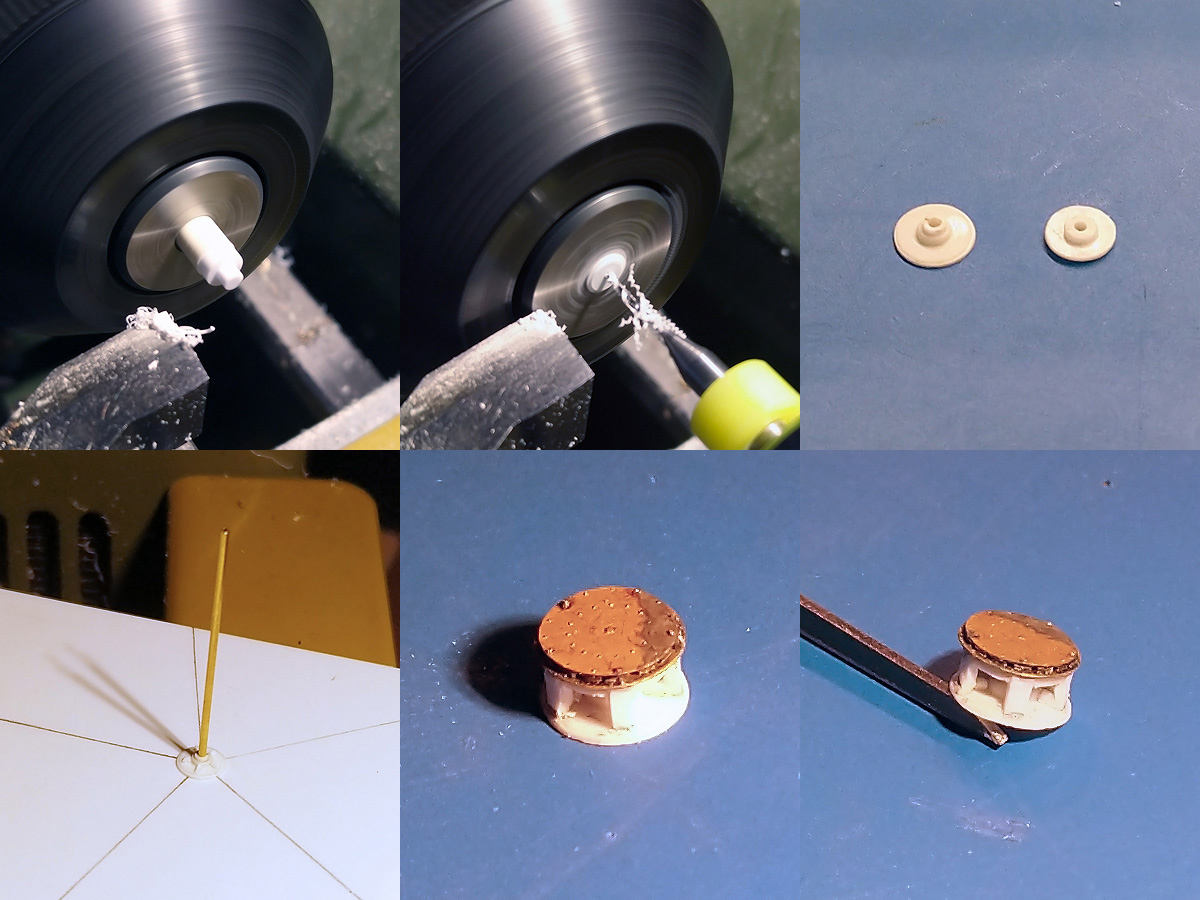
The capstan was remade simply because I lost the one I had. These are a nice combination of etched parts and styrene. The main (Napier) capstan is built up from disc and making these discs were tricky to do on a lathe: the parting tool would always deform the styrene. I played with tool angles and revs for a while, but in the end used a different approach by first cutting of a piece of rod with a small step in the diameter (top left). The part would then be reversed and work would continue from the other side with the cutting tool going fully against the chuck (carefully). The top etched parts were a bit of an experiment with three layers of PE and the small eyelets on top. Normally etching 0.1mm holes is asking for trouble as these holes are rarely etched through but now that I have a series of miniature drills I felt confident enough to drill in the etched holes; this went well enough. Too bad the eyelets are are too small to notice...
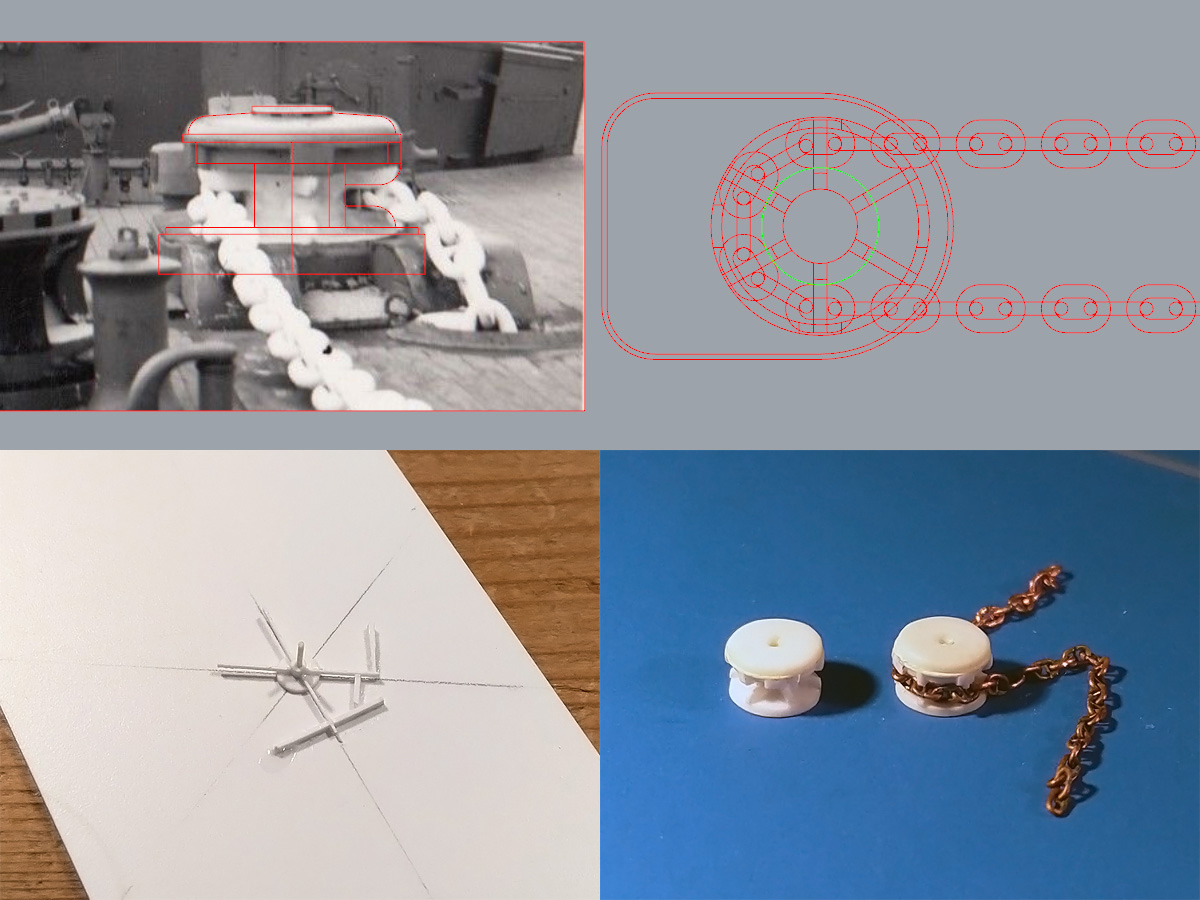
The Napier capstan can also serve as a cable holder when its whelps are removed and this holder has five spokes. The main cable holder dimensions were estimated from photographs and I estimate six spokes the holder for a proper spacing of the cable around the holder; otherwise the distance between cable on either side of the holder would not really match the photographs. A small template was helpful to keep the spacing at consistent angles.
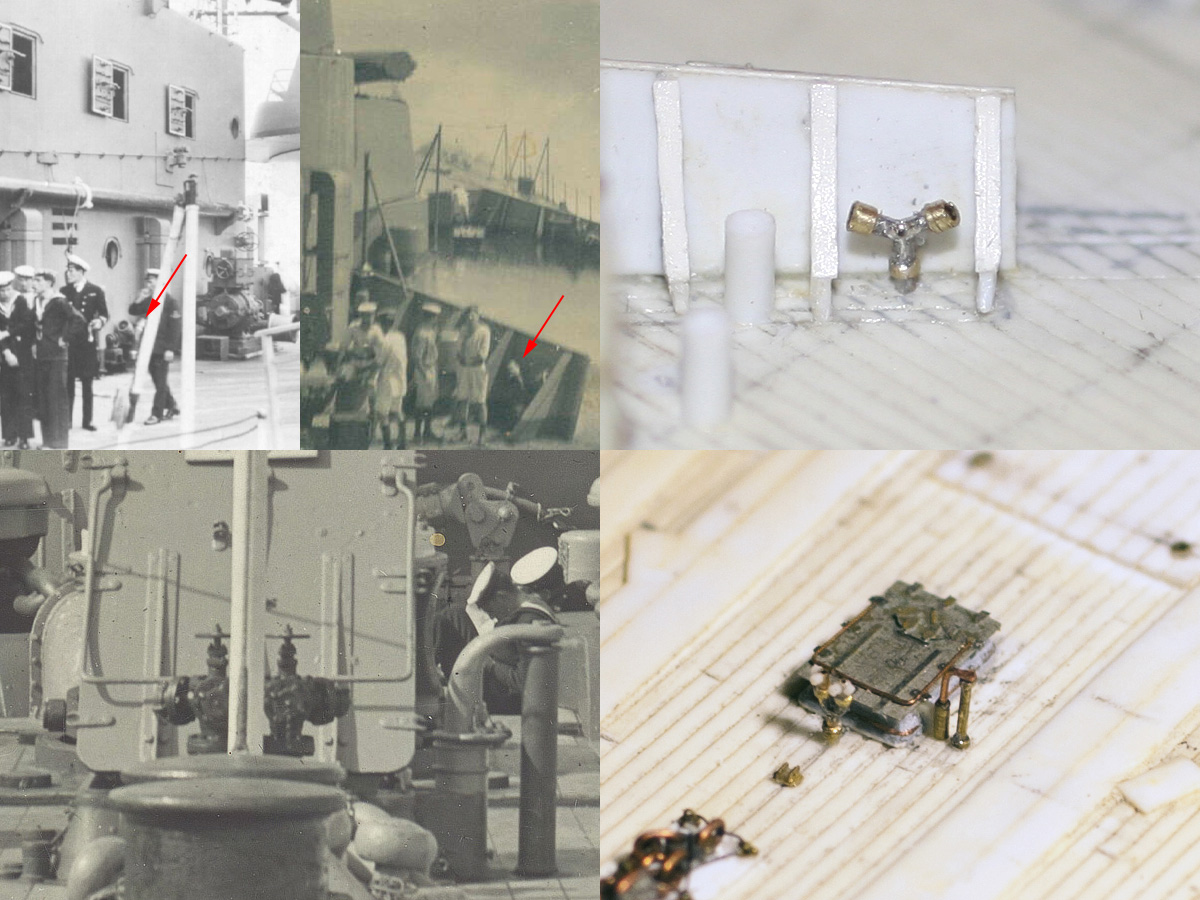
After I thought the main deck was done I made a few passes finding out small details I might have missed. The top row of images shows a small Y-shaped manifold behind the forward breakwater and against the rear quarterdeck bulkhead (a pair of them). I do not see more of them and they also do not show up on any of the plans. The forward hatch received a small support roller and some hydrant manifold. All parts are mainly soldered Albion Alloy tubes.

There are two pairs of paravane fairleads and the rear pair was replaced by some small support structure. Initially I thought this was added to keep any paravane cable away fro the degaussing cable but this structure shows up in 1939, prior to fitting the cable; a small plate was added in front of the structure when the degaussing cable was present though.
Top right shows the floor plate of the navel bonnet under construction. With the Proxxon drill press and divider it�s very easy to drill a polar array of holes on a plate. A small jig was built using 1.5mm rod and some strip with a hole punched out. The rod was made on the lathe as my experience showed that stock rod by Evergreen or Plastruct is not round enough.
The bottom right show the cable holder arrangement, a collection of strips finished by Magic Sculpt. The arrow indicates some detail but I do not know what it was for.
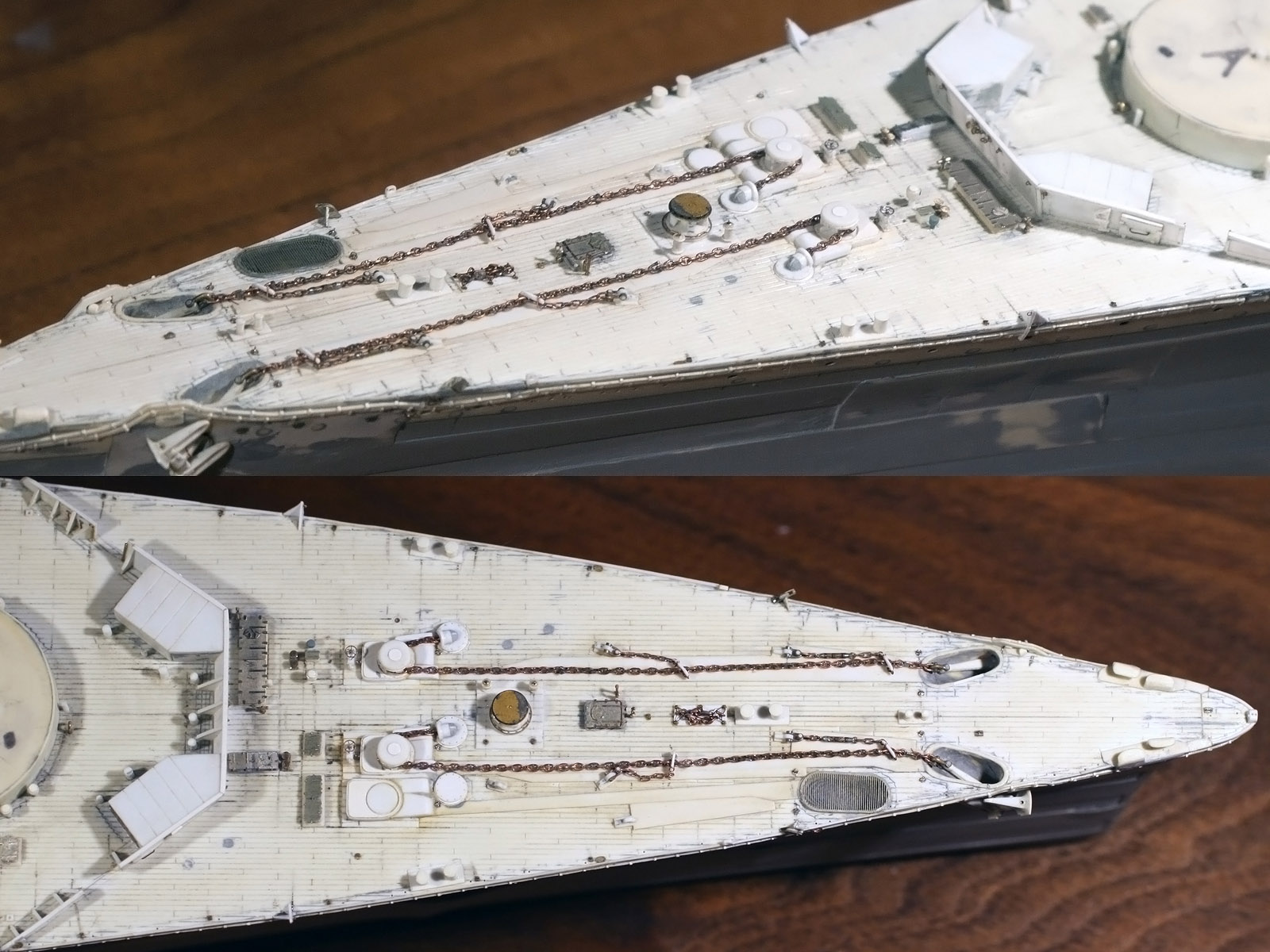
And here is the entire fo'c' sle. After the chains and capstans were replaced a few lifting eyes were added that are scattered around the deck. The cable holder brake handles were reproduced as well as a pair of staghorn bollards near the torpedo loading hatch (the wide hatch in front of the breakwater). A few hatches, capstan and support rollers are not yet fixed for ease of painting. One thing I do not really like is that the skylights on front of the breakwater should have a bit more distance between them; ah well.
And the rest of the blog post on the ground tackle. Work progressed simultaneously with the cables and each pic is at least a day of work. The modelling mojo is now utterly spent and I cannot gather enough motivation to add primer
Perhaps dry January is incompatible with model building I think I'll now spend some more time on my audio project (going to build a surround set) and I'm actually looking forward to going back to work designing propellers...Blog post copied in full
With the cables slowly progressing as discussed in part I a few other bits & pieces were built to fully detail the area in front of the forward breakwater.
The capstan was remade simply because I lost the one I had. These are a nice combination of etched parts and styrene. The main (Napier) capstan is built up from disc and making these discs were tricky to do on a lathe: the parting tool would always deform the styrene. I played with tool angles and revs for a while, but in the end used a different approach by first cutting of a piece of rod with a small step in the diameter (top left). The part would then be reversed and work would continue from the other side with the cutting tool going fully against the chuck (carefully). The top etched parts were a bit of an experiment with three layers of PE and the small eyelets on top. Normally etching 0.1mm holes is asking for trouble as these holes are rarely etched through but now that I have a series of miniature drills I felt confident enough to drill in the etched holes; this went well enough. Too bad the eyelets are are too small to notice...
The Napier capstan can also serve as a cable holder when its whelps are removed and this holder has five spokes. The main cable holder dimensions were estimated from photographs and I estimate six spokes the holder for a proper spacing of the cable around the holder; otherwise the distance between cable on either side of the holder would not really match the photographs. A small template was helpful to keep the spacing at consistent angles.
After I thought the main deck was done I made a few passes finding out small details I might have missed. The top row of images shows a small Y-shaped manifold behind the forward breakwater and against the rear quarterdeck bulkhead (a pair of them). I do not see more of them and they also do not show up on any of the plans. The forward hatch received a small support roller and some hydrant manifold. All parts are mainly soldered Albion Alloy tubes.
There are two pairs of paravane fairleads and the rear pair was replaced by some small support structure. Initially I thought this was added to keep any paravane cable away fro the degaussing cable but this structure shows up in 1939, prior to fitting the cable; a small plate was added in front of the structure when the degaussing cable was present though.
Top right shows the floor plate of the navel bonnet under construction. With the Proxxon drill press and divider it�s very easy to drill a polar array of holes on a plate. A small jig was built using 1.5mm rod and some strip with a hole punched out. The rod was made on the lathe as my experience showed that stock rod by Evergreen or Plastruct is not round enough.
The bottom right show the cable holder arrangement, a collection of strips finished by Magic Sculpt. The arrow indicates some detail but I do not know what it was for.
And here is the entire fo'c' sle. After the chains and capstans were replaced a few lifting eyes were added that are scattered around the deck. The cable holder brake handles were reproduced as well as a pair of staghorn bollards near the torpedo loading hatch (the wide hatch in front of the breakwater). A few hatches, capstan and support rollers are not yet fixed for ease of painting. One thing I do not really like is that the skylights on front of the breakwater should have a bit more distance between them; ah well.
-
JIM BAUMANN

- Posts: 5686
- Joined: Mon Jan 10, 2005 5:30 pm
- Location: Nr Southampton England
Re: 1/350 HMS Hood (scratchbuild)
EJ.....
as ever-- it is STUNNINGLY impressive.... and I guess it is the journey that gives the pleasure...
as it certainly is quite some journey!! 
impressive detaiiling, impressive photo searching and interpretation.
( ...==> manifold behind breakwater eh!!
watching with respect and admiration
JB
as ever-- it is STUNNINGLY impressive.... and I guess it is the journey that gives the pleasure...
as it certainly is quite some journey!!
impressive detaiiling, impressive photo searching and interpretation.
( ...==> manifold behind breakwater eh!!
watching with respect and admiration
JB
....I buy them at three times the speed I build 'em.... will I live long enough to empty my stash...?
http://www.modelshipgallery.com/gallery ... index.html
IPMS UK SIG (special interest group) www.finewaterline.com
http://www.modelshipgallery.com/gallery ... index.html
IPMS UK SIG (special interest group) www.finewaterline.com
-
Timhan
- Posts: 351
- Joined: Mon Dec 28, 2009 12:57 am
Re: 1/350 HMS Hood (scratchbuild)
Hello EJ.
Have you ever considered documenting your remarkable build into book form when you (finally !!!) finish it.
Two books come to mind - Nepean Longridge book describing his beautiful "Cutty Sark" model, and Harold Underhill's
book "Plank on Frame" book on his building the brigantine "Leon". Am sure there are more such books out there, but
a formal work describing you truly amazing model would be a treasure trove for model makers. Please consider.
Love your work.
Tim.
Have you ever considered documenting your remarkable build into book form when you (finally !!!) finish it.
Two books come to mind - Nepean Longridge book describing his beautiful "Cutty Sark" model, and Harold Underhill's
book "Plank on Frame" book on his building the brigantine "Leon". Am sure there are more such books out there, but
a formal work describing you truly amazing model would be a treasure trove for model makers. Please consider.
Love your work.
Tim.
-
EJFoeth
- Posts: 2911
- Joined: Wed Jan 21, 2009 1:51 pm
Re: 1/350 HMS Hood (scratchbuild)
I have considered that and decided to continue blogging on. One reason is that the entire project has been mostly a learn-by-doing exercise (a journey as Jim puts it ) with some parts not really well done (the hull of which I shall not speak). Also, most pics are taken with bad cameras and reduced much in quality. Only for this model I retrieved my SLR camera because my new smart phone isn't any good at taking pictures of the model (Nokia) but I'm still not happy with the results. I guess I'd need a dedicated place to take pictures, a few new lenses and lights... Currently I do not have a hobby room working at our dining table, clearing up the mess and stacking parts.... Having said that, I do really like the idea and will probably take it into account for my next project when Hood is done (if that ever happens)... F
) with some parts not really well done (the hull of which I shall not speak). Also, most pics are taken with bad cameras and reduced much in quality. Only for this model I retrieved my SLR camera because my new smart phone isn't any good at taking pictures of the model (Nokia) but I'm still not happy with the results. I guess I'd need a dedicated place to take pictures, a few new lenses and lights... Currently I do not have a hobby room working at our dining table, clearing up the mess and stacking parts.... Having said that, I do really like the idea and will probably take it into account for my next project when Hood is done (if that ever happens)... F
Last edited by EJFoeth on Thu Jan 30, 2020 8:02 am, edited 1 time in total.
-
ModelMonkey
- Model Monkey

- Posts: 4103
- Joined: Sat Aug 20, 2005 9:27 pm
- Location: USA
- Contact:
Re: 1/350 HMS Hood (scratchbuild)
Superb.
Thanks for taking us to school!
Thanks for taking us to school!
Have fun, Monkey around. TM
-Steve L.
Complete catalog: - https://www.model-monkey.com/
Follow Model Monkey™ on Facebook: - https://www.facebook.com/modelmonkeybookandhobby
-Steve L.
Complete catalog: - https://www.model-monkey.com/
Follow Model Monkey™ on Facebook: - https://www.facebook.com/modelmonkeybookandhobby
-
EJFoeth
- Posts: 2911
- Joined: Wed Jan 21, 2009 1:51 pm
Re: 1/350 HMS Hood (scratchbuild)
The fore deck was next in line for painting. Unfortunately I had a minor disaster with a coat of Humbrol H72 giving rough spots plus some over-spray that didn't dry up thinly and it was worst some distance after the deck (taped off areas). After brushing the model with alcohol I lightly sanded the deck and removed the grainy surface where I could using pieces of sanding paper glued to toothpicks, etched parts could be scraped clean. Many details are soldered or glued firmly, but the vents around the barbettes are fragile and took a bit more time. It went well enough, but I was otherwise very much not pleased loosing a day or two that could have been spent painting. Not sure if it insufficient stirring but it was probably my fault somewhere along the line. Learn by failure I suppose. The result is still not too bad but macro shots will show the bad finish. Perhaps one of the reasons I dread painting; small errors are very difficult to correct. But rather than trashing the model, getting drunk and starting over I just continued; it's a hobby after all and just hope for the best. Details as the chain and such still show a bad finish and that does dampen the enthusiasm ever so slightly. On the bright side, we can act as if it's a bit of dirt or salt deposition adding texture. And since I also no longer use dry-brushing it should be fine. It's not so much that the situation cannot be salvaged but more so that I do not control the process to my liking. I did not have this problem with my grey coats fortunately. It's funny, as from the construction part the model is quite accomplished, but I consider myself to be a bit of a beginner with painting. And as an expert is someone who has made all errors in his field that can be made I have some additional erring left to do.

The entire deck was masked after a layer of primer, corrections, and a couple of coats of Humbrol H72, rough-spot corrections and a barrel of Whisky. There's a lot of detail to work around, so this takes many wee bits of tape. As the deck will be painted by hand it doesn't have to be exact.

The rest was sprayed with two coats of my AP507A/B mixture. I stored some batches on paint in Badger jars and most of this went bad (dried in the jar); I bought a stash of empty tins at https://www.phoenix-paints.co.uk/, including some 125ml tins for storage. Meanwhile, the new Humbrol colours I ordered do not mix to the same colour I had; too blue. With some black and some drops of red the colour might be used as a base. Fortunately I have a a few tins of my old paint + white lying around, more that enough to finish the model, so that will be the main colour. Might as well have used the new Colourcoat range. Note that the sandy layer of H72 on the deck shows patterns of masking, as a final insult to my painting troubles, but as the next stage is painting in all planks one by one that doesn't worry me at all.

Forepeak has received three passes with H72+white (50/50), H72+H110 Natural Wood (50/50) and H187 Sand. Only a few light planks behind the breakwater need to be added. The contrast is purposely overdone as a few wash layers will be added (eventually) that will pull the colours together.
The entire deck was masked after a layer of primer, corrections, and a couple of coats of Humbrol H72, rough-spot corrections and a barrel of Whisky. There's a lot of detail to work around, so this takes many wee bits of tape. As the deck will be painted by hand it doesn't have to be exact.
The rest was sprayed with two coats of my AP507A/B mixture. I stored some batches on paint in Badger jars and most of this went bad (dried in the jar); I bought a stash of empty tins at https://www.phoenix-paints.co.uk/, including some 125ml tins for storage. Meanwhile, the new Humbrol colours I ordered do not mix to the same colour I had; too blue. With some black and some drops of red the colour might be used as a base. Fortunately I have a a few tins of my old paint + white lying around, more that enough to finish the model, so that will be the main colour. Might as well have used the new Colourcoat range. Note that the sandy layer of H72 on the deck shows patterns of masking, as a final insult to my painting troubles, but as the next stage is painting in all planks one by one that doesn't worry me at all.
Forepeak has received three passes with H72+white (50/50), H72+H110 Natural Wood (50/50) and H187 Sand. Only a few light planks behind the breakwater need to be added. The contrast is purposely overdone as a few wash layers will be added (eventually) that will pull the colours together.
-
MartinJQuinn

- Posts: 8532
- Joined: Tue Jan 11, 2005 1:40 pm
- Location: New Jersey
Re: 1/350 HMS Hood (scratchbuild)
My modeling credo!EJFoeth wrote:Learn by failure I suppose.
I think you are being way to hard on yourself. It looks really good. I especially like the last photo, showing the planking detail. Well done!
Martin
"Tomorrow is the most important thing in life. Comes into us at midnight very clean. It's perfect when it arrives and it puts itself in our hands. It hopes we've learned something from yesterday." John Wayne
Ship Model Gallery
"Tomorrow is the most important thing in life. Comes into us at midnight very clean. It's perfect when it arrives and it puts itself in our hands. It hopes we've learned something from yesterday." John Wayne
Ship Model Gallery
-
JCRAY
- Posts: 633
- Joined: Sun Feb 08, 2009 3:18 pm
- Location: Palm Beach, Fla
Re: 1/350 HMS Hood (scratchbuild)
What an awesome accomplishment!
Thank you EJ
Thank you EJ
-
LE BOSCO

- Posts: 2261
- Joined: Thu Aug 27, 2009 11:05 am
- Location: Paris France
Re: 1/350 HMS Hood (scratchbuild)
Hi
your work is always just as incredible in accurate detail and the final result will be a master piece
best regards
cheers
Nicolas
your work is always just as incredible in accurate detail and the final result will be a master piece
best regards
cheers
Nicolas