1. Trawling through Navsource, it looks to me like 1990 or thereabouts is the cutoff point after which the US Navy stopped painting the uppermost upperworks of its ships black, and switched to the super-boring "Nothing but Haze Gray Anywhere but the Decks" scheme used today. Is that correct?
2. Am I right in perceiving that at least initially, the SPY-1 panels on the Ticonderoga-class CGs were painted a somewhat paler, slightly browner color from the surrounding superstructure plating? If so, what is that color? Radome Tan, maybe? And, again if it really is a different color, is it still in use? More recent photos of the Ticonderogas (and of the Arleigh Burkes) sometimes seem to show differences between the SPY-1 panels and the surfaces to which they're attached, but only sometimes, and in a much more ambiguous way, so that whatever differences I think I see would fall well within the margin of error for tricks of the light.
3. What about the other missile-guidance radars? In Cold War-era photos, it often looks like the business end of an AN/SPG-51 or AN/SPG-49 is lighter in color than the rest of the ship, while AN/SPG-55s sometimes look almost olive drab to me. Am I just seeing things, or were there really variations in how these radars were painted during the years when they were in service?
A few extra-fiddly USN painting questions
Moderators: MartinJQuinn, Timmy C, Gernot, Olaf Held, JWintjes
-
DougC
Re: A few extra-fiddly USN painting questions
As for 1., the change was made when they switched from steam turbines to cleaner burning gas turbines.
-
Rick_H
- Posts: 278
- Joined: Sun Jan 16, 2005 2:06 am
- Location: Seattle, WA
Re: A few extra-fiddly USN painting questions
In 1989, the experiment to stop painting the upperworks in black was presented by NAVSEA to my ship as a "low observability" scheme. I was on a Knox class ship, so it had nothing to do with the propulsion plant. In 1987-88 USS Cook and a Spruance made a deployment and it was determined that the lack of black topmasts kept the ships from being seen for a difference of several miles. (It was commonly known that the topmasts of a Knox or a Spruance stood out in stark contrast to the horizon.) I don't know how widely or how quickly that change was implemented.
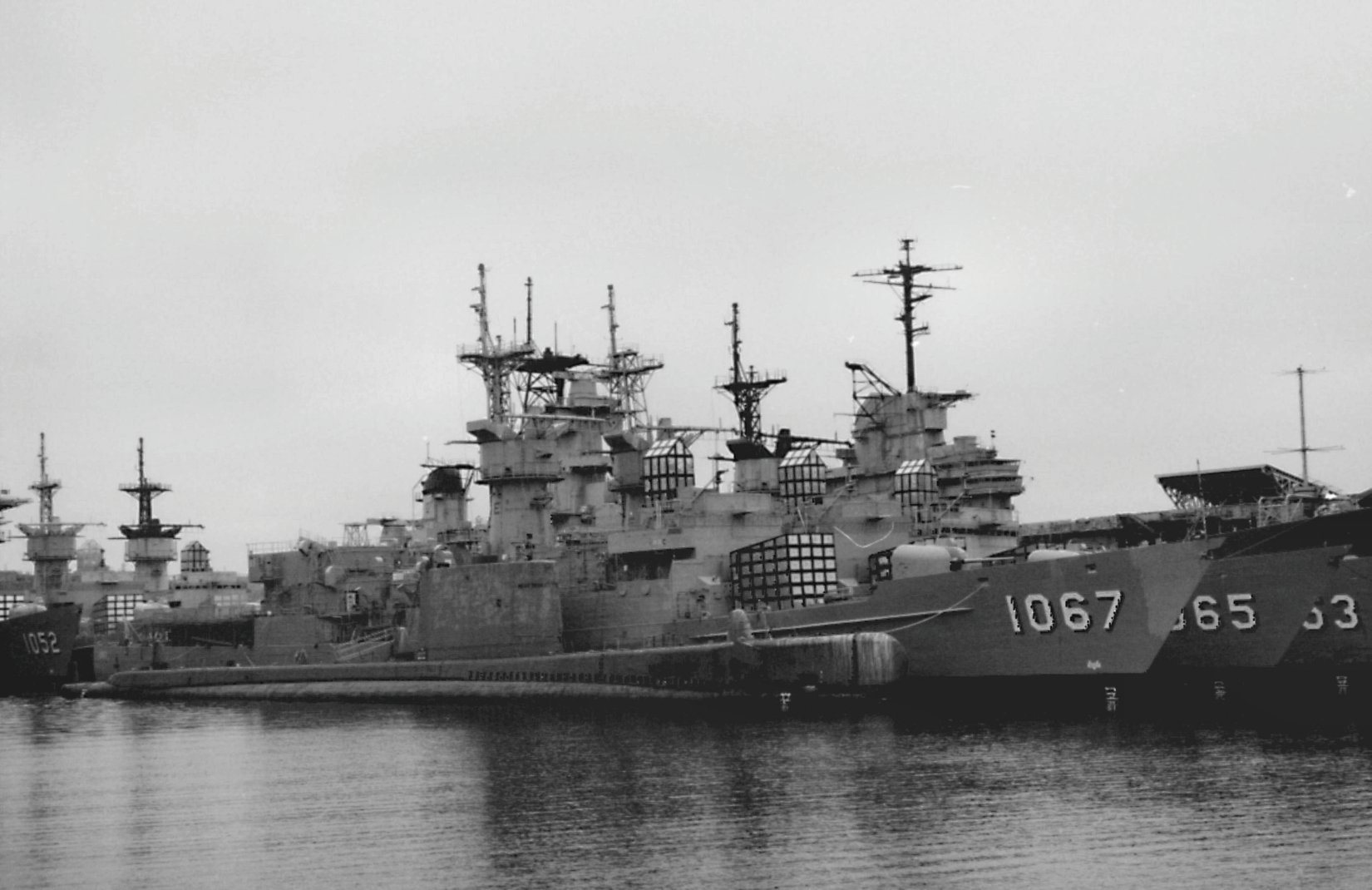
The Navsource photo at http://www.navsource.org/archives/06/im ... 105315.jpg shows a mixture of black and grey topmasts on a bunch of 1052s after their decomm in 1992.
The NAVSEA folks made a point of telling us that the black had not been a Navy mandate but a custom that filtered from the Sixth Fleet/Second Flt in the 50s to the Seventh Fleet/Third Flt when the ships were deployed together around Viet Nam. Apparently the Sixth Fleet commanders saw the black upperworks on European ships and copied it. Or maybe that was just a story, with a couple of NAVSEA O-6s pulling our leg.
My ship (Stein, FF-1065) got the grey topmasts and at the same time, lost all black and white paint, as a measure against IR missiles. (The good Lord knows we couldn't defend ourselves with the weapons onboard - "shoot with the 5" until the incoming missile is in range of the BPDMS, then stop shooting 5" so we don't knock down our own outbound missiles" - good grief). So at that 1988-89 yard period, Stein had the hull numbers painted in dark grey/ light grey, the top of the ASROC mount became light grey, the bottom of the small boats became dark grey.
I know that in 1993 (July?) the dark grey/light grey hull number scheme was adopted fleetwide. Don't know how long that lasted.
The Navsource photo at http://www.navsource.org/archives/06/im ... 105315.jpg shows a mixture of black and grey topmasts on a bunch of 1052s after their decomm in 1992.
The NAVSEA folks made a point of telling us that the black had not been a Navy mandate but a custom that filtered from the Sixth Fleet/Second Flt in the 50s to the Seventh Fleet/Third Flt when the ships were deployed together around Viet Nam. Apparently the Sixth Fleet commanders saw the black upperworks on European ships and copied it. Or maybe that was just a story, with a couple of NAVSEA O-6s pulling our leg.
My ship (Stein, FF-1065) got the grey topmasts and at the same time, lost all black and white paint, as a measure against IR missiles. (The good Lord knows we couldn't defend ourselves with the weapons onboard - "shoot with the 5" until the incoming missile is in range of the BPDMS, then stop shooting 5" so we don't knock down our own outbound missiles" - good grief). So at that 1988-89 yard period, Stein had the hull numbers painted in dark grey/ light grey, the top of the ASROC mount became light grey, the bottom of the small boats became dark grey.
I know that in 1993 (July?) the dark grey/light grey hull number scheme was adopted fleetwide. Don't know how long that lasted.
On the workbench:
1/700 HMS Swiftsure - Combrig
1/700 CGC Chelan - White Ensign
1/700 HMCS Forrest Hill - HP
1/700 Ulsan - Kobo Hiryu
--and dozens more
1/700 HMS Swiftsure - Combrig
1/700 CGC Chelan - White Ensign
1/700 HMCS Forrest Hill - HP
1/700 Ulsan - Kobo Hiryu
--and dozens more
-
Admhawk

- Posts: 959
- Joined: Sat Feb 03, 2007 1:00 pm
- Location: Bowmanville, ON, Canada
Re: A few extra-fiddly USN painting questions
The change from black to grey was definitely due to IR guided missiles. I was told hand held ones that were becoming prevelant.
The lo viz hull numbers are still req'd, but there are exceptions. You often see black and white numbers on ships in port or at events like fleet week.
The spg-55s were first made for the army, so they were olive drab. Because you couldn't paint radomes (paint interferes with the signals) they stayed green. Nobody thought it important enough to make grey domes for them.
The spy covers have a few variations. Again, no paint. Some have a grid on them, others are flat. The color is usually a light tan, but newer ones look like they have made an attempt to dye them Gray.
All the dishes and domes are unpainted, so they vary in color due to manufacturing variances. They also fade and discolor to varying degrees. Newer manufacturing techniques are more consistent, but older versions are more noticeable.
The lo viz hull numbers are still req'd, but there are exceptions. You often see black and white numbers on ships in port or at events like fleet week.
The spg-55s were first made for the army, so they were olive drab. Because you couldn't paint radomes (paint interferes with the signals) they stayed green. Nobody thought it important enough to make grey domes for them.
The spy covers have a few variations. Again, no paint. Some have a grid on them, others are flat. The color is usually a light tan, but newer ones look like they have made an attempt to dye them Gray.
All the dishes and domes are unpainted, so they vary in color due to manufacturing variances. They also fade and discolor to varying degrees. Newer manufacturing techniques are more consistent, but older versions are more noticeable.
Darren (Admiral Hawk)
In the not so tropical climate of the Great White North.
In the not so tropical climate of the Great White North.