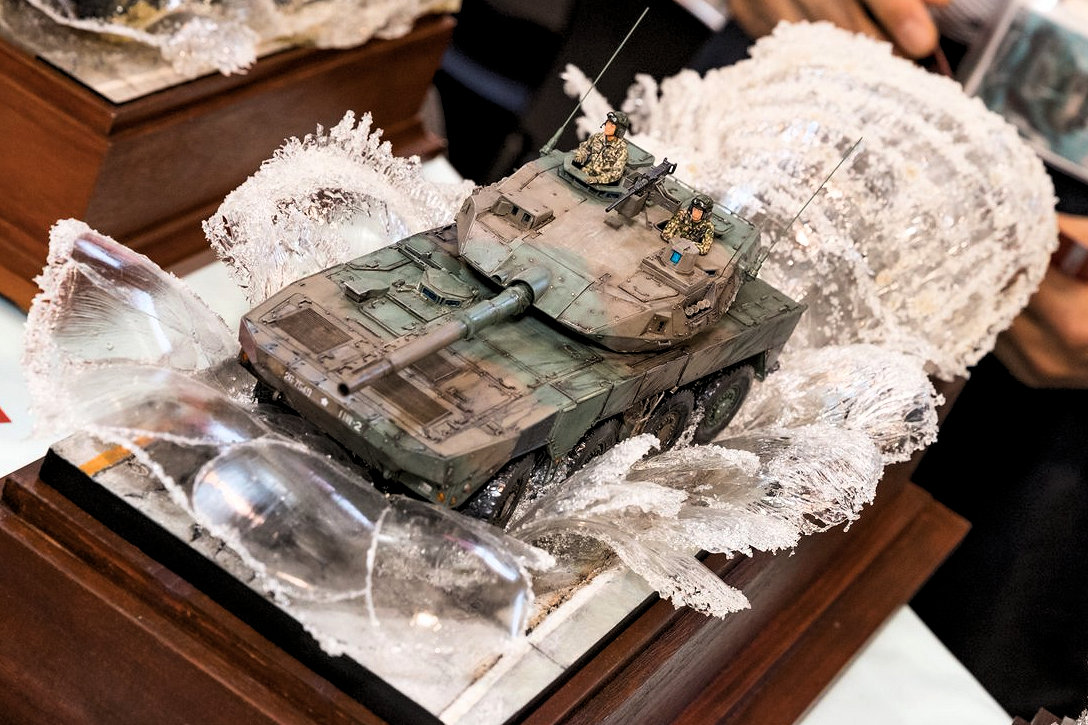
So I'm working on King George V and want to do a deep ocean scene. Here's the feasibility visual for you guy's opinion and direction... after watching a video on creating waterfalls i began to wonder if i could use a similar technique for creating the big bow wave. Instead of using a flat non stick surface i spread out the water effects on a sharply curved whiskey glass. Makes it better already right?
Had to throw in a seasonal background...and here it is dry.
now I'll have to figure out a way to support it, maybe a thin wire underneath. Let me know what you think of this and what might make it better. Ideas on support and forming the shape appreciated as well.
i think I need more coming up and over the bow and stuff. This is just 1 piece so i can make lots more and tack them together as well. Throw some thought and ideas my way gents!
The above example looks excellent, but I think I would have tinted the "water" before, to make it look dirty, or muddy. As it is, the water looks too crystal clear. The material you used, is it similar to clear acrylic modelling paste, or clear silicon sealer (as for around bathtubs, sinks, etc.)? Clear acrylic paste can be colored or tinted with acrylic colors - in this case (your bow wave) blue-ish-green. Pre-tinting the clear acrylic looks a LOT better than painting it after.
I'm definitely going to have to experiment with this technique!
For the example above it�s an acrylic paste- Scenic Woodlands Water Effects. It dries flexible like the silicone caulk. Looking at the Model specjic posted it looks like it�s rigid. Are you familiar with the material?
Definitely needs to be tinted a little first I would agree. Good observation to hang onto.
I suspect it's the same as this https://www.amazon.ca/Liquitex-Gloss-Su ... 6F75KE1YPQ
It's white in the jar and dries glossy clear. Comes in opaque white as well as clear. You have to read the label carefully or you'll be disappointed!
Personally, I am not so fond of these overdramatic representations, as the fine structure of the spray is difficult to represent.
However ... if you support the outside of the wave and represent just at it hits the water around, this should solve the problem.
Acrylics need time to cross-link and the water trapped between the cross-linked molecules needs time to diffuse out and evaporate. That is why acrylic gels and paints stay somewhat rubbery for quite some time. The thicker the layer, the longer it takes. So you need some patience.
Woodland scenics offer some great stuff, but some of the materials are just ordinary industrial products adapted and confectioned for modellers. If you go to a shop with art materials, you can get acrylic gels of different viscosity at a much lower litre-price I would suspect.
There are many visible- or UV-light hardening acrylics resins on the market. These are not gels like the above, but monomers that are configured with different viscosities and different light sensibilities. Upon exposure to light, they will polymerise, forming a true acrylic plastic. They are sold as cements (Bondic being one of them, the Acrifix series by R�hm, now Evonik, the original manufacturers of Plexiglas, another one) or casting resins. After a day or two of curing, they attain a hardness as that of acrylic glass. However, per litre they are much more expensive than acrylic gels - but the volume change upon curing is minimal.
You can build up shapes from those acrylic resins quite quickly, some of them curing within a few minutes. One could make such wave 'tunnels' in situ over a former covered with aluminium foil that can be pulled out afterwards.
Eberhard
Former chairman Arbeitskreis historischer Schiffbau e.V. (German Association for Shipbuilding History)